XPeng’s VLA 630 version is here, with the on-device model expanded 3.5-fold.
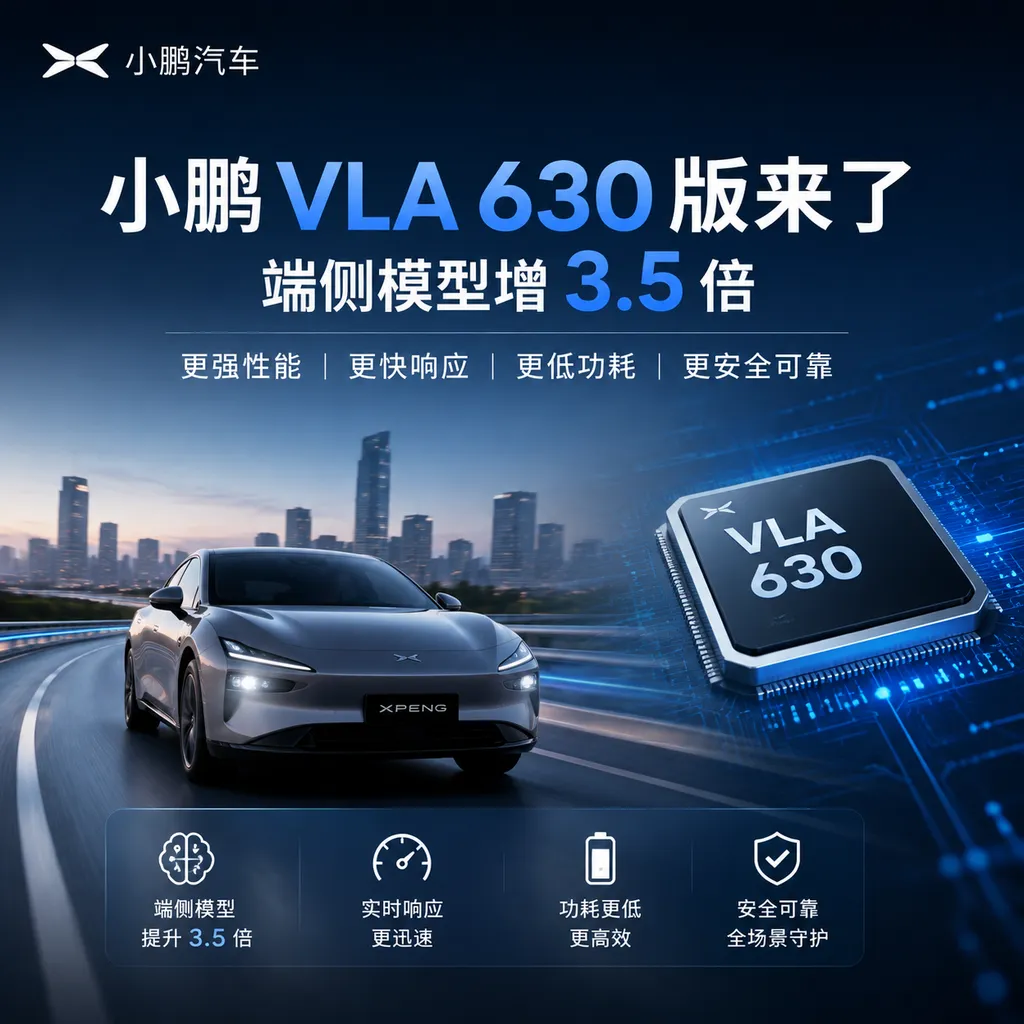
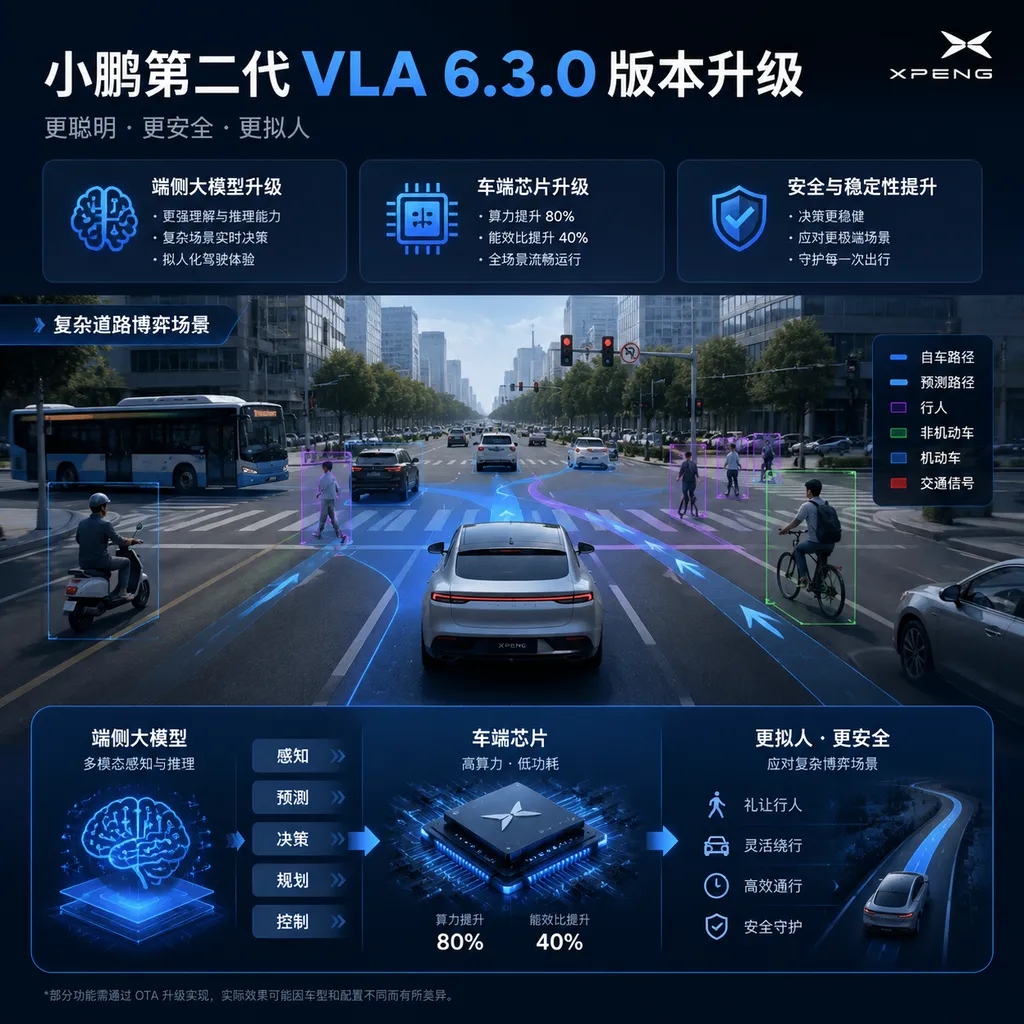
XPeng has announced the first major upgrade to its second-generation VLA, version 6.3.0: the parameter count of the on-device model has increased 3.5-fold, while end-to-end response speed has tripled. The upgraded system will make its global debut in the G9L. The focus is not on simply adding parameters, but on handling complex road interactions more quickly and reliably.
XPeng’s Second-Generation VLA Receives Its First Major Version Upgrade
XPeng Motors announced today that version 6.3.0 of its second-generation VLA will receive its first major model upgrade. According to the company, there are two core changes: the number of parameters in the on-device model has increased 3.5-fold, while end-to-end response speed has improved by 300%, meaning it is approximately three times faster than before.
This upgrade is not an ordinary in-car system update. XPeng refers to it as the 630 version of its second-generation VLA, with the focus placed on the capabilities of the in-vehicle model and the quality of real-time decision-making. The vehicle is not merely expected to identify objects ahead more quickly; it must also make smoother choices across a sequence of actions such as slowing down, yielding, detouring, and changing lanes.
The XPeng G9L will make its global debut with this version onboard. According to XPeng’s schedule, the Physical AI Sharing Event and Second-Generation VLA New Version Experience Day will be held at 15:00 on August 27, when more details are expected to be disclosed regarding real-world road performance, compatible vehicle models, and the rollout schedule.
The Model Is 3.5 Times Larger, but the Real Change Is in the Vehicle
According to XPeng, the number of parameters in the 630 version’s on-device model has increased 3.5-fold, reaching 15 times that of mainstream VLA models in the industry. This is a figure that can easily be misinterpreted.
An increase in model parameters first means that the model can accommodate more patterns concerning the road environment, traffic participants, and driving behavior. It does not mean that driving capability automatically improves 3.5-fold, much less that the vehicle can directly enter an autonomous-driving state. Model size is only one of the upper limits of a model’s capabilities. The final experience also depends on training data, in-vehicle computing power, inference latency, sensor quality, and safety strategies.
For assisted driving, a larger on-device model places particularly high demands on engineering. Cloud-based large models can call upon large numbers of GPUs, and when they encounter a complex problem, waiting a few hundred extra milliseconds usually goes unnoticed by users. A vehicle, however, must continuously process camera, positioning, and vehicle-status data. When a vehicle is traveling at a relatively high speed, a few hundred milliseconds may correspond to several meters of movement. If a model becomes larger but inference slows down, its theoretical capabilities may not translate into real-world safety gains.
Therefore, the key to XPeng’s upgrade is not simply putting a larger model into the vehicle, but ensuring that the larger model can still run in real time on the vehicle. XPeng previously disclosed that its second-generation VLA uses a coordinated optimization approach involving the model, chip, and compiler, and that it restructured the model around its proprietary Turing chip. This approach is similar to rewriting a large program to suit specific hardware: rather than seeking universal compatibility across all devices, it aims to extract as much effective computing power as possible from the in-vehicle chip.
From a product perspective, this improvement in on-device capability offers three direct benefits:
- Reduced reliance on cloud connectivity: The vehicle can complete more environmental understanding and driving decisions locally, making it less prone to major fluctuations in capability in weak-network conditions, tunnels, or areas with unstable connectivity.
- Lower decision-chain latency: Perception, prediction, and control do not need to make frequent round trips to the cloud, allowing actions to be executed more quickly in complex road conditions.
- Support for more complex scenario generalization: The model can understand road structures, vehicle behavior, and traffic rules simultaneously, rather than relying solely on predefined rules matched one by one.
However, it is important to clarify that a larger on-device model does not mean that all equipped vehicle models will receive the same capabilities. Differences in chip count, camera configurations, sensor-data quality, and thermal conditions will all affect the final results. The G9L’s global debut primarily indicates that it will serve as the first complete validation platform for the new model; it does not mean that other vehicle models will receive all of its capabilities simultaneously.
Threefold Faster Response: Addressing One of Assisted Driving’s Biggest Pain Points
XPeng’s official description of the second metric is a 300% improvement in end-to-end response speed. Depending on the technical definition used, this could refer to lower end-to-end latency, faster environmental-perception refresh rates, or an acceleration of the entire chain from perception to action output. Regardless of the exact measurement method, users ultimately do not perceive a millisecond figure. What they perceive is whether the vehicle acts promptly when it should, while remaining stable instead of braking abruptly when it should not.
What most affects trust in an assisted-driving system is often not whether it can identify a vehicle, but whether its actions during dynamic interactions feel natural.
For example, when there is a slow-moving vehicle ahead, the vehicle must determine whether to continue following it, look for an opportunity to change lanes, or wait for oncoming traffic to pass before going around it. A traditional system may repeatedly switch between several strategies, resulting in light braking, acceleration again, and then sudden deceleration. To the driver, this behavior is more unsettling than simple caution, because the vehicle appears indecisive.
The “more stable interaction” emphasized by XPeng this time is essentially intended to shorten the time from scene understanding to behavior selection while improving decision continuity. When another vehicle cuts in, the system can predict its trajectory earlier; when passing through a construction zone, it can determine the passable space more quickly; and when facing pedestrians, bicycles, or oddly shaped vehicles, it can avoid sudden braking or abrupt steering at the last moment.
Higher speed also affects the smoothness of deceleration. Good assisted driving is not merely about being able to stop in time; deceleration should begin early and occur evenly. Identifying risks in advance gives the vehicle a longer braking and interaction window. If the model does not make a judgment until it is very close to an obstacle, passengers will clearly feel hard braking and jolts even if no danger ultimately occurs.
That is why XPeng has not focused solely on being “smarter,” but has instead highlighted safe interaction and smooth deceleration as selling points of the upgrade. For users who have already experienced multiple generations of assisted-driving systems, smoothness is often more important than seeing several additional recognition boxes on the screen. An intelligent-driving system can only evolve from an “occasional novelty” into something used every day if it does not make people nervous during frequent commutes, stop-and-go traffic, and complex intersections.
From the Second-Generation VLA to the 630 Version: XPeng Is Filling in a Productization Path
The previous positioning of XPeng’s second-generation VLA was not that of a limited functional upgrade, but rather a physical-world foundation model built around L4 capabilities. It attempts to place visual understanding, behavior prediction, and vehicle control within a more unified model framework, reducing the coordination losses among the many rule-based modules found in traditional assisted-driving systems.
A traditional solution is more like a collection of programs with clearly divided responsibilities: one module identifies lane lines, another identifies vehicles, the prediction module estimates trajectories, the planning module selects a path, and the control module executes steering-wheel and pedal movements. Its advantage is that each layer is relatively easy to interpret and debug. However, when information becomes unsynchronized between modules, the vehicle may behave less coherently in complex environments.
The VLA approach is closer to having the model directly generate driving behavior from multimodal environmental inputs. Here, “language” does not merely mean enabling the vehicle to understand commands. More importantly, it places visual information, spatial relationships, the intentions of traffic participants, and the outcomes of actions into the same representational space. The question the model must answer is not “What is ahead?” but rather “What should be done next, and why should it be done now?”
XPeng has also previously disclosed technical concepts such as visual reasoning chains, bird’s-eye-view representations, and behavior scoring. For example, when encountering a slow vehicle on a straight road, the system can generate several candidate behaviors—following the vehicle, changing lanes, or searching for an available space—and then make a selection based on the road and surrounding-vehicle conditions. In theory, this approach can cover scenarios without clear signs or with nonstandard road configurations more easily than fixed rules.
However, the VLA approach also faces obvious challenges:
- Real-time performance is difficult: The larger the model, the greater the demands on the throughput and memory bandwidth of the in-vehicle chip.
- Safety validation is difficult: Model outputs are no longer governed entirely by fixed rules, so their boundaries must be verified through extensive simulation, replay, and real-world road testing.
- Long-tail scenarios are difficult: Road construction, nonstandard vehicles, unusual weather, and anomalous pedestrian behavior are difficult to cover through conventional data alone.
- Vehicle-model adaptation is difficult: The same model may require distillation, pruning, or tiered deployment when running on vehicles with different computing power and sensor configurations.
The value of the 630 version lies in its attempt to advance both “large-model capabilities” and “real-time operation in the vehicle” simultaneously. The former determines whether the system can understand a more complex physical world; the latter determines whether that understanding can become the right action at the right time.
The G9L’s Debut Is Both a Product Selling Point and a Stress Test
The G9L’s global debut with the new version of the second-generation VLA means that the vehicle will become XPeng’s first showcase for the model upgrade. New models often have a more complete hardware foundation and are better suited to carrying new chips, sensors, and software architectures. At the same time, the launch vehicle will also face the greatest pressure from large-scale user validation.
For XPeng, what really needs to be proven is not the parameters announced at the launch event, but whether the 630 version can operate reliably in the high-frequency scenarios users encounter every day:
- In congested urban traffic, can it reduce frequent braking and stopping while following vehicles?
- During unprotected left turns, can it strike a better balance between safety and traffic efficiency?
- When encountering vehicles cutting in, construction, or temporary obstacles, can it plan ahead rather than wait until it is close to the obstacle?
- On narrow roads and at nonstandard intersections, can it maintain stable path selection?
- At night, in rainy weather, and in situations with significant changes in lighting, can it avoid sudden drops in perception capability?
- During long-distance travel, can it reduce tiring hard acceleration and hard braking for passengers while maintaining safety?
None of these scenarios is suitable for evaluation using a single metric. A faster response does not necessarily mean that the vehicle will drive more aggressively, and a larger number of parameters does not necessarily mean that the vehicle will be better at handling unusual situations. The final experience depends on whether the system can identify risks earlier and leave sufficient safety margins.
XPeng has repeatedly emphasized “reassuring smoothness” and “full-scenario capability,” and the 630 version continues this product logic. Rather than continuing to add a batch of features that users may not actively use, it is better to first make existing assisted-driving capabilities in urban, highway, and complex-road environments more stable. For a system to which users must entrust themselves over the long term, the lower bound matters more than the upper bound.
Whether This Upgrade Can Reshape the Competitive Landscape Will Also Depend on Rollout and Validation
From an industry-competition perspective, XPeng is not the only automaker increasing the scale of its end-to-end models. Tesla, Huawei, Li Auto, NIO, and numerous autonomous-driving suppliers are all pursuing larger models, fewer rules, and greater in-vehicle computing power. The differences between manufacturers are no longer simply a matter of whether they have end-to-end systems; they now involve a comprehensive competition encompassing model-iteration speed, data-loop efficiency, in-vehicle deployment costs, and safety-validation capabilities.
XPeng’s advantage lies in having committed to full-stack in-house development relatively early, while optimizing the model, chip, compiler, and vehicle itself within the same engineering system. If these capabilities can continue to translate into lower latency and better energy efficiency, XPeng may have an opportunity to turn large-model capabilities from a showcase feature of high-end vehicles into a fundamental capability available across more models.
However, XPeng also faces two practical issues.
First, the official claim of a “300% improvement” requires further disclosure of the testing methodology. Does it refer to a reduction in average inference latency, or an increase in response time under specific scenarios? Does it reflect a change in perception refresh frequency, or acceleration of the complete chain from perception to control? Only when accompanied by real-world road data, comparisons across typical scenarios, and explanations of different hardware versions will this metric become meaningfully comparable.
Second, how quickly can the model upgrade cover existing vehicles? Launching first on new vehicles naturally makes it easier to control hardware conditions, but the large number of existing users is the real test of software-defined vehicles. If the 630 version can serve only a small number of new models, its technical value will look more like a product-differentiation feature. If it can be pushed to more Max models through model distillation and tiered deployment, XPeng will have genuinely established the ability to generate continuous value through software.
Therefore, what deserves attention at the August 27 experience event is not only the model-parameter and speed figures, but also three details: the range of initially compatible vehicle models, the specific rollout schedule, and how XPeng demonstrates the 630 version’s stability in complex interaction scenarios. If the event can provide continuous-trip data, failure cases, and the boundaries of hardware compatibility, its informational value will be significantly higher than that of simple promotional slogans.
Conclusion: Competition Among On-Device Large Models Will Ultimately Come Down to Every Brake Application
The upgrade direction of XPeng’s second-generation VLA 630 version is the right one: put more model capability in the vehicle, reduce inference latency as much as possible, and enable the vehicle to make earlier judgments and interact more steadily on complex roads.
For users, however, 3.5 times the parameters and three times the response speed are not the endpoint. The true product value of assisted driving ultimately lies in whether every deceleration begins early, whether every lane change feels natural, and whether every complex intersection inspires confidence. A model can be very large and the promotional figures can be very high, but only when the system no longer frequently requires drivers to take over on real roads can on-device physical AI be said to have truly completed a productization upgrade.
At present, XPeng has confirmed that the G9L will make its global debut with the new version of the second-generation VLA. More functional and experiential details will be announced on August 27. For developers and industry professionals observing the end-to-end intelligent-driving approach, this update is worth examining closely for its in-vehicle inference efficiency, model-compression strategies, and stability after large-scale user deployment—not merely for the model size itself.
References
- ITHome: XPeng’s Second-Generation VLA Receives Its First Major Model Upgrade — Provides information on XPeng’s version 6.3.0 upgrade, changes in on-device model parameters, response-speed data, and the G9L’s global debut.