Qwen Integration Token Plan, API Key Directly Connects to Qwen3.8-Max
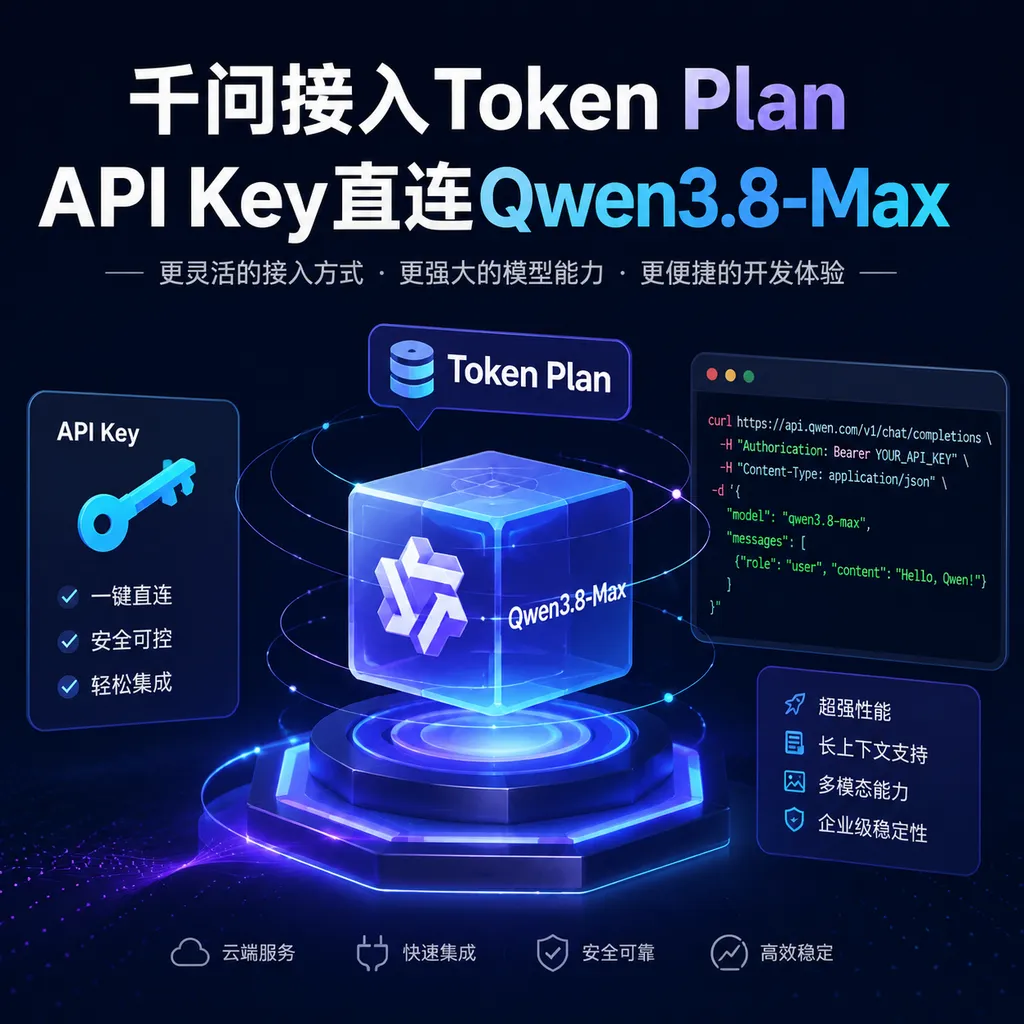
Alibaba Cloud Token Plan is now officially available in the Qwen App and PC client. After binding an API key, users can directly call models such as Qwen3.8-Max in Qwen Work Assistant and extend the same subscription quota to AI tools such as Qoder and Codex.
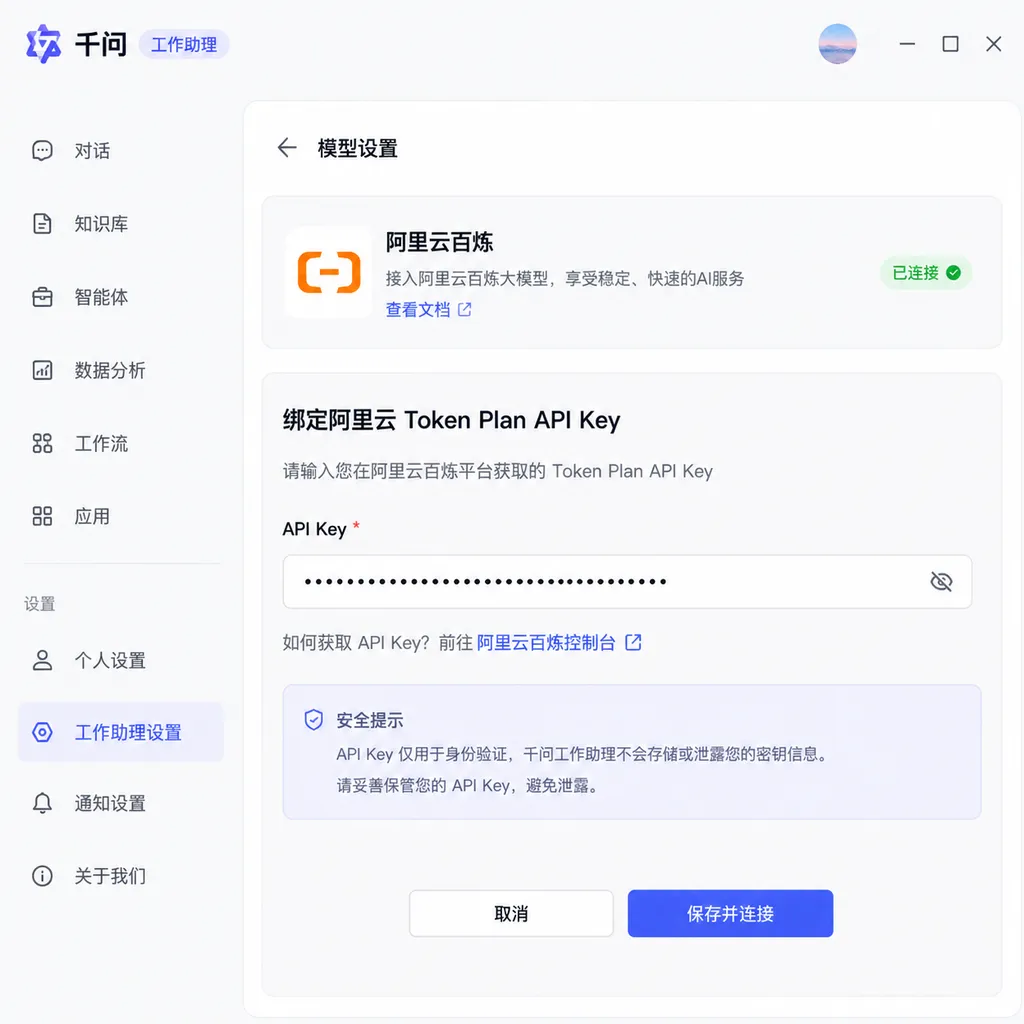
Alibaba Cloud has further moved the Token Plan entry point from developer tools to the Qwen App and PC. On August 25, Alibaba Cloud announced that Token Plan had officially been integrated into the Qwen App and PC: users only need to bind a dedicated API Key to directly consume their subscription quota in Qwen Work Assistant and access multiple models, including Qwen3.8-Max.
The focus of this update is not that Qwen has gained another login method, but that Alibaba Cloud is turning “model subscriptions” into a cross-application AI account system. For developers, the same Token Plan API Key can be used with tools such as Qwen Code, Qoder, and Codex; for ordinary office users, it is embedded behind Qwen Work Assistant to handle browser operations, file processing, and cross-application tasks.
API Keys Move from Developer Tools into Qwen Workflows
Qwen App users can add a Token Plan API Key in Work Assistant. Once the binding is complete, Work Assistant can use the Token Plan subscription quota when executing complex tasks. The value of the PC version is even more apparent: with a larger screen and a more complete system environment, Qwen can break down a goal into steps and then call tools such as browsers, email, calendars, and cloud drives.
For example, users no longer need to open their email, calendar, and document applications separately. They only need to make a relatively complete request: organize this week’s meeting emails, extract the action items, generate a weekly report, and format the result as a Word file. Work Assistant can first read the relevant information, then call the appropriate tools, and finally deliver the file.
The difference between this experience and traditional chatbots is that the output is no longer just a few paragraphs of text. The model must understand the goal, plan the process, call tools, handle intermediate results, and adjust its approach when something fails. Alibaba Cloud calls this capability Agent Harness. Put simply, the model is the “thinking brain,” while the Harness provides the hands, eyes, and workbench prepared for it.
Of course, whether an Agent can deliver reliably cannot be judged by the model alone. Tool permissions, context length, task-decomposition quality, and the stability of external application interfaces all affect the final result. Qwen Work Assistant currently covers common office scenarios involving email, calendars, cloud drives, browsers, and Word, Excel, and PPT. In practice, it is closer to an automation assistant that can operate software than to a mere chat window.
One Quota, Multiple Toolsets
The product logic behind Token Plan is therefore becoming clear: users are not buying a certain number of conversations on a single webpage, but a quota of model calls that can flow among multiple AI tools.
According to official materials, Token Plan supports a unified API Key and allows users to switch models as needed. The current plans cover models including Qwen3.8-Max, Qwen3.7-Max, Qwen3.7-Plus, Qwen3.6-Flash, DeepSeek-V4-Pro, GLM-5.2, Wan2.7-Image, Wan2.7-Image-Pro, and HappyHorse1.1, spanning text reasoning, visual understanding, image generation, and video.
It also integrates capabilities such as web search, text-to-image search, image-to-image search, webpage scraping, and code interpreters. For developers who frequently test different models, this is more convenient than applying for a separate key for each model service and maintaining different Base URLs. For enterprise teams, unified quotas and configurations are also easier to incorporate into permission management.
However, a “unified key” does not mean that the calling experience is identical for every model. Context windows, billing methods, tool protocols, and multimodal input capabilities may still differ. If developers treat Token Plan as a completely interchangeable model relay layer, incompatibilities in parameters, differences in capability boundaries, or changes in output formats should not come as a surprise. It solves the cost of access and switching; it does not automatically eliminate the technical differences between models.
Qwen3.8-Max’s Position: A Flagship Model Enters the Subscription Scenario
The most closely watched model in this integration is Qwen3.8-Max. Alibaba Cloud positions it as a multimodal flagship model, emphasizing autonomous coding, complex reasoning, and visual understanding, and supports deducting its usage from the Token Plan personal edition.
From a product-strategy perspective, Qwen3.8-Max’s initial inclusion in Token Plan means Alibaba Cloud wants to tie the trial and real-world use of its latest model to actual workflows, rather than placing the model only in an API console for developers to test. Users can use it to handle tasks in the office assistant or switch to programming tools for code generation and modification. Model capability is therefore no longer measured only by “how well it answers,” but also by whether it can complete the task.
For programming scenarios, whether a model can reliably read a codebase, call the command line, run tests, understand errors, and continue making modifications is often more important than single-turn code generation. Tools such as Qwen Code, Qoder, and Codex are essentially competing over this “workflow above the model.” With Token Plan providing a unified key, users can reduce configuration friction and focus more attention on model selection and task orchestration.
But it is also important to note that Qwen3.8-Max’s concrete performance still depends on tool adaptation and context engineering. Even if a model has strong reasoning capabilities, it may ultimately produce results that look polished but cannot be delivered directly if its tool-calling permissions are too limited, project context is not injected correctly, or long tasks lack state management. Alibaba Cloud’s decision to place the model, tools, and Agent Harness in the same subscription is directionally correct, but whether this system is stable enough still requires validation through more real-world tasks.
Why Alibaba Cloud Is Turning Token Plan into a “Universal Pass”
In the past, AI models were generally used in two ways: ordinary users subscribed monthly in an app, while developers paid according to usage on an API platform. The two systems operated independently. Users could not freely configure models in apps, and developers found it difficult to bring a single subscription quota to multiple clients.
Token Plan attempts to merge the two. Users purchase a plan, receive an API Key and Base URL, and then configure them in different AI tools. This design resembles a resource pool in cloud services: models can be switched, clients can be replaced, and the quota follows the account.
Its commercial value lies in increasing subscription-quota utilization. If users can access models only in a single chat app, their quota may sit idle because of limited use cases. When the quota can be jointly consumed by the Qwen App, programming tools, and office Agents, the subscription is more likely to become part of users’ daily workflows. For the platform, once users configure the API Key in local tools, the cost of switching away also increases.
This is also the difference between Token Plan and a simple “model membership.” A membership sells access rights; Token Plan sells a cross-tool productivity infrastructure. The former emphasizes chat quota, while the latter emphasizes model calls, tool collaboration, and task delivery.
What It Means for Developers
First, the cost of integration is lower. Developers can use one key to configure multiple tools without managing credentials repeatedly for each client. For people who frequently switch among local Agents, coding assistants, and browser-automation tools, this convenience is quite tangible.
Second, model experimentation becomes faster. A task can first be handled by a faster, less expensive model, then switched to a flagship model for complex reasoning. When images or video are involved, the corresponding multimodal capabilities can also be called under the same plan. This “choose a model by task” approach is more suitable for Agent workflows than being permanently tied to a single model.
Third, availability in domestic network environments is a practical advantage. Alibaba Cloud emphasizes that Token Plan and its related tools support direct connections within China. For individual developers and teams that need stable access to model services, this matters more than model rankings on paper. A model being occasionally faster cannot compensate for the cost of frequent timeouts, rate limits, and complicated configuration.
However, developers should still pay attention to three issues:
- Do not treat an API Key as an ordinary configuration item. Once a key is written to a public repository, log, or screenshot, the quota may be stolen and misused. Environment variables or local secret-management tools should be used, and team members should be given the minimum necessary permissions.
- Confirm the compatibility range of the model and tool first. The same OpenAI-style interface does not mean that all parameters are interchangeable, especially for visual input, tool calls, thinking modes, and structured output.
- Incorporate quota consumption into task design. Long contexts, repeated calls, and parallel multi-Agent execution can easily amplify token consumption. An automated workflow without budget monitoring may exhaust a subscription quota faster than manual operation.
Is This Update Useful? It Depends on Whether You Are a “Multi-Tool User”
If you only chat with Qwen occasionally, this update will not feel particularly significant. You will still enter questions in the app and wait for answers; binding an API Key will not suddenly make ordinary Q&A smarter.
The real beneficiaries are two groups: users who need to handle files, browsers, and office applications, and developers who use coding assistants, Agent tools, and multiple models at the same time. For them, Token Plan consolidates the previously scattered configuration, quotas, and model choices, reducing the “glue code” in their workflows.
Compared with a subscription tied to a single model, Token Plan is more flexible; compared with a fully usage-based API, its cost expectations are clearer. The trade-off is deeper platform coupling: specific model capabilities, calling rules, and quota-usage methods are all influenced by Alibaba Cloud’s product ecosystem.
From the perspective of industry competition, model companies are shifting from “launching a more powerful model” to “occupying users’ work entry points.” Whoever can connect models, clients, tools, and quotas into a stable chain will have a better chance of retaining developers. By integrating Token Plan with the Qwen App and PC, Alibaba Cloud is filling in the link closest to users in this chain.
What is worth watching next is not only how many models Token Plan will support, but whether Qwen Work Assistant can make cross-application execution reliable enough: Can tasks be completed in one attempt? Are permissions granular enough? Can the system recover after failures? Are the generated Office files genuinely deliverable? Agent competition will ultimately not stop at “can it call tools?” but will come down to “can it require less human supervision?”
For developers already using Alibaba Cloud’s model services, this update is worth trying. For people who only need a chat window, it is more like an infrastructure upgrade moved closer to the user. The true value of Token Plan does not lie in having one more API Key, but in whether that key can become a pass between models and workflows.
Sources
- ITHome: Alibaba Cloud Token Plan Integrates with Qwen App and PC, Supporting Models Including Qwen3.8-Max: Reports on the product integration and use cases involving Qwen Work Assistant, Qoder, Codex, and others.
- ITHome: A Chinese technology media outlet covering developments in AI models, cloud services, and developer products.