Qwen Previews Qwen3.8-Flash-Next, Giving an Early Look at the Qwen4 Architecture
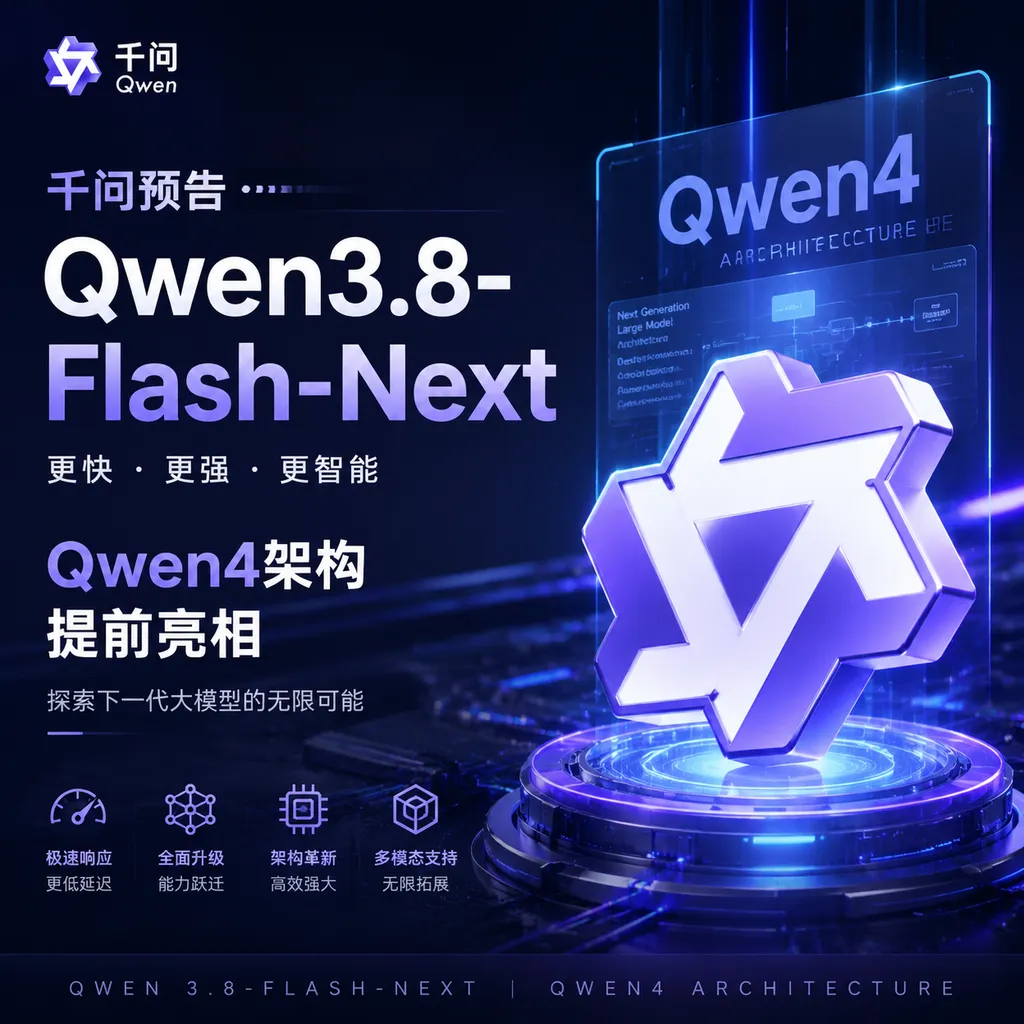
Alibaba Qwen announced that it will open-source Qwen3.8-Flash-Next and its FP8 version at 23:00 Beijing Time on August 26. This is a multimodal MoE model built on the next-generation Qwen4 architecture, and the company hopes this will help the community adapt to Qwen4’s architectural changes in advance.
Qwen Previews Qwen3.8-Flash-Next: Letting the Community Trial-Run the Qwen4 Architecture First
Alibaba's Qwen has released the first piece of its next-generation model ahead of schedule. According to information on the ModelScope community page, Qwen3.8-Flash-Next will be open-sourced at 23:00 Beijing Time on August 26, 2026, with two versions released simultaneously: Qwen3.8-Flash-Next and Qwen3.8-Flash-Next-FP8.
Although the official information disclosed so far is limited, one signal is clear enough: this is not an ordinary minor update to the Flash series, but a multimodal MoE model built on the next-generation Qwen4 architecture. The Qwen team says that opening up the architectural improvements ahead of time is intended to help the community prepare for the forthcoming complete Qwen4 model family.
In other words, Qwen3.8-Flash-Next is more like a public preview of the architecture. Its focus may not be to top every performance leaderboard immediately, but to let developers, inference frameworks, and hardware manufacturers become familiar with the next-generation Qwen technology roadmap first.
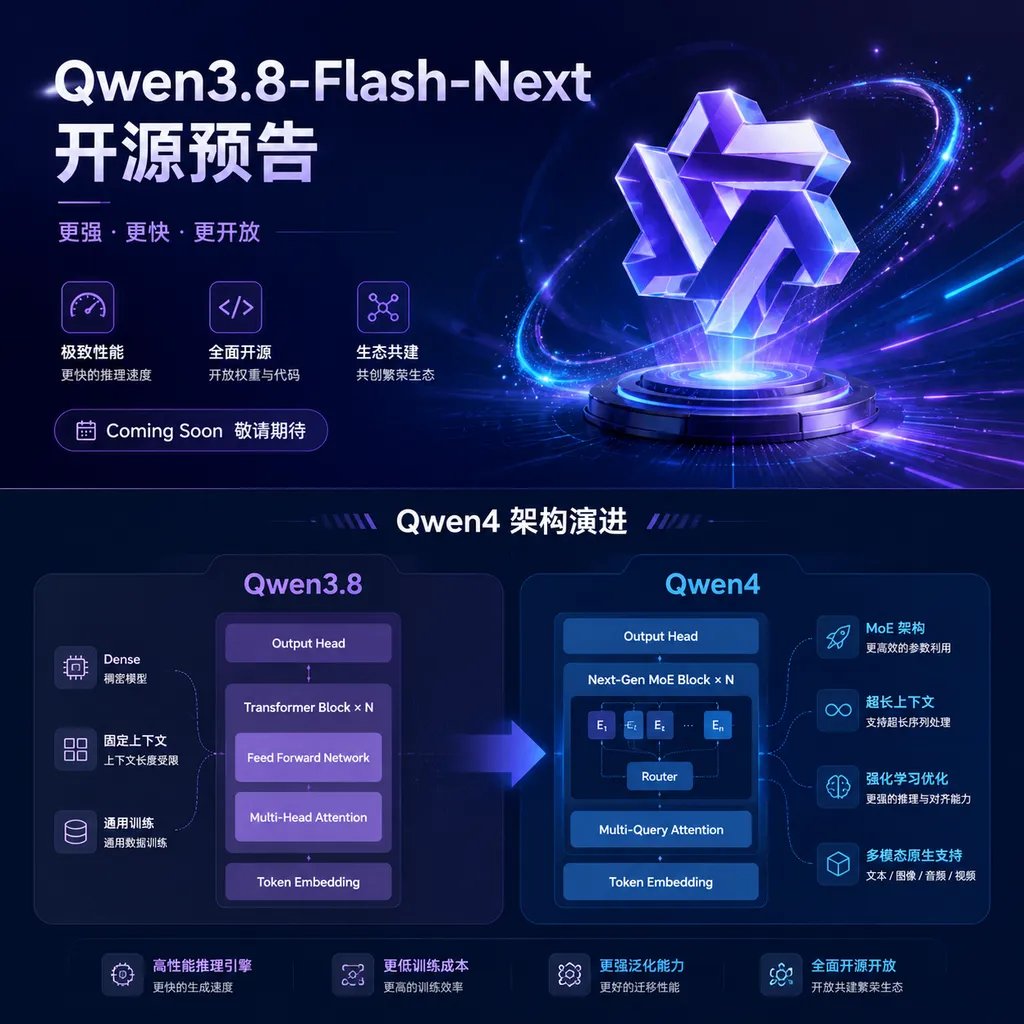
Two Versions, with FP8 as the Initial Focus
This release includes at least two weight versions:
Qwen3.8-Flash-Next: The standard version. The specific precision and weight format still await further official clarification.Qwen3.8-Flash-Next-FP8: A version designed for FP8 inference scenarios, theoretically better suited for deployment on modern data-center GPUs that support low-precision computation.
FP8 is not simply a matter of making the model “smaller.” It is more like replacing the ruler used to measure model parameters with one that has coarser graduations but offers greater efficiency: each parameter requires less storage and fewer computing resources, potentially reducing memory pressure and data-movement costs while increasing throughput. However, the ultimate benefits depend on whether the hardware natively supports FP8, whether the inference framework has completed operator optimizations, and how well precision loss is controlled during quantization.
As a result, the FP8 version is more attractive for cloud deployment and large-scale services, but that does not mean ordinary developers can easily run it on consumer-grade graphics cards. An MoE model's total parameter count, active parameter count, expert-routing method, KV cache usage, and parallelization strategy will all directly determine the practical deployment threshold. The official has not yet released these key specifications, so it is premature to infer specific speeds from the words “Flash” or “FP8.”
What Does a Multimodal MoE Mean?
Qwen3.8-Flash-Next is defined as a multimodal MoE model. This involves two layers of change.
The first is multimodality. The model no longer processes only text tokens; it must also convert different types of information, such as images, documents, and possibly video, into representations that can be jointly reasoned over. For developers, the value of such models is not merely that they “can see images,” but that they can integrate visual information into complete workflows: for example, reading a financial report with charts, understanding screenshots of software interfaces, analyzing equipment photos, and then making judgments or generating code based on text instructions.
The second is MoE, or the mixture-of-experts architecture. It can be understood as a large team: the model has many “experts” specialized in different tasks, but each input does not activate all experts simultaneously. Instead, a routing mechanism selects a subset to participate in the computation. This makes it possible to increase the total parameter scale while controlling the actual computation required for each token.
The advantage of MoE is that it may achieve a better balance between scale and efficiency. The challenge lies in engineering implementation. Whether expert workloads are balanced, whether cross-device communication becomes a bottleneck, whether routing remains stable, and whether inference services can maintain high throughput will all affect how the model performs when moving from paper metrics to production environments. This is especially true for open-source models: releasing the weights is only the starting point. The real developer experience also depends on inference stacks such as vLLM, SGLang, and TensorRT-LLM, as well as how quickly the hardware ecosystems of NVIDIA, AMD, and domestic GPU vendors can adapt.
The Real Highlight of This Release: Opening Up Architectural Changes Early
In the past, model releases typically followed the sequence of “launch the complete product first, then let the community adapt.” The narrative order for Qwen3.8-Flash-Next is reversed: Qwen is first releasing a model based on the Qwen4 architecture, allowing the community to begin preparing before the official Qwen4 family launch.
This is more significant to the open-source ecosystem than simply adding another model name.
Inference Frameworks Can Adapt in Advance
If Qwen4 makes substantial changes to its attention mechanism, positional encoding, vision encoder, expert routing, or context processing, inference frameworks will need to rework their handling of the model structure, tensor parallelism, pipeline parallelism, and cache management. The sooner framework teams receive runnable weights, the sooner they can identify compatibility issues.
For developers, this means that when Qwen4 officially launches, they may not have to go through another lengthy waiting period for framework support, quantized versions, and GPU compatibility.
Hardware Manufacturers Can Get a Head Start on Optimization
The first competition after a large model is open-sourced often takes place not only in the model community, but also at the hardware and compiler layers. Those who complete operator adaptation, communication optimization, and low-precision inference earlier will have a better chance of securing an entry point into the Qwen4 ecosystem.
After the Qwen3.8 series was previously open-sourced, the community quickly produced quantized, serving, and hardware-adapted versions. This speed shows that the ecosystem around open-weight models often expands faster than that of closed-source API products: the official team provides the base model, while the community branches out around different graphics cards, frameworks, and application scenarios.
The Community Can Validate the Architectural Direction
An early release also gives the community more room for experimentation. Researchers can test the model's performance in coding, visual question answering, long-document understanding, and agent tasks. Developers can integrate it into real workflows, while inference frameworks can use real workloads to validate the architectural design.
Of course, this also means that Qwen3.8-Flash-Next may not be the “final answer” for every production environment. It is more like a developer preview: valuable, but best used with an experimental mindset.
Don't Focus Only on Parameter Count; Deployment Cost Is the Key
The official has not yet disclosed Qwen3.8-Flash-Next's total parameter count, active parameter count, context length, visual input specifications, training-data scale, or benchmark results. Compared with these missing details, the word “Flash” in the model name does not directly indicate how much faster it will be than the previous generation.
For teams preparing to deploy the model, the metrics that truly matter include:
- Active parameter count: An MoE model may have a very large total parameter count, but the number of experts actually activated during each inference determines the primary computational cost.
- Memory and communication requirements: Whether the model can run on a single GPU or requires multi-GPU expert parallelism directly affects the deployment budget.
- Long-context performance: The nominal context-window length is not equivalent to effective accuracy on long-text tasks. Memory usage under multimodal input is especially important.
- Multimodal input limitations: Image resolution, video duration, document page count, and input formats determine whether the model is suitable for real-world business applications.
- Inference framework support: Without mature serving support, even a powerful model will struggle to enter high-concurrency production environments.
- Post-quantization performance: The FP8 version should be evaluated particularly closely for precision loss in code generation, visual understanding, and complex reasoning tasks.
From a cost perspective, the advantage of MoE is not that “larger models are cheaper,” but that it may reduce the effective computation required per request while maintaining strong capabilities. However, if expert workloads are unbalanced, cross-device communication is too expensive, or request concurrency is insufficient, the theoretical efficiency gains may be offset by engineering overhead.
How Should Developers Prepare Now?
Before the official specifications are released, developers should prepare in three ways.
First, Prepare a Reproducible Evaluation Set
Do not rely solely on general-purpose leaderboards to determine whether the model is worth integrating. Extract a set of de-identified samples from your own code repositories, customer-service conversations, product screenshots, technical documents, and structured tables. Test text, vision, and tool-calling capabilities separately. This way, once the model is open-sourced, you can obtain conclusions that are genuinely meaningful for your business within a few hours.
Second, Check Your Inference Environment in Advance
If you plan to deploy locally, confirm whether your GPUs support BF16 or FP8, whether your drivers and CUDA versions are compatible, and how well mainstream inference frameworks support the model. For multi-GPU deployments, also evaluate the interconnect bandwidth between GPUs. With MoE models, the problem is often not insufficient compute, but communication slowing everything down.
Third, Treat It as a Technical Preview of Qwen4
Do not rush to replace all existing production models. A more prudent approach is to integrate it first through a canary service, offline evaluation, or an internal agent experiment, paying close attention to output stability, tool-calling success rates, interruption rates during long-running tasks, and per-request costs.
Its Relationship to the Earlier Qwen3.8 Open-Source Release Cycle
This preview comes after the continued expansion of the Qwen3.8 series. Previously released information indicates that Qwen3.8 already covers multiple directions, including flagship large models, 27B-class models, and extremely large-scale MoE models. The community has also rapidly developed a secondary ecosystem around quantization, inference services, and hardware adaptation.
The emergence of Qwen3.8-Flash-Next may be laying the groundwork for the next phase of the product line. On the one hand, the Flash series can handle high-frequency tasks that place greater emphasis on response speed and cost. On the other hand, the Next suffix suggests that this is not merely an incremental upgrade to the current version, but a model serving as an architectural transition.
This approach resembles releasing a developer preview of a software project first, allowing ecosystem partners to migrate their interfaces and infrastructure in advance. For Qwen, the advantage is that it can shorten the time from the release of Qwen4 to the maturation of its ecosystem. The cost is that early versions may have incomplete compatibility, performance, and documentation.
Assessment: This Is Less a Typical Open-Source Release Than an Ecosystem Mobilization
At first glance, Qwen3.8-Flash-Next may appear to be simply another model added to Qwen's product line. But viewed within the timeline leading to Qwen4, its significance is different. Alibaba is attempting to turn model releases from one-off events into a continuous ecosystem effort: announce the architectural direction first, let the community, frameworks, and hardware manufacturers jointly complete the adaptation, and finally consolidate capabilities and applications with the complete model family.
This is good news for developers, but it also sets higher expectations. In the future, evaluating an open-source model will require looking beyond whether its weights are available. The completeness of its model card, the progress of inference framework support, the maturity of its quantization ecosystem, and the community's ability to quickly resolve real deployment problems will all matter.
For now, the most important question about Qwen3.8-Flash-Next is not where it will rank on a particular leaderboard, but whether it can successfully accomplish three things: make the multimodal MoE architecture work on real-world tasks, establish a usable engineering path for FP8 inference, and enable the community to complete an effective technical migration before Qwen4 officially arrives.
If it accomplishes all three, it will be more than a model that was “open-sourced early”; it will become a trial-run environment for the Qwen4 ecosystem. Conversely, if the official team continues to lack specifications, documentation, and inference support, developers may treat it as no more than a brief preview. The answer will have to wait until the model is open-sourced on August 26, when the actual weights and deployment tests can provide a definitive assessment.
Sources
- ITHome: Alibaba's Qwen Previews Qwen3.8-Flash-Next — Introduces the model's open-source release time, version information, and positioning as a multimodal MoE model based on the Qwen4 architecture.
- ITHome: Alibaba Open-Sources the Qwen3.8-27B Model — Provides context on the earlier open-source release schedule and community ecosystem surrounding the Qwen3.8 series.
- ITHome: Alibaba Releases the Qwen3.8-2.4T-A95B Model Weights — Provides additional background on the Qwen3.8 large-scale MoE approach.