MiniCPM Downloads Surpass 50 Million

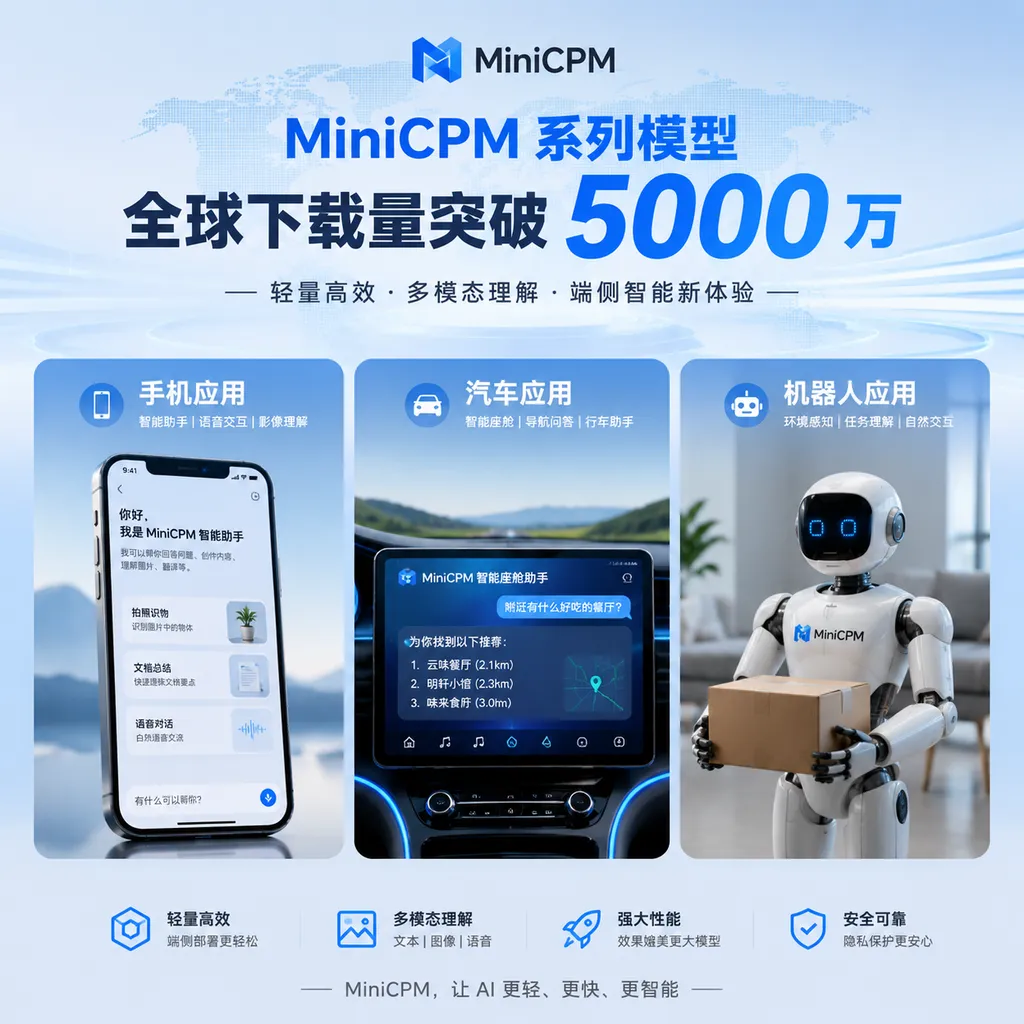
ModelBest announced that its MiniCPM series has surpassed 50 million downloads worldwide. Behind this milestone, Chinese-developed on-device models are moving beyond the open-source community into Samsung smartphones, automotive cockpits, and robots, while the focus of competition is shifting from parameter scale to deployment efficiency.
MiniCPM Surpasses 50 Million Downloads Worldwide
ModelBest announced today (August 26), on the occasion of the company’s fourth anniversary, that its open-source MiniCPM model family has surpassed 50 million cumulative downloads worldwide.
This is a noteworthy figure, but the pace of growth is even more significant. Public information shows that as of June 30, 2026, the MiniCPM family had accumulated 38 million downloads. Based on a rough calculation using the same methodology, it gained approximately 12 million downloads in less than two months, an increase of more than 31%.
Of course, model downloads cannot be directly equated with active developers, device installations, or commercial revenue. The same developer may repeatedly download different versions, while cloud mirrors, automated builds, and derivative model projects can also inflate the numbers. But for a Chinese model family whose core selling point is on-device deployment, 50 million downloads still indicate that it has moved beyond the stage of “a small number of teams experimenting with it” and is becoming a common name on model shortlists among developers worldwide.
What Do 50 Million Downloads Really Prove?
From the outset, MiniCPM’s approach has not been to make its parameter count as large as possible, but to increase the capability carried by each parameter. ModelBest summarizes this concept as “model density”: enabling a model to perform more tasks within the same memory, computing, and energy budgets.
This sounds like model compression, but it is more than that. Traditional compression is more like packaging an already-written file to make it smaller, whereas on-device models must address an entire range of issues spanning training data, model architecture, quantization methods, inference engines, and chip adaptation. Even if a model performs well in benchmarks, it will struggle to enter mass-produced devices if its time to first token is too long, it generates excessive heat during sustained output, or adapting it to a different chip requires starting the troubleshooting process all over again.
The rapid growth in MiniCPM downloads demonstrates at least three things:
- Demand for small models is indeed expanding. Developers no longer assume that all AI capabilities must be delivered through cloud APIs. Offline assistants, local knowledge bases, in-vehicle interaction, and robotic perception are creating new demand for models.
- Multimodal capabilities have broadened developer reach. MiniCPM includes not only text models but also models for vision, speech, and real-time interaction, giving it a wider range of use cases than text-only models.
- Open source remains an efficient path for on-device models to enter the hardware ecosystem. Hardware manufacturers, chip companies, and independent developers can directly test, quantize, and adapt models without first going through lengthy commercial procurement processes.
However, download numbers answer only whether people are taking notice—not whether they will use the models over the long term. What truly determines the quality of an on-device model ecosystem is the number of derivative projects, chip coverage, maintenance of stable releases, the scale of mass-produced devices, and whether developers can deploy models at low cost. MiniCPM has already gained open-source momentum. The next stage is to prove whether that momentum can translate into sustained usage.
MiniCPM5-2B Brings the Competition Back to Real-World Deployment
During the 2026 World Artificial Intelligence Conference held in July this year, ModelBest and OpenBMB jointly released MiniCPM5-2B. It is an on-device text model with approximately 2 billion parameters, focusing on general knowledge, mathematical reasoning, coding, instruction following, and agent capabilities. It has also been adapted to multiple chips.
According to information published by ModelBest, MiniCPM5-2B scored 17 points in Artificial Analysis’s benchmark rankings at the time, placing it among the world’s leading models with fewer than 4 billion parameters. Benchmark results must be understood in the context of the specific model version, prompt template, and inference configuration, and cannot be directly equated with the experience on real devices. Nevertheless, the fact that a 2B-class model can compete at this level shows that the capability boundaries of small models are continuing to expand.
For developers, the significance of a 2B model is not merely that the model file looks smaller, but that it has the potential to fit within more mainstream hardware budgets:
| Deployment Dimension | Large Cloud Model | 2B-Class On-Device Model | |---|---|---| | Network dependency | High; capabilities are significantly limited without a network connection | Can run entirely offline | | Cost per invocation | Ongoing charges based on tokens or requests | Primarily device and integration costs | | Data path | Data generally needs to be uploaded to a server | Processing can be completed locally | | Model updates | Centrally managed by the service provider | Developers can control versions and update schedules | | Capability ceiling | Higher; suitable for complex reasoning | Better suited to frequent, well-defined, constrained tasks |
This is not a simple replacement relationship. Asking a 2B model to write a complex industry research report will generally produce inferior results to calling a flagship cloud model. But for tasks such as local command parsing, in-vehicle intent recognition, device status Q&A, or short responses following document retrieval, using an extremely large cloud model may instead result in higher costs and greater latency.
The most practical form of on-device models remains device-cloud collaboration: local models handle frequent, privacy-sensitive, and latency-critical tasks, while cloud models handle complex planning, long-context reasoning, and open-ended generation. The companies that can effectively handle task routing, context synchronization, and failure fallback will be closest to delivering usable products.
Entering Samsung’s Flagship Lineup Matters More Than Topping a Benchmark
MiniCPM’s most significant industry milestone this year was not leading a particular benchmark, but entering Samsung’s global flagship smartphone lineup.
In July this year, Samsung unveiled the Galaxy Z Fold8, Galaxy Z Fold8 Ultra, and Galaxy Z Flip8. ModelBest subsequently announced that on-device models from the MiniCPM family were helping power Galaxy AI. According to ModelBest, this marks the first time a Chinese on-device large model has entered the global flagship product lineup of a leading international smartphone manufacturer.
When smartphone manufacturers select third-party on-device models, their evaluation criteria are far more complex than benchmark scores. A model must not only provide correct answers but also meet requirements for memory usage, response speed, power consumption, heat generation, system stability, and multilingual coverage. Flagship smartphones are sold globally, which also involves region-specific feature strategies, privacy regulations, and ongoing upgrades.
The value of entering the supply chain therefore lies in validating engineering maturity. Many models can run in a laboratory, but far fewer can operate reliably on millions of devices and be maintained over the long term alongside system updates.
However, the practical significance of this partnership still depends on several metrics: which specific Galaxy AI capabilities MiniCPM supports, how many regions and languages it covers, whether it is enabled by default, and whether it can subsequently enter more of Samsung’s mid-range devices. A flagship debut is an entry ticket, not proof that MiniCPM has already secured a system-level gateway.
From Smartphones to Automobiles, On-Device AI Is Moving Beyond the Proof-of-Concept Stage
In addition to smartphones, MiniCPM has entered automobiles, robots, and other device scenarios. Public information shows that its models have been used in the intelligent cockpits of vehicles such as the Geely Galaxy M9 and Changan Mazda EZ-60, while ModelBest is also advancing partnerships with multiple automakers.
Automobiles are a typical deployment environment for on-device models. In-vehicle network connectivity is not always stable, while voice commands require fast responses. Data from cameras, microphones, and vehicle status systems is also highly privacy-sensitive and unsuitable for being uploaded entirely to the cloud. A small model capable of running continuously on an automotive chip can handle air-conditioning, navigation, window controls, and local knowledge-based Q&A, while passing more complex tasks to the cloud.
Robots place even more demanding requirements on on-device models. A model must do more than generate text; it must also participate in visual understanding, action planning, and environmental feedback. Several hundred milliseconds of latency caused by network jitter might merely make a response feel “a little slow” in a chat window, but for robotic arms and mobile robots, it could cause an action to fail.
ModelBest also released MiniCPM-RobotManip this year for robotic manipulation, entering the embodied intelligence field with a relatively small parameter count. This direction remains in a period of rapid experimentation and is still clearly far from becoming a general-purpose robotic “brain.” Nevertheless, it reflects a trend: on-device models are evolving from human-machine interaction components into part of the hardware control chain.
China’s On-Device Ecosystem Has Shifted From “Does It Exist?” to “Is It Easy to Use?”
MiniCPM’s growth cannot be viewed in isolation from the broader market. The on-device model sector is already highly crowded. Alibaba has established an open-source model portfolio through Qwen spanning multiple parameter scales and modalities. ByteDance continues to invest in on-device inference. Smartphone manufacturers such as Huawei, Xiaomi, OPPO, and vivo are also integrating model capabilities into their operating systems. In international markets, Apple, Google, Samsung, and chip manufacturers are all competing to control the gateway to on-device AI.
Within this competitive landscape, ModelBest’s advantage is its focused strategy. Compared with diversified vendors simultaneously competing in cloud foundation models, enterprise APIs, and consumer applications, it devotes more resources to small models, quantization, inference efficiency, and hardware-software adaptation. This focus makes it easier for MiniCPM to establish a distinctive identity and helps the company build partnerships with hardware manufacturers.
Its weaknesses are equally apparent. The performance of on-device models can easily be matched by the broader product portfolios of larger companies, while hardware manufacturers also tend to seek control over their own system-level models. If third-party model companies provide only model weights, their long-term bargaining power may be limited. To avoid becoming readily replaceable suppliers, they need to possess training methodologies, toolchains, chip adaptation capabilities, and industry delivery experience.
In other words, MiniCPM’s moat cannot simply be that it is “small yet powerful,” because all small models will become increasingly capable. What is truly difficult to replicate is the engineering expertise required to make a model run reliably across more than a dozen chips, different operating systems, and a large number of devices.
Open-Source Model Commercialization Will Not Replicate the Cloud API Model
The business model for large cloud models is relatively clear: deploy models centrally and charge based on tokens or request volume. On-device models are different. Once a model is deployed to a user’s device, each inference does not generate the same kind of API revenue.
On-device model vendors are more likely to generate revenue from the following areas:
- Model and software licensing. Charging based on the number of devices, product lines, or licensing periods.
- Custom training and industry adaptation. Tailoring model capabilities for scenarios such as automobiles, smartphones, and robots.
- Chip and system integration. Providing quantization, inference optimization, operator adaptation, and performance tuning services.
- Ongoing maintenance. Handling security updates, model upgrades, multilingual expansion, and migration to new hardware.
- Device-cloud collaboration services. Providing cloud models, agent platforms, and unified orchestration capabilities in addition to local models.
This type of revenue does not scale as linearly as API usage, but it more closely resembles traditional infrastructure software and automotive supply-chain businesses: integration cycles are lengthy in the early stages, but once a model enters a mass-production project, the partnership tends to be more stable.
The commercial value of 50 million downloads therefore depends on the conversion rate. If large numbers of developers merely download and test the models in model communities, their revenue contribution will be limited. The open-source ecosystem will only create a genuine commercial flywheel if these developers go on to bring the models into device prototypes, enterprise projects, and mass-produced products.
Which Tasks Are Best Suited to MiniCPM for Developers?
The increase in MiniCPM downloads also shows that developers are beginning to reassess architectures in which “every request goes to the cloud.” The following types of scenarios are especially worth considering for on-device models:
- Tasks with clearly defined output ranges, such as device control and command parsing;
- Processing privacy-sensitive data such as local documents, photos, and recordings;
- Offline Q&A and voice interaction in environments with unstable network connectivity;
- Features with high invocation frequency and simple individual tasks, where cloud token costs are difficult to control;
- Embedded applications with stringent requirements for time to first token and sustained response speed.
However, developers should not be misled by “high benchmark scores with a small parameter count.” At a minimum, on-device model selection should test peak memory usage, prefill speed, decoding speed, heat generation during extended operation, capability loss after quantization, and operator compatibility on the target chip. Demonstration results on desktop GPUs usually cannot directly represent the experience on smartphone NPUs or automotive-grade chips.
A more prudent approach is to first divide tasks into three categories—“must be completed locally,” “can be sent to the cloud,” and “require device-cloud collaboration”—and then determine the appropriate model size. The purpose of on-device deployment is not to prove that a device can run a model, but to achieve a better system-level balance among cost, privacy, and user experience.
50 Million Downloads Are Only an Entry Ticket to the Ecosystem
The MiniCPM family surpassing 50 million downloads marks a clear milestone in the expansion of China’s on-device model ecosystem. It shows that global developer interest in small models is shifting from research and evaluation toward real-world deployment. It also demonstrates that the international influence of Chinese models no longer depends solely on massive parameter counts and benchmark performance.
The “on-device first” strategy that ModelBest has pursued over the past several years has evolved from a non-mainstream choice into an industry consensus. The question is no longer whether on-device AI will happen, but who can make models sufficiently stable, affordable, and maintainable across smartphones, automobiles, robots, and other devices.
For MiniCPM, 50 million downloads demonstrate its open-source distribution capabilities, while Samsung’s flagship devices and automotive projects are beginning to validate its mass-production capabilities. The next and most important test is whether it can transform these isolated partnerships into a standardized platform spanning chips, device categories, and industries.
Download numbers make for an impressive report card, but the future of on-device models will not be determined by how many times the download button is clicked. It will be determined by how many models are actually running on users’ devices.
References
- ITHome: ModelBest’s Open-Source MiniCPM Model Family Surpasses 50 Million Cumulative Downloads Worldwide—ModelBest’s official August 26 announcement and a summary of recent developments involving Samsung flagship devices, MiniCPM5-2B, and more.