MiniMax M3 Pro Charges Toward 3T

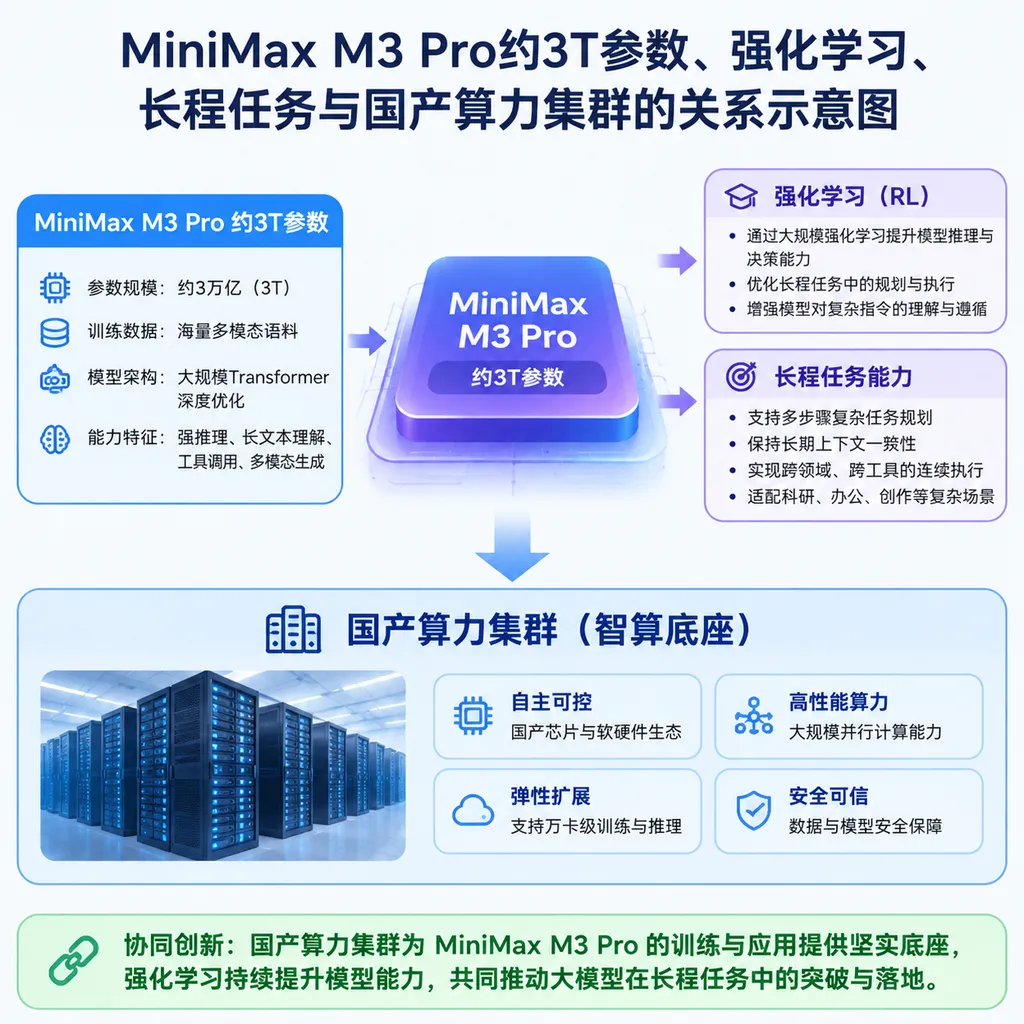
MiniMax has confirmed that M3 Pro is expected to scale to approximately 3 trillion parameters, with increased investment in reinforcement learning and long-horizon task training. More important than the parameter count is whether it can translate its higher capability ceiling into practical agent performance and controllable inference costs.
MiniMax Pushes Its Next-Generation Flagship Model to the 3T Scale
MiniMax today (August 26) disclosed the latest progress on its next-generation flagship model, M3 Pro, during its interim results conference call: the model is expected to scale to approximately 3T, or about 3 trillion parameters, while reinforcement learning and long-horizon task training will be expanded further to improve the model's generalization capabilities and upper intelligence ceiling.
This is the first time MiniMax has provided relatively clear confirmation through company management regarding M3 Pro's scale and training direction. Previous market reports generally put M3 Pro at 2.7 trillion parameters. The official description of "approximately 3T" does not contradict those reports; instead, it suggests that the training plan is still being adjusted dynamically and that the final release may differ.
However, the boundaries must first be made clear: as of August 26, MiniMax has not announced M3 Pro's official release date, model architecture, number of active parameters, training token count, context window, API pricing, or open-source license. It is still too early to call it "the strongest model in China." For now, 3T is primarily a signal of training scale, not a conclusion about capability.
3T Is Huge, but "Total Parameters" Are Not What Developers Actually Pay For
What does 3 trillion parameters mean? Public information puts the parameter count of MiniMax's current M3 model at approximately 428 billion. If M3 Pro ultimately reaches 3T, its total parameter count will be nearly seven times that of its predecessor.
That would be enough to place M3 Pro among the largest models, but it does not mean its capabilities will improve sevenfold. Today's large-model competition is no longer a linear game in which more parameters necessarily produce higher scores. The factors that actually affect final performance include at least:
- Whether the model uses a dense architecture or a Mixture-of-Experts (MoE) architecture;
- How many parameters are actually activated for each token;
- The quality, composition, and deduplication of the pretraining data;
- The tasks and reward signals used during reinforcement learning;
- Whether dynamic computation, extended reasoning, and tool use are supported at inference time;
- Whether the server-side infrastructure can run the model with sufficiently low latency and cost.
It is particularly important to distinguish between total parameters and active parameters. If M3 Pro uses an MoE architecture, 3T may be more like a "technical team" with a large number of experts: the entire team has 3 trillion parameters, but each request engages only some of those experts. This expands model capacity without requiring all parameters to be computed for every generated token.
For developers, what determines the actual experience is not the size of the model repository, but how much computation each inference activates, how long it takes to receive the first token, how many tokens can be generated per second, and how much it costs to complete a task.
Therefore, the first technical question worth asking after M3 Pro is released is not "Is it really 3T?" but rather: How many active parameters correspond to those 3T total parameters, and what do those parameters deliver?
What MiniMax Really Wants to Improve Is Long-Horizon Task Performance, Not Just Benchmark Scores
In this conference call, MiniMax's statement that it would expand "reinforcement learning and long-horizon task training" was more informative than the parameter count itself.
Long-horizon tasks are not simply about getting the model to produce longer outputs in a single response. They are closer to the real work faced by today's agent products: a model must continuously plan, call tools, read returned results, identify errors, revise its approach, and still remember the original objective after dozens or even hundreds of steps.
For example, asking a model to migrate a medium-sized code repository typically requires it to:
- Read the directory structure and dependency configuration;
- Identify the affected modules;
- Modify code in multiple places;
- Run tests and static checks;
- Continue fixing issues based on error messages;
- Summarize the changes and generate a commit message.
Strong single-turn code generation does not mean the model can complete this entire chain. Many models appear highly capable during the first three steps, but by the tenth step they begin repeatedly calling tools, forgetting constraints, or modifying tests to conceal errors. This is also one of the most common failure points as agents move from demos into production.
Strengthening long-horizon task training means MiniMax aims to optimize not only whether each individual step is correct, but also whether the entire execution trajectory is effective. This type of training is more difficult than scoring only the final answer: reward signals are sparser, task execution is more expensive, and errors may not surface until dozens of steps later.
If MiniMax can combine process-level rewards, tool-use feedback, and verifiable tasks, M3 Pro could achieve more substantial gains in areas such as coding, deep research, and complex data analysis. Conversely, if so-called long-horizon training merely means increasing the context length or adding synthetic long-conversation data, the practical benefits will be limited.
Our assessment is that long-horizon task capability is the core metric that will determine whether M3 Pro can return to the top tier; 3T merely provides a higher capacity ceiling for achieving that goal.
"Generalization" Depends on Whether the Model Can Perform in Unfamiliar Environments
MiniMax also specifically mentioned improving generalization. The term appears frequently in model release materials, but it must be validated on tasks the model has not seen before.
A model with strong generalization should not merely reproduce common problem types and tool formats from its training data. When API fields change, webpage structures differ, a codebase uses an unfamiliar framework, or user constraints conflict with one another, the model must still understand the objective, adjust its plan, and find a workable path.
After M3 Pro is released, its generalization capabilities can be assessed in at least four areas:
- Transfer to unfamiliar tasks: Whether it can quickly understand the rules of specialized tasks for which it has not been specifically fine-tuned;
- Adaptation to tool changes: Whether it can continue using tools reliably when their names, parameters, and return formats change;
- Error correction in long workflows: Whether it can identify the cause when an intermediate step fails instead of blindly restarting;
- Cross-domain composition: Whether it can combine retrieval, coding, spreadsheet analysis, and writing into a complete workflow.
This is also why isolated benchmarks in areas such as mathematics and programming are insufficient. A model can score highly on standardized test sets yet frequently fail in real-world agent tasks because of inadequate state management and error recovery.
If M3 Pro is to demonstrate that its "upper intelligence ceiling" has genuinely increased, it should ideally provide reproducible success rates on long-running tasks rather than merely showing a few percentage points of improvement on a benchmark.
Domestic Computing Clusters Will Handle Real Traffic, Signifying More Than Completed Compatibility Work
Alongside the model preview, MiniMax also disclosed progress on its infrastructure. The company said it is working to adapt M3 and H3 to domestic chips, and that large-scale domestic computing clusters will soon come online and gradually begin handling real production traffic.
The most important phrase here is "real production traffic."
Successfully loading a model onto domestic chips and running sample workloads is only the first step in adaptation. Entering production requires resolving an entire range of engineering issues, including operator compatibility, parallelization strategies, memory management, quantization accuracy, batch scheduling, fault recovery, and monitoring systems.
For extremely large MoE models, these challenges become even greater. Expert routing can create cross-accelerator communication overhead and uneven workloads, with some experts called frequently while others remain relatively idle. If cluster interconnects, compilers, and scheduling systems do not work well together, high theoretical compute capacity may still translate into disappointing real-world throughput.
Therefore, having domestic clusters begin handling online requests for M3 and H3 carries more weight than merely announcing that "chip adaptation has been completed." It means MiniMax is preparing to subject this infrastructure to real tests of concurrency, latency, and stability, while also accumulating deployment experience for M3 Pro.
However, adapting M3 and H3 to domestic chips does not mean M3 Pro can already run efficiently on the same cluster. A 3T-scale model will place greater demands on memory capacity, interconnect bandwidth, and inference frameworks. MiniMax still needs to answer several questions: Will domestic computing resources primarily handle pretraining, post-training, or online inference? How will traffic be distributed across different hardware platforms? Will the cost per token actually decrease after migration?
Faster Model Releases Also Mean Greater Cost Pressure
MiniMax founder and CEO Yan Junjie said that in the next phase, the company will pursue coordinated improvements in model intelligence, inference efficiency, and infrastructure capabilities, while accelerating the development and release cycles of its M-series and H-series models.
The M series covers language and multimodal foundation models, while the H series is more focused on video generation. Accelerating both product lines simultaneously allows MiniMax to cover text, agents, and video content production, but it also requires concurrent investment in training, inference, and engineering resources.
The company's financial results for the first half of fiscal year 2026, disclosed on the same day, showed:
- Total operating revenue of $117 million, up 283.1% year over year;
- Gross profit of $20.813 million, up 464.8% year over year;
- A gross margin of 17.9%;
- A net loss attributable to shareholders of $358 million, narrowing by 11% year over year;
- A debt-to-asset ratio of 21.5%.
Revenue is growing rapidly, but the scale of the losses remains significant. Based on a rough calculation using the disclosed figures, the net loss attributable to shareholders in the first half was approximately three times the company's operating revenue for the same period. This is not unusual for a foundation-model company, but it shows that M3 Pro cannot serve only as a technical flagship; it must also become part of a commercially sustainable business cycle.
Larger models usually mean higher training costs and may also lead to more expensive inference bills. If MiniMax imposes strict rate limits, significantly reduces inference compute budgets, or deploys a weaker configuration through the actual API to control costs, laboratory capabilities will be difficult to convert into a strong reputation among developers.
MiniMax must accomplish three things at once: the model must be sufficiently capable, inference costs must be sufficiently low, and online capacity must be able to support traffic growth. None of these can be omitted.
After M3 Pro Launches, Developers Should Examine These Six Areas First
M3 Pro has not yet been officially released, so debating winners and losers based on 3T does not mean much at this stage. Once the model and its technical report are available, developers should prioritize the following metrics:
- Architecture and active parameters: Beyond total parameters, how many parameters are actually used for each token;
- Real context capability: Not just the advertised context window, but also accuracy in long-document retrieval and cross-section reasoning;
- Long-horizon agent success rate: Whether it can complete complex tasks rather than becoming trapped in loops partway through;
- Inference efficiency: Time to first token, output speed, concurrency limits, and stability;
- Cost per task: Do not compare only the price per million tokens; also calculate how many tokens and retries are required to complete the same task;
- Degree of openness: Whether model weights will be open-sourced, which license will be used, and whether commercial deployment and further training will be permitted.
Among these, "cost per task" is often more meaningful than the listed API price. A low-cost model that requires repeated retries may ultimately be more expensive than a higher-priced model that succeeds on the first attempt. In agent workflows, retries also amplify the costs of tool calls, searches, and sandbox execution.
If M3 Pro later offers a standard API, developers should not immediately migrate production traffic simply because of its parameter count. A more prudent approach is to add it to existing evaluation suites first, then compare it with current models through gradual traffic routing. For teams already using OpenAI-compatible formats, migrating code is usually not the difficult part, whether access is provided through the official API or an aggregation platform such as OpenAI Hub. The time-consuming work lies in revising prompts, tool definitions, timeout strategies, and cost controls.
3T Is a Ticket to Compete, Not the Deciding Factor
The message from MiniMax is clear: it has not abandoned the continued scaling of foundation models, and it is incorporating reinforcement learning, long-horizon tasks, and domestic computing infrastructure into the same round of upgrades.
This approach has merit. Long-horizon agents require stronger world knowledge, planning abilities, and error-correction capabilities, and expanding model capacity remains an effective way to raise the upper capability ceiling. But 3T will also magnify engineering challenges, including training stability, expert load balancing, inference costs, and cluster capacity.
Therefore, the most compelling prospect for M3 Pro is not that it could become China's largest model by parameter count, but that it could demonstrate whether an extremely large model can operate more reliably on real-world tasks while remaining affordable for developers.
Parameter count generates the first wave of attention. Long-horizon task success rates determine whether developers will try the model. Inference costs and service stability determine whether they will stay.
Before M3 Pro's official release, MiniMax has already set expectations at 3T. Its next step is to explain that figure clearly through the model itself, its technical report, and real-world usage bills.
References
- MiniMax: M3 Pro's Parameter Count Is Expected to Increase to Approximately 3T, With Large-Scale Domestic Computing Clusters Coming Online Soon — An August 26 report from IT Home summarizing information disclosed during MiniMax's interim results conference call concerning model training, domestic chip adaptation, and financial performance.