<think>**Refining headline translation**</think> Qwen3.8-Flash Gets Another Price Cut
Alibaba Cloud Model Studio has cut Qwen3.8-Flash API prices, lowering input costs to RMB 0.8 per million tokens and output costs to RMB 2.7 per million tokens. The reductions are not particularly aggressive, but they offer direct cost savings for long-context and high-concurrency workloads.
Bailian Cuts Prices Again Within a Day
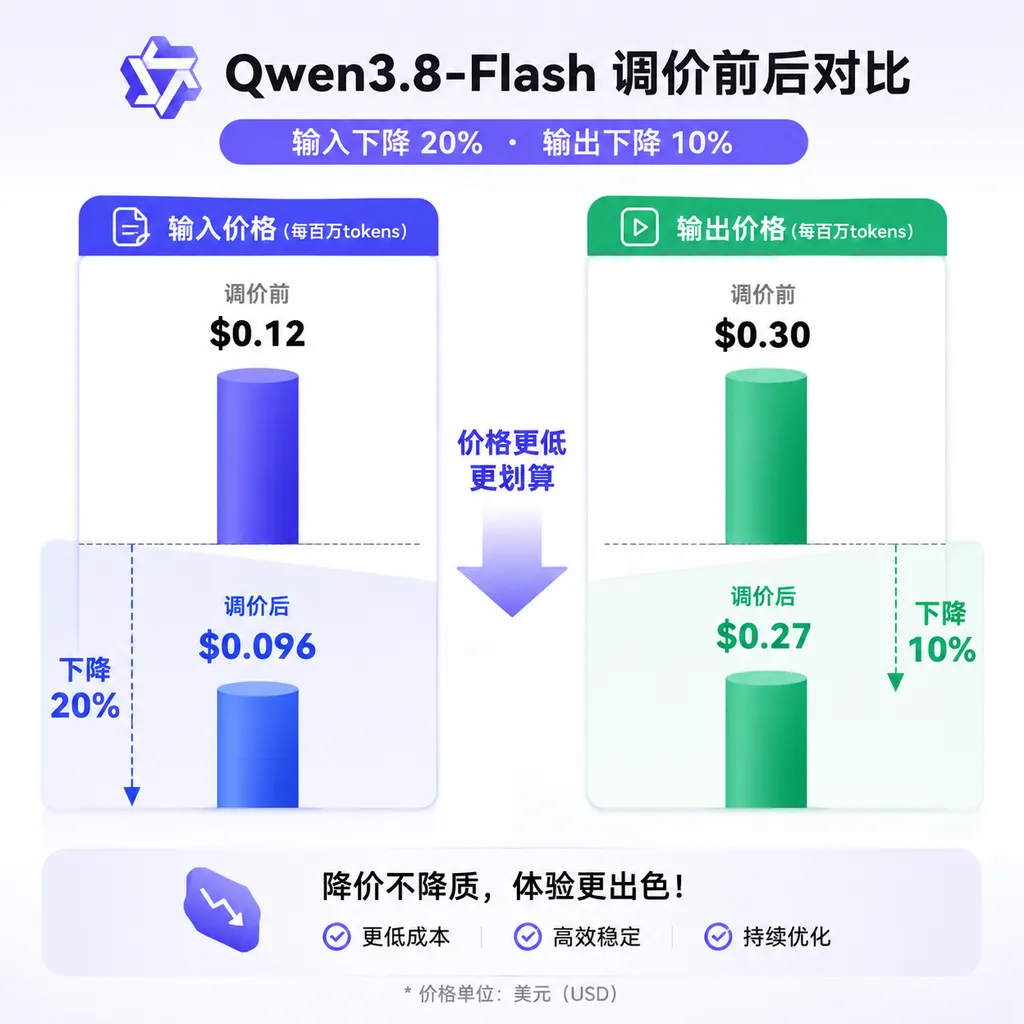
Alibaba Cloud announced on August 27 that, effective today at 12:00 Beijing time, it is lowering the model usage price for Qwen3.8-Flash on the Bailian platform: input will drop from RMB 1 to RMB 0.8 per million tokens, while output will fall from RMB 3 to RMB 2.7 per million tokens.
This represents a 20% reduction in input pricing and a 10% reduction in output pricing. The new prices are as follows:
| Billing Item | Before | After | Reduction | | --- | ---: | ---: | ---: | | Input | RMB 1.00 / million tokens | RMB 0.80 / million tokens | 20% | | Output | RMB 3.00 / million tokens | RMB 2.70 / million tokens | 10% |
This price adjustment comes shortly after the release of Qwen3.8-Flash. Alibaba released and open-sourced the model on the evening of August 26, with launch API pricing already as low as RMB 1 for input and RMB 3 for output. Less than a day later, Bailian lowered the prices even further.
A difference of RMB 0.2 or RMB 0.3 may not look significant in isolation, but for online services processing hundreds of millions or even billions of tokens every day, it is far from negligible. More importantly, Qwen3.8-Flash is specifically designed for long-context workloads, coding assistance, and agent workflows. These scenarios continuously ingest system prompts, code repositories, tool outputs, and conversation histories, resulting in much higher input consumption than ordinary chatbots. The 20% reduction in input pricing is therefore more meaningful in practice than the reduction on the output side.
A Few Cents Less per Call Adds Up at Scale
Consider an example that more closely resembles a production environment.
Suppose a coding agent processes 1,000 tasks per day. For each task, it reads an average of 1 million tokens of code, documentation, and execution logs, while generating 100,000 tokens of analysis, patches, and explanations. Its total daily usage would be 1 billion input tokens and 100 million output tokens.
The costs before and after the price adjustment would be:
Before: 1,000 × RMB 1.00 + 100 × RMB 3.00 = RMB 1,300
After: 1,000 × RMB 0.80 + 100 × RMB 2.70 = RMB 1,070
Daily savings: RMB 230, an overall reduction of approximately 17.7%
If usage remains unchanged, monthly spending would fall by approximately RMB 6,900. For large platforms, the savings would scale even further. For small and medium-sized teams, they could offset part of the cost of logging, vector databases, or sandboxed execution environments.
However, this price adjustment should not simply be summarized as a 20% reduction in costs for every workload. The actual reduction depends on the ratio of input to output:
- RAG retrieval, code repository analysis, and long-document review are usually input-heavy, so their savings will be closer to 20%.
- Content generation, translation, and long-form report generation have a higher proportion of output, so their overall savings will be closer to 10%.
- Multi-agent systems both pass large amounts of context and generate lengthy plans and tool parameters, so their actual savings will generally fall somewhere between the two.
- If a workload already makes extensive use of context caching, batch calls, or platform discount packages, the change in its bill must be recalculated according to the relevant billing rules.
Using a common input-to-output token ratio of 3:1 as an example, the original cost would be RMB 6, while the adjusted cost would be RMB 5.1, an overall reduction of 15%. This figure is more suitable as a rough budget estimate for ordinary chat, customer service, and lightweight agent workloads.
The Architecture Is Beginning to Deliver on Its Cost Advantage
Qwen3.8-Flash is Qwen's latest multimodal mixture-of-experts model. According to publicly available information, its Transformer component has 125 billion parameters in total, but activates only around 6 billion parameters per token. It also includes 51 billion N-gram embedding parameters, supplementing the model's pattern memory at relatively low computational cost.
The MoE concept is not new: a model can be very large while involving only a small number of experts in each inference step. It is similar to a company with multiple specialized departments that does not need to bring everyone into every meeting. The real challenges lie in routing efficiency, expert load balancing, and training stability. Listing parameter counts in a model description is easy; turning them into a stable, low-latency, and inexpensive API is where engineering capability becomes evident.
Qwen3.8-Flash also uses a hybrid attention architecture combining QSA sparse attention with GDN. With traditional full attention, computational and cache pressure rise rapidly as context length grows. Sparse attention attempts to retain only the connections that are genuinely useful, preventing the model from repeatedly computing large numbers of low-value relationships across million-token contexts.
Alibaba claims that this architecture can deliver a speedup of more than 8x in million-token long-context scenarios with high cache hit rates. This figure must be interpreted in light of request structure, cache hit rate, hardware, and concurrency conditions. It does not mean that every request will be eight times faster. At the very least, however, it helps explain why Qwen3.8-Flash can continue cutting prices even though its launch pricing was already low: price competition is no longer driven solely by cloud-provider subsidies, but increasingly by efficiency gains in model architecture and inference systems.
According to publicly available information, Qwen3.8-Flash consumed approximately one-ninth of the training resources used by the previous-generation Qwen3.7-Plus, while still targeting capabilities close to those of the previous Plus-tier model. If this level of capability holds up in real-world workload evaluations, its positioning extends beyond that of a conventional "small model." Instead, it uses Flash-tier costs to handle some tasks that previously required Plus-tier or even flagship models.
What Really Matters Is Cost per Task, Not Benchmark Rankings
Alibaba describes Qwen3.8-Flash as outperforming Claude Opus 4.6 and approaching Opus 4.8. Such cross-model claims are useful for quick promotion, but they are insufficient for making technical decisions.
Developers should focus more closely on four metrics:
- Task success rate: Can the model reliably complete repository-level modifications, function calls, and structured outputs, rather than merely answering single-turn questions correctly?
- End-to-end latency: Supporting a million-token context does not mean using one is practical. Time to first token and total task completion time are equally important.
- Retry cost: A cheap model that frequently requires three attempts may ultimately cost more than a model with a higher unit price.
- Cost per task: The real production cost emerges only when token pricing, caching, tool calls, failed retries, and human review are considered together.
For example, if Qwen3.8-Flash requires an average of two rounds to complete a code fix while a more expensive model needs only one, its token price advantage will quickly disappear. Conversely, if it is already reliable enough for code retrieval, log summarization, tool selection, and basic patch generation, moving these high-frequency steps away from flagship models could generate savings far greater than the headline reduction of 10% to 20%.
A more sensible deployment strategy is usually to use tiered routing rather than assigning every task to a single model. Qwen3.8-Flash can handle classification, retrieval, long-context compression, routine code modifications, and tool calls. Tasks would be escalated to a more capable flagship model only when they involve high-risk decisions, complex architecture design, or repeated failures. With input pricing now down to RMB 0.8, this model-routing strategy has become even more attractive.
Useful for Developers, but No Need to Migrate Immediately
This price adjustment is clearly beneficial, but a 20% reduction in input pricing is not, by itself, sufficient reason to migrate. Teams already using Qwen3.8-Flash will benefit directly. Teams currently using other Flash or lightweight models should first conduct comparative tests that closely reflect their production traffic.
At a minimum, the test set should cover:
- System prompts and multi-turn contexts of realistic lengths;
- Function calling, JSON Schema, and recovery from invalid parameters;
- Chinese, English, and mixed-language coding scenarios;
- Retrieval of information located in the middle of long documents;
- Time to first token and rate-limiting behavior under high concurrency;
- Output consistency when running the same task repeatedly.
Qwen3.8-Flash is compatible with the OpenAI and Anthropic API protocols, reducing integration and migration costs for existing applications. For teams that have already implemented a model abstraction layer, switching will usually involve only the model identifier, base URL, and authentication configuration. OpenAI-compatible aggregation platforms such as OpenAI Hub also make it possible to evaluate and route Qwen, GPT, Claude, Gemini, and DeepSeek through the same calling logic.
However, API compatibility does not imply identical behavior. Tool-call fields, streaming events, reasoning modes, image input limitations, error codes, and context-caching strategies may all differ. SDKs and gateways still require regression testing before launch. Production traffic should not be switched simply by changing a model name.
The Flash Model Price War Is Not Over
Over the past year, competition among model vendors has shifted from "who has the highest-scoring flagship model" to "who can reliably process real-world tasks at the lowest cost." Flagship models demonstrate the upper limits of capability, but Flash models are more likely to be adopted by workloads that continuously generate API traffic, including customer service, search, office productivity, coding assistants, and agents.
Low pricing was already a central selling point when Qwen3.8-Flash launched. Bailian's subsequent price reduction indicates that Alibaba wants to expand usage volume and developer adoption as quickly as possible. For cloud platforms, lower per-token prices can also drive demand for related services such as storage, retrieval, serverless computing, databases, and agent platforms.
From a developer's perspective, this price cut is not market-disrupting, but it is highly practical. Input pricing of RMB 0.8 brings million-token contexts closer to being an engineering option that can be invoked frequently, rather than merely a demonstration feature. What ultimately determines whether Qwen3.8-Flash captures more production traffic will not be another RMB 0.2 reduction, but whether it can remain stable across long-running tasks, tool calls, and high-concurrency environments.
Prices are now low enough. The next round of comparisons should return to success rate, latency, and reliability.
References
- ITHome: Alibaba Cloud Lowers Qwen3.8-Flash Model Pricing on the Bailian Platform: Covers the timing of this price adjustment, prices before and after the change, and Qwen3.8-Flash's context and API capabilities.