China's large models surpass 500 trillion tokens per day

As of June 2026, the average daily token usage of China’s large AI models has surpassed 500 trillion, while the iteration cycle for flagship models has shortened to four to six weeks. Competition in the industry is shifting from parameter scale toward agent deployment, inference costs, and ecosystem efficiency.
China’s Daily Large-Model Token Usage Surpasses 500 Trillion
China’s large-model industry has set another scale record.
According to a CCTV report on August 27, as of June 2026, China’s average daily Token usage had surpassed 500 trillion. At the same time, the iteration cycle for flagship large models has shortened from approximately three months in the second half of 2025 to four to six weeks today. Some vendors are updating their models almost monthly.
Taken together, these two figures are more significant than a simple “record high in usage”: China’s AI market is entering a new phase in which the concentrated release of models is giving way to the mutually reinforcing forces of frequent model supply, large-scale application consumption, and continued expansion of computing capacity.
What Does 500 Trillion Tokens Actually Represent?
Tokens are the basic units used by large language models to process text, code, and some types of multimodal information. In Chinese-language contexts, a single Chinese character typically corresponds to one or two Tokens, although the exact number depends on the model’s tokenizer. English words, punctuation marks, and code symbols are also split into varying numbers of Tokens.
Therefore, 500 trillion Tokens does not equal 500 trillion Chinese characters, nor does it equal 500 trillion user queries. An ordinary question-and-answer exchange may consume only a few hundred to a few thousand Tokens, while code generation, long-document analysis, or an agent task may consume tens of thousands or more. This metric measures the total workload involved in model calls, context processing, and result generation.
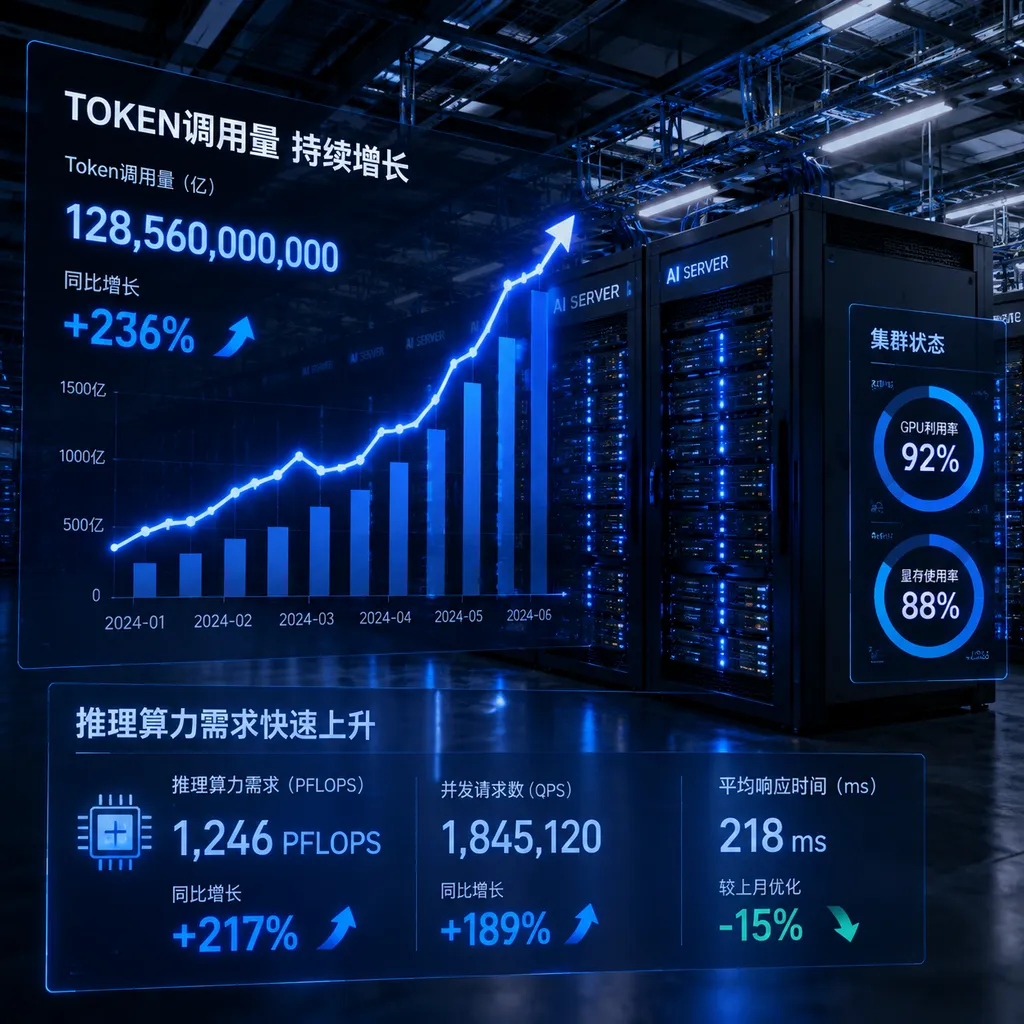
To put it another way, 500 trillion Tokens equals approximately 5×10^14 Tokens per day. In March 2026, China’s average daily Token usage had just surpassed 140 trillion; assuming consistent measurement standards, it has grown to more than three times that level in just a few months. By comparison, China’s average daily usage was approximately 100 billion Tokens at the beginning of 2024. In a little over two years, usage has jumped from the hundreds-of-billions level to the hundreds-of-trillions level. This growth rate can no longer be explained as ordinary user growth for an internet product.
More precisely, this is an explosion in “machine workload.” A large number of model calls no longer come from users occasionally opening a chat window. Instead, they are embedded in business processes such as search, office work, customer service, research and development, marketing, risk control, education, and software engineering, becoming infrastructure that runs continuously in the background.
Model Iteration Enters the “Monthly Update” Era
Feng Wen, chief architect of the open platform at MiniMax, said that in the second half of 2025, the industry generally aimed to iterate its models once every three months. Today, the release cycle for new models has shortened to four to six weeks.
This means model vendors are competing on more than a model’s highest benchmark score in a given generation. They must also be able to continuously complete an entire engineering loop: collecting feedback from real-world use, identifying where models fail on complex tasks, supplementing training data, optimizing inference efficiency, and then reliably delivering new versions to developers and enterprise customers.
In the past, large-model releases were more like flagship smartphone launches in the consumer electronics industry: one major version per year, with an emphasis on parameter scale, evaluation results, and several new capabilities. Now they are increasingly adopting the continuous-release model of cloud services and operating systems. Models may be updated every few weeks, with targeted improvements to tool calling, coding capabilities, long-context processing, structured output, inference speed, or pricing.
For developers, monthly model updates represent both an opportunity and a burden.
The opportunity is that many tasks that previously required complex prompts, manual review, or chains of multiple models may become native model capabilities in the next version. The burden is that model behavior, output formats, costs, and latency may all change, requiring previously stable Agent workflows to undergo regression testing again.
As a result, after enterprises integrate large models, the truly important capability is no longer simply producing a Demo that works. It is building model routing, version pinning, evaluation sets, fallback strategies, and cost monitoring. The faster model capabilities improve, the less applications can afford to bind their system architecture to the temporary performance of a single model.
From “Able to Chat” to “Able to Work”
The core reason for the rapid growth in usage is that AI applications are shifting from conversational interaction toward agent-based execution.
A typical chatbot operates on a “question-and-answer” basis: the user enters a question, the model generates a response, and the call chain is relatively short. An agent task, by contrast, may involve the following process:
- Understand the user’s objective and break down the task;
- Search an enterprise knowledge base or external websites;
- Read historical context and business data;
- Select and call search, database, browser, or code tools;
- Continue reasoning based on the results returned by the tools;
- Validate and revise intermediate results;
- Ultimately generate a report, code, order, or operational instruction.
During this process, the user may send only one sentence, while dozens of model calls may take place in the background. Each call may include system prompts, historical messages, search results, and tool outputs. The more complex the Agent, the more Token consumption compounds.
This is also why inference computing is becoming a more urgent issue than training computing. Training capacity determines whether a model can be created; inference capacity determines whether the model can be used at scale. The former is a periodic investment, while the latter is an ongoing daily cost.
Liu Feng, general manager of Tencent’s Smart Industries division, disclosed that during its first week after the official release of Hunyuan 3, its Token usage grew 68-fold compared with the previous-generation Hunyuan 2. This figure does not necessarily mean that usage by each individual user increased 68-fold. It is more likely to reflect the fact that, as the model’s capabilities improved, it was integrated into more products, developer projects, and business processes. Regardless of the precise composition, the figure shows that once a new model enters production systems, its usage may expand far faster than a traditional software version upgrade.
The Advantage of Chinese Models Has Shifted from “Can They Be Used?” to “Are They Worth Using?”
Chinese large models have remained in the global top tier in terms of usage for at least three reasons.
First, supply is highly dense. Baidu, Alibaba, Tencent, ByteDance, DeepSeek, Zhipu, MiniMax, StepFun, and a large number of vertical-model vendors are continuously releasing models of different sizes, reasoning profiles, and price ranges. Developers do not need to procure the most expensive flagship model for every task. They can choose fast models, reasoning models, coding models, or locally deployed models according to the difficulty of the task.
Second, the combination of price and performance is better suited to large-scale usage. For enterprises, model capability is only half the equation. The other half consists of the price per million Tokens, time to first Token, concurrency limits, stability, and tool-calling performance. For large volumes of low- and medium-difficulty tasks such as customer-service summarization, classification, information extraction, and code completion, a model that costs less and responds faster is generally more likely to enter production, provided its capabilities are comparable.
Third, application scenarios are sufficiently diverse. China’s internet platforms, manufacturing, finance, retail, government services, and education systems contain large numbers of real business processes. These processes are being broken down into individual tasks that models can handle. Models are used in real business environments, generating feedback that in turn drives model and product iteration, forming a cycle of “application-data-training-reapplication.”
Public data from OpenRouter and other sources has repeatedly shown that Chinese models rank near the top globally in usage, with substantial use of Chinese models even among US developers. This does not necessarily mean that any single model leads comprehensively in every capability. It does indicate, however, that cost-effectiveness, openness, and Agent compatibility are becoming hard metrics in model competition.
Computing Centers Begin to Be Built Around “Token Capacity”
The growth in Token usage ultimately translates into demand for servers, networks, storage, and electricity.
To compete for inference resources, major internet companies are accelerating the construction of AI computing centers while securing GPUs, domestic AI chips, and data-center services through long-term cooperation agreements. Zheng Zihao, general manager of the AI Computing Center at Envision Group, said that the construction of AI computing centers is experiencing explosive growth, largely because users can provide long-term, stable order commitments.
This change is significant. Resource utilization at traditional data centers depends largely on peak traffic and business cycles. AI computing centers, by contrast, must be specifically designed around model training and inference workloads, including high-bandwidth interconnects, memory capacity, low-latency networks, liquid-cooling systems, and model-service orchestration. As the proportion of inference tasks rises, computing centers are no longer simply places to “install chips in a server room.” Their capacity must be measured by how many Tokens they can generate reliably per unit of time.
They can be understood as new industrial production lines: models are the software equipment in the factory, computing chips are the production machinery, data is the raw material, and Tokens are the products continuously produced. The revenues of model-service providers, the resource utilization of cloud vendors, and the AI productivity of enterprises will all become increasingly tied directly to Token throughput.
However, a larger number of Tokens does not necessarily mean that AI applications are more valuable. Repeated calls, excessively long contexts, ineffective retrieval, and Agent loops can all create “false prosperity.” The metrics that truly deserve attention should move beyond total Token volume and be refined to include effective task-completion rates, Token cost per task, time saved on human labor, and business conversion results.
Three New Questions the Industry Must Address After Scaling Up
1. Cost Control Has Become an Architectural Issue Rather Than a Financial Issue
When enterprises call tens of billions or even more Tokens every day, even a small decline in model prices can directly affect profits. However, switching to an insufficiently capable model to save money may increase the costs of retries, manual review, and failed processes.
A more practical approach is layered routing: assign simple tasks to low-cost models, complex reasoning to flagship models, and retain human or rule-based validation for critical steps. The system must record the Token consumption, latency, success rate, and business outcome of every call rather than looking only at the monthly bill.
2. Rapid Model Updates Can Disrupt Application Stability
A model iteration cycle of four to six weeks may improve efficiency for research teams, but it can create compatibility risks for production systems. If the output style changes, JSON formatting may become unstable. If the model’s interpretation of tool parameters changes, an Agent may call the wrong interface. If safety policies are adjusted, tasks that could previously be completed may be blocked.
Production environments therefore need fixed model versions, phased rollouts, and automated regression testing. For critical business operations, the “latest model” is not necessarily the “most suitable model.” Predictability is often more important than a few percentage points on a leaderboard.
3. Data Governance and Security Pressure Are Rising at the Same Time
Every model call may carry user input, enterprise documents, database records, and tool-execution results. Once usage reaches the hundreds-of-trillions level, data classification, de-identification, access control, log retention, and cross-system auditing can no longer rely on manual configuration.
This is particularly true in agent scenarios, where models do more than generate text. They may also read files, query systems, execute code, and trigger business operations. The larger the Token volume, the more complex the data-flow paths exposed by the system become. Improvements in the model itself do not automatically resolve questions of permission boundaries and accountability.
The Real Competition Is Not “Who Has the Largest Model”
Judging from the 500 trillion Tokens used per day and the four-to-six-week iteration cycle, the industry’s competitive logic has already changed.
Model parameter scale remains important, but it is no longer the only answer. For developers, whether a model can enter a production environment is usually determined by the following combination:
- Whether it can reliably complete real tasks rather than merely score well on evaluation sets;
- Whether tool calling, structured output, and long-context processing are reliable;
- Whether its inference price and latency can support high concurrency;
- Whether it supports flexible deployment, data isolation, and version control;
- Whether it has a sufficiently mature developer ecosystem and service infrastructure.
This is the more precise meaning of Chinese large models “remaining firmly in the global top tier”: they may not lead comprehensively in every fundamental capability metric, but they have formed a sufficiently large systemic advantage in the combined competition involving model supply, application scale, usage costs, developer coverage, and industrial deployment.
For developers using multiple models, model selection is also shifting from a one-time procurement decision to ongoing operations. Aggregation gateways such as OpenAI Hub, which are compatible with the OpenAI format, can provide unified integration and switching among models such as GPT, Claude, Gemini, and DeepSeek. Their value does not lie simply in stacking models together, but in helping teams reduce the engineering costs of multi-model adaptation, version migration, and failover. The more frequently models are updated, the more important unified interfaces and observability become.
Today’s 500 trillion Tokens may only be the starting point for the next wave of growth. What must truly be verified next is not how much further usage can increase, but whether these Tokens can be consistently converted into higher levels of software automation, lower business costs, and more work that can genuinely be taken over by agents.
Sources
- ITHome: China’s Average Daily Token Usage Surpasses 500 Trillion, and Chinese Large Models Remain Firmly in the Global Top Tier — Summarizes the CCTV report and industry experts’ comments on average daily Token usage, model iteration cycles, Hunyuan 3’s usage growth, and the construction of AI computing centers.
- ITHome: China’s Average Daily Token Usage Surpasses 500 Trillion, and Chinese Large Models Remain Firmly in the Global Top Tier — References the industry information on large models shifting from conversation toward agents and the growing demand for inference computing.