Ant Bailin Financial Model to Be Open-Sourced Next Week

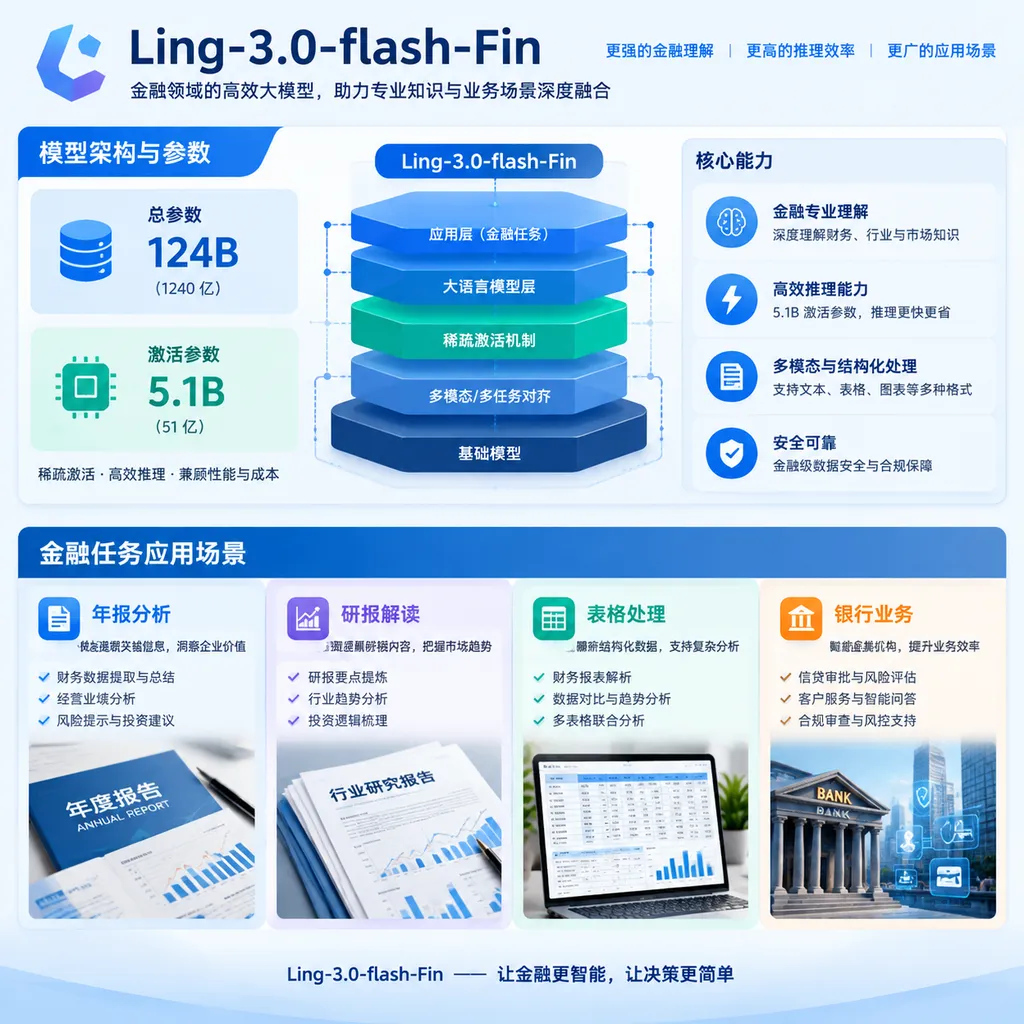
Ant Ling has released Ling-3.0-flash-Fin, a finance-enhanced model that retains 124B total parameters and 5.1B activated parameters while strengthening capabilities in financial retrieval, research report analysis, and valuation modeling. API access will be free for one month, and the model weights will be open-sourced next week.
Financial Models Need to Do More Than Calculate—They Must Also Find the Original Evidence
On August 28, Ant Ling announced the finance-enhanced model Ling-3.0-flash-Fin. The new model retains the architecture and long-context capabilities of Ling-3.0-flash, with the same parameter scale: 124B total parameters and 5.1B activated parameters. Building on this foundation, Ant enhanced the model through continued pretraining on financial corpora, domain-specific post-training, and tool-use optimization, with a focus on capabilities such as annual report analysis, financial workbook processing, synthesis of multiple research materials, information retrieval, and valuation modeling.
The company also announced two open-access initiatives: Ling-3.0-flash-Fin will be available through OpenRouter with free API access for one month, while the model weights are scheduled to be officially open-sourced next week.
This represents a clear product rollout strategy: first use the free API to attract developers and test the model on real-world tasks, then use open weights to enter the private deployment market, which matters more to financial institutions. For financial models, the latter may be even more important than free API access—research materials, customer data, transaction records, and internal financial data often cannot leave an organization’s environment. A financial model that can only be accessed through a public API will struggle to enter core production systems.
124B Parameters, but Only 5.1B Used at a Time
Ling-3.0-flash-Fin does not simply scale up the model to improve its financial capabilities. Instead, it continues to follow the MoE approach used by Ling-3.0-flash.
The 124B figure represents the model’s total capacity for knowledge and capabilities, while 5.1B is the number of activated parameters that actually participate in computation when generating each token. It can be compared to an organization with many specialized departments: the organization as a whole is large, but for any specific task, only a small number of relevant teams are assigned rather than having everyone attend the same meeting.
The value of this design is especially evident in financial applications. A financial agent rarely stops after answering a single question. It often needs to continuously perform searches, read disclosures, extract tables, invoke calculation tools, cross-check information, and generate reports. Every step consumes tokens. If the model activates tens or hundreds of billions of parameters for every inference, costs and latency can quickly accumulate.
Therefore, Ling-3.0-flash-Fin’s selling point is not simply that it is a “hundred-billion-parameter model,” but that it attempts to balance three objectives:
- Retain sufficiently large capacity for knowledge and capabilities;
- Keep the computational cost of each inference relatively low;
- Enable organizations to deploy the model locally or in private clouds.
However, 5.1B activated parameters should not be directly equated with a conventional 5.1B dense model. MoE inference still requires loading and routing a much larger set of weights. Actual VRAM usage, parallelization methods, and deployment complexity depend on the quantized version, inference framework, context length, and concurrency settings. Developers should not assume that the model can be casually fitted onto a consumer-grade GPU simply because it activates only 5.1B parameters.
Financial Enhancement Is Not About Memorizing More Terminology
Many so-called financial models are essentially general-purpose models trained to memorize more financial terminology, exam questions, and investment Q&As. Such models may perform well on standardized benchmarks, but their weaknesses quickly become apparent in real-world workflows: unreliable citations, inconsistent accounting bases across different years, errors when reading spreadsheet rows and columns, and even conclusions that appear professional but cannot be traced back to their sources.
The capabilities emphasized in Ling-3.0-flash-Fin are more closely aligned with actual production requirements. According to the company, the model underwent continued pretraining on financial corpora, domain-specific post-training, and tool-use optimization, primarily to process three types of complex input:
- Long-form public documents: such as listed companies’ annual reports, prospectuses, stock exchange disclosures, and regulatory filings;
- Structured and semi-structured tables: such as financial workbooks, valuation models, and multi-period operating data;
- Cross-document research materials: such as joint analysis across multiple research reports, industry materials, and company announcements.
These three task types present different challenges. Reading annual reports requires long-context comprehension and information localization. Processing workbooks requires recognizing relationships among cells, formulas, and reporting periods. Synthesizing research reports requires the model to distinguish facts, analyst assumptions, and secondhand opinions. Combining them within a single agent workflow also introduces problems such as tool-call failures, context contamination, and error accumulation.
In other words, the real challenge for a financial model is not whether it can explain the price-to-earnings ratio. It is whether the model can locate the correct data within hundreds of pages of documents, identify the reporting period to which the data belongs, perform the calculation, and accurately trace the conclusion back to the original materials.
FinFIRST Includes “Where the Answer Came From” in Its Scoring
To evaluate these capabilities, Ant Group and China International Capital Corporation jointly developed FinFIRST, short for Financial Information Retrieval, Sourcing and Traceability. More than 50 financial professionals participated in designing the benchmark, which evaluates performance across three dimensions:
- Results: Whether the final answer is accurate and complete;
- Process: Whether the research methodology, reasoning process, and calculation methods are sound;
- Evidence: Whether key data and conclusions can be traced back to authoritative primary sources.
Of these, “evidence” deserves the most attention.
The most dangerous problem with general-purpose models in financial research is often not that they are completely unable to answer, but that they provide an answer that is broadly correct in direction, wrong in the details, and unsupported by reliable sources. For example, a model may correctly determine that a company’s gross margin has declined but cite data from the wrong quarter. It may also draw a conclusion from media coverage without locating the relevant company disclosure or regulatory filing.
By incorporating sourcing and traceability into its scoring, FinFIRST effectively checks not only the calculations but also the underlying working papers. In investment research, auditing, compliance, and banking, this matters far more than fluent language.
According to the company, Ling-3.0-flash-Fin achieved a higher overall FinFIRST score than some large flagship models and was highly competitive with models of a similar scale. It was particularly strong at prioritizing official, primary, and highly reliable sources. FinFIRST is also expected to be opened to the public soon.
However, the currently available information does not include a complete leaderboard, raw scores for each model, invocation configurations, or failure cases. Developers should therefore treat claims such as “outperforming flagship models” as results from the company’s own testing rather than conclusions that have already been independently reproduced. Once the benchmark is released, the more meaningful validation will be whether the results can be reproduced using the same search tools, context budgets, and sampling parameters.
It Tests More Than Q&A—It Tests Whether an Agent Can Complete the Task
In addition to FinFIRST, the company evaluated Ling-3.0-flash-Fin on several financial and agent benchmarks, including FinSearchComp Verified, Finance Agent, APEX-Agents, SpreadsheetBench, and τ³-Banking. These benchmarks cover financial information retrieval, investment research, long-horizon task execution, spreadsheet processing, valuation modeling, and banking applications.
This benchmark suite reveals a clear shift: competition among financial models is moving from “answering a question” to “completing an entire workflow.”
A typical listed-company research task might require the model to complete the following steps in sequence:
Task: Analyze the earnings quality of a listed company over the past three years
Steps:
  - Locate annual reports and stock exchange disclosures
  - Extract revenue, operating cash flow, accounts receivable, and inventory data
  - Standardize currencies, fiscal years, and accounting bases
  - Calculate cash-to-revenue and turnover metrics
  - Search for management explanations of anomalous years
  - Produce conclusions and cite locations in the original documents
Acceptance criteria:
  - Figures can be independently recalculated
  - Citations are traceable
  - Assumptions and facts are clearly distinguished
An error at any stage could render the final report useless. This is especially true for long-horizon tasks, where strong single-response performance does not necessarily mean the entire agent is reliable. The agent may choose the wrong search keywords, fail to read the complete output returned by a tool, misalign spreadsheet data, or carry small early-stage errors into subsequent calculations.
Therefore, the effectiveness of Ling-3.0-flash-Fin’s tool-use optimization cannot be assessed solely by its final score. It is also necessary to examine task completion rates, the number of tool calls, retry rates, citation accuracy, and per-task costs. These metrics more closely reflect the real challenges developers face when deploying financial agents.
Improved Domain Expertise Without an Apparent Sacrifice in General Capabilities
Another result announced by Ant is that Ling-3.0-flash-Fin’s score on the AA Intelligence Index v4.1.1 increased from 38 for the base model to 41.
A common problem with domain-specific models is over-specialization. To strengthen performance in a particular industry, developers add large amounts of domain data and format-specific training. As a result, the model performs better on specialized questions but becomes worse at general reasoning, instruction following, or cross-domain tasks. Ling-3.0-flash-Fin’s general intelligence score increased rather than declined, suggesting—at least based on the company’s results—that its financial post-training did not turn it into a specialized tool capable only of reading financial statements.
This matters for agents. Real-world financial tasks combine webpage comprehension, code reasoning, mathematical calculation, document parsing, and tool use. They cannot rely solely on financial knowledge. A model with strong domain expertise but unstable general instruction-following capabilities will often struggle to connect the steps into a complete workflow.
Of course, an increase from 38 to 41 does not mean that the model has entered the capability range of top-tier general-purpose flagship models. A more reasonable positioning is that it uses relatively few activated parameters and high deployment efficiency as its foundation, then leverages domain training to gain localized advantages in financial tasks, rather than attempting to comprehensively replace the largest closed-source models.
The Free API Is Suitable for Evaluation, but Do Not Treat It as a Production Environment
Ling-3.0-flash-Fin will be available through OpenRouter with free API access for one month. For developers, the best use of this access is not casual conversation but rapidly building an evaluation set that closely reflects actual business requirements.
The following metrics should be tested first:
- Accuracy when locating data in annual reports and disclosures;
- Consistency of years, currencies, and accounting bases across multiple documents;
- Capabilities in reading spreadsheets, generating formulas, and recalculating results;
- Whether search results prioritize original documents from regulators, stock exchanges, and companies;
- Tool-call success rates and mid-task deviation rates in long-horizon tasks;
- Whether cited content actually supports the conclusions provided by the model;
- Whether answers remain consistent across repeated runs of the same question.
The purpose of a free API is to reduce evaluation costs. It does not mean the production environment will also operate at zero cost. Organizations still need to confirm rate limits, context limits, log retention policies, data-processing terms, service availability, and pricing after the free period ends. When dealing with non-public financial data, customer information, or internal research working papers, organizations should not upload such material directly to a third-party service simply because it is “free.”
For such sensitive scenarios, the release of the model weights next week will be the decisive milestone. Developers will then need to closely examine the open-source license, quantized versions, compatibility with inference frameworks, tool-calling templates, and actual hardware requirements. “Open weights” does not mean that the training data, training code, and complete training process will all be publicly available. Whether the model can be commercially deployed and redistributed will still depend on the final license terms.
Assessment: The Direction Matters More Than the Benchmark Scores
The most valuable aspect of Ling-3.0-flash-Fin is not that it is yet another model with “Fin” appended to its name. Rather, it is that the model’s development focuses on several long-standing pain points: primary-source retrieval, evidence traceability, cross-document analysis, spreadsheet processing, and long-horizon agent execution.
If these capabilities can be reproduced in independent testing, the model will be more practical than one that merely excels at financial Q&A. In particular, the design of 124B total parameters and 5.1B activated parameters leaves relatively practical room for balancing performance, cost, and private deployment.
However, caution is still warranted at this stage. The company has not released complete category-level scores, and FinFIRST has not yet been officially opened. External observers therefore cannot determine whether the model’s advantages come from the base model’s capabilities, search tools, prompt engineering, or extensive optimization for the benchmark. Financial tasks also demand much higher accuracy than ordinary content generation. A seemingly minor numerical or citation error can alter valuation and risk assessments.
Ling-3.0-flash-Fin is therefore better suited as a research assistant and an execution foundation for agents than as an automated investment decision-maker. A sound production architecture should still retain processes for data validation, calculation review, source verification, and human approval.
One month of free API access should be enough for developers to complete an initial round of comparative testing. The real milestone, however, will come next week. Once the model weights, license, and deployment configurations are fully released, the market will be able to determine whether this is merely a financial model with impressive benchmark scores or a financial AI foundation capable of entering institutional intranets and taking on real-world workflows.
References
- ITHome: Ant Ling Launches Finance-Enhanced Model Ling-3.0-flash-Fin—Announcement details covering model parameters, financial training methods, evaluation benchmarks, free API access, and open-source plans.
- Zhihu: Ling-3.0-flash Open-Source and Deployment Resources—Supplementary information on the base model architecture, quantized deployment, and inference configurations.