ABot-Recon: Achieving 10,000-Frame Performance with Just 12 Frames

Amap has released ABot-Recon, which continuously reconstructs 3D scenes spanning tens of thousands of frames using a short 12-frame context. The real breakthrough is not “looking at fewer frames,” but freeing long-video reconstruction from its ever-expanding dependence on historical data.
Amap Compresses the Context for 10,000-Frame 3D Reconstruction to Just 12 Frames
On August 28, Amap officially unveiled its streaming 3D reconstruction model, ABot-Recon. Its most striking metric is this: when processing video sequences exceeding 10,000 frames, the model needs to maintain only a short context of 12 frames to continuously reconstruct 3D scenes, eliminating its reliance on an ever-growing history of long-range frames.
This can easily be misread as saying, “Give the model 12 images, and it can generate from scratch a complete scene spanning a 10,000-frame video.” That is not what it means.
More precisely, the video must still be fed into the model continuously. Like a person walking with a camera and mapping the environment along the way, ABot-Recon continually receives new images, updates its internal state, and expands the 3D scene. The difference is that it does not need to repeatedly revisit hundreds or thousands of earlier frames; it operates around a very short local window.
The 12 frames describe the context size required for the model to process long sequences, not the total input for the entire scene.
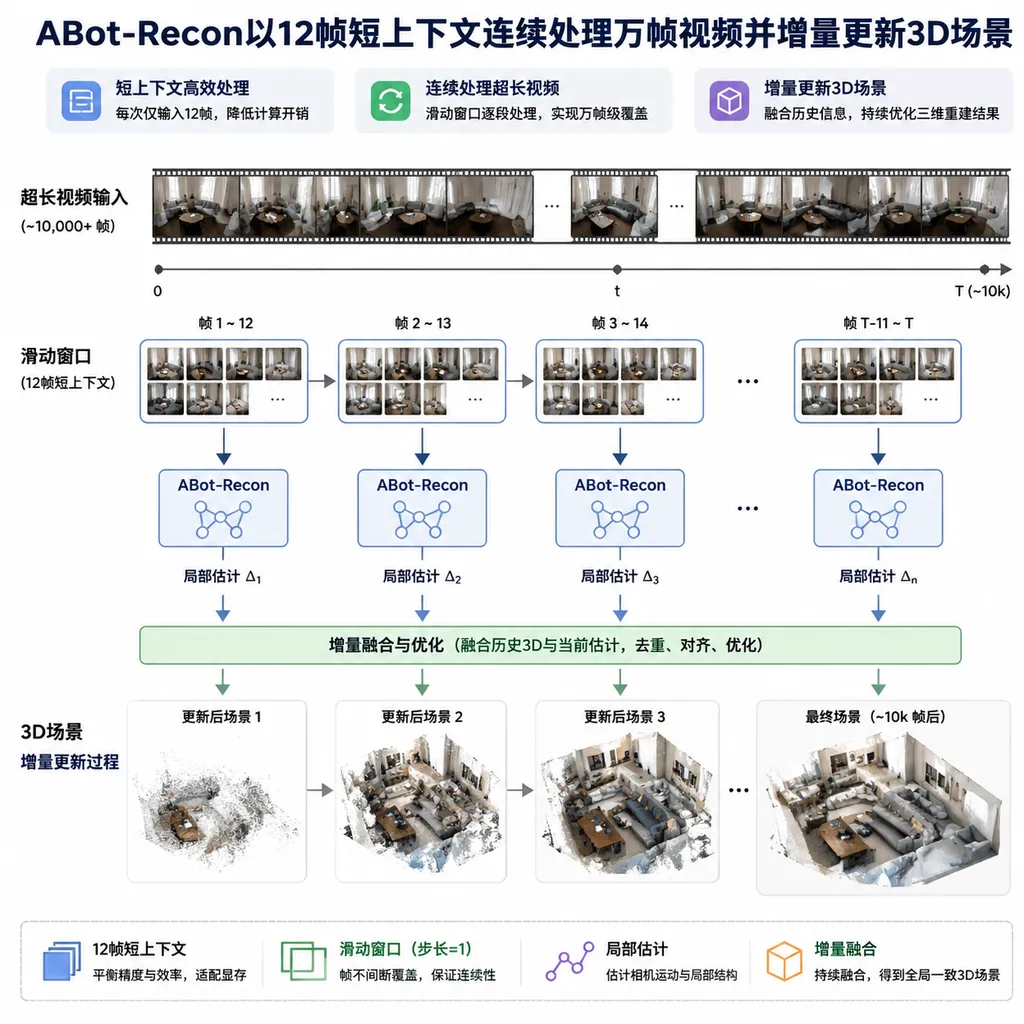
Amap describes it as the first 10,000-frame-scale streaming 3D reconstruction model with “no long-range dependencies.” Whether that claim withstands rigorous academic comparison will have to wait for the paper, code, evaluation protocol, and further third-party reproductions. But judging from how the problem is defined, ABot-Recon does address one of the hardest engineering challenges in long-video 3D reconstruction: how to let the sequence grow without allowing computation and GPU memory usage to spiral out of control.
The Real Problem With Long-Video Reconstruction Is Not the Number of Frames
The basic goal of 3D reconstruction is to recover camera motion, object surfaces, and spatial structure from 2D images captured from multiple viewpoints. Short videos are relatively easy to process because the model can load all images at once and match any two frames against each other.
But once the sequence grows to thousands or even tens of thousands of frames, this approach quickly hits a wall.
If the model must continuously retain past image features, depth estimates, camera poses, and inter-frame correspondences, three types of problems emerge as the video grows:
- GPU memory and system memory usage keep increasing. If every frame must participate in subsequent computation, it is difficult to run a 10,000-frame sequence reliably on consumer-grade devices.
- Matching costs rise sharply. In the worst case, the number of global inter-frame relationships grows nearly quadratically. A tenfold increase in sequence length may produce far more than a tenfold increase in computation.
- System latency becomes progressively higher. The first few hundred frames may run in real time, only for the system to begin stuttering in the latter half. This is nearly unacceptable for robotics and autonomous driving.
Traditional offline reconstruction can split videos into segments, downsample them, or first complete global pose optimization before generating the scene as a whole. The trade-off is that the system must wait until all the data has arrived and cannot truly build the scene on the fly.
Streaming reconstruction, by contrast, requires the system to update its results immediately whenever a new frame arrives. It is more like a live broadcast than video editing: it cannot wait until filming is complete, nor should it reread hours of earlier footage just to process the current frame.
The core value of ABot-Recon lies in its attempt to turn this process into continuous updates with approximately constant overhead.
“No Long-Range Dependencies” Does Not Mean No Long-Term Memory
Two concepts that are easily conflated must be distinguished here: long-range frame dependencies and long-term scene state.
If a model is reconstructing a large urban district, it obviously cannot completely forget the building it saw in frame 100 by the time it reaches frame 9,000. Otherwise, when the camera loops back to the same place, the model might create another building in a slightly different position, ultimately producing two overlapping but misaligned worlds.
A more reasonable technical interpretation of “no long-range dependencies” would therefore be:
- The model does not need direct access to a large number of raw historical frames;
- Historical observations are compressed into some form of scene state or geometric representation;
- Newly arriving images interact only with the short window and the current scene state;
- The scene can continue to expand while the active context remains at around 12 frames.
One way to understand this is that, instead of saving every image from a dashcam during navigation, the system organizes what it has seen into a map. Subsequent localization primarily consults the map, without having to restart the comparison from the first minute of video.
The challenge in this type of design is not “discarding old frames,” but deciding which information from those old frames must be retained. Excessive compression loses geometric detail, while retaining too much causes the state to grow without bound. Errors may also accumulate gradually in the presence of dynamic objects, repetitive textures, low-light conditions, and long straight roads.
Amap is currently emphasizing the short 12-frame context and 10,000-frame scale, suggesting that ABot-Recon has at least adopted an aggressive approach to context management. However, the launch announcement alone does not reveal whether it uses point clouds, voxels, neural fields, 3D Gaussians, or a hierarchical state composed of multiple representations. Developers should also not equate “12 frames” directly with the model’s total GPU memory footprint—the 3D map itself still has to be stored. In theory, however, the model no longer needs to retain a continuously growing context of historical video frames.
Why 12 Frames May Be Enough
From the perspective of local geometry estimation, 12 frames is not an absurdly small number.
Adjacent video frames usually exhibit strong continuity: camera-pose changes are limited, and the same objects repeatedly appear across multiple neighboring viewpoints. The model can use this short window to estimate local depth, camera motion, and pixel correspondences, then fuse the results into the existing scene.
A possible streaming workflow can be summarized as follows:
- Receive the latest video frame;
- Maintain a local window consisting of the most recent frames;
- Estimate geometric relationships and camera poses within the window;
- Fuse the new geometry into the global scene state;
- Discard old frame features that are no longer needed;
- Continue processing the next frame.
The most critical factor here is not the window length, but whether the state-update mechanism can prevent errors from being permanently written into the map.
If a depth estimate is wrong at a particular moment, the model must be able to correct it later rather than propagate the incorrect geometry indefinitely. In a 10,000-frame sequence, even a very small pose error in each frame can accumulate into a visibly distorted street by the end.
The metrics ABot-Recon truly needs to prove therefore go beyond simply “being able to finish 10,000 frames.” They also include:
- Whether pose drift remains controllable at the end of a long sequence;
- Whether loop-closure correction works when the camera returns to a previously visited location;
- Whether the boundaries between new and old local maps remain continuous;
- Whether moving vehicles and pedestrians contaminate the static scene;
- Whether the scene state can also maintain approximately constant memory overhead;
- What its throughput and latency are at different resolutions and on different hardware.
In other words, running for a long time is merely the price of admission; accuracy and stability determine whether the model can actually be deployed.
It Does Not Share the Same Selling Point as LingBot-Map
Chinese teams have recently been highly active in streaming 3D reconstruction. Ant Group’s LingBot team has developed LingBot-Map, which also targets long sequences of 10,000 frames. Publicly available information emphasizes that it can reach approximately 20 FPS at a resolution of 518×378 and process videos exceeding 10,000 frames with approximately constant memory usage through a compact streaming-state representation.
The two models appear to address the same problem, but their current public messaging emphasizes different points:
| Model | Current primary selling point | Metrics that deserve closer attention | | --- | --- | --- | | ABot-Recon | Short 12-frame context, no long-range dependencies, 10,000-frame-scale reconstruction | Context compression, long-term consistency, error accumulation | | LingBot-Map | Compact streaming state, 10,000-frame processing, approximately 20 FPS | Real-time throughput, fixed memory usage, public reproducibility |
It is important to note that the approximately 20 FPS figure comes from publicly available materials related to LingBot-Map and cannot be directly applied to ABot-Recon. The core information in Amap’s announcement concerns the short context and 10,000-frame scale, not a disclosed real-time speed at a standardized resolution.
If ABot-Recon can later demonstrate high resolution, fixed GPU memory usage, real-time frame rates, and long-sequence accuracy simultaneously, it will form a more complete engineering loop. If it merely removes historical images from the context while allowing the global scene state to keep expanding, its practical deployment value will be diminished.
It Is Not the Same as ABot-Earth0.5 Either
In June this year, Amap also released the 3D-native urban world model ABot-Earth0.5. That model focuses on generating kilometer-scale 3D cities from a single satellite image or text description and is designed for large-scale urban-world modeling.
ABot-Recon addresses a different kind of task: it reconstructs the geometry of real environments from continuous video observations. The inputs, constraints, and sources of error differ between the two.
- ABot-Earth0.5 is closer to large-scale urban generation and prior modeling;
- ABot-Recon is closer to online perception, localization, and real-world geometry recovery;
- The former addresses “how to quickly create an urban world”;
- The latter addresses “how a device can build the real world as it observes it while moving through it.”
However, viewed in the context of Amap’s business, the two paths point in the same direction: one builds large-scale urban priors, while the other continuously updates the local world using video from vehicles, robots, or mobile devices. If the two types of models can eventually be connected, a generative urban base map could provide priors, while streaming reconstruction could calibrate and update road construction, building changes, and temporary obstacles.
This has greater commercial value than simply producing an attractive 3D demo.
The Most Direct Application Is Not Film Production, but Robotics
Streaming 3D reconstruction is often demonstrated through indoor scanning or digital twins, but the applications most worth watching for models such as ABot-Recon are autonomous driving and embodied intelligence.
1. Online Mapping for Robots
When a robot enters an unfamiliar warehouse, underground parking garage, or large shopping mall, it cannot obtain a complete map in advance. A short-context model can build a navigable 3D space as the robot moves while avoiding GPU memory exhaustion after prolonged operation.
2. Autonomous-Driving Environment Updates
High-definition maps do not remain unchanged forever after a single data-collection pass. Road construction, lane adjustments, and temporary barriers all require timely updates. Vehicle video can serve as a continuous observation stream, incrementally writing changes into an existing 3D map.
3. AR Glasses and Spatial Computing
Head-mounted devices must continuously understand the furniture, walls, and interactive areas around the user. Because such devices have limited compute, memory, and power, they cannot retain historical images indefinitely. A fixed short window and compressed scene state are naturally suited to continuous on-device operation.
4. Large-Scale Digital Twins
Inspection videos of industrial parks, factories, and urban districts often last for hours. Full offline reconstruction is expensive, while streaming methods can directly generate and update scenes during data collection, reducing the burden of data transmission and post-processing.
These scenarios share one characteristic: the system does not stop after finishing a test video, but may operate continuously for hours or even days. In such cases, whether memory usage grows over time matters more than peak accuracy on an individual short-video benchmark.
It Is Too Early to Draw Conclusions—the Key Lies in Four Sets of Materials
The direction taken by ABot-Recon deserves recognition. Compressing the context to 12 frames while extending the processing length to the 10,000-frame scale at least shows that streaming 3D reconstruction is moving beyond short laboratory clips toward continuous spatial perception on real devices.
However, “first” and “no long-range dependencies” are both strong claims. To determine whether this represents a breakthrough in model architecture or an engineering metric shaped by a carefully defined setup, we need to see whether Amap provides four types of information:
- A paper and complete architecture: How the 12-frame window is updated and how the long-term scene state is encoded;
- Code and model weights: Whether the results can be reproduced outside Amap’s internal datasets;
- Results on standardized benchmarks: Comparisons with LingBot-Map and other online reconstruction methods using the same hardware, resolution, and sequence length;
- Real-world deployment data: GPU memory curves, frame rates, drift, and failure cases during long-duration operation.
Failure cases are especially important. The greatest danger in 10,000-frame reconstruction is not an occasional local surface artifact, but an error entering the long-term state and continuously contaminating subsequent scenes. Glass, mirrors, low-texture walls, rapid turns, motion blur, and large numbers of dynamic objects all impose pressures that are closer to reality than conventional datasets.
Assessment: This Is Not “Generating a World From 12 Frames,” but an Upgrade in State Management
The most valuable aspect of ABot-Recon is not that it uses more dramatic numbers to tell a story about 3D generation, but that it rethinks the burden of history in a streaming system.
Long-video reconstruction has traditionally assumed that “the longer you observe, the more you need to remember.” Amap is attempting to prove an alternative path: observing for longer does not mean the context must grow longer; as long as the history can be compressed into an updatable spatial state, local observations can still support large-scale scenes.
This idea is especially important for robotics. Large models can mitigate forgetting by expanding their context windows, but sensor data from the physical world is an infinite stream, and any fixed limit will eventually be filled. A truly sustainable system must learn to transform history from “raw records” into a “structured world state.”
ABot-Recon has already provided an eye-catching answer: 12 frames.
What it must prove next is that these 12 frames not only allow the model to reach frame 10,000, but also ensure that frame 10,000 remains in the same 3D world as frame one—with no significant misalignment.
References
- Zhihu: The First Real-Time 20 FPS Streaming 3D Reconstruction and Geometric Context Method — Introduces the technical background of LingBot-Map, including 10,000-frame long sequences, compact state representation, and a processing speed of approximately 20 FPS, and can serve as a reference for competing streaming 3D reconstruction systems.