Tencent Open-Sources Hunyuan Hy4: 770B Parameters Geared for Productivity
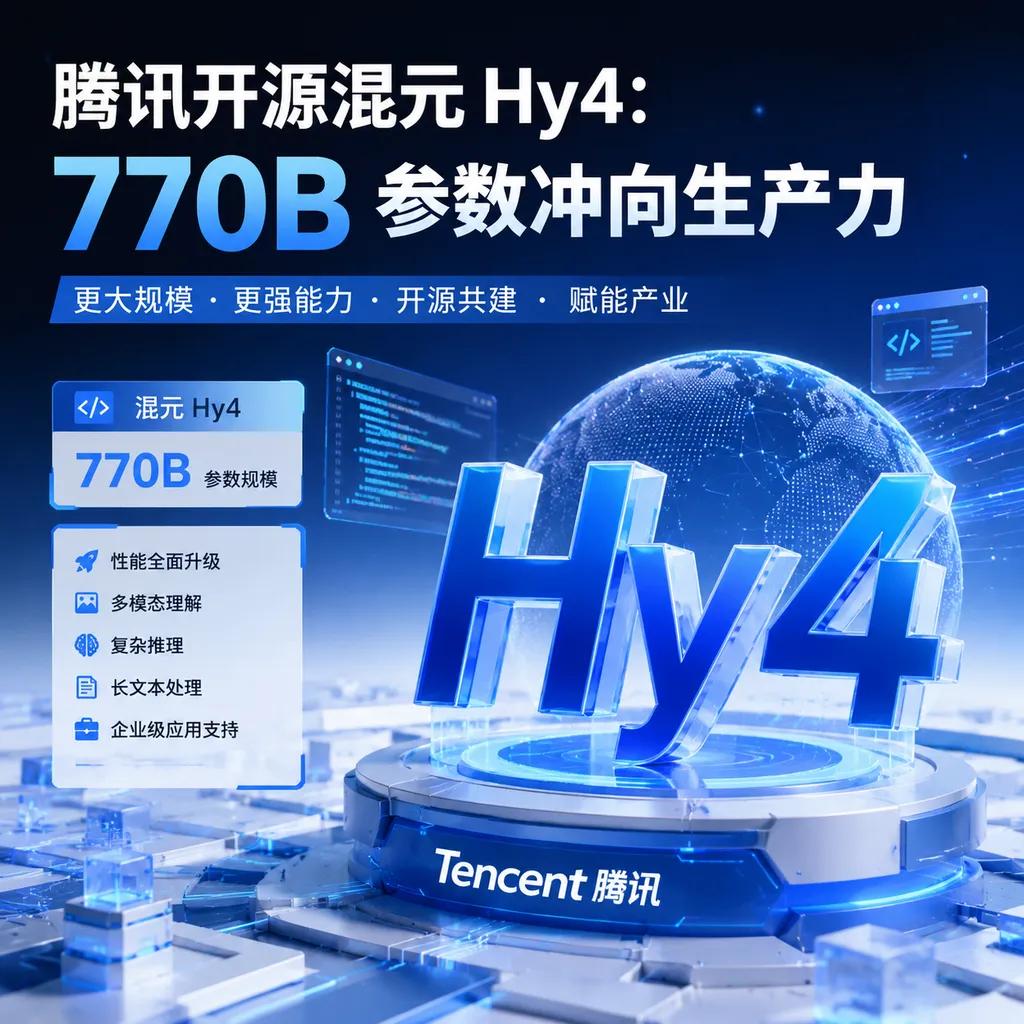
On August 28, Tencent released and open-sourced Hunyuan Hy4 Preview, with 770B total parameters, 49B active parameters, and a context length of 1M. It focuses on long-horizon tasks such as coding, office productivity, game development, and scientific research, and was released as a preview to gather real-world feedback as quickly as possible.
Tencent Pushes Hunyuan’s Parameter Count and Context Window Up Another Notch
On August 28, Tencent released and open-sourced Hy4 preview, the latest generation of its Hunyuan large language model. The core specifications announced by the company are 770B total parameters, 49B activated parameters, and a context length of 1M tokens.
In terms of total parameter count, Hy4 preview has entered the ultra-large-scale tier of today’s open-source models. Its activated parameter count indicates that it uses a sparse activation architecture, meaning the number of parameters actually involved in each inference run is far lower than the total parameter count. Put simply, the model’s “brain capacity” continues to grow, but it does not need to mobilize all of its parameters for every response. This has become the mainstream approach for ultra-large models seeking to balance capability, cost, and throughput.
However, the most noteworthy aspect of Hy4 preview is not merely the two figures—770B parameters and a 1M-token context window. Tencent has positioned it very clearly: “Built for productivity.” Rather than focusing on short, one-off tasks such as writing a few snippets of code or revising an email, it aims to connect requirements comprehension, document ingestion, execution, validation, and delivery into a longer end-to-end workflow.
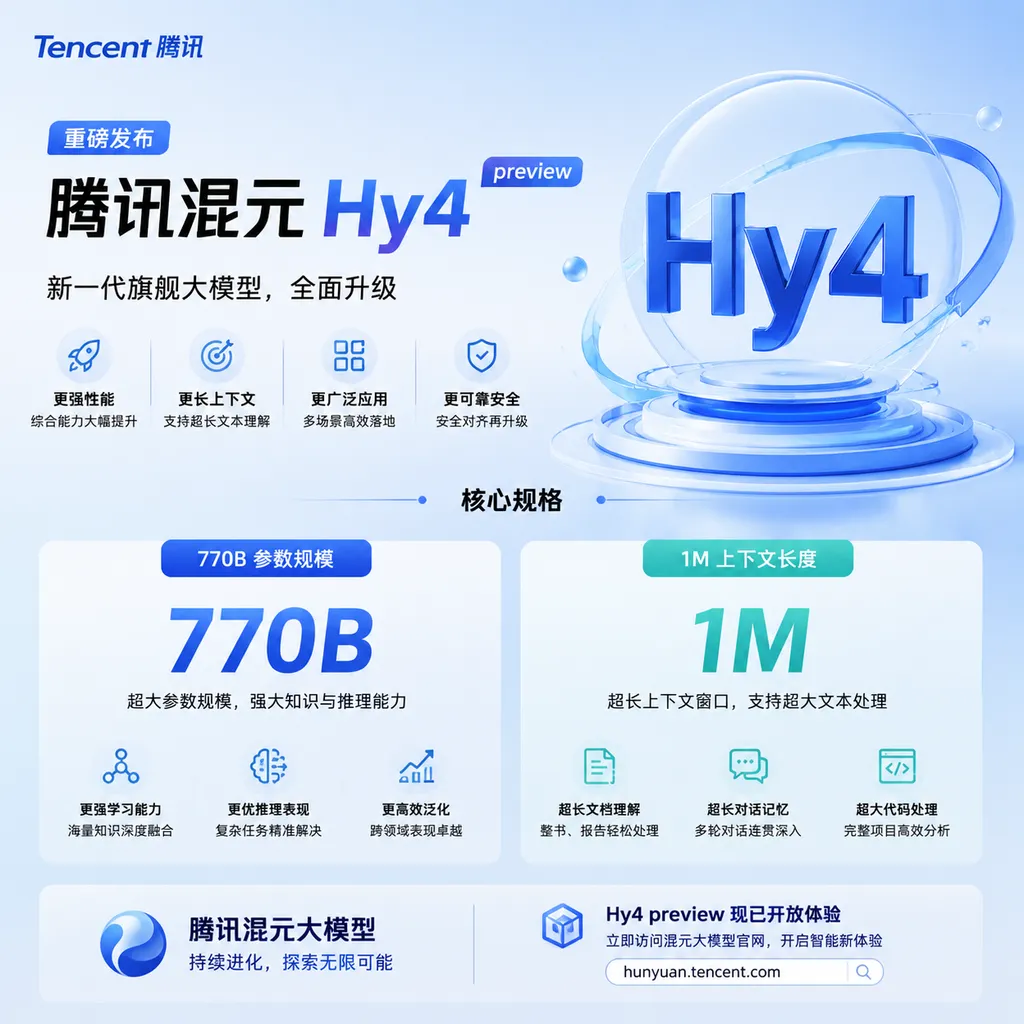
The Value of a 1M Context Window Lies in Whether It Can Handle Complete Workflows
A million-token context window is no longer simply about having a “larger window.” The real question is whether the model can locate relevant information within such a long input and continuously maintain state across multiple rounds of operation.
For developers, a 1M-token context window can accommodate a large codebase, lengthy requirements documents, API specifications, test logs, and historical commit records. The model does not need to recompress the context every time it completes a subtask, nor does it need to rely frequently on a human to select the relevant files. Ideally, it can start from the requirements, locate the relevant code, analyze the call chain, modify multiple modules, and then revise its work based on test results.
But a long context window does not necessarily translate into long-horizon task capability. Loading more files into the window only solves the problem of what the model can “see.” Whether it can establish the correct dependencies, filter out noise, and remember critical constraints is what determines whether it is truly useful. Many models perform well on short code-completion tasks, but once the scope expands from a single function to multiple services, multiple configuration files, and complex build pipelines, their error rates rise significantly.
This is precisely what Tencent is emphasizing with Hy4 preview: its ability to understand, plan, debug, and validate long-horizon development tasks. Tencent also specifically highlighted visual aesthetics and interaction quality in front-end development, indicating that the model’s goal is not merely to generate runnable code, but also to handle page structure, interaction logic, and visual presentation.
Of course, at the preview stage, these marketing claims cannot be equated directly with stable production capabilities. Developers will need to evaluate time to first token under a million-token context, long-input pricing, caching strategies, context-retrieval accuracy, and error accumulation after multiple rounds of tool use in real-world projects.
Tencent Has Turned Training Data into “Internal Productivity Samples”
Another major theme of Hy4 preview is Tencent’s deeper integration of feedback from internal experts and product usage into the model development process.
According to Tencent, it worked with internal experts in software engineering, gaming, finance, security, and other fields to jointly develop high-quality data, while continuously optimizing the model in collaboration with products such as CodeBuddy and WorkBuddy. The value of this approach is that the data is no longer derived solely from public web pages or generalized instructions, but increasingly from real-world work tasks: how to break down a requirement, how to reconcile a report, how to maintain consistency across multiple files, and how to evolve a game prototype from a one-sentence request into a playable version.
More specifically, Hy4 preview focuses on four categories of use cases:
- Software engineering: Enhances requirements comprehension, task planning, debugging, and validation for long-horizon tasks, while improving the aesthetics and interaction quality of front-end pages.
- Office analytics: Strengthens its understanding of complex office environments, financial analysis, data processing, and cross-file collaboration, with the goal of completing the entire workflow from information organization to the delivery of documents, spreadsheets, and presentations.
- Game development: Supports generating playable prototypes from one-sentence requirements and continuously refining complex projects through multi-turn conversations, while becoming more proficient in the use of game engines.
- Scientific research: Improves its ability to understand, reason about, and solve complex problems in areas such as AI R&D, molecular dynamics simulations, condensed-matter physics, and fundamental mathematics.
This approach is distinctly different from that of traditional “general-purpose chat models.” Chat models are often evaluated on whether a single-turn response is correct and naturally expressed. Productivity models, by contrast, must contend with project context, tool use, file formats, execution results, and delivery quality. The latter is more akin to a collaborator that is not entirely reliable but can be continuously verified.
Slightly Outperforming GLM 5.3 and Kimi K3 in Internal Blind Testing
Tencent disclosed a set of internal blind-test results: 163 internal experts participated in 203 engineering tasks, with Hy4 preview receiving an average score of 2.99/4.00, higher than GLM 5.3’s 2.92/4.00 and Kimi K3’s 2.94/4.00.
In head-to-head results, Hy4 preview recorded a 46.8% win rate, 12.8% tie rate, and 40.4% loss rate against GLM 5.3. Against Kimi K3, it achieved a 51.2% win rate, 7.9% tie rate, and 40.9% loss rate.
These results suggest that Hy4 preview is at least competitive with the leading tier of open-source models on Tencent’s selected set of engineering tasks. However, they should not be interpreted as evidence that it comprehensively outperforms all models across all tasks.
The reason is straightforward: Tencent organized the tests, the tasks were performed by Tencent’s internal experts, and the evaluation criteria leaned toward software engineering and productivity workflows. Such testing is valuable for assessing whether a model is suitable for real-world development, but it is not equivalent to a public benchmark leaderboard. In particular, prompt templates, tool permissions, reasoning time, context configurations, and evaluator preferences can all significantly affect the final results.
What developers should really focus on is not whether 2.99 is higher than 2.94, but the following questions:
- Can the model reliably make changes across files and modules, rather than excelling only at localized code edits?
- Can the model identify the cause of a test failure, or does it repeatedly generate similar patches?
- With a 1M-token context, can the model accurately locate the code and rules that are genuinely relevant?
- Do errors accumulate rapidly during tool use, long execution chains, and multi-turn conversations?
- Is the model’s output stable enough to integrate into CI, code review, or internal enterprise automation workflows?
These metrics ultimately need to be evaluated using the publicly released weights, inference frameworks, and real-world projects, rather than determined by a specification sheet presented at launch.
Hyra Participates in Geometric Problem Exploration, and the Mathematical Result Is Not the Only Point
Tencent also disclosed that Hy4 preview, working with Hyra, made progress on the classic geometric “three-dimensional Blaschke–Lebesgue problem,” raising the lower bound on volume from 0.380799 to 0.41104. Compared with the 0.41986 given by the Meissner tetrahedron conjecture, Tencent says only the final roughly 2% remains before a complete proof.
Results of this kind have limited direct relevance to ordinary application developers, but they demonstrate a new way for models to work on scientific research tasks: instead of merely producing an answer, the model proposes approaches, runs experiments, reads the results, and incorporates code, logs, and feedback into the next round of exploration.
Tencent says Hy4 preview participated for the first time in the automated optimization of training methods, data strategies, evaluation systems, and low-level operators, establishing an initial recursive self-improvement loop. At the same time, the model analyzed bottlenecks in the inference system in areas such as operator fusion and communication optimization, increasing end-to-end throughput by 31.8% over the baseline while delivering consistent gains across different context lengths and concurrency levels.
Two points need to be distinguished here. First, the model’s participation in optimizing its own training and inference infrastructure shows that it is moving from “using tools” toward “helping improve the toolchain.” Second, this remains only an initial closed loop and does not mean the model has acquired autonomous R&D capabilities. Experimental design, objective functions, permission boundaries, and result validation are still controlled by the engineering team.
For AI infrastructure teams, what is truly worth watching is whether the model can consistently reduce the human effort required for experimental iteration: whether it can automatically generate candidate optimization plans, accurately modify low-level code, run reproducible benchmarks, and abandon ineffective directions based on the results. If this process becomes sufficiently reliable, the model could become an R&D assistant for training and inference systems rather than merely a code generator at the application layer.
Pricing Is Low, but Long-Context Costs Still Need Careful Calculation
Hy4 preview has launched simultaneously in Tencent products including WorkBuddy, the domestic and international editions of CodeBuddy, Yuanbao, and ima. Developers and enterprises can access the API through channels such as Tencent Cloud TokenHub and OpenRouter.
The official pricing is RMB 6 per million input tokens, RMB 18 per million output tokens, and RMB 0.3 per million tokens for cache hits.
At these rates, Tencent is continuing Hunyuan’s emphasis on accessibility and cost-effectiveness. In particular, cache-hit pricing is significantly lower than standard input pricing, making it suitable for scenarios involving repeated processing of fixed codebases, product documentation, corporate policies, or lengthy project materials. For agents that need to retain the same context over an extended period, caching may be more important than simply reducing input prices.
However, developers cannot look only at the price per million tokens. The actual cost of long-context applications also includes:
- Whether every request genuinely needs to include the entire interaction history;
- Whether caching remains effective across sessions and requests;
- Whether time to first token with long inputs affects the user experience;
- Whether output token usage expands because of excessive reasoning and self-verification;
- How much additional consumption is caused by retries and rollbacks after tool-use failures.
Tencent has acknowledged that Hy4 preview has known issues such as prolonged reasoning on complex tasks and excessive self-verification. These traits may be advantageous in scientific reasoning, but they can become sources of cost and latency in coding agents and office automation. If a model repeatedly checks a simple modification over multiple rounds, its accuracy may not improve, but the bill certainly will.
The Significance of the Preview: Enter Workflows First, Then Iterate Through Feedback
Since rebuilding Hunyuan’s infrastructure in February this year, Tencent has released a major iteration roughly every two months and has continued to follow a release model in which preview versions come first, followed by stable releases. Hy4 preview continues this cadence: the model is first introduced into the product and API ecosystem, after which real user feedback is used to drive subsequent versions.
This is an iteration model better suited to productivity models. The complexity of coding, office, and scientific research tasks is difficult to capture fully with a static set of benchmarks. A model may be able to solve a problem in the lab, but in a real-world project it will encounter incomplete requirements, dirty data, legacy interfaces, implicit permissions, and incomplete tests. These issues can only be exposed once the model enters actual workflows.
The trade-off is equally clear: preview versions should not be assigned high-risk production tasks without prior evaluation. Enterprises should, at a minimum, retain mechanisms for human review, sandboxed execution, permission isolation, and result rollback. When financial data, internal code, or scientific research materials are involved, they must also verify data-retention policies, use of data for training, regional compliance, and third-party routing strategies.
For developers, the value of Hy4 preview can be summarized in one sentence: rather than competing through yet another chat interface, it attempts to combine ultra-long context, a sparse large-model architecture, and real-world workflows. Its 770B total parameters and 1M-token context window give it the technical foundation to enter the top tier, while its internal blind tests and product integrations provide application-side evidence. However, prolonged reasoning, excessive verification, and insufficient public evaluation also mean that it has not yet crossed the line from “worth testing” to “safe as the default choice.”
If your tasks involve large codebases, cross-file information analysis, complex document delivery, or game prototypes that require continuous iteration, Hy4 preview is worth adding to your testing list. Whether it should replace your current model still depends on your own codebase, context length, latency budget, and cost of failure—not on the model’s parameter count at launch.
Conclusion
With the release of Hy4 preview, Tencent has shifted Hunyuan’s competitive focus from being “yet another general-purpose large model” toward whether it can complete real-world productivity tasks. Its 770B total parameters, 49B activated parameters, and 1M-token context window represent specification upgrades, while internal expert blind tests, integration with CodeBuddy and WorkBuddy, and automated optimization of inference infrastructure represent attempts at productization.
For now, its most appropriate positioning is as an open-source preview that developers should seriously stress-test. Its capabilities have already entered the top tier, and its pricing is attractive for long-context applications, but its stability, latency, tool-use quality, and cost on complex tasks still need to be validated through real-world projects. Tencent has released the model early; what will ultimately determine the ceiling of the stable Hy4 release is whether this feedback can be rapidly converted into training data, evaluation criteria, and engineering improvements.