Zhipu’s New Flash Slashes Prices by 90% Upfront

Zhipu has released and open-sourced GLM-5.3-Flash, targeting the high-concurrency market with 18B active parameters, a 1M-token context window, and native multimodal capabilities. Its real competitive edge lies not in benchmark scores, but in bringing the inference cost of a frontier model down to a level that makes large-scale deployment viable.
Zhipu officially launched and open-sourced GLM-5.3-Flash this Wednesday (August 26). Two days later, the signal from this model is already clear: Zhipu does not intend to compete on leaderboards solely with flagship models. Instead, it aims to enter the Flash market—which accounts for the highest volume of developer API calls—with near-flagship capabilities at roughly one-tenth the price.
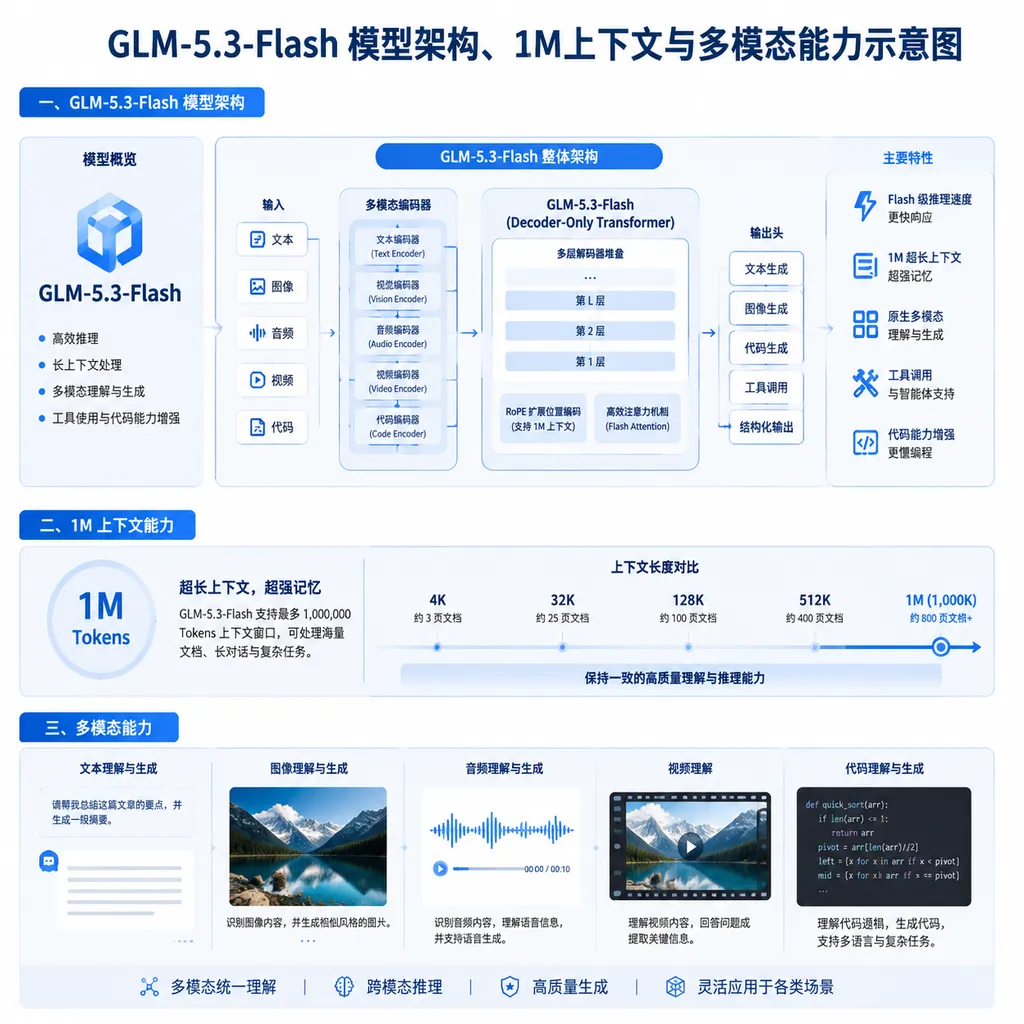
GLM-5.3-Flash is the first natively multimodal model in the GLM-5 series. The public version is labeled 320B-A18B, meaning it has approximately 320 billion total parameters but activates only about 18 billion parameters when generating each token. The model supports context windows of up to 1 million tokens, accepts text, image, and video inputs, and has been specifically optimized for code generation, agents, long-document processing, and visual understanding.
Zhipu also announced that it is releasing the model weights under the relatively permissive MIT License. Its online API is now available, with the underlying inference service supported by domestic computing infrastructure from SenseTime’s SenseCore platform. Teams that want to retain an OpenAI-compatible interface without separately maintaining SDKs from multiple providers can also access GLM, GPT, Claude, Gemini, DeepSeek, and other models through OpenAI Hub’s unified model gateway, making direct routing and performance comparisons easier.
Flash Is Not a “Small Model”—It Just Uses Less Compute
Developers can easily misunderstand the Flash label: if a model has Flash in its name, it must be a lightweight version distilled from a flagship model, with both capabilities and price scaled down.
GLM-5.3-Flash does not follow that path.
It still retains a parameter pool numbering in the hundreds of billions, but uses sparse MoE activation to reduce the parameters actually involved in each inference pass to 18B. Think of it as a company with several hundred experts that calls only the dozen or so most relevant people into a meeting for each question, rather than bringing everyone into the conference room. Its knowledge capacity still comes from a large-parameter foundation, while the inference bill is determined primarily by the activated parameters.
Compared with the GLM-4.5 series, GLM-5.3-Flash reduces the number of layers from 92 to 45 and the activated parameters from 32B to 18B. Fewer layers mean that each token passes through fewer sequential computations in the network, directly improving time to first token, decoding speed, and concurrent throughput.
But what truly determines whether it can handle a 1M-token context window is its attention mechanism.
Traditional full attention requires every token in the context to establish relationships with every other token, causing computation to grow rapidly as the input length increases. A few thousand tokens are manageable, but at hundreds of thousands or even one million tokens, it becomes like asking someone to compare the relationship between every possible pair of pages in an entire library at once. GPU compute and memory are quickly exhausted.
GLM-5.3-Flash uses a hybrid architecture that combines linear attention with sparse attention:
- Linear attention preserves local and sequential information through recurrent states, avoiding quadratic cost growth as context length increases;
- Sparse attention uses a lightweight indexer to retrieve the truly relevant positions from large spans of context;
- IndexPool further compresses multiple cached vectors from the indexer into one, reducing memory usage and retrieval latency with million-token contexts;
- mHC manifold-constrained hyper-connections improve information flow and training stability in deep networks, leaving room for further model scaling.
According to Zhipu’s published architectural comparison, GLM-5.3-Flash reduces attention computation by approximately 3.01× and KV cache size by approximately 4.44× compared with the full GLM-5.3 model. Among the models included in the comparison, it has the lowest attention computation.
There is also a weakness that must be acknowledged: GLM-5.3-Flash’s KV cache is still slightly larger than those of Kimi-K3 and DeepSeek-V4-Flash. In other words, while it is already highly aggressive in computational efficiency, it is not yet the optimal solution for GPU memory usage in ultra-long conversations. Teams deploying it themselves for large numbers of concurrent 1M-token tasks cannot focus only on whether the model weights fit on their hardware; they must also account for peak KV cache requirements.
Pricing May Matter More Than Benchmark Scores
GLM-5.3-Flash’s currently published API pricing is RMB 0.8 per million input tokens and RMB 2.8 per million output tokens, with cache-hit input priced at approximately RMB 0.23 per million tokens. According to Zhipu, the standard pricing is roughly one-tenth that of GLM-5.3 and may fall to as little as one-twentieth during the limited-time promotional period.
What do these numbers mean?
Suppose a coding agent reads 200,000 tokens of repository context for each task and outputs 20,000 tokens after multiple rounds of tool calls. Without factoring in caching, the raw model cost per task would be only a few tenths of a yuan. If the system can reliably reuse code indexes, specification documents, and historical context, cache hits will reduce the cost even further.
For an individual developer, this may mean saving only a few yuan per call. For a platform that performs hundreds of thousands of classification, review, retrieval, and coding tasks every day, it can directly determine whether the product is economically viable.
In the past, powerful models such as Claude Opus were suitable for high-value, low-frequency tasks, including complex architecture design, difficult code repairs, and in-depth research, but they were hard to deploy indiscriminately across every business workflow. The value of Flash models is that teams no longer have to choose between a “rules engine” and “the most expensive flagship.” Large numbers of medium- to high-difficulty tasks can be assigned to inexpensive models, while only failed or low-confidence requests are escalated to flagship models.
This is far more important than merely reducing the per-query cost of a chatbot. It turns model routing from a cost-optimization technique into a default system architecture.
Where Does Zhipu Win Against Qwen and DeepSeek?
On the same day GLM-5.3-Flash launched, Alibaba also released Qwen3.8-Flash. The latter uses a MoE architecture with 125B total parameters and 6B activated parameters, and its API pricing was subsequently adjusted to RMB 0.8 per million input tokens and RMB 2.7 per million output tokens. The two providers are priced almost identically, and their intentions are exactly the same: to capture the high-frequency inference market previously served by models such as Gemini Flash and DeepSeek Flash.
On paper, Qwen3.8-Flash activates only 6B parameters per token, theoretically giving it a lower per-unit inference burden. GLM-5.3-Flash activates 18B parameters and requires more computation, but Zhipu is attempting to justify that cost with stronger coding, multimodal, and agent capabilities. This is not simply a matter of “more parameters beat fewer parameters,” but rather two different trade-offs between capability and throughput.
DeepSeek-V4-Flash and Kimi-K3 go further in controlling KV cache usage, making them better suited to scenarios that are extremely sensitive to concurrent density with long contexts. GLM-5.3-Flash’s advantage lies in its more complete combination of capabilities: it is not merely a text reasoning model, but the first GLM-5 model to have multimodal capabilities trained natively from the foundation-model stage.
This is critical for agents. Real-world automation tasks rarely involve text alone: coding agents need to inspect browser screenshots, office agents need to read charts in PDFs, customer-service agents need to understand product images, and video tools must process visuals, subtitles, and timelines simultaneously. If visual capabilities are added later through an external encoder, models often “see” the content but fail to genuinely use the visual evidence in their reasoning. Native multimodality at least provides a higher architectural ceiling.
According to results published by Zhipu, GLM-5.3-Flash scored 57 on the Artificial Analysis Intelligence Index, placing it among frontier models. Zhipu’s internally developed Z.ai Code Bench also concluded that its practical coding experience approaches that of Claude Opus 4.8.
These results are worth noting, but they should not be treated as equivalent to production experience. The AA index aggregates multiple benchmarks, while internally developed coding evaluations are inevitably influenced by the test set, toolchain, prompts, and preference criteria. Claims such as “comparable to Opus” should be independently verified by developers on their own tasks rather than copied directly into model-selection documents.
A more reliable testing method is to conduct blind evaluations using real workloads:
- Sample 100 to 500 representative tasks from production logs;
- Fix the system prompts, tool permissions, and maximum output length;
- Record task success rate, manual rework rate, time to first token, and total token usage;
- Group long-context tasks separately and observe whether retrieval accuracy declines as context length increases;
- For agent tasks, measure the end-to-end success rate of the complete workflow rather than evaluating only the first response;
- Finally, calculate the cost per successful task instead of comparing only the price per million tokens.
A low per-token price does not necessarily mean a low task cost. If a model requires three additional attempts, frequently invokes search tools, or generates large quantities of useless reasoning tokens, it may ultimately cost more than a premium model.
A 1M-Token Context Window Is Useful, but Do Not Treat It as a Database
GLM-5.3-Flash positions its 1M-token context window as a core selling point. That is enough to ingest thousands of pages of documents, a medium-sized code repository, or a lengthy video transcript together with visual information in a single pass. Its suitable use cases are highly specific:
- Analyzing business performance across multiple quarterly reports while retaining supporting citations;
- Reading large code repositories and tracing interface and type dependencies across modules;
- Consolidating contracts, specifications, and historical emails to identify conflicting clauses;
- Analyzing long-form video footage to generate shot lists, editing plans, and publishable final videos;
- Preserving relatively complete trajectories during agent execution, reducing information loss caused by repeated compression.
But a 1M-token context window does not mean RAG can be eliminated, nor does it mean copying an entire database table into a prompt is sound architecture.
Long context addresses “how much the model can see at once,” while RAG addresses “what the model should see.” The former is like making a desk larger; the latter is like building a document index. No matter how large the desk is, indiscriminately piling every file onto it will still increase noise, latency, and incorrect citations.
A more practical engineering approach remains the same: first use retrieval, permission filtering, and structured queries to narrow the candidate set, then use long context to synthesize information across documents. The 1M-token capacity should be treated as an upper limit for difficult tasks, not the default configuration for every request.
Domestic Computing Support Is More Worth Watching Than the Marketing Slogan
Another noteworthy aspect of this launch is that GLM-5.3-Flash’s service is supported by domestic computing infrastructure from SenseTime’s SenseCore platform.
This is not the first time a domestic Chinese foundation model has run on domestic computing hardware, but operating an online service for a frontier model is far more difficult than successfully completing a single inference run. The real tests for the platform are continuous batching, expert parallelism, inter-node communication, KV cache scheduling, fault recovery, and peak-period SLAs. MoE models are particularly dependent on inter-GPU communication: if certain experts suddenly become hot spots and scheduling is poorly managed, some devices may become congested while others remain idle.
The value of “domestic computing support” will therefore ultimately depend on three metrics: whether latency remains stable under high concurrency, whether long-context requests frequently queue, and whether pricing can be sustained after the promotional period ends. If this heterogeneous inference system can support public API traffic over the long term, its significance will exceed that of a one-off domestic hardware compatibility demonstration—it would indicate that domestic models, inference frameworks, and computing clusters are forming a commercially viable closed loop.
Our Assessment: Worth Adding to the Shortlist, but Not Ready for a Blind Replacement
GLM-5.3-Flash is currently one of the most complete productization efforts among domestic Flash models. It combines open weights, a 1M-token context window, native multimodality, agent capabilities, and sufficiently aggressive API pricing, without basing its affordability on a small, text-only model.
For developers, it is best suited to three types of tasks:
- High-volume online services that cannot tolerate the obvious capability degradation of small models;
- Multimodal agents that need to process documents, screenshots, charts, and videos together;
- Enterprise teams that want private deployment and are willing to invest resources in inference optimization.
However, even if a 320B-class model activates only 18B parameters per token, that does not mean it can be easily deployed on an ordinary workstation. Weight storage, expert sharding, communication bandwidth, and long-context caching still raise the barrier to private deployment. For most small and medium-sized teams, using the API or an aggregation platform remains more practical than maintaining their own cluster.
What GLM-5.3-Flash truly changes is not any single benchmark leaderboard, but developers’ expectations of what frontier capabilities should cost. With input pricing approaching RMB 0.8 per million tokens, model providers will find it increasingly difficult to justify high prices simply by saying, “It is expensive because it is powerful.”
Flash is evolving from a low-cost companion to flagship products into the primary model handling most real-world calls. Zhipu has chosen the right direction this time. What remains to be proven is whether these low prices can be sustained over the long term and whether the model’s stability in real end-to-end agent workflows can truly match its leaderboard position.
References
- Zhihu: Zhipu Fully Open-Sources GLM-5.3-Flash—A Review of Its Performance, Architecture, and Pricing—Summarizes the model’s open-source license, hybrid attention architecture, API pricing, and benchmark performance. Some conclusions are based on vendor disclosures, and production model selection still requires independent verification.