
DeepL Voice API Launch: Speech Translation Enters the Real-Time Era
DeepL officially launched the Voice API today, supporting real-time speech transcription and multilingual translation. Blind tests show that 96% of linguists prefer DeepL, marking a shift in speech translation from “usable” to “user-friendly.”
DeepL Voice API Launch: Speech Translation Enters the Real-Time Era
Today (April 16), DeepL officially launched the Voice API, marking its first entry into the field of real-time speech translation. The German company, known for the quality of its text translations, is now targeting voice call scenarios—not simple speech-to-text translation, but end-to-end speech-to-speech real-time translation.
The timing is interesting. Google, Microsoft, and Zoom have offered similar features for years, but a blind test commissioned by DeepL and conducted by Slator showed that 96% of linguists preferred DeepL Voice. The reasoning behind that number is clear: the battlefield of speech translation has shifted from “can we do it” to “how well can we do it.”

Three Product Lines, Each with a Different Focus
DeepL Voice is not a single product but rather a suite with three distinct directions:
Voice for Meetings: Real-time translation for meeting scenarios. This directly competes with Zoom and Teams translation features. The difference is DeepL’s emphasis that “professional capability is key, language doesn’t matter”—in other words, it wants multilingual teams to forget about language barriers during meetings.
Voice for Conversations: Face-to-face translation on mobile. Two people share a single device, each speaking their own language while seeing translations in real time. It’s a subtle yet important use case—Google Translate has had something similar for years, but DeepL’s differentiator is translation quality. In high-stakes settings like business negotiations or medical consultations, quality gaps can be dramatically magnified.
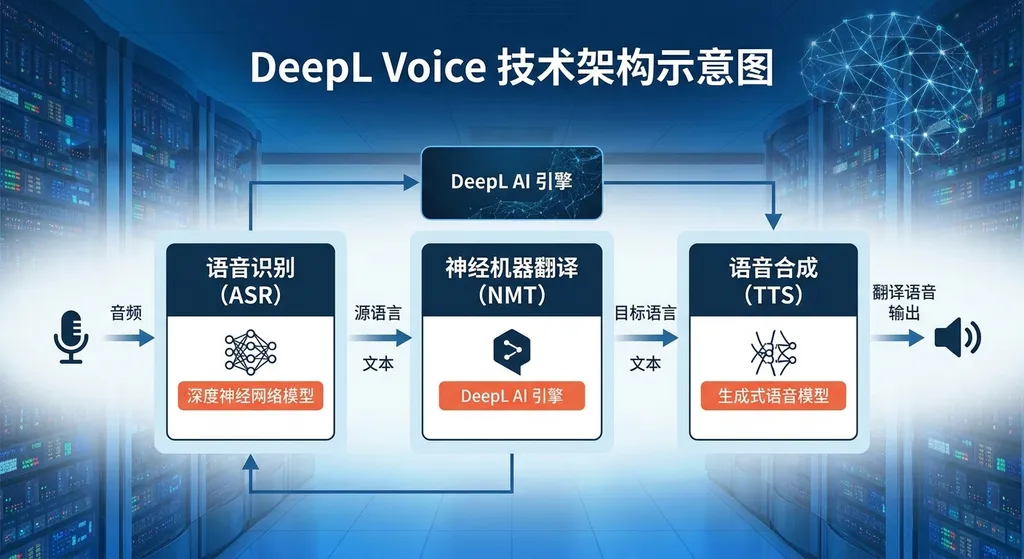
Voice API: A developer tool—and arguably the most noteworthy part. The API supports real-time speech transcription and can output both source text and translations in up to five target languages simultaneously. This means developers can embed DeepL’s speech translation capabilities directly into their own apps.
API Technical Details
The core capability of the DeepL Voice API is real-time speech transcription + synchronous translation. And here, “real-time” isn’t just marketing—it’s a measurable technical metric:
- Supports streaming input, transcribing and translating as you speak
- Can output both the source text and up to five target languages simultaneously
- Supports both WebSocket and HTTP interface modes
DeepL mentioned in its technical blog that it did not use an off-the-shelf speech recognition engine, but trained its own proprietary model. The reason: existing architectures perform inconsistently with multi-language, colloquial, or domain-specific speech. This is very much DeepL’s style—prioritizing careful model refinement over “good enough” shortcuts.
API Call Example
If you want to integrate DeepL Voice into your own application, the calling process is similar to other speech APIs. DeepL uses its own API format, but through OpenAI Hub, you can unify calls under a single interface:
import openai

# Configure OpenAI Hub
openai.api_base = "https://openai-hub.com/v1"
openai.api_key = "your-openai-hub-key"

# Call the DeepL Voice API (forwarded via OpenAI Hub)
response = openai.Audio.transcribe(
    model="deepl-voice",
    file=open("audio.mp3", "rb"),
    language="en",
    target_languages=["zh", "ja", "de"]  # Simultaneous translation into Chinese, Japanese, and German
)

print(response["text"])  # Source language text
print(response["translations"])  # Multilingual translation results
This example demonstrates the key advantage of the Voice API: a single request yields both transcription and multilingual translations. For multilingual apps (like customer service systems or e-learning platforms), this is far more efficient than calling transcription and translation APIs separately.
The Challenges of Speech Translation
At first glance, speech translation seems like a simple combination of “speech recognition + machine translation,” but in practice, it’s much more complex. DeepL’s blog highlights several technical challenges:
Handling colloquial expressions: The gap between written and spoken language is far larger than most expect. Sentences like “uh... how do I say this... it’s kind of like...” are problematic for text translation models. DeepL’s approach was to heavily include conversational data during training, teaching models to handle incomplete, repetitive, and filler-filled phrases.
Balancing real-time performance and accuracy: Real-time translation means not waiting for the speaker to finish a sentence before translating—it must interpret as it listens. Translate too soon and errors arise (e.g., with reversal phrases like “I’m not... I am actually…”), but waiting too long introduces latency. DeepL’s solution: use context prediction models to output translations as early as possible without sacrificing accuracy.
Domain terminology and expertise: This is one of DeepL’s traditional strengths. Its text API supports custom glossaries, and the Voice API inherits that capability. In specialized domains like medicine, law, or finance, the accuracy of terminology translation directly determines usability.
How DeepL Stands Against Competitors
The speech translation market is already crowded. Google Translate offers voice conversation mode, Microsoft Teams has real-time subtitles, and Zoom integrates translation into meetings. As a latecomer, how did DeepL achieve a 96% blind test preference rate?
Translation quality: This is DeepL’s foundation. Its text translation performance among European languages has long been considered superior to Google and Microsoft, particularly for complex syntax and specialized terminology—and this advantage carries over to speech translation.
Low latency: DeepL emphasizes “real-time” rather than “near real-time.” In practice, Voice for Meetings keeps translation delay within 1–2 seconds—acceptable for meetings. Competitors, in contrast, often have delays of 3–5 seconds, disrupting conversational flow.
Privacy and security: DeepL’s servers are located in Europe and compliant with GDPR. For enterprise clients, that’s a key consideration—cross-border meeting data often contains trade secrets, and where and how data is handled directly impacts compliance risk.
However, DeepL’s weakness is language coverage. Google Translate supports 100+ languages, while DeepL currently covers only 30+. If your use case involves minor languages, DeepL may not be the right fit for now.
What This Means for Developers
The release of Voice API gives developers an important new choice. Previously, implementing speech translation meant combining Google Cloud Speech-to-Text with Translation API, or using Azure Cognitive Services. Now DeepL is a viable third option.
Cost: DeepL hasn’t yet announced pricing, but based on its text API ($20 per million characters), it will likely be slightly more expensive than Google or Azure. But if translation quality is crucial to your app, the premium may be worthwhile.
Integration effort: The Voice API supports both WebSocket and HTTP interfaces with comprehensive documentation. If you’ve previously worked with other speech APIs, migration won’t be difficult. Through aggregator platforms like OpenAI Hub, you can call DeepL, Google, or Azure uniformly—simplifying A/B testing and cost optimization.
Use cases: DeepL Voice is best suited for apps requiring top-tier translation quality for a limited set of major languages, such as:
- Internal meeting systems for multinational corporations (mainly English, Chinese, Japanese, German, etc.)
- Telemedicine platforms (where terminology accuracy is critical)
- Premium customer support systems (where mistranslations directly impact experience)
If your app needs dozens of languages or has tight cost constraints, Google or Azure may be the better fit.
The Next Step for Speech Translation
DeepL CEO Jarek Kutylowski claims, “we’ve solved the hardest part,” which may be somewhat bold. Many challenges in speech translation remain unsolved:
Emotion and tone preservation: Today’s speech translation captures semantics but loses emotion, tone, and pauses. The next frontier would be translating how something is said—e.g., an angry tone remains angry, a joke stays a joke.
Multi-speaker handling: Most current speech translation tools support one-on-one or one-way speech (e.g., a presenter in a meeting). Real-time translation for multi-speaker, interruptive conversation remains an open problem.
Dialects and accents: DeepL Voice currently works best with standard accents; heavy accents or dialects still reduce accuracy. In a global context, this is a significant challenge—Indian English, Singaporean English, and Australian English differ greatly but are all “English.”
DeepL’s Voice API launch is less about dominating the market and more about setting a benchmark: This is how high translation quality can go, and this is how low latency can get. The next move belongs to Google and Microsoft.
For developers, now is a prime moment. Speech translation infrastructure has matured, API integration is easy, and it’s time to consider adding multilingual voice support to your products. Especially for B2B SaaS, enabling seamless communication between teams across countries can be a powerful differentiator.

References
- DeepL Launches Real-Time Speech Translation for Voice Calls - IT Home
IT Home’s report on DeepL Voice, including product features and blind test results


