Gemini 3.8 Flash is now undergoing internal testing at Google.
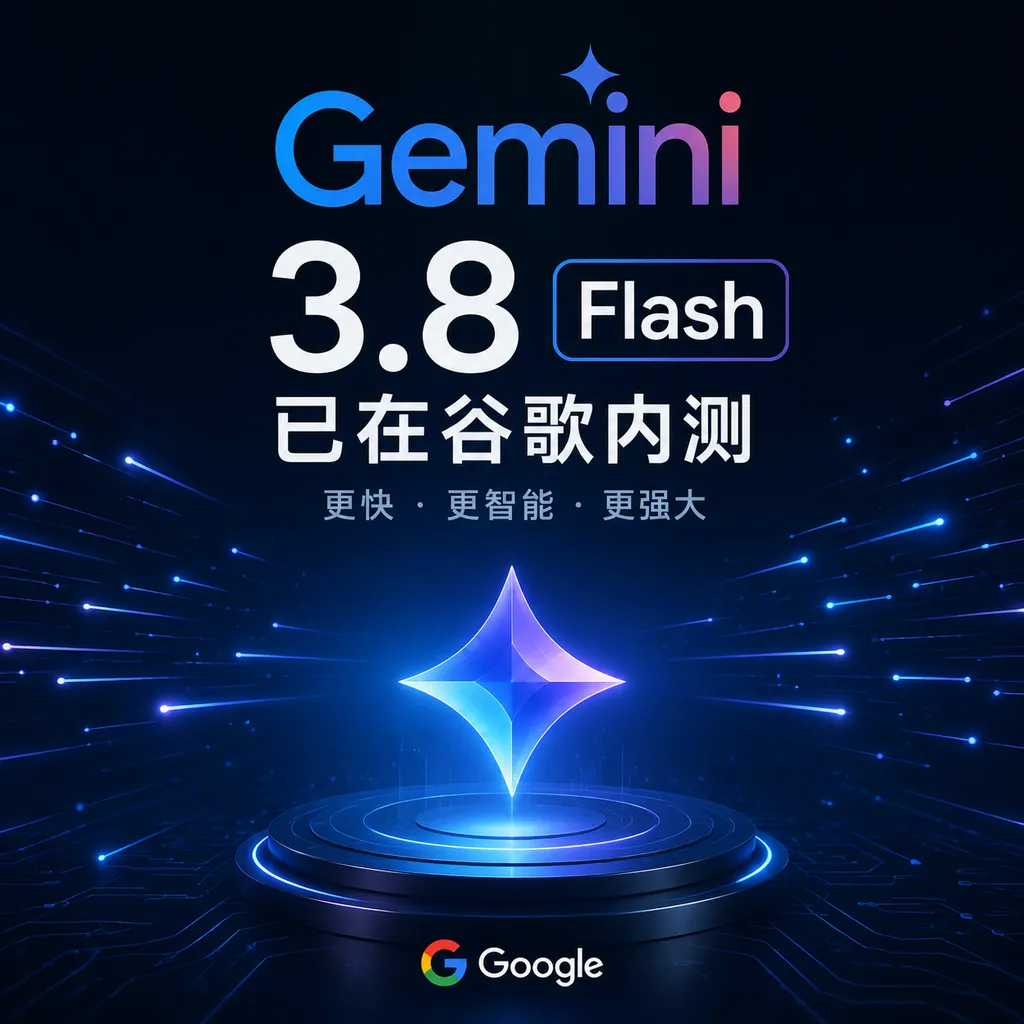
Shortly after Gemini 3.7 Flash launched, Google employees had already begun testing 3.8 Flash. Flash is approaching monthly releases, but the flagship Pro continues to be absent, revealing Google's pragmatic yet somewhat reactive model strategy.
Gemini 3.8 Flash Has Entered Internal Testing at Google
Google is accelerating Gemini Flash once again.
According to information disclosed on August 28, some Google employees have begun testing a new model internally named Gemini 3.8 Flash Preview. The model is currently available on Jetski, Google’s internal programming platform, primarily for employee testing. It has not yet been released publicly, and there is no confirmed public launch date.
One employee participating in the testing offered this initial assessment: 3.8 Flash delivers a noticeably better experience than 3.7 Flash. However, this remains an early impression rather than a benchmark result, and it certainly should not be treated as a definitive assessment of the final release’s capabilities.
But more noteworthy than “how much it has improved” is the pace.
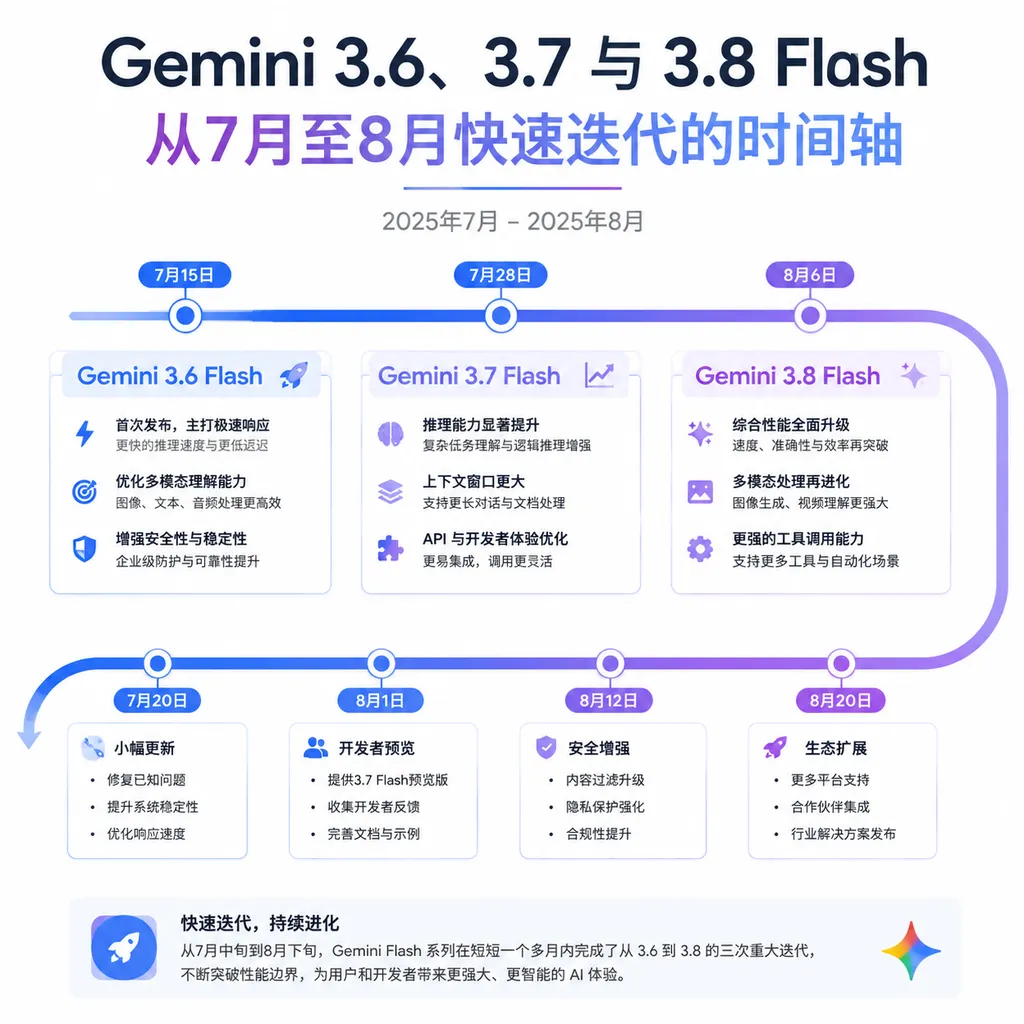
Gemini 3.6 Flash was released in July, with 3.7 Flash succeeding it about three weeks later. Now that 3.8 Flash has entered employee testing, Google has effectively compressed the iteration cycle for its general-purpose models from quarters to mere weeks. Google CEO Sundar Pichai previously said that he hoped to increase the release frequency of new models to nearly once a month. Judging by the current pace, this is no longer merely a target discussed on an earnings call.
Of course, internal testing does not mean an immediate release. The model still needs to undergo safety evaluations, capacity preparation, inference-stack optimization, and product integration. It may also be renamed, delayed, or even canceled during testing. But the fact that employees can already access it through an internal programming platform usually means it has moved beyond training experiments and entered the product validation stage.
Flash Is Becoming Google’s True “Workhorse Model”
Google’s positioning of Flash is becoming increasingly clear: it is not a cheaper substitute for the flagship Pro model, but a workhorse model specifically built for high-frequency calls, programming workflows, and agent execution.
This distinction matters.
In an ordinary chatbot product, a user asks a question and the model answers once, making costs relatively easy to control. Agents are different. To complete tasks such as “inspect the repository, identify the issue, modify the code, run tests, read the error messages, and revise the code again,” an agent may call the model dozens of times in succession, repeatedly feeding code, logs, and tool outputs back into the context.
A slightly cheaper individual call may not seem like a major difference. But once multiplied across long contexts, multi-step planning, and tool-use loops, the total bill can look entirely different.
As a result, when enterprises select a foundation model for agents, they look beyond whether a model scored a few extra points on a leaderboard. What matters is a more practical combination of factors:
- Whether code generation and tool use are sufficiently reliable;
- Whether time to first token and total response time are acceptable;
- Whether the model frequently goes off track when executing dozens of consecutive steps;
- How effectively it uses relevant information in long contexts;
- How much it costs to complete each task—not merely to generate one million tokens;
- Whether stable rate limits and capacity guarantees are available under high concurrency.
This is where Flash has an opportunity. It may not need to defeat the strongest models on every difficult reasoning benchmark. As long as it can complete most real-world tasks at a lower cost, it has a chance to become the most frequently invoked layer in agent systems.
It is somewhat analogous to general-purpose instances in cloud computing: the most expensive, high-performance machines handle a small number of extremely difficult tasks, while the vast majority of production requests ultimately run on instances that offer a better balance of price, throughput, and reliability.
Google is clearly reinforcing this direction. Gemini 3.6 Flash was positioned as a “workhorse” model for coding, knowledge work, and multimodal tasks; 3.5 Flash-Lite placed greater emphasis on low latency and high throughput; and 3.5 Flash Cyber targeted cybersecurity tasks. With 3.7 Flash, Google continued to improve programming and complex task execution while using more aggressive pricing to win workloads.
Public information shows that Gemini 3.7 Flash has introductory pricing through the end of this year of $0.75 per million input tokens and $3.75 per million output tokens—half the original prices of 3.6 Flash. After cutting prices in half and then quickly advancing 3.8, Google’s objective has become very direct: first embed Flash into more developer workflows, then compete for the high ground with its flagship model.
The Faster the Iteration, the Less Meaningful the Version Number
From a developer’s perspective, updates every few weeks are certainly a good thing, but they also introduce a new problem: model versions are becoming more like browser versions than traditional major software releases.
The successive appearance of 3.6, 3.7, and 3.8 does not necessarily mean the underlying architecture changes each time. Updates may come from post-training, reinforcement learning, data recipes, tool-use strategies, inference services, or adjustments to context processing. External users cannot easily determine where the performance gains actually come from based on the version number alone.
This means teams should not replace “3.7” in production with “3.8” simply because they see a higher version number. What truly matters is performance on their own task metrics.
For example, a coding agent should independently evaluate at least the following types of changes:
- Patch executability: Whether the generated modifications pass compilation and testing, rather than merely looking plausible;
- Tool-use accuracy: Whether parameter formatting, call order, and recovery from failures remain reliable;
- Long-task completion rate: Whether the model forgets the objective or repeats operations during tasks involving more than ten steps;
- Token consumption: Whether improved capabilities come with longer reasoning and outputs that offset the lower per-token price;
- Latency distribution: Teams should examine not only averages but also P95 and P99 latency;
- Regressions: A new version may be better at complex reasoning while performing worse in scenarios such as fixed-format output or concise answers.
The risk is particularly apparent for teams using floating aliases such as latest. Once the underlying model switches automatically, output style, tool parameters, and even safety policies may change. A more reliable approach is to pin a specific version, evaluate it using shadow traffic, and then migrate gradually.
Once models begin updating monthly, what enterprises truly lack may not be another more powerful model, but a model engineering system capable of continuous regression testing, staged rollouts, and cost monitoring.
3.8 Flash Looks More Like a Product Iteration Than a “Frontier Breakthrough”
There is not yet a public technical report, context-window specification, benchmark score, or API pricing for Gemini 3.8 Flash, so it would be premature to describe it as a new frontier model.
The employee’s statement that it is “noticeably better than 3.7” could also refer to several dimensions: more reliable code completion, smoother tool use, faster responses, or simultaneous improvements to the user experience on the internal Jetski platform. Without standardized test results, such subjective assessments indicate only that the direction is positive—not that the model has surpassed comparable products from GPT or Claude.
A more accurate assessment is: 3.8 Flash is another attempt by Google to rapidly optimize a production-oriented model.
Its value will most likely not come from sweeping every leaderboard in a single release, but from making slightly fewer mistakes in everyday development scenarios, consuming somewhat fewer tokens, and achieving a slightly higher tool-call success rate. For agents, these seemingly incremental improvements are often more useful than a high score on any single benchmark.
If a model’s tool-call success rate improves from 90% to 95%, that appears to be a gain of only five percentage points. But across a ten-step task, assuming each step is independent for a rough calculation, the probability that the entire chain succeeds could rise from about 35% to nearly 60%. The user experience of agent products is often determined by this kind of compounding effect.
Therefore, whether 3.8 Flash is worth using will ultimately depend on whether Google can translate the improvements experienced by internal employees into repeatable gains in task completion rates and controllable production costs.
The More Attention Flash Gets, the More Conspicuous Pro’s Absence Becomes
Google’s current product lineup presents a stark contrast.
On one side, Flash is being updated rapidly, becoming steadily cheaper, and expanding into variants for coding, security, and high-throughput scenarios. On the other, the long-awaited Gemini 3.5 Pro has yet to make an official appearance, with no confirmed launch date.
The delay of Pro is particularly sensitive because it is not intended for high-volume workloads. Instead, it bears on whether Google can compete directly with the frontier models from OpenAI and Anthropic. In AI programming in particular, a flagship model’s capabilities in complex reasoning, cross-file modifications, and long-running autonomous execution have become important indicators enterprises use to assess the technology’s upper limits.
No matter how good Flash becomes, it will struggle to fully replace a flagship model. A more realistic agent architecture typically uses tiered routing:
- Lightweight models handle simple classification, information extraction, and high-frequency Q&A;
- Flash handles routine coding, tool use, and document processing;
- Pro-tier models are reserved for complex architecture design, difficult debugging, and high-risk decisions.
If Google cannot fill that top tier soon, customers may continue using multi-model combinations: Gemini for low-cost execution, with complex tasks routed to GPT or Claude. Google may capture call volume without necessarily controlling the highest-value layer of the overall agent technology stack.
This is why Flash’s rapid iteration is both an advantage and, to some extent, a sign of necessity. It shows that Google is highly competitive in inference costs, infrastructure, and productization. At the same time, it suggests that until its flagship model is ready, Google needs cheaper, faster, and more frequent updates to retain developers.
What Developers Should Do Now
Gemini 3.8 Flash has not yet been released publicly. There is currently no need to modify production code around it, and developers certainly should not assume an API name or launch date based on reports of internal testing.
However, the trend it signals is already clear enough: model updates will become more frequent, and the application layer needs to proactively reduce its coupling to any single version.
Practical preparations include:
- Place model names, timeouts, retry settings, and routing policies in the configuration layer rather than hard-coding them into business logic;
- Establish fixed evaluation sets for core tasks while tracking quality, latency, and token costs;
- Distinguish between preview and stable releases, and prioritize pinned versions for critical production workflows;
- Set maximum step counts and cost limits for high-frequency agent tasks to prevent models from becoming trapped in loops;
- Preserve the ability to switch between providers rather than binding tool protocols to a single vendor;
- Convert “price per million tokens” into “cost per successful task,” or the expense of retries after failures may be underestimated.
If 3.8 Flash is officially released, aggregation platforms such as OpenAI Hub that provide OpenAI-compatible interfaces will typically add support according to upstream availability. At this stage, however, it remains in internal testing at Google. Developers should rely on official model catalogs, pricing, and version documentation rather than attempting to call unconfirmed model identifiers in advance.
Google Is Turning Model Competition Into Continuous Delivery
Gemini 3.8 Flash is not yet an official release, but the change it represents may be more important than the release itself: large models are moving away from a few annual “product launches” toward continuous delivery resembling cloud services.
For Google, this is a pragmatic path. It has in-house chips, global data centers, development tools, and a vast enterprise customer base. The cheaper and more reliable Flash becomes, the easier it will be to embed in real-world workflows. For customers, inference bills are indeed more tangible than leaderboard rankings.
But rapid iteration cannot indefinitely substitute for a flagship breakthrough. Flash can help Google capture call volume, drive down prices, and defend its position as an entry point for agents, but it cannot by itself answer the most important question: can Gemini’s capability ceiling continue to catch up with—or even surpass—OpenAI and Anthropic?
Gemini 3.8 Flash may not be far from a public debut. But when the next release arrives, developers should not focus on the version number increasing by another 0.1. They should look at three things: how much the task completion rate has improved, how much the per-task cost has fallen, and how much longer they will have to wait for Google’s still-absent Pro model.
References
- ITHome: Google Reportedly Begins Internal Testing of Gemini 3.8 Flash — Reports on the availability of Gemini 3.8 Flash Preview on Google’s internal Jetski platform, preliminary employee feedback, and the context behind Google’s accelerated iteration of the Flash series.