AMD ROCm 10.0 Bets on AI Inference
AMD Releases ROCm 10.0.0, Updating Major AI Toolchains Including PyTorch, JAX, vLLM, and SGLang, While Strengthening HIP, Performance Analysis, Virtualization, and GPU Partitioning Capabilities. For AMD GPU users, the key point of this upgrade is not the version number, but that inference workloads are finally receiving more comprehensive engineering support.
AMD ROCm 10.0 Released, Filling Gaps in the AI Inference Toolchain
AMD released ROCm 10.0.0 this week. Coinciding with ROCm's 10th anniversary, this release does not focus on a single operator or benchmark results for a particular graphics card. Instead, AMD has concentrated the updates on AI inference, developer tools, performance analysis, and multi-GPU workloads.
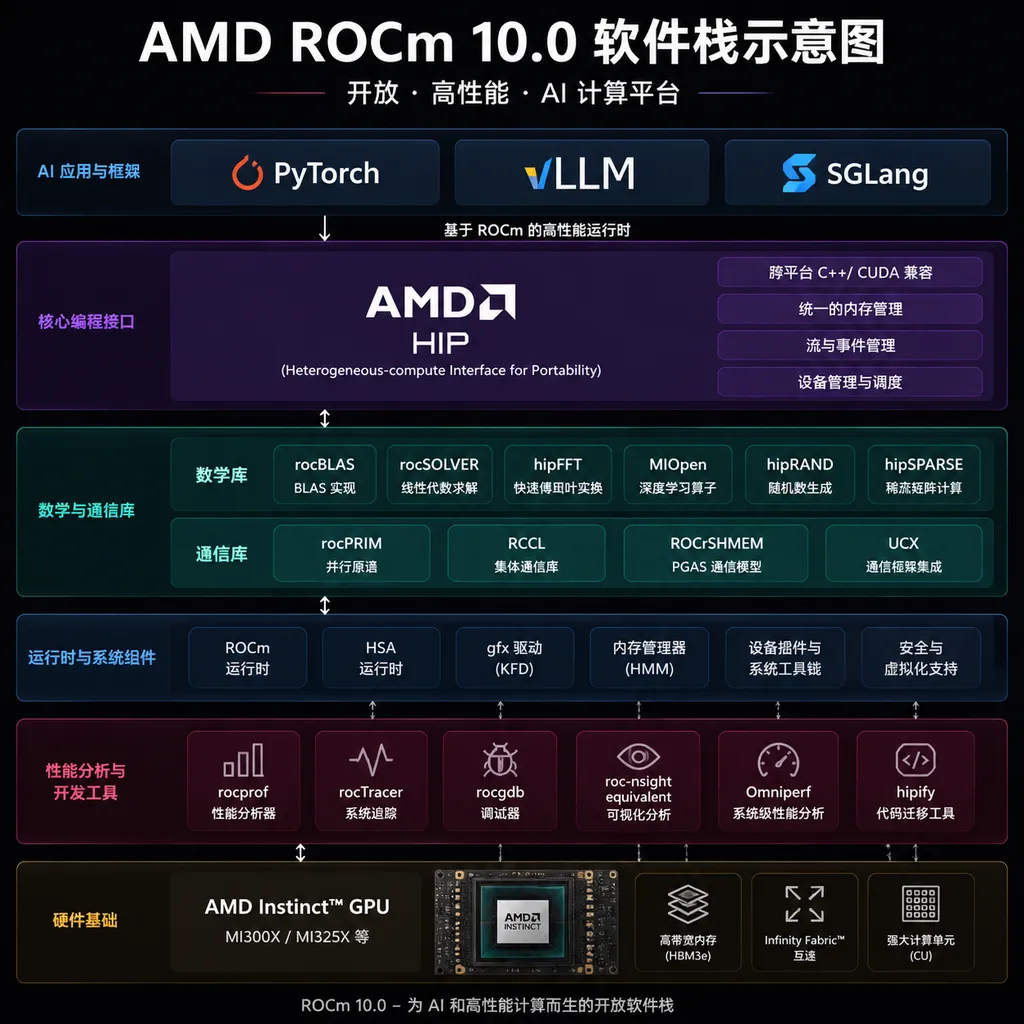
For developers using AMD Instinct, Radeon, or Ryzen AI platforms, the most immediate change is that ROCm's version support for mainstream AI frameworks has broadly moved forward. PyTorch, JAX, vLLM, SGLang, TensorFlow, ONNX Runtime, and other tools have all received a new round of compatibility updates. AMD has also updated its mathematics, sparse computing, and communication libraries, while bringing more GPUs, virtualization capabilities, and partitioning features into the software stack.
This is not simply a driver upgrade. AMD is trying to address another category of problems that developers have often encountered when using ROCm: a model may theoretically run, but developers frequently have to assemble the framework versions, operator implementations, communication libraries, profiling tools, and container environment themselves. For training users, this increases migration costs; for inference services, it can directly affect deployment schedules and machine utilization.
Mainstream Frameworks Upgrade as a Whole, with vLLM and SGLang as Priorities
According to the ROCm 10.0.0 release information, the main framework versions officially supported in this release include:
- PyTorch 2.12.0
- JAX 0.10.0
- vLLM 0.23.0
- SGLang 0.5.13
- TensorFlow 2.21
These versions replace the older compatibility combinations previously used in the ROCm ecosystem, including PyTorch 2.9.1, JAX 0.8.2, vLLM 0.19.1, and SGLang 0.5.9. For developers, the significance is not merely that “newer versions can be installed.” It is that AMD is beginning to treat inference framework compatibility as a core part of ROCm releases.
Historically, NVIDIA CUDA users have generally been able to build relatively stable production environments around CUDA, cuDNN, NCCL, and TensorRT. AMD ROCm, by contrast, has long given the impression that it offers considerable low-level capabilities, but that the higher-level combinations do not work together as smoothly. A model running in PyTorch does not necessarily mean it can be transferred seamlessly to vLLM; vLLM starting successfully does not mean that paged attention, quantization, parallel communication, and GPU memory management will all perform as expected.
The inclusion of vLLM and SGLang in this upgrade indicates that AMD is investing resources in the paths that large-model online inference actually uses. Training workloads can often tolerate lengthy environment debugging, while online inference places greater emphasis on time to first token, generation speed, batching efficiency, memory consumption, and fault recovery. Framework adaptation that stops at “it runs” is still insufficient for production environments. However, judging from the direction of the ROCm 10.0 updates, AMD has at least begun moving from basic compatibility toward a more complete inference workflow.
For vLLM Users, Version Matching Remains the Top Priority
vLLM is one of the most widely used inference engines for large-model serving today. Through continuous batching, paged attention, and KV cache management, it organizes a large number of concurrent requests into a shared GPU execution process. Put simply, traditional inference services are more like giving each request its own dedicated lane, whereas vLLM dynamically organizes memory and compute resources so that multiple requests can share the GPU's idle capacity as much as possible.
This mechanism is already relatively mature in the CUDA ecosystem, but after moving to HIP and ROCm, the underlying kernels, memory access, operator scheduling, and compilation paths all require adaptation. Some of the problems developers previously encountered when migrating vLLM were not caused by errors in the model code itself. Instead, the same inference logic used different kernels and runtime behavior on different GPU backends.
ROCm 10.0 provides support corresponding to vLLM 0.23.0, along with inference-ready vLLM images and packages. For teams that need to deploy inference services on AMD GPUs, this is more valuable than simply releasing a new version, because it reduces the complexity of assembling system environments and framework dependencies.
However, a version number does not guarantee performance. The official release information still notes that when some Radeon GPUs use vLLM 0.21.0 through 0.25.0, certain large language model inference workloads may experience significantly longer warm-up times. The issue is fixed in vLLM 0.26.0 and later. In other words, ROCm 10.0 users cannot simply combine the “ROCm-supported version” with “any version of vLLM.” The complete compatibility matrix should still be checked before deployment.
In an actual deployment, it is recommended to verify at least the following dimensions:
- Whether the GPU model, memory capacity, and ROCm support range are consistent;
- Whether the ROCm, driver, PyTorch, and vLLM version combination has been tested;
- Whether features such as quantization formats, Flash Attention, and Paged Attention are available on the target GPU;
- Whether warm-up time, time to first token, and sustained throughput have been tested separately;
- Whether the communication libraries used in multi-GPU scenarios match the topology.
For small-scale experiments, whether an image can start is one useful metric. For production services, the metrics that should actually be compared are throughput after several hours of stable operation, P99 latency, and the state of memory fragmentation.
SGLang Support Expands, but Default Settings Are Not a Universal Solution
SGLang places greater emphasis on structured generation, complex workflows, and efficient server-side execution. It is particularly attractive for applications requiring constrained decoding, tool calls, batched requests, or multi-stage generation. By upgrading SGLang support to 0.5.13, ROCm 10.0 means that AMD platforms are beginning to cover more inference services built on SGLang.
However, SGLang still presents a practical issue that requires particular attention on Radeon GPUs: some default settings and model combinations may cause inference failures. For developers, this means that startup parameters from NVIDIA environments cannot simply be copied unchanged to AMD platforms. Model architecture, precision, KV cache configuration, parallelization method, and backend kernels can all affect the final result.
A more reasonable migration approach is to first run a small model through the complete pipeline, then enable optimizations such as quantization, tensor parallelism, continuous batching, and custom kernels one at a time. Performance tuning should be built on functional stability. Otherwise, backend compatibility problems can easily be misdiagnosed as issues in the model or business code.
ROCm Is Not Just Catching Up on Framework Versions
Another focus of ROCm 10.0 is the update of HIP, performance analysis, system telemetry, and validation tools.
HIP is AMD's core GPU programming interface and an important bridge when migrating CUDA software to AMD platforms. It provides a programming model similar to CUDA, allowing developers to port some GPU kernels and runtime logic to AMD hardware. However, HIP is not a translation layer that automatically eliminates all differences. The memory hierarchy, thread organization, compiler behavior, and underlying library implementations still need to be adjusted for the target hardware.
This ROCm update refreshes the HIP API and expands profiling and tracing capabilities. The ROCmprofiler-SDK is being used more extensively in AI performance analysis workflows, while the coverage of system telemetry and validation has also been expanded. For inference services, the value of performance analysis tools lies in answering “where is it slow?” rather than simply telling developers “what is the average speed?”
For example, the total latency of a request may consist of the following:
- Request queuing and batching delays;
- Prefill computation for input tokens;
- KV cache allocation and access;
- GPU kernel execution;
- Communication between multiple GPUs;
- Step-by-step generation of output tokens.
Without complete tracing, it is difficult for developers to determine whether the bottleneck comes from GPU compute, memory bandwidth, the communication path, or service-layer scheduling. ROCm 10.0's decision to highlight performance analysis indicates that AMD is beginning to focus on “observable performance,” rather than only peak compute figures in promotional materials.
This is also an easily underestimated part of AMD's gap with the CUDA ecosystem. Theoretical hardware performance can be compared using specification sheets, but developers actually need mature tools to locate problems in kernels, communication, and memory access. Without this layer of tool support, even abundant hardware resources can be wasted by inefficient execution paths.
Support Added for the Radeon RX 9050, Bringing Consumer GPUs into the Fold
ROCm 10.0 expands GPU and virtualization support and adds both 8 GB and 4 GB memory versions of the Radeon RX 9050 to the support list.
This is somewhat appealing to individual developers and small teams. Compared with data center-class Instinct GPUs, Radeon graphics cards are less expensive to acquire and are suitable for model quantization, inference framework adaptation, and local development. However, consumer GPUs differ from data center cards in memory capacity, cooling, memory bandwidth, and long-term stability under sustained full load. The experience of local development cannot be used directly to infer how an online cluster will perform.
The 4 GB memory version is especially constrained in terms of suitable workloads. Small models, short context lengths, and quantized inference can serve as starting points for testing, but large models, highly concurrent services, and long-context tasks generally require a much stricter memory budget. Even if the framework can start, frequent swapping caused by insufficient memory can make actual latency unusable.
The expansion of virtualization and GPU partitioning capabilities is more relevant to cloud and enterprise users. It allows infrastructure teams to allocate GPU resources to different tasks at a finer granularity, making it suitable for sharing hardware among development environments, inference services, and batch-processing tasks. However, performance isolation, memory quotas, monitoring, and fault handling after partitioning still need to be validated against the specific hardware and deployment platform.
ROCm.AI: AMD Begins Applying AI to Development Tools Themselves
AMD has also opened ROCm.AI to users, including the ROCm Hyperloom autonomous agent system, the AMD Skills skill library, and the ROCm CLI command-line interface.
The direction of this update is clear: AMD not only wants GPUs to run AI, but also wants to use AI to help developers configure environments, diagnose performance, and receive optimization recommendations. For a software stack as complex as ROCm, with its many components, automation tools could reduce the time developers spend switching among documentation, versions, build logs, and profiling data.
However, whether “AI-assisted development” is ultimately useful depends on whether it can connect to the real runtime environment, rather than merely generating suggestions from a few log excerpts. An effective tool must at least understand the GPU model, driver version, framework version, compiler options, model architecture, and current performance metrics. Otherwise, it can provide only a generic troubleshooting checklist and cannot replace an engineer's judgment about kernels and system topology.
In the short term, the value of ROCm Hyperloom and AMD Skills is more likely to lie in reducing onboarding and migration costs than in directly delivering order-of-magnitude performance improvements. For teams already familiar with HIP and ROCm, the truly critical factors remain the quality of the underlying libraries, the speed of framework adaptation, and the issue resolution cycle.
Can This Upgrade Change AMD's Position in AI Inference?
ROCm 10.0 should be evaluated on two levels.
First, it is indeed a significant effort to fill gaps in the ecosystem. AMD is advancing PyTorch, vLLM, SGLang, JAX, and ONNX Runtime simultaneously, while also improving performance analysis, telemetry, communication libraries, and virtualization capabilities. This indicates that ROCm is moving from being “software bundled with the hardware” toward becoming a complete AI runtime platform. For enterprises that have already purchased AMD GPUs and do not want to depend entirely on CUDA, this will increase deployment confidence.
Second, it should not be interpreted as proof that AMD has already caught up with CUDA. When developers choose an inference platform, they consider more than tokens per second in a particular benchmark. They also consider model coverage, operator completeness, quantization support, container stability, the number of community issues, documentation quality, and whether problems can be fixed quickly when they arise. CUDA's advantage comes from years of accumulated tools, talent, and third-party software. It cannot be immediately replicated by a single version number.
ROCm 10.0 is more like a concentrated investment by AMD in inference infrastructure. It lowers the barrier to “can it run?” and improves the toolchain for determining “how do we locate the problem?” But whether it runs fast enough, remains stable, and has an acceptable maintenance cost still needs to be determined through load testing with specific models and business workloads.
For developers, the most practical approach is not to migrate all production services immediately, but to establish a reproducible comparison test. Use real models, real context lengths, and real concurrency levels, and record warm-up time, time to first token, generation speed, P95/P99 latency, memory usage, and error rate. ROCm can be considered to have truly moved from the development environment into production only when all of these metrics meet business requirements.
OpenAI Hub Users Do Not Need to Be Tied to a Single Hardware Stack
If a team's goal is to quickly integrate different models such as GPT, Claude, Gemini, and DeepSeek, the underlying GPU vendor does not need to become part of the business code. OpenAI Hub provides a unified API compatible with the OpenAI format, allowing developers to decouple the model invocation layer from specific CUDA or ROCm deployments and switch models and providers when needed.
This does not mean ROCm 10.0 lacks value. For teams building their own inference clusters, deploying privately, or operating under strict requirements for data paths and costs, the underlying software stack still determines whether the hardware can be used effectively. For most application developers, however, the model service layer and GPU runtime should be kept as separate as possible, preserving flexibility among hardware, models, and service providers.
Conclusion
The core change in AMD ROCm 10.0 is not the addition of another framework support list. It is that multiple parts of the AI inference workflow have been addressed in the same release: frameworks, HIP, communication libraries, performance analysis, telemetry, virtualization, and developer tools are all advancing together.
It has not eliminated all of the migration costs associated with the AMD GPU ecosystem. Version matching, model compatibility, and performance stability on the Radeon platform still need to be verified individually. However, for teams looking to reduce their dependence on CUDA or that have already deployed AMD GPUs, ROCm 10.0 is now worth adding to the technical evaluation list. The real dividing line will not be the number of features announced at a launch event, but whether developers can get inference services such as vLLM and SGLang running stably with fewer patches and less troubleshooting time.
References
- ITHome: AMD Releases ROCm 10.0.0, Focusing on AI Inference, Developer Tools, and Performance Analysis: Covers the release date, main update directions, and ROCm.AI tools in ROCm 10.0.0.
- Official ROCm GitHub Releases Page: For ROCm release records, changes in framework support, and known issue descriptions.
- vLLM for AMD Project Page: For information about the adaptation progress of the AMD ROCm and vLLM inference ecosystem.