OpenAI Will Cut Off Cursor
OpenAI has notified SpaceX that it plans to stop providing models to Cursor, which was acquired by SpaceX. Access is expected to end on November 12, 2026. Existing Cursor users can still use OpenAI models for the time being, but future new models will not be added to the platform.
OpenAI Decides to Cut Off Cursor, Access to End on November 12
OpenAI is preparing to terminate its model supply agreement with Cursor.
On August 28 local time, OpenAI announced that it had formally notified SpaceX of its plan to end the arrangement under which it provides OpenAI models to Cursor, with access scheduled to be discontinued on November 12, 2026. OpenAI said this was the longest advance notice permitted under the contract, intended to give developers as much time as possible to continue using OpenAI models in Cursor.
This is not a routine model delisting, nor is Cursor voluntarily switching suppliers. The direct reason given by OpenAI is that Cursor has been acquired by SpaceX, and OpenAI cannot confirm whether Musk-owned companies will be able to use the relevant technology in compliance with its terms of service going forward.
More importantly, OpenAI said Cursor will not receive any new models released before the contract ends. In other words, November 12 is the final deadline for the existing partnership, but the gap in model capabilities between OpenAI and Cursor may begin widening today.
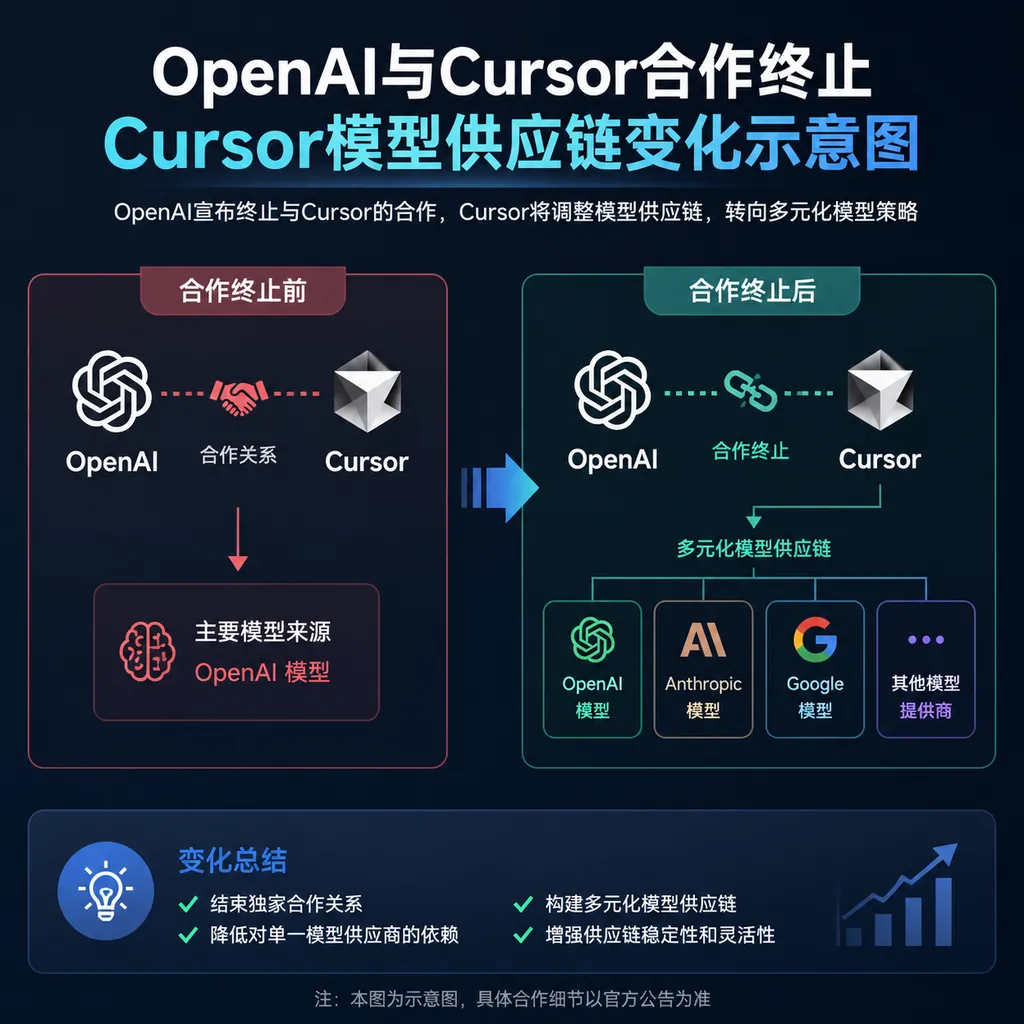
Service Will Not Stop Immediately, but Cursor Will Lose Access to “Next-Generation Models” First
From a user's perspective, OpenAI's decision can be broken down into two parts:
- In the short term, Cursor can continue using the OpenAI models already integrated into the product.
- Starting now, Cursor will no longer gain access to new models subsequently released by OpenAI; on November 12, the supply of existing models is also expected to end.
This means Cursor users do not need to switch editors immediately today, but they do need to reassess their model configurations and team workflows for the coming months. For individual developers, the main impact will be fewer model choices. For teams that have already integrated Cursor into enterprise codebases, internal agent systems, and automated development workflows, the problem is far more complex: switching models may change output styles, code modification strategies, context utilization, and the calculation of usage costs.
Models in development tools are not interchangeable “backend compute” that can be swapped out without users noticing. The same codebase and the same prompt may produce different refactoring approaches on different models. How a model understands repository structure, whether it tends to edit files directly, the granularity of the patches it generates, and its strategy for handling test failures can all affect how much developers trust it.
Products such as Cursor, in particular, are no longer merely model chat windows. They embed model calls into code completion, Agent mode, multi-file editing, terminal operations, and project-level context retrieval. Once the model changes, the effects will appear throughout the entire interaction chain rather than amounting to a simple change of an API endpoint.
Change-of-Control Clause Becomes Key to the Supply Cutoff
The most noteworthy technical and commercial detail in OpenAI's announcement is that the parties did not sign a fully standardized model supply contract, but rather a customized agreement.
According to OpenAI, the agreement explicitly stipulates that when control of the partner company changes, OpenAI has the right to terminate the agreement within a specified period. Cursor's acquisition by SpaceX therefore triggered the contract's change-of-control clause, and OpenAI chose to initiate its exit process within the scope permitted by the contract.
Such clauses are not uncommon in large-model supply agreements. What model providers truly need to control is not merely who the customer is, but also the systems in which the model is ultimately deployed, who manages it, how the terms of service are enforced, and whether the model will be used for training, distillation, abuse, or high-risk automation scenarios.
For a model company, providing an API to an independent developer-tool company presents a fundamentally different risk profile from supplying models to a large conglomerate with aerospace, social media, autonomous-driving, and AI businesses. Following an acquisition, the previously relatively clear customer relationship is reorganized, potentially changing data flows, access management, the entities making model calls, and compliance responsibilities.
OpenAI said in its announcement that when working with large partners such as SpaceX, it typically uses customized contracts to ensure that the other party complies with its terms of service and to safeguard security in large-scale system integrations. In other words, OpenAI's concern is not Cursor itself, but whether the original contractual constraints will remain sufficiently effective after Cursor is brought into the SpaceX organization.
OpenAI Puts the “Record of Contractual Breaches by Musk-Owned Companies” on the Table
OpenAI did not characterize this decision as a purely commercial strategy. Instead, it explicitly cited the history of contractual disputes involving companies owned by Elon Musk.
OpenAI said that after Musk acquired Twitter, which has now been incorporated into SpaceX, the company violated multiple provisions of the contract between the two parties. Earlier this year, Musk also admitted under oath that xAI—which has likewise now been incorporated into SpaceX—had violated OpenAI's terms of service. OpenAI further noted that these terms were similar to xAI's own rules.
This wording sends a strong signal: OpenAI is using the companies' past record of contractual performance to explain why it is unwilling to continue assuming future risk. For model suppliers, terms of service are not merely disclaimers at the bottom of a website; they are the core contractual foundation restricting how models may be called, integrated, and redistributed. Once a supplier believes that a customer may not consistently enforce those restrictions, the most direct way to control risk is to stop supplying the models.
Of course, OpenAI's announcement represents a unilateral position. Based on the information currently available to the public, SpaceX and Cursor have yet to provide a complete account of whether they accept this assessment or plan to challenge it. The matter may therefore still involve questions concerning contract interpretation, closing arrangements, and the timing of service termination.
Regardless of whether the parties ultimately become embroiled in a legal dispute, however, the fact that a change in control triggered a model supplier's exit mechanism has already sent a clear signal to the developer market: the source of models used by AI applications is no longer simply a matter of an engineering team choosing a supplier; it is also directly connected to a company's ownership structure and ultimate controlling party.
Cursor Faces Not a Model Swap, but a Supply-Chain Restructuring
Much of Cursor's previous competitiveness came from its productized orchestration of multiple models. Developers could use different models for different tasks: fast completion suited low-latency models, complex refactoring could be assigned to stronger reasoning models, and code-related Q&A relied on longer context windows and better repository comprehension.
After OpenAI ends supply, Cursor could theoretically continue integrating models from other providers, including Anthropic, Google, open-source models, and other commercial models. But “alternatives exist” does not mean “replacement costs are zero.”
First comes product-level adaptation. Different models vary in their support for tool use, structured output, context windows, and error recovery. Cursor will need to retune its Agent execution strategies, prompt templates, tool permissions, and context-compression mechanisms to deliver a comparable user experience.
Second are performance and cost. The coding experience offered by large models typically involves trade-offs among speed, accuracy, and price. A model that performs better on benchmarks is not necessarily more useful in a real-world codebase. Higher context costs may also change Cursor's policies on retaining conversation history, file contents, and terminal logs.
Third are branding and user expectations. Some developers have already established fixed workflows around a particular model, relying, for example, on its patch style or approach to explaining errors, or creating corresponding prompt standards within their teams. After switching suppliers, Cursor will have to bear some of the cost of educating users through the migration.
This is why OpenAI's “maximum advance notice” matters. For Cursor, the buffer of roughly two and a half months is intended not only for technical migration, but also for informing enterprise customers, updating pricing plans, revalidating model quality, and addressing long-term subscriptions and service commitments.
The New Astra Model Will Not Come to Cursor
OpenAI also said that its forthcoming new model, Astra, must be used in strict compliance with its terms of service. Following a comprehensive compliance risk assessment, OpenAI decided to extend the contract termination date to the latest date permitted, but it will no longer provide Cursor with any subsequent new models.
This statement means that Astra's availability may have been designed from the outset around a stricter tiered system. OpenAI may decide which platforms can access its latest models, which can only continue using older versions, and which will be cut off entirely based on customer type, control structure, deployment scenarios, and security capabilities.
In the past, developers often viewed model APIs as a form of standardized infrastructure: as long as authentication and interface integration were completed, the same family of models could be used over the long term. But as models become more capable, suppliers will increasingly focus on who controls them, how they are packaged, and whether they will be incorporated into larger automated systems. Access to the latest models may come to resemble high-risk permissions in cloud services, requiring additional review and contractual safeguards.
This is especially important for teams that rely on third-party development tools. The fact that developers do not contract directly with OpenAI does not mean the model supply relationship is irrelevant to them. When an upstream model company ends a partnership, the downstream product may continue operating, but its core capabilities, release cadence, and pricing structure may all change.
What Developers Need to Do Now
OpenAI has not yet disclosed how Cursor will specifically adjust its model lineup, nor has it explained which features will be directly affected after November 12. Development teams can begin with several preparations:
1. Take Inventory of Model Dependencies
Determine whether the team uses OpenAI models exclusively in Cursor or already mixes models from multiple providers. Do not look only at the model names displayed in the editor; also check team documentation, prompt templates, Agent rules, and automation scripts for hidden dependencies.
2. Establish Switchable Model Configurations
If project workflows depend on Cursor Agent, it is advisable to manage model-related configurations, context strategies, and quality-control processes separately. When switching models, avoid tying prompts, tool permissions, and business rules entirely to the behavioral habits of a single model.
3. Conduct Regression Testing on Real Codebases
General-purpose leaderboards cannot replace testing on enterprise codebases. Teams should compare performance on representative tasks, including cross-file refactoring, unit-test completion, complex bug diagnosis, dependency upgrades, and terminal command execution, while recording success rates, time required, number of files modified, and the cost of manual rework.
4. Reassess Data and Compliance Boundaries
If a team plans to switch to another model provider, it must reconfirm how code, logs, prompts, and intermediate outputs will be handled. Cursor's terms of service state that unless a user expressly consents, Anysphere will not use the relevant content to train AI models or allow third parties to use it for training. Nevertheless, enterprises should still make their assessment based on their own contracts and internal data-classification policies rather than relying solely on the product's default settings.
5. Do Not Treat November 12 as the Only Migration Milestone
Because OpenAI has made clear that no subsequent new models will be provided to Cursor, the actual divergence in capabilities may emerge before the contract termination date. Enterprises that require stable versions over the long term should ideally complete at least one round of alternative-model validation in September and October rather than waiting until service shuts down and then scrambling to respond.
The Broader Impact: Model Companies Begin Reclaiming Control Over Distribution
At the heart of this event is not merely the termination of a contract between OpenAI and Cursor, but a reordering of the relationship between model providers and AI applications.
In the early days, model companies wanted to maximize usage, while developer tools sought to package model capabilities into better products. As models become critical application infrastructure, the relationship between the two sides is shifting from “supplier–customer” to a “contest for control over capability distribution”: model companies want to control who can use their most advanced models, while application companies need to avoid being constrained by a single supplier.
For Cursor, the most practical choice may be to continue strengthening its multi-model strategy and reduce the weight of any single supplier in the product experience. For OpenAI, proactively cutting off a platform that reaches a large number of developers suggests that it values compliance certainty and control more than API revenue alone.
This will affect every AI programming tool in the future. When enterprises procure similar products, in addition to comparing completion quality, Agent capabilities, and pricing, they will need to ask several questions that previously received little attention: Does the model supply contract allow service to continue after a change in control? Is simultaneous access to the latest models guaranteed? Can the supplier unilaterally terminate service based on compliance risks? Does the product support migration across models?
For developers, the safest conclusion is this: Cursor will not immediately stop working because of this announcement, but its relationship with OpenAI models has entered a countdown. Users still have time to continue using existing models before November 12, but if a team regards OpenAI's capabilities as an irreplaceable production dependency, it should begin migration drills now.
OpenAI Hub currently aggregates major models such as GPT, Claude, Gemini, and DeepSeek, providing unified access through an OpenAI-compatible format. For development teams that need to test models from multiple providers simultaneously, the value of such a unified interface lies not in offering “one more gateway to models,” but in reducing the engineering cost of switching suppliers. However, a unified API can address only compatibility at the invocation layer; model quality, data compliance, and enterprise contracts still need to be evaluated separately.
Ultimately, this controversy may not deprive developers of an AI programming tool, but it will make more teams realize that the model supply chain itself is part of the production system.