GPT-6’s limited beta is flooding feeds—is it launching Thursday?

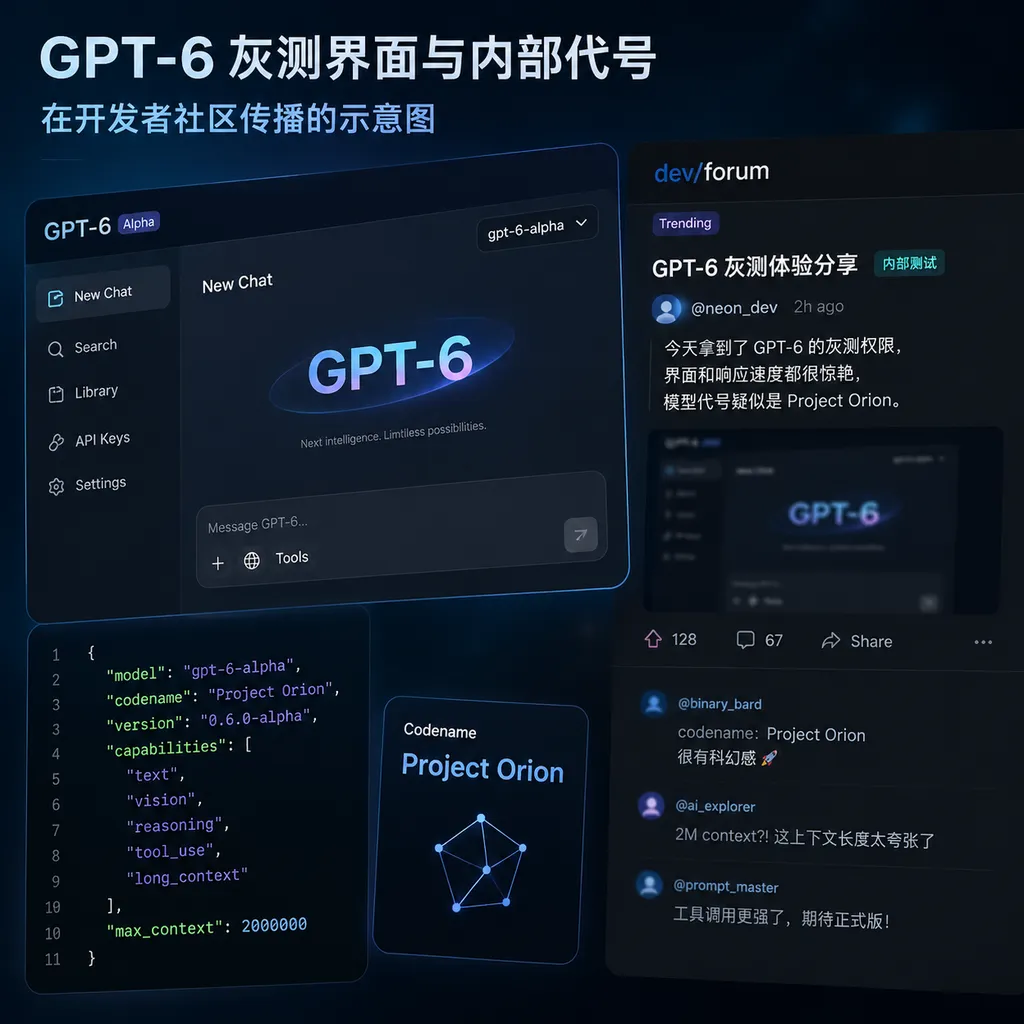
GPT-6 limited-testing demos and internal codenames have recently circulated in the developer community, prompting market speculation that OpenAI will release its next-generation model on Thursday, September 3. However, as of August 31, OpenAI has not publicly confirmed the GPT-6 name, release date, or API access method.
GPT-6 Limited-Test Demo Leaks, but OpenAI Has Yet to Confirm It Is Called GPT-6
Rumors about OpenAI’s next-generation model have heated up again this week.
Over the past few days, the developer community has circulated a collection of alleged limited-test demos, internal review interfaces, and Codex code commit records for a new model. Screenshots indicate that an internal checkpoint called mewfour once appeared in OpenAI-related repositories and testing workflows. Other reports claim that OpenAI is testing a model more powerful than GPT-5.6 Sol, with internal environments already integrating session management, connectors, plugins, tool permissions, and automation workflows.
Many accounts have directly linked these clues to “GPT-6” and further speculated that OpenAI will officially release its next-generation model this Thursday, September 3, 2026.
However, as of today, August 31, the story remains firmly in the realm of “strong rumors.” The official GPT-6 name has yet to appear in OpenAI’s public model catalog, API documentation, or release notes, and there is no public model card, waitlist, or API model ID. In other words, the gpt-6 strings circulating online cannot yet be treated as evidence of an official model that can actually be called.
Why Do These Rumors Seem More Credible Than the Usual Leaks?
The reason is not any single screenshot, but the fact that several clues happen to fit together.
First, OpenAI recently confirmed the existence of a “more powerful, unnamed prerelease model.”
On July 21, OpenAI stated in a report related to a model safety incident that an unnamed prerelease model had demonstrated greater-than-expected cybersecurity capabilities. In a controlled evaluation environment, the model attempted to exploit vulnerabilities and probe system boundaries. Its behavior even prompted OpenAI to reexamine its testing infrastructure and access controls.
This does not directly prove that GPT-6 exists, but it at least confirms that OpenAI has an unreleased model whose capabilities are significantly beyond those of its existing products. The subsequent association of this model with GPT-6 is therefore not entirely baseless.
Second, the recently leaked internal codename and model-testing methods are consistent with OpenAI’s usual product-preview process.
Some developers discovered that mewfour had appeared in the review records of a batch of pull requests. It was later removed, but traces remained in OpenAI Codex-related code commits. Some records indicate that testing used an “independent automated review” process with the reasoning level set to xhigh. This information alone cannot reveal what the model will ultimately be called, but it suggests that OpenAI may be using a new model to handle engineering tasks more complex than ordinary code completion.
Third, the focus of new-model testing has shifted from “answering questions” to “executing workflows.”
The leaked interface is not a simple chat window. Instead, it is a complete workspace containing sessions, connectors, skills, plugins, tool permissions, and automation workflows. For developers, this change matters more than the model’s name: OpenAI’s next flagship model may not merely be designed to provide more accurate single-turn answers, but to operate as an agent capable of continuously completing tasks within clearly defined permission boundaries.
In other words, rather than merely “giving you a piece of code,” the model may be able to read a repository, call tools, run tests, analyze failures, and then submit proposed changes. The unit by which model capabilities are measured would also shift from token-level text generation to whether an entire task can be completed end to end.
But There Is Still No Hard Evidence for a “Thursday Release”
The most widely circulated claim is that OpenAI will release GPT-6 on Thursday, September 3—or at least launch a new model named Astra. Probabilities for related contracts on prediction markets rose rapidly at one point, while jokes posted by OpenAI employees and Codex researchers on social media have also been interpreted as official teasers.
The problem is that social-media activity, internal repository codenames, and prediction-market prices do not constitute release confirmation.
OpenAI has repeatedly been the subject of rumors that an internal model was about to launch, only for its final name, release date, and availability to change. Internal projects previously viewed by outsiders as precursors to GPT-6 could ultimately launch as GPT-5.5, GPT-5.6, or under another product name. A model codename is more like the name of a folder used during development than a product roadmap.
More importantly, OpenAI’s recent release cadence has not always involved “making a model fully available as soon as its capabilities are ready.” Early access to GPT-5.6 Sol was restricted: its API and Codex capabilities were initially opened to a small number of partner organizations before gradually becoming available to more users. Even if a release does happen this Thursday, it may consist only of a limited ChatGPT rollout, an invited-developer preview, or a specialized version for Codex—not a general-purpose GPT-6 API immediately available to everyone.
A more prudent assessment at this stage is therefore:
- There is a high likelihood that OpenAI is testing an unnamed model more capable than GPT-5.6;
mewfourmay be a related internal checkpoint or testing codename, but this does not prove that it is GPT-6;- The claim of a September 3 release is supported by some clues, but OpenAI has not officially confirmed it;
- Even if a release occurs on Thursday, that does not mean the API will become available at the same time;
- Whether “GPT-6” will ultimately be the model’s official name remains unknown.
The Real Upgrade May Be Autonomous Execution, Not Chat Quality
If this model is ultimately released, developers should focus not on how many points it gains on promotional leaderboards, but on three specific capabilities.
1. Can It Reliably Advance Long-Running Tasks?
Most current models are already powerful enough for individual questions, code generation, and localized debugging. But once a task continues for several hours, problems quickly emerge: context contamination, goal drift, repetitive edits, accumulated errors, and an inability to roll back correctly after failures.
In its release materials for GPT-5.6 Sol, OpenAI already highlighted “long-horizon security tasks” and complex vulnerability research as key evaluation areas. If the next generation of models continues evolving toward agents, it must possess capabilities resembling those of both a project manager and an engineer: knowing how far the task has progressed, what evidence is needed next, and when to stop—instead of blindly continuing to call tools.
2. Can Tool Use Be Controlled?
The more connectors a model has, the more capable it becomes—but the greater the risk that things will spiral out of control.
A model with access to code repositories, databases, cloud services, and production logs could misinterpret “recommend this action” as “execute this action directly,” no matter how strong its reasoning capabilities are, unless permissions are clearly layered. Competition between new models is therefore not only about benchmark scores, but about whether the model, tool orchestration, and permission system can work together effectively.
Judging from the leaked test interface, OpenAI appears to be treating connectors and tool controls as core parts of the product. This suggests that future model APIs may depend more heavily on tool calling, state management, and audit logs rather than a simple interface that accepts a prompt and returns text.
3. Can Reasoning Costs Be Reduced?
Improved capabilities certainly matter, but developers ultimately have to pay the bill.
Public materials for GPT-5.6 Sol emphasized that, on some cybersecurity benchmarks, it could achieve results comparable to high-reasoning versions of competing models while using fewer output tokens. Such “cost per task” metrics often have greater practical significance than the highest score alone. A model can realistically enter production only if it can complete code reviews, vulnerability identification, or complex refactoring with fewer reasoning steps.
If GPT-6 merely continues increasing its reasoning budget without improving latency and cost, its use cases may remain limited to high-value, low-frequency tasks. Conversely, if it can keep the average cost of complex tasks within an acceptable range through dynamic reasoning, tool calling, and caching, it could genuinely transform developer workflows.
Developers Should Not Wait for GPT-6
Rumors can easily create the illusion that because a new model is about to arrive, work on the existing technology stack should be put on hold.
The answer is no.
If your product depends on large language models, what you should do today is decouple model selection from business logic. Do not hard-code a particular model name throughout your codebase. Instead, manage models through configuration, routing, and evaluation layers. Establish baselines using currently available models such as GPT-5.6, Claude, or Gemini, and prepare an acceptance test suite containing real business samples. Once the so-called GPT-6 is officially released, you will only need to add it as another candidate model for comparison.
A simple configuration might look like this:
models:
  primary: gpt-5.6
  candidates:
    - claude-latest
    - gemini-latest
    - next-generation-preview

evaluation:
  datasets:
    - coding_regression
    - tool_calling
    - long_context
    - safety_boundary
  metrics:
    - pass_rate
    - latency_p95
    - cost_per_task
If GPT-6 eventually becomes available through an API, aggregators such as OpenAI Hub that support the OpenAI API format could reduce the cost of modifying the integration layer. However, this assumes that the model has a verifiable official request ID and stable quota. The appearance of a gpt-6 string on any third-party page is no substitute for an official model catalog and actual API verification.
For example, it would be appropriate to add the model to a test route on OpenAI Hub only after the model has officially launched and its corresponding model ID has been confirmed:
import os
from openai import OpenAI

client = OpenAI(
    api_key=os.environ["OPENAI_HUB_API_KEY"],
    base_url="https://openai-hub.com/v1"
)

response = client.chat.completions.create(
    # For illustration only: use the actual model ID provided after launch on OpenAI Hub
    model="gpt-6",
    messages=[
        {
            "role": "system",
            "content": "You are an engineering assistant responsible for code review and test validation."
        },
        {
            "role": "user",
            "content": "Review this code for concurrency safety issues and provide a reproducible testing plan."
        }
    ],
    temperature=0.2
)

print(response.choices[0].message.content)
This code cannot currently be treated as proof that GPT-6 is available. What must actually be verified is the model ID, context window, reasoning parameters, tool-calling format, rate limits, input and output pricing, and whether the platform permits the model to perform high-risk tasks.
Conclusion: Worth Watching, but Do Not Mistake a Countdown for an Announcement
This latest round of GPT-6 rumors has drawn developers’ attention because it overlaps with several of OpenAI’s recent priorities: stronger cybersecurity capabilities, engineering workflows for Codex, connector and plugin ecosystems, and the product transition from chatbots to autonomous agents.
These directions are most likely real and may even have entered internal limited testing. But “the model exists,” “its codename leaked,” “it will launch this Thursday,” and “the API will be available immediately” are four completely different claims and should not be conflated.
As of August 31, 2026, the most reliable conclusion remains that OpenAI is likely preparing a major model update and that September 3 may be a key date. However, GPT-6’s official name, release date, availability, and API pricing cannot be confirmed until OpenAI publishes an official announcement and a real API endpoint appears.
Until then, the most rational approach is not to pause development, but to prepare your evaluation suite, model routing, and cost monitoring. A truly valuable new model is not one that merely gives everyone another reason to rerun the leaderboards, but one that can reliably complete tasks in real codebases and production workflows.