Integrating Large Language Models Such as OpenAI into AWS GovCloud
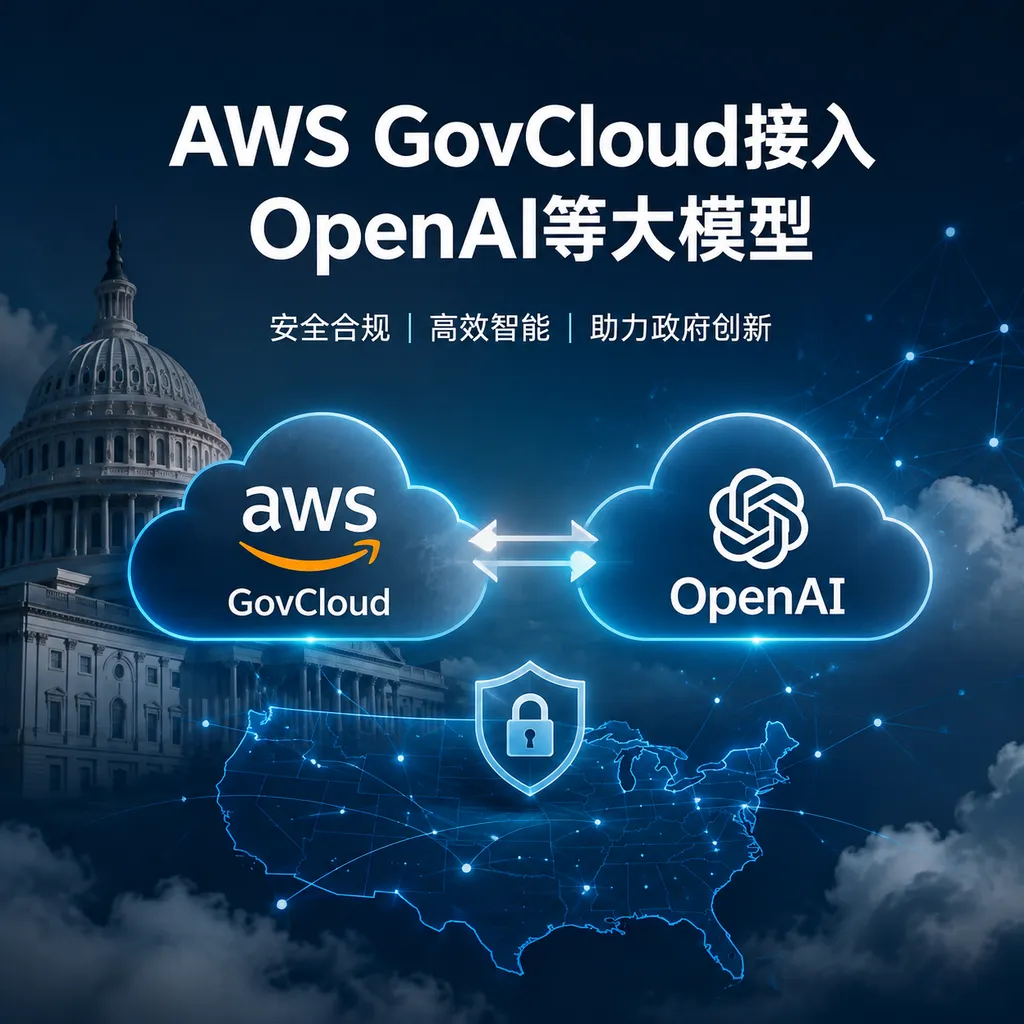
AWS has announced the expansion of the range of Amazon Bedrock models available in GovCloud, enabling U.S. government agencies, the defense industrial base, and technology partners to access models from OpenAI, Anthropic, Meta, and Amazon Nova within regulated cloud environments.
AWS Brings a Range of Leading Large Models to Its Government Cloud
On August 30, Amazon Web Services (AWS) announced that AWS GovCloud (US), which serves U.S. government agencies, has expanded the range of models available through Amazon Bedrock. Through this channel, government customers, defense industry companies, and technology partners can access large models from companies including Anthropic, OpenAI, and Meta, as well as Amazon’s own Nova model family.
This is not an ordinary model rollout. What truly deserves attention is that AWS is bringing model capabilities previously scattered across different vendors into a compliant cloud environment designed for government and defense use cases. For government customers, the models themselves are only the first step. Whether data can be moved to the cloud, whether requests remain within controlled boundaries, and whether permissions and audits can be clearly accounted for are often more important than a few percentage points on a model leaderboard.
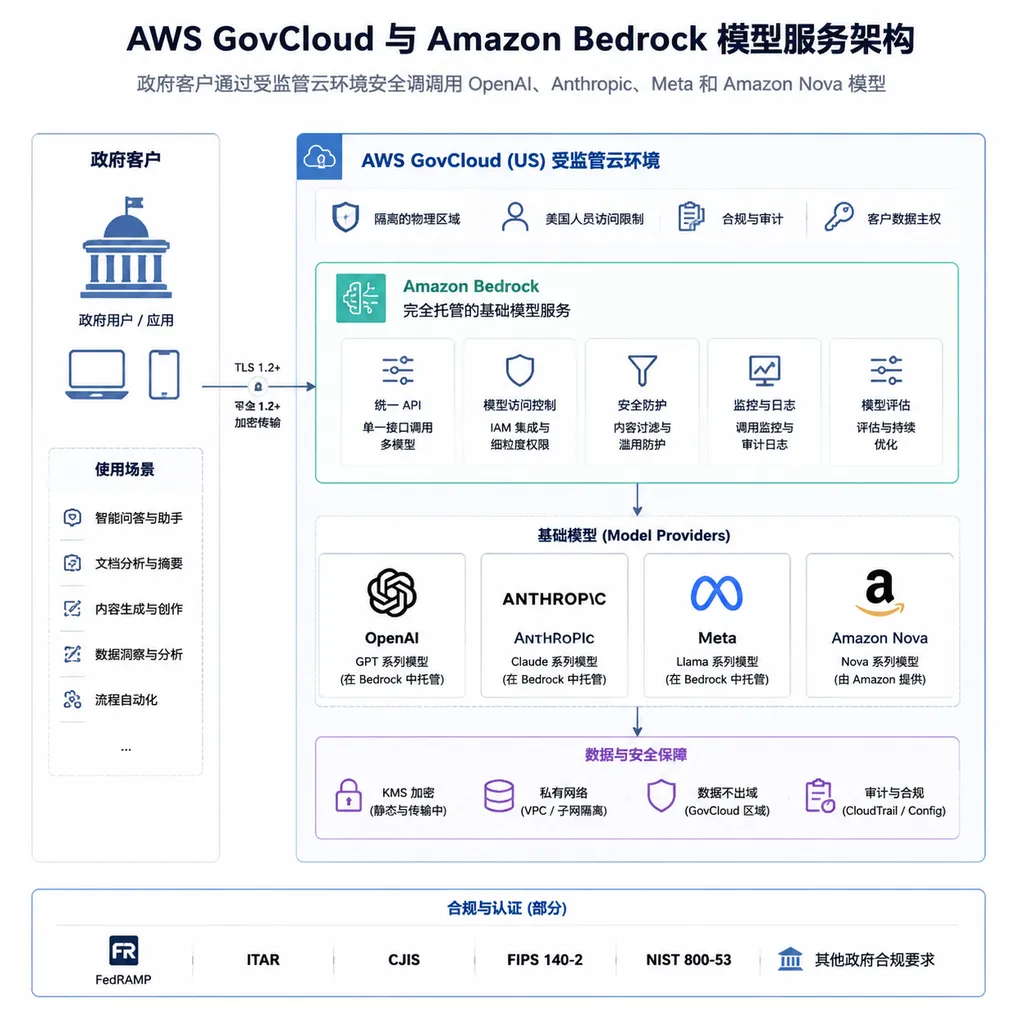
GovCloud Does Not Solve the Question of “Whether Models Exist,” but “Whether Models Can Be Used”
AWS GovCloud is an isolated cloud environment built by AWS for U.S. government agencies, designed to meet government regulatory, security, and external isolation requirements. What distinguishes it from an ordinary commercial cloud is not simply the addition of a “Government” label to the interface. Its infrastructure, access controls, personnel permissions, data processing, and compliance certifications must all be redesigned around the requirements of government and defense customers.
When deploying generative AI, these customers typically face several barriers that are more difficult than those encountered by ordinary enterprises:
- Data boundaries: Government documents, procurement information, intelligence materials, and defense industry data cannot be allowed to flow freely into public cloud services.
- Access control: Who may access which models and what classification level of data they may process must be integrated into existing identity and permissions systems.
- Auditing and traceability: Model calls, inputs and outputs, and administrator actions may all need to be logged for subsequent review.
- Vendor management: Government customers do not want to integrate separately with multiple service providers and maintain multiple compliance processes just to use different models.
- Business continuity: Model capabilities must be integrated into existing cloud infrastructure rather than remain confined to demonstration pages or standalone chat tools.
Bedrock serves as the model access layer in this context. It does not retrain these models. Instead, it provides models from different vendors through a unified cloud service, allowing customers to access them within AWS’s identity, networking, security, and operations framework. For agencies that have already deployed their data and applications in GovCloud, this is easier to incorporate into existing IT processes than purchasing a separate external model service.
The boundaries must still be made clear, however. The availability of models in GovCloud through Bedrock does not mean that every government customer can process every type of data without restrictions, nor does it mean that permissions, regional availability, and compliance coverage are identical across models. Actual availability still depends on AWS’s service catalog, the specific model version, the authorization requirements of the customer’s agency, and the security level of the relevant workload.
Why Now: Government AI Procurement Is Moving from Experimentation to Infrastructure
Over the past two years, government use of generative AI has largely focused on pilot projects such as internal Q&A, document summarization, policy search, and coding assistance. Model services are now beginning to enter a more serious phase of infrastructure procurement. Customers are no longer asking only, “Can this model write a summary?” They are also asking, “Can it operate within designated boundaries?”, “Can it integrate with our existing identity systems?”, “How will invocation logs be retained?”, and “Will the application need to be rewritten when the model is upgraded?”
AWS’s expansion of the model selection in GovCloud is, in effect, a response to this procurement logic. Government customers do not necessarily need a model that is the strongest at every task. Instead, they need a pool of models that allows them to switch flexibly based on the task, data sensitivity, and cost requirements.
For example, an agency could assign the rewriting of low-sensitivity official documents to a faster, lower-cost model, use a more capable reasoning model to analyze complex technical materials, and restrict internal knowledge-base Q&A to specified data domains and permission scopes. The application layer would not need a separate set of authentication, billing, and monitoring logic for each model vendor. This is precisely the value a model aggregation layer provides to large organizations.
From a developer’s perspective, Bedrock’s significance extends beyond simply adding a few new model names. It transforms model selection from a one-time technical decision into an orchestrated and governed runtime strategy:
- Select models based on task type rather than binding the entire application to a single model.
- Determine whether a request may leave a specific network boundary based on the sensitivity level of the data.
- Switch between high-performance and low-cost models based on latency and budget requirements.
- Preserve alternative routes when a model service experiences throttling, outages, or version changes.
- Use unified logging and permission systems to trace the source and outcome of every model call.
This is particularly important for government software that requires long-term maintenance. Models will be updated, prices will change, and vendors may alter their product strategies. If an application hard-codes its business logic to a specific model’s proprietary interface, it may launch quickly in the short term, but long-term migration costs will continue to accumulate. A unified service endpoint may not eliminate every compatibility issue, but it can at least reduce vendor differences to a more manageable scope.
AWS’s Strategy: Selling Not One Model, but the Entire Cloud Foundation
AWS does not have a single flagship model on the level of GPT or Claude, but it is competing in another way: by putting as many models as possible on its cloud platform while continuing to sell storage, computing, networking, security, database, and data analytics services.
This is a classic platform strategy. Which model a customer uses does not necessarily determine whether AWS can benefit. As long as model calls take place within AWS’s infrastructure and service ecosystem, AWS has opportunities to generate revenue from computing resources, model usage, data processing, and related enterprise services. For government customers, model diversity also reduces the risk of being locked into a single vendor, further increasing Bedrock’s appeal as an access point.
AWS’s business growth is providing the funding and confidence behind this strategy. According to the reference materials, in the second quarter of 2026, AWS operating income increased 63% year over year, while revenue rose 37%, with AI and chip businesses serving as major growth drivers. Amazon’s management also expects AWS’s long-term revenue to eventually reach $1 trillion.
That target may sound aggressive, but the cloud migration market is still far from mature. Approximately 85% of global IT spending currently remains devoted to on-premises environments. The on-premises share is often even higher among government agencies and large defense contractors because of complex legacy systems, strict compliance requirements, sensitive data, and lengthy procurement cycles. For this very reason, GovCloud is not a peripheral AWS product, but an important gateway for winning a group of high-value customers with long procurement and retention cycles.
Compared with Microsoft and Google, AWS Has Clear Strengths and Weaknesses
AWS is not acting alone in the government AI market. Microsoft has Azure Government, its own Copilot offerings, and the Azure AI ecosystem, while Google competes through Google Cloud’s security capabilities and its Gemini models. By comparison, the core selling point of AWS’s latest offering is not the brand of any individual model, but the ability to provide models from multiple vendors in one mature government cloud.
It has three main advantages.
First is greater model neutrality. Customers can access OpenAI, Anthropic, Meta, and Amazon Nova models simultaneously without staking their entire AI strategy on a single model company. Second is infrastructure integration. For agencies that already have AWS accounts, networks, and data platforms, Bedrock can be more easily incorporated into their existing architectures. Finally, there is enterprise-grade governance. The permissions, auditing, key management, network isolation, and operational processes that matter to government projects are typically strengths of large cloud providers.
AWS also has weaknesses, however. Having more models does not automatically translate into a better experience. Developers must still account for differences among models in context-window length, tool use, structured output, visual capabilities, and safety policies. A unified endpoint can address only some interface and infrastructure issues; it cannot fully standardize model behavior.
In addition, customers seeking the latest capabilities from a particular model may gain access more quickly by using the model vendor’s official service directly. Aggregation platforms generally have to wait for models to be adapted, reviewed, and launched in specific regions. For government projects, this delay may be an acceptable trade-off for more stable compliance boundaries. For teams that need early access to new capabilities, however, it may become a cost.
What This Means for Development Teams
The most immediate impact of this update is not that developers suddenly gain an entirely new model capability, but that it changes how government and defense software is integrated.
Previously, a team might have needed to integrate separately with multiple model vendors and then build its own gateway, permissions system, logging platform, and failover mechanisms. AWS is now attempting to bring some of that work within the service boundaries of GovCloud and Bedrock. Development teams can devote more effort to retrieval augmentation, workflow orchestration, evaluation systems, and business integration rather than repeatedly building model access layers.
Several steps are still required before a system can actually go into production:
- Build model evaluation sets: Do not rely solely on public leaderboards to evaluate models. Use real, sanitized government tasks to test accuracy, hallucination rates, and refusal behavior.
- Differentiate model-routing strategies: Highly sensitive data, low-latency tasks, and complex reasoning tasks should not be routed to the same model by default.
- Maintain a vendor abstraction layer: Even when using Bedrock as the unified platform, do not bind business logic to the specialized output format of a particular model.
- Ensure human review: For legal opinions, procurement decisions, intelligence assessments, or defense processes, model outputs cannot directly replace the judgment of authorized personnel.
- Track cost and latency: Once model usage enters production, token costs, concurrency limits, and response times will directly affect system design.
- Monitor version changes: Model upgrades, deprecations, and safety-policy adjustments can all alter outputs and require continuous regression testing.
In other words, Bedrock addresses “how to connect the models,” not “how to make AI work reliably in government operations.” The latter still requires data governance, prompt and tool-permission design, offline evaluation, red-team testing, and clearly defined lines of responsibility.
The Real Value of This Update
By bringing models from OpenAI, Anthropic, Meta, and others into GovCloud, AWS is signaling that competition among large models is moving beyond consumer chat interfaces and into the infrastructure layer of government cloud, the defense industry, and highly regulated enterprises.
Its value does not lie in the one-time release of a stronger model, but in lowering the barrier for government customers to adopt a multi-model strategy. Future enterprise AI architectures will likely no longer follow the approach of “select one model and use it indefinitely.” Instead, model gateways, data permissions, evaluation systems, and business workflows will jointly determine which route each request should take.
Whether AWS can convert this advantage into long-term contracts will depend on three questions: whether the models and features actually available in GovCloud can continue to expand; whether these models perform reliably enough on government tasks; and whether AWS can strike a balance between security and compliance on one hand and the pace of model iteration on the other.
What can be confirmed for now is that AWS has shifted the focus of competition from “Do I have the strongest model?” to “Can I enable customers to use enough powerful models within a controlled environment?” For the U.S. government and defense industry, that may have more practical significance than yet another winner on a public leaderboard.