TimesFM-3 Makes Multivariate Forecasting Work Out of the Box

Google has released TimesFM-3, a 330-million-parameter model that natively supports zero-shot multivariate forecasting for the first time and can simultaneously handle historical features, future events, and quantile outputs. Its real target is not every traditional model, but the enterprise workflow of repeatedly training and maintaining numerous specialized forecasters.
<think>Planning comprehensive translation with markdown preservation</think>
Google Packs Multivariate Forecasting Into a 330-Million-Parameter Model
Google today (September 1) released the time-series foundation model TimesFM-3. The new model has 330 million parameters and was pretrained on a corpus of real-world and synthetic time series comprising more than 1 trillion time points, with a focus on native zero-shot multivariate forecasting.
This means developers can feed the model a group of mutually influencing time series and have it jointly forecast their future trajectories, without first retraining a separate model for every business scenario or set of metrics.
TimesFM-3 is the third generation of Google’s TimesFM series. While earlier versions placed greater emphasis on univariate, out-of-the-box forecasting, the key upgrade this time is not merely the increase in parameter count from roughly 200 million to 330 million. Rather, the model is finally tackling the most troublesome aspects of real-world business forecasting head-on: variables are not independent of one another, and the future is not determined solely by historical values.
Consider forecasting ice cream sales for a retail chain. The truly valuable inputs would not be limited to the past year’s sales of a particular SKU. Different brands may substitute for one another, store traffic affects overall demand, and future weather and scheduled promotions can alter short-term trends. Traditional univariate forecasters generally require these relationships to be handled separately, while TimesFM-3 attempts to model them within a unified system.
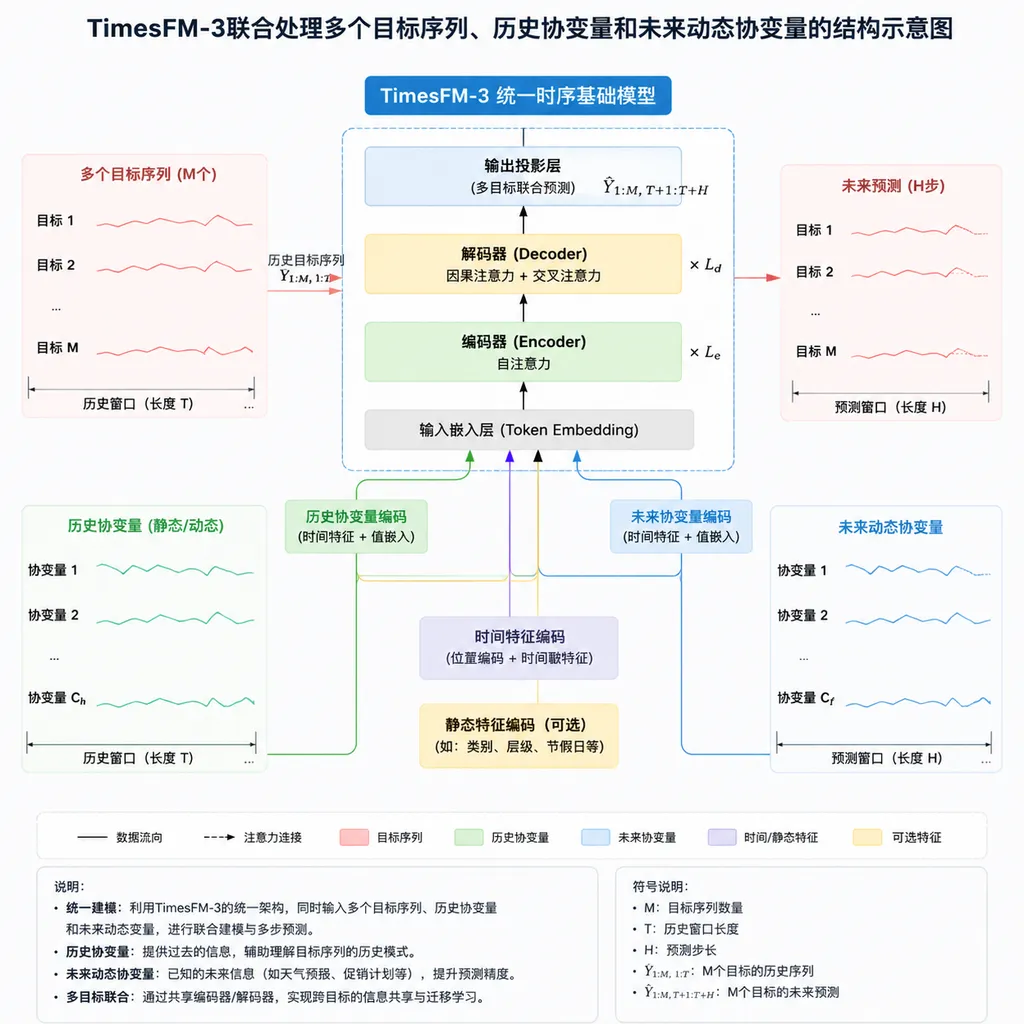
“Multivariate” Does Not Mean Simply Stitching Several Columns of Data Together
TimesFM-3 natively supports three types of inputs and forecasting methods:
- Multi-target forecasting: Forecasts multiple related series at once and provides both point and quantile forecasts;
- Past covariates: Accepts features available only for the historical period, such as observed store traffic, failure records, or actual transaction prices;
- Past-and-future dynamic covariates: Uses events whose future values are known or have already been estimated, such as promotion schedules, holidays, weather forecasts, and planned capacity.
The following simplified data structure illustrates the type of problem it addresses. This is not API invocation code, but an example of the input to a multivariate forecasting task:
timestamp: hourly
targets:
  - brand_a_sales
  - brand_b_sales
  - brand_c_sales
past_covariates:
  - store_traffic
  - actual_temperature
  - historical_price
future_covariates:
  - weather_forecast
  - promotion_schedule
  - planned_price
outputs:
  - point_forecast
  - quantile_0.1
  - quantile_0.5
  - quantile_0.9
Here, the sales of multiple brands are not three unrelated problems. A discount on Brand A may cannibalize Brand B’s sales; high temperatures may lift demand across the entire category; and a decline in store traffic may weaken all brands simultaneously. A true multivariate model must identify shared movements and mutual influences across these series, rather than running a univariate model three separate times on three columns of data.
This is the most substantive change in TimesFM-3 compared with its predecessors.
Google introduced a dual-attention mechanism to process both the temporal dimension and dependencies among variables. It can be understood as observing the data in two ways: once along the time axis to identify cycles, trends, and abrupt changes, and once across variables to compare how different targets and covariates move together.
This design is more sensible than simply flattening all the numbers into one extremely long sequence. Flattening not only causes attention-computation costs to rise rapidly, but can also blur the distinction between “the relationship between two consecutive time points” and “the relationship between two variables at the same moment.” The value of dual attention lies in processing these two structures separately before merging the information.
Continuous Patch Masking Bridges the Gap Between Training and Deployment
The TimesFM series retains the idea of “patching” time series: rather than treating every time point as an independent token, it packages a segment of consecutive data into a patch before passing it to the Transformer.
This is somewhat similar to how vision models divide images into small patches. For data sampled every minute, every second, or at even higher frequencies, calculating attention point by point quickly makes sequence lengths unmanageable. Compressing consecutive time points into patches can significantly reduce computational costs and make it easier to learn local patterns.
TimesFM-3 goes a step further by introducing continuous patch masking. Its core purpose is to expose the model during training to historical contexts of varying lengths and visible ranges, rather than allowing it to depend on a single fixed window.
Time series in real-world deployments are rarely as tidy as those in benchmark datasets. Some devices have just come online and have accumulated only a few days of records; some products have years of sales history; and some series contain gaps caused by data-collection failures. Masking consecutive patches during training effectively changes the historical range visible to the model, forcing it to recover patterns from incomplete context.
This does not mean that TimesFM-3 can automatically solve every missing-value problem, but it helps narrow the gap between pretraining conditions and real-world inputs. This is especially important for zero-shot models: if each dataset is no longer fine-tuned before deployment, the pretraining stage must cover as many complex input patterns as possible.
Why 330 Million Parameters May Be More Practical Than Tens of Billions
TimesFM-3 has only 330 million parameters. In the world of general-purpose large models, that scale would barely qualify as “large.” However, time-series forecasting does not need to learn the full breadth of knowledge found in natural language. Instead, it must learn numerical patterns such as trends, cycles, lagged correlations, structural breaks, and uncertainty.
The modest parameter count brings at least three direct benefits:
- Manageable inference costs: Enterprises often need to forecast thousands or even millions of series simultaneously. A low cost per call is not enough; total throughput cost is what matters;
- Lower latency: Tasks such as inventory replenishment, traffic scheduling, and equipment alerts often require rolling updates by the hour or even by the minute;
- Easier private deployment: Time series often contain sensitive data such as sales, production capacity, cash flow, and equipment status. Smaller models are better suited to running on an enterprise’s own infrastructure.
An early version of the previous-generation TimesFM had roughly 200 million parameters and was pretrained on approximately 100 billion real-world time points. TimesFM-3 expands the training corpus to more than 1 trillion time points while introducing synthetic data and a native multivariate architecture. The dataset grew by an order of magnitude, while the increase in parameter count remained relatively restrained. This suggests that Google is not simply copying the language-model parameter race, but is instead pursuing generalization through broader data coverage and stronger architectural design.
This is a choice better suited to time-series applications. Enterprises will not pay merely because a forecasting model is “larger”; they will pay for lower error, fewer training workflows, and more stable throughput.
What Zero-Shot Forecasting Really Eliminates Is Model Maintenance, Not Just Training
The zero-shot capability emphasized by TimesFM-3 means that the model can directly process time series it did not encounter during pretraining, without retraining or fine-tuning for a specific task.
Traditional forecasting projects typically involve the following workflow:
- Define features and forecast horizons for each business scenario;
- Select among ARIMA, exponential smoothing, gradient-boosted trees, and deep-learning models;
- Split the data into training and validation sets and repeatedly tune hyperparameters;
- Maintain separate models for different product categories, regions, or devices;
- Retrain and backtest models after the data distribution changes.
The truly expensive part is often not the initial training, but the subsequent maintenance. A retailer may have tens of thousands of stores and hundreds of thousands of SKUs, while a manufacturer may operate tens of thousands of sensors. Even if each individual model is not complex, maintaining a large collection of specialized models turns version management, drift monitoring, and failure rollback into substantial engineering burdens.
TimesFM-3 aims to compress this workflow into “prepare context—run inference—validate performance.” It is more like a general-purpose initializer for time-series forecasting: first establish a reliable baseline without training, then decide whether a specialized model is worthwhile for high-value tasks.
That is also the most realistic way to deploy it, rather than attempting to replace all of an enterprise’s existing forecasting systems immediately.
Quantile Outputs Matter More Than a Single Definitive Answer
TimesFM-3 supports not only point forecasts but also quantile forecasts for all targets.
A point forecast answers only, “Approximately how many units will sell tomorrow?” A quantile forecast instead provides a range of possible outcomes. For example, if the median forecast is 1,000 units and the 90th-percentile forecast is 1,400 units, sales may approach the latter figure under a more optimistic or high-demand scenario.
For practical decision-making, intervals are often more valuable than point estimates:
- Inventory management must balance stockout costs against overstock costs;
- Power systems must reserve capacity for peak loads;
- Cloud-service scheduling must provision redundant resources according to risk tolerance;
- Financial risk management focuses not on average outcomes, but on tail risk.
If a model reduces average error slightly but cannot express uncertainty, its value in a decision-making system remains limited. TimesFM-3 unifies point and quantile forecasting across multiple targets, suggesting that Google is targeting not merely a single academic metric, but forecasts that can be integrated into planning systems.
But “Zero-Shot” Definitely Does Not Mean “Instant Victory”
TimesFM-3 is moving in a promising direction, but developers should not interpret zero-shot foundation models as the end of traditional methods.
First, time series are highly domain-specific. Financial markets, equipment vibrations, store sales, and medical monitoring all have different generative mechanisms. No matter how large the pretraining corpus is, it cannot be guaranteed to cover every extreme distribution.
Second, the covariates themselves may be unreliable. Weather forecasts can be wrong, promotion plans can change at the last minute, and upstream systems may accidentally leak future information into historical samples. Support for future covariates does not automatically eliminate data-governance problems.
Third, multivariate does not mean that more variables are always better. Feeding large numbers of irrelevant metrics into the model may introduce noise and increase inference costs. Variable selection, time alignment, frequency normalization, and missing-value handling remain foundational skills for production systems.
Fourth, zero-shot performance must be locally backtested against strong baselines. For tasks with highly stable seasonality and limited data, seasonal naïve methods, ETS, or ARIMA may still be cheaper and more transparent. In scenarios with abundant labeled data and stable business mechanisms, specially trained PatchTST, DeepAR, or tree-based models may also be more accurate.
A reasonable evaluation should therefore look beyond overall average error and compare at least the following:
- MAE, RMSE, or business-appropriate weighted error across different forecast horizons;
- Calibration and Pinball Loss for different quantiles;
- Performance on short-history series such as new products and newly deployed devices;
- Stability during abrupt-change periods such as promotions, failures, and holidays;
- Per-inference latency, batch throughput, and total cost of ownership.
If Google does not provide comprehensive evaluations covering these dimensions, developers should not select the model based solely on the labels “1 trillion time points” and “zero-shot.”
It May First Change the Development Sequence for Forecasting Systems
The most likely impact of TimesFM-3 is not that every company will immediately abandon its existing models, but that it will change the order in which time-series projects are developed.
In the past, teams often spent weeks building training pipelines before determining whether deep learning was effective. Now, they can first run a foundation model in zero-shot mode and compare its results with seasonal naïve methods, statistical models, and existing production models within the same backtesting framework. If out-of-the-box performance is already good enough, there is no need to rush into training a specialized model. If the gap is significant, the team can then invest in feature engineering and fine-tuning.
This will allow time-series foundation models to play three roles:
- Strong baseline: Quickly determine how difficult a task actually is;
- Cold-start model: Step in when new products, stores, or devices lack sufficient historical data;
- Fallback model: Provide backup forecasts when specialized models fail, data distributions drift, or training pipelines go down.
From this perspective, TimesFM-3’s 330 million parameters are not a compromise, but a product-positioning choice. It does not need to memorize world knowledge like a conversational model; it needs to be integrated into enterprise data pipelines for frequent, high-volume use. The ability to jointly forecast thousands of related series at relatively low cost is far more important than adding several billion more parameters.
Verdict: This Is the Generation That Takes the TimesFM Series From Demo to Production
The first two generations of TimesFM demonstrated that time-series foundation models can be competitive forecasters under zero-shot conditions. TimesFM-3 adds the capabilities that production environments truly need: native multivariate forecasting, dynamic covariates, and uncertainty outputs.
Its value does not lie in merely repackaging forecasting tasks with a Transformer. Rather, it lies in gradually turning models that previously had to be trained separately for each dataset into reusable, general-purpose capabilities. For teams with large numbers of related series, frequently changing business conditions, and model fleets that are difficult to maintain over the long term, this approach is genuinely useful.
Whether TimesFM-3 can become the default baseline for production systems will ultimately depend on three things: whether its zero-shot accuracy remains stable across domains, whether the cost of multivariate inference is manageable, and whether the model is reliable under abrupt changes, missing data, and distribution drift.
At least based on the information released today, Google has advanced the competition among time-series foundation models from “Can it accurately forecast a single curve?” to “Can it understand an interconnected business system?” That matters far more than the increase in parameter count itself.
References
- ITHome: Google Releases TimesFM-3, Enabling Zero-Shot Multivariate Time-Series Forecasting With 330 Million Parameters — Overview of the TimesFM-3 release date, parameter count, pretraining data volume, and native capabilities.