
3B activation parameters go head‑to‑head with the 27B dense model — the open‑source version of Qwen 3.6 is here
Today, Alibaba open-sourced Qwen3.6-35B-A3B, an MoE model with 35 billion total parameters and only 3 billion active parameters. It significantly surpasses its predecessor in agent programming and multimodal reasoning, even matching Claude Sonnet 4.5 in certain visual tasks.
Two weeks ago, Qwen3.6-Plus made its debut through an API, and today Alibaba has released its open-source version.
On April 16, Alibaba’s Qwen Team officially open-sourced Qwen3.6-35B-A3B — a Mixture-of-Experts (MoE) model with 35 billion total parameters, of which only 3 billion are activated per inference. The model weights are now available on Hugging Face and ModelScope, while the API can be accessed under the name qwen3.6-flash via Alibaba Cloud Bailian.
This is not a routine version update. From benchmarks to real-world use cases, Qwen3.6-35B-A3B demonstrates a new level of capability density that is redefining the limits of what “small models” can do.
First, the takeaway — where it truly excels
The core selling point of Qwen3.6-35B-A3B can be summed up in one sentence — it delivers the performance of a 27B dense model using only 3B activated parameters.
Specifically:
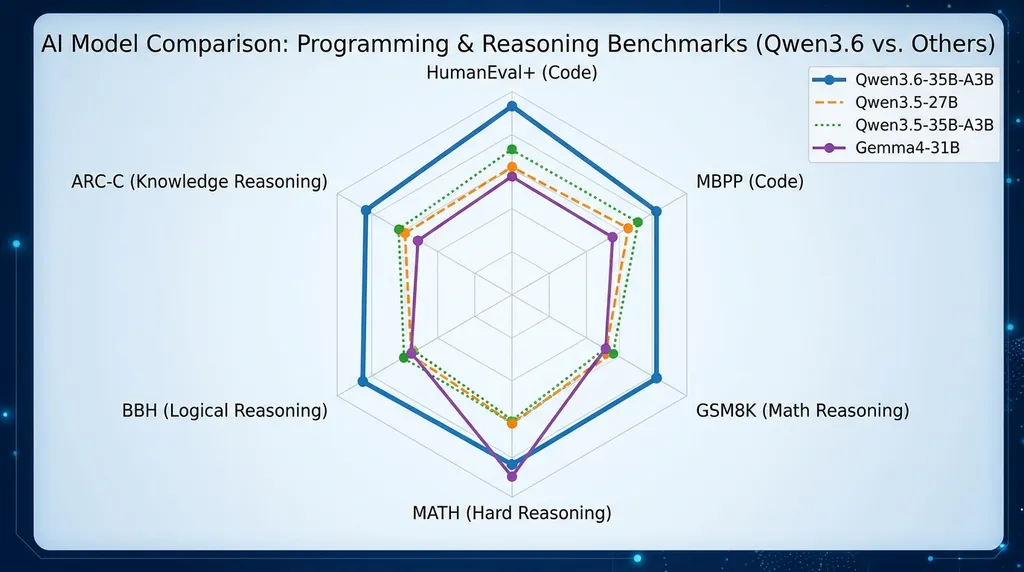
- Outperforms its predecessor Qwen3.5-27B (a 27B dense model) on key programming benchmarks
- Greatly surpasses Qwen3.5-35B-A3B, the direct predecessor, in agentic programming and reasoning tasks
- Matches Claude Sonnet 4.5 on most vision-language benchmarks, and even exceeds it on some
- Exceptional spatial intelligence performance, achieving a RefCOCO score of 92.0
In other words, if you previously found Qwen3.5-27B too memory-heavy or slow during inference, now you have a replacement that activates less than one-ninth of its parameters but offers equal or even superior coding capability.
MoE architecture — how 3B parameters can match a 27B model
If you’re unfamiliar with the MoE (Mixture of Experts) architecture, think of it like this: a traditional dense model activates all its parameters during inference — like a company mobilizing all employees for every task. In contrast, an MoE model contains multiple “expert networks,” and only a few relevant experts are activated per inference while others remain dormant.
Qwen3.6-35B-A3B has 35 billion total parameters, but only about 3 billion are activated per token. That means:
- The knowledge capacity depends on the 35B total parameters — it “knows” as much as a dense 35B model.
- The inference cost depends on the 3B activated parameters — each forward pass is as lightweight as a 3B model.
That’s the core value of MoE: trading storage for computation. You need more VRAM to hold full weights, but every inference consumes far fewer FLOPs.
From Qwen3.5 real-world data, the 35B-A3B MoE model required only 32GB VRAM at 4-bit quantization, running 122 tokens/second on an RTX 4090. Since Qwen3.6-35B-A3B keeps the same specs, deployment should be similar — runnable on a single consumer-grade GPU, making it very developer-friendly for individuals and small teams.
Agentic Programming — the main highlight
Starting with Qwen3.6-Plus, Alibaba positioned Agentic Coding as the core focus of this generation. The open-source version carries this forward.
What is Agentic Programming? In simple terms, it’s not about generating a piece of code for you — it’s about enabling the model to act like a junior engineer who can:
- Understand your requirements and break them down into subtasks
- Autonomously call tools (terminal commands, file operations, API calls, etc.)
- Evaluate results and decide what to do next
- Detect, debug, and fix errors on its own
This demands much more than simple code generation — including long-horizon planning, precise tool use, and consistent multi-step context management.
The official blog described it as having “outstanding agentic coding ability comparable to much larger models.” Judging from Qwen3.6-Plus, which featured targeted optimization for code repair, terminal automation, and multi-step agent tasks, Qwen3.6-35B-A3B likely inherits those improvements.
A notable detail: During the Qwen3.5 era, developers found the 35B-A3B MoE version underperformed the 27B dense model on multi-step agent tasks — because 3B activation was insufficient for long-chain reasoning. Qwen3.6 clearly addressed this weakness; Alibaba even claims it surpassed the 27B dense model on programming benchmarks, implying the issue was effectively solved.
For developers integrating it into coding assistants, CI/CD pipelines, or automation tools, this signals that small-scale MoE models are rapidly approaching — or even surpassing — mid-sized dense models in agent usability.
Native multimodality — not just image interpretation
Qwen3.6-35B-A3B continues the native multimodal training path from Qwen3.5 — rather than attaching a vision encoder to a text model, it fuses text and vision information during pretraining.
The results are impressive. The official benchmarks claim this 3B-activation model performs on par with Claude Sonnet 4.5 on most multimodal tasks — an extraordinary feat given Claude Sonnet 4.5 is Anthropic’s flagship multimodal model.
Key capabilities include:
- Complex document understanding: Handles multi-page PDFs, tables, and mixed text-image layouts
- Spatial intelligence: RefCOCO 92.0 — accurately identifies object relations within an image
- Video reasoning: Performs temporal analysis and logical inference on video content
- Visual programming: Generates front-end code from a UI screenshot
For multimodal app developers, this means you no longer need a separate vision model. A 32GB MoE model instance can handle both text reasoning and visual perception, simplifying deployment architectures significantly.
Thinking vs. Non-thinking modes — flexible switching
Qwen3.6-35B-A3B supports two inference modes:
- Thinking mode: Performs internal reasoning (Chain of Thought) before outputting an answer — ideal for math, logic, and complex coding.
- Non-thinking mode: Skips internal reasoning and outputs directly — ideal for simple Q&A or latency-sensitive tasks.
This dual-mode design helps control costs. Thinking mode consumes more tokens (since reasoning is part of the output), while non-thinking mode is cheaper. Developers can dynamically switch between modes for optimal balance of quality and efficiency.
How to use — deployment and access
Three ways to get started, covering different use cases:
1. Online access
Try directly at Qwen Studio (chat.qwen.ai) — zero setup required.
2. API access
Invoke via Alibaba Cloud Bailian under the model name qwen3.6-flash.
On OpenAI-compatible aggregation platforms (like OpenAI Hub), it’s plug-and-play — just change the model name:
from openai import OpenAI

client = OpenAI(
    api_key="your-openai-hub-key",
    base_url="https://api.openai-hub.net/v1"
)

response = client.chat.completions.create(
    model="qwen3.6-flash",
    messages=[
        {
            "role": "user",
            "content": "Write a Python script to monitor file changes in a specified directory. When new files appear, automatically run lint checks and output a report."
        }
    ]
)

print(response.choices[0].message.content)
Multimodal calls use the same interface pattern:
response = client.chat.completions.create(
    model="qwen3.6-flash",
    messages=[
        {
            "role": "user",
            "content": [
                {
                    "type": "image_url",
                    "image_url": {"url": "https://example.com/ui-screenshot.png"}
                },
                {
                    "type": "text",
                    "text": "Based on this UI screenshot, generate the corresponding component code using React + Tailwind CSS."
                }
            ]
        }
    ]
)

print(response.choices[0].message.content)
3. Local deployment
Download model weights from Hugging Face or ModelScope and load using vLLM, Ollama, or llama.cpp.
With 4-bit quantization, it runs comfortably with 32GB VRAM, delivering solid performance on a single RTX 4090.
Competitor comparison — where it stands
Placing Qwen3.6-35B-A3B in the open-source landscape:
| Model | Architecture | Total Params | Activated Params | Positioning | |--------|---------------|---------------|----------------|--------------| | Qwen3.6-35B-A3B | MoE | 35B | 3B | Lightweight, agentic coding | | Qwen3.5-35B-A3B | MoE | 35B | 3B | Previous generation, fully surpassed | | Qwen3.5-27B | Dense | 27B | 27B | Dense model, now outperformed on programming benchmarks | | Gemma4-31B | Dense | 31B | 31B | Google open-source, comparable overall capability |
Key takeaways:
- Compared to Qwen3.5-35B-A3B, this is a qualitative leap, not a numerical upgrade. Same architecture, same parameter scale — yet major improvements in agent and reasoning indicate deep training optimization.
- Surpassing Qwen3.5-27B (a 27B dense model) on programming benchmarks verifies the MoE architecture’s practical effectiveness. Qwen3.6 answers earlier doubts about whether 3B activation suffices for complex agent tasks — it does.
- The comparison with Gemma4-31B is intriguing — similar overall ability, but Gemma4 activates all 31B parameters, making inference an order of magnitude costlier. For throughput and cost-sensitive scenarios, MoE wins hands down.
- The claim of matching Claude Sonnet 4.5 in vision tasks should be tempered — benchmarks don’t always equate to real-world experience. Nevertheless, even at “70% parity,” a 3B activation open-source model reaching that multimodal level is a major operational advantage.
What this means for developers
Practically speaking:
- If you’re building a coding assistant, Qwen3.6-35B-A3B may currently be one of the best open-source foundations by cost-performance ratio.
Low 3B activation means cheap inference, while its Agentic coding ability supports code generation, repair, and tool use — capabilities once limited to closed APIs. - If you’re developing multimodal apps, a single model that handles both text and vision halves operational complexity.
- If you prefer local deployment, a 32GB VRAM requirement means one RTX 4090 or M2 Ultra is enough. For independent developers and small teams, this is a truly feasible setup — not just a theoretical “PPT deployment.”
Of course, MoE models have limits. Although activation is lower, total weights are still 35B — VRAM usage during loading is comparable to a dense 27B model under equal quantization. MoE shines in inference speed and throughput, not memory reduction.
The Qwen3.6 roadmap
Timeline recap:
- April 2: Qwen3.6-Plus released — closed API, focused on agentic programming
- April 16: Qwen3.6-35B-A3B — open-sourced MoE version, lightweight and efficient
- Upcoming: Qwen3.6-Max (higher performance) and more open-sized variants
Alibaba’s strategy is clear: use closed-source flagship models to validate direction, then open-source to expand the ecosystem.
Qwen3.6-Plus proved its agent-related competitiveness; Qwen3.6-35B-A3B brings that power to the community at minimal cost.
From Qwen3 → 3.5 → 3.6, the Qwen team’s pace is accelerating — and each iteration now has clear thematic focus rather than incremental metric gains. Qwen3.6 is defined by agents and programming: evolving models from “can write code” to “can autonomously complete programming tasks.”
That’s the right bet. By 2026, the greatest growth in AI applications will be in agents.
Whoever delivers models that are better, cheaper, and easier to deploy for Agent scenarios will reap the rewards — and Alibaba is clearly aiming to secure that position in open source.
References:
- ITHome: Alibaba Qwen3.6-35B-A3B Open Source Release — Official launch and introduction
- Linux.do Community Discussion: Qwen3.6 Open Source Released — Developer community first reactions


