<think>**Translating headline idiomatically**</think> Grok 4.7 Gets a Release Date, with 2.1 Trillion Parameters Set to Challenge for the Most Powerful Model Title
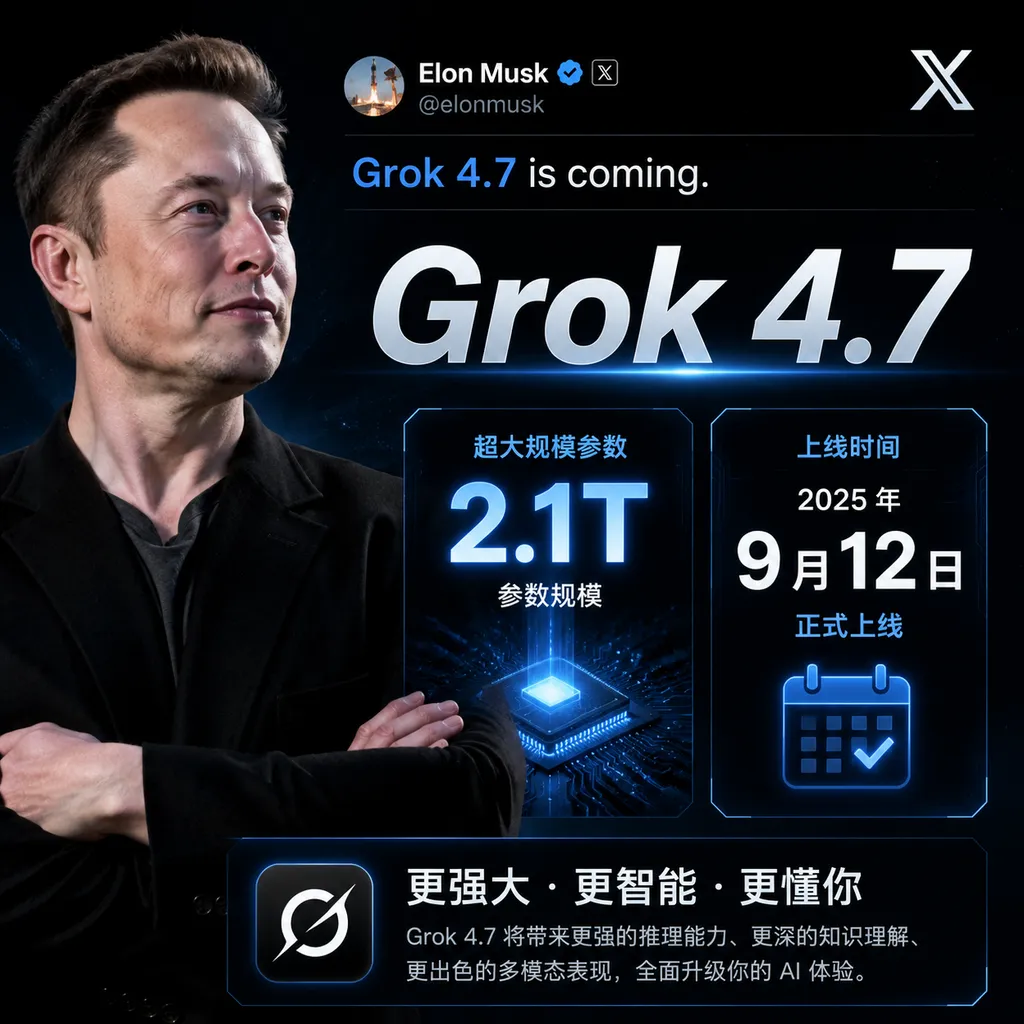
Musk announced that Grok 4.7 is expected to launch on September 12, with its parameter count increasing from 1.5 trillion in Grok 4.6 to 2.1 trillion. xAI claims that the new model will trade slightly slower service speeds for greater token efficiency, but its true competitiveness will still depend on public benchmarks, pricing, and API stability.
<think>Planning accurate markdown-preserving translation</think>
Grok 4.7 Gets a Release Date, 2.1 Trillion Parameters Aim for the Most Powerful Model
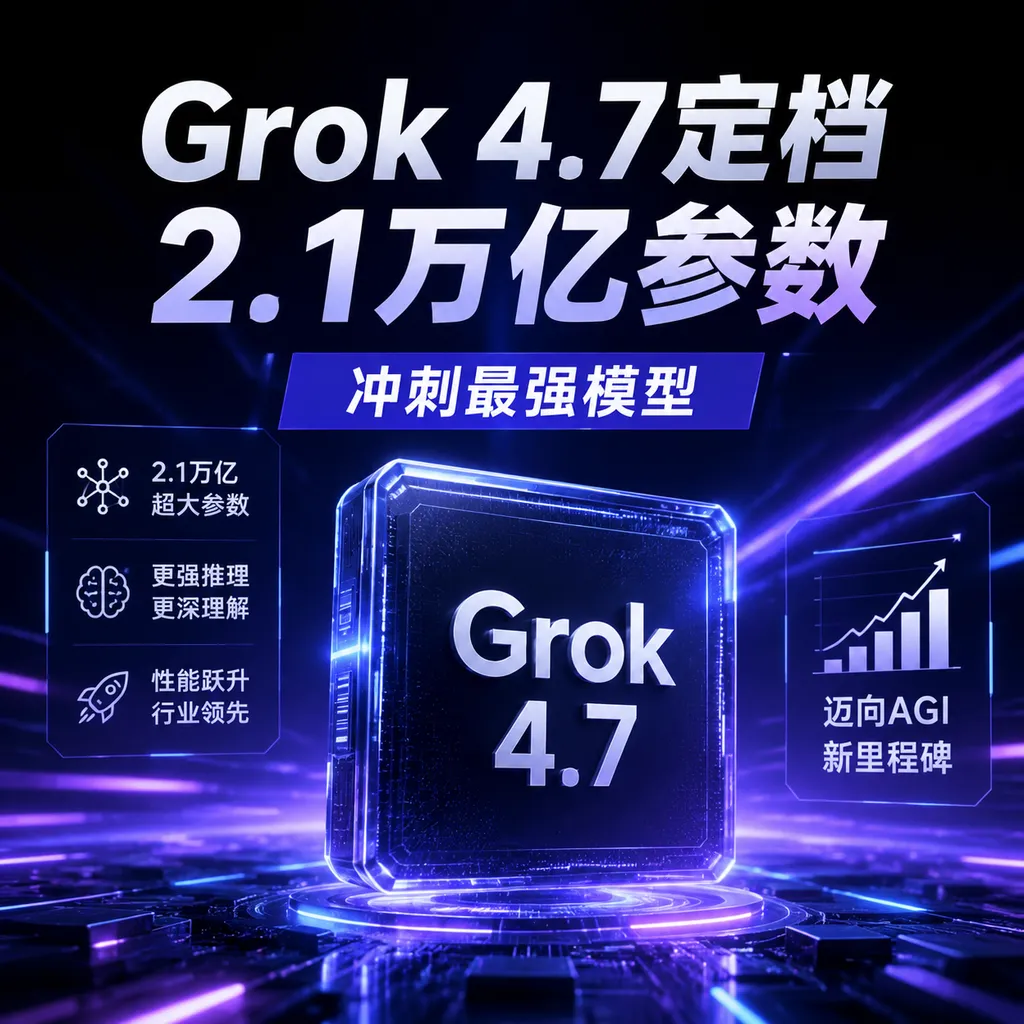
Musk has set a specific date for Grok 4.7: September 12, 2026.
On September 2, he announced on X that Grok 4.7 would be released ten days later. According to information he disclosed previously, the new model will have 2.1 trillion parameters, approximately 40% more than Grok 4.6, which launched in August with 1.5 trillion parameters. Musk’s assessment was also quite direct: apart from potentially being slightly slower in service, Grok 4.7 will outperform Grok 4.6 in every respect while also offering greater Token efficiency.
This is not a routine minor-version update. For xAI, Grok 4.7 looks more like a concentrated increase in model scale, training data, and agent capabilities. Musk has also said previously that, once released, Grok 4.7 will “surpass all existing models.”
The problem is that 2.1 trillion parameters alone cannot automatically translate into the most powerful model. They show that xAI is willing to continue investing massive amounts of computing power, but they do not directly prove that the model will lead in coding, tool use, long-context processing, or real-world production tasks.
A 40% Parameter Increase, with Speed as a Potential Trade-Off
Grok 4.7’s parameter count will rise from 1.5 trillion to 2.1 trillion, representing a nominal increase of approximately 40%. If these parameters correspond to the effective activated parameter count rather than merely the total parameter count, they could provide greater knowledge capacity, deeper reasoning, and stronger performance on complex tasks.
However, publicly available information does not currently specify the architecture used by Grok 4.7, nor does it disclose whether it is a dense model or an MoE (Mixture of Experts) model.
This distinction is important.
If it is a dense model, every inference would require large-scale computation across 2.1 trillion parameters, making service costs and latency extremely high. If it is an MoE model, the 2.1 trillion parameters would be closer to the model’s “total repository,” with only a portion of the experts activated for each Token, potentially making the actual inference cost much lower. Many next-generation large models increase their total parameter count while controlling inference costs through sparse activation. Therefore, model performance cannot be compared simply by looking at total parameter counts.
Musk has already acknowledged in advance that Grok 4.7 may be slightly slower in service. This statement effectively exposes the practical costs of the upgrade:
- Greater model capacity may raise the ceiling for complex reasoning, knowledge association, and multistep tasks;
- Longer generation chains may increase first-Token latency and overall response time;
- Higher inference costs will directly affect API pricing and concurrency;
- Greater pressure on service clusters may lead to throttling or degradation during peak periods.
For ordinary chat users, a slight decrease in speed may not be critical. For developers, however, latency is part of the product metrics. A model that delivers 10% higher-quality answers but makes a customer-service bot, coding agent, or real-time search application wait an additional two seconds is not necessarily the better choice.
“Higher Token Efficiency” Is More Worth Watching Than Parameter Count
Compared with 2.1 trillion parameters, Musk’s mention of “higher Token efficiency” is actually more relevant to developers.
Token efficiency can be understood from at least two perspectives.
First, the model may be able to complete the same task with fewer input Tokens. For example, in long-document question answering, the model may be able to locate key information more accurately instead of repeatedly restating the context. In coding-agent scenarios, it may reduce meaningless file reads, repetitive explanations, and trial-and-error tool calls.
Second, the model may be able to produce results of equivalent quality with fewer output Tokens. For API users, this means not only faster responses but also lower costs. In Agent scenarios in particular, a single task may involve dozens of consecutive model calls. Saving a few hundred Tokens per call can result in substantial cumulative savings.
This can be compared to two cars: one has a larger engine but takes a detour every time, while the other may not have the biggest engine but can reach its destination by a shorter route. What truly affects a developer’s bill is not the number of parameters, but the total Tokens consumed, number of calls made, and amount of waiting time required to complete a task.
Of course, xAI has not yet published Grok 4.7’s Token-consumption curves, context length, caching mechanisms, or actual pricing. “Higher Token efficiency” remains a product slogan and has not yet become a verifiable engineering metric.
Grok 4.6 Has Reached the Top Tier, but Coding Remains a Weakness
To understand Grok 4.7’s competitive position, it is necessary to first examine Grok 4.6.
Grok 4.6 launched on August 12. Publicly compiled information shows that it scored 61 on the Artificial Analysis Intelligence Index, matching GPT-5.6 Sol and slightly below Anthropic’s Fable 5 and Opus 5. Other information suggests that Grok 4.6 performed strongly in tests involving knowledge work and legal reasoning, but scored approximately 26% on coding-agent-oriented evaluations such as Terminal-Bench v3.0, trailing some competing models.
These results indicate that Grok 4.6 has already entered the top tier, but is not yet a model with “no obvious weaknesses across the board.”
Its strengths appear to include:
- Strong performance in real-time information, knowledge-based question answering, and complex text tasks;
- Continued improvements in long-running agent tasks and vision-related scenarios;
- Relatively aggressive pricing, offering high cost-effectiveness for API calls;
- Close integration with products such as Grok, Cursor, and Grok Build.
Its weaknesses are concentrated primarily at the engineering-execution level. A coding agent does not merely generate a piece of code. It must understand a codebase, modify multiple files, run tests, locate errors, and continue iterating after failure. What matters here is discipline in tool use, state management, error recovery, and stability during long-running tasks—not merely how intelligent the model appears in a single response.
If Grok 4.7 only expands the model scale without improving these areas, it may look better on leaderboards while offering limited improvement to real software-development workflows.
xAI May Turn Its Data Advantages into Product Differentiation
One obvious difference between the Grok series and other closed-source models is its deep connection to the real-time information stream on the X platform. Supplementary materials also mention that Grok 4.7 may use proprietary data from Cursor and SpaceX for training or enhancement.
There is currently no complete official disclosure regarding this information. However, if it is accurate, Grok 4.7’s positioning would not simply be that of “a larger general-purpose language model.” Instead, it would be attempting to combine several data advantages:
- Real-time public discussions and event information from the X platform;
- Coding, debugging, and development-workflow data that Cursor may provide;
- Engineering, manufacturing, and complex-systems data related to SpaceX scenarios;
- Interaction feedback from Grok’s own chat, search, and agent products.
This type of data may not enable the model to lead on every benchmark, but it could give the model a more distinctive advantage in certain real-world tasks. For example, when users ask the model to summarize an event that has just occurred, analyze code that is currently being iterated on, or have an Agent continuously execute a task, a data-and-product feedback loop may be more valuable than simply adding parameters.
However, proprietary data also raises two issues.
The first is data quality. Real business data is usually noisier and more disorganized. Without rigorous cleaning, it may instead reinforce erroneous patterns.
The second is compliance and explainability. When developers use models in enterprise environments, they often need to know the sources of training data, data-isolation policies, log-retention periods, and whether enterprise inputs will be used for subsequent training. The stronger the model becomes, the less likely enterprises are to look only at benchmark scores.
What Developers Should Watch After the September 12 Launch
Once Grok 4.7 becomes officially available, developers should focus less on the highest score shown at the launch event and more on the following metrics, which can directly affect production environments.
1. Context Length and Long-Context Stability
Claiming to support a certain context length is one thing; accurately finding information within a long context is another. Developers should focus on testing the model’s ability to locate information in large codebases, collections of contracts, log files, and multiparty conversations, rather than simply inserting a long document and checking whether it can generate a summary.
2. Tool Use and Structured Output
For Agent applications, function calling, adherence to JSON Schema, parallel tool calls, and error recovery are more important than ordinary chat capabilities. A “smart model” that frequently outputs invalid JSON still requires extensive external fixes in a production environment.
3. The Closed-Loop Capabilities of Coding Agents
It is recommended to test the model on real repositories rather than merely running a few algorithm problems. Observe whether it can complete the full chain of “read the issue—locate the file—modify the code—run the tests—fix failures—submit the changes,” while recording the total number of calls, total Tokens, and failure rate.
4. Latency, Rate Limits, and Peak-Period Stability
Musk has already warned that service speed may decrease. This means developers need to monitor P50 and P95 latency, as well as whether queuing, timeouts, or automatic degradation occur under high concurrency. For real-time applications, P95 is often more informative than average speed.
5. Pricing and Caching Policies
If Grok 4.7’s output pricing is significantly higher than that of 4.6, the parameter upgrade may not provide any real cost advantage. Developers should also pay attention to input caching, batch calls, long-context billing, and whether reasoning Tokens are priced separately.
Prepare for Model Switching by Connecting Through OpenAI Hub
Grok 4.7 has not yet officially launched. The specific API model name, pricing, context window, and rate-limit rules should be determined by announcements released by xAI and the platform on September 12. If the model provides a compatible interface after launch, developers can use OpenAI Hub’s unified OpenAI-style interface to switch among Grok, GPT, Claude, Gemini, DeepSeek, and other models, avoiding tight coupling between business logic and a single vendor’s SDK.
Below is an example call using the OpenAI-compatible format. The model name in the example should be replaced with the configuration actually available on the platform. Before formal integration, developers should first confirm the available ID in the model list.
from openai import OpenAI

client = OpenAI(
    api_key="YOUR_OPENAI_HUB_KEY",
    base_url="https://openai-hub.com/v1"
)

response = client.chat.completions.create(
    model="grok-4.7",
    messages=[
        {
            "role": "system",
            "content": "You are a rigorous software engineering assistant. Prioritize verifiable and actionable solutions."
        },
        {
            "role": "user",
            "content": "Analyze the concurrency-safety issues in this code and provide recommendations for modifications."
        }
    ],
    temperature=0.2
)

print(response.choices[0].message.content)
A more robust engineering approach is to encapsulate model calls within your own service layer, allowing the business side to depend only on a unified message format. For example, place the model name, timeout, retry policy, Token budget, and fallback model in a configuration file. This way, even if Grok 4.7’s latency increases during peak periods, you can temporarily switch to another model without modifying the upper-level business logic.
However, a unified interface does not mean that model behavior will be completely consistent. Different models still vary in tool-call formats, adherence to system prompts, JSON output, visual inputs, and safety policies. Before launch, developers should establish a dedicated regression test set for Grok 4.7 covering, at minimum, core prompts, structured output, and failure-retry scenarios.
Whether 2.1 Trillion Parameters Can Make It the “Best at Everything” Requires Real-World Testing
From a timing perspective, the release of Grok 4.7 will further accelerate competition among closed-source models. In the past, model updates often arrived several months apart. Now, xAI is advancing Grok 4.7 less than a month after the release of Grok 4.6, indicating that model companies are turning version iteration into an ongoing competition in computing power and data.
However, “surpass all models” remains Musk’s judgment, not an established industry conclusion. Truly convincing evidence would need to meet three conditions simultaneously:
- Lead in public, reproducible evaluations rather than merely showcasing handpicked samples;
- Have no obvious weaknesses across different tasks, including coding, reasoning, long-context processing, vision, and Agents;
- Offer sufficient advantages in pricing, latency, stability, and tool ecosystems to support developer migration.
If Grok 4.7 can improve in all of these areas at once, it will become a more substantial general-purpose model option alongside GPT, Claude, and Gemini. It may be particularly competitive in real-time information, coding-agent, and high-frequency API-call scenarios.
If it merely increases the total parameter count and boosts benchmark scores while being delivered at a higher price and lower speed, developers will ultimately vote based on the cost per completed task.
The answer will become truly clear after September 12. At that point, the most important thing to watch will not be the 2.1T figure itself, but whether it can complete the real work in developers’ hands with fewer Tokens, fewer tool calls, and a lower failure rate.
References
- ITHome: Musk Announces That Grok 4.7 Will Launch in Ten Days — Provides the release date, parameter count, and Musk’s exact statements regarding the model’s performance and speed.
- Zhihu: AI Large-Model News Briefing — Compiles public evaluation results and pricing information for Grok 4.6, as well as early updates on Grok 4.7.