<think>**Translating Chinese headline**</think> TwinDEX Bets on Embodiment-Free Data to Replace Real-Robot Teleoperation

<think>**Translating company and concept names**</think> X Square has unveiled TwinDEX, a three-fingered, nine-DoF dexterous robotic hand. The company claims that its consistent design across the data-collection and execution systems makes robot-free data collection 5.3 times more efficient than teleoperating a physical robot, while allowing such data to almost entirely replace real-robot data during training.
<think>Translating company name as X Square</think>
X Square Launches TwinDEX: Dexterous-Hand Training No Longer Tied to the Robot Itself
On September 2, embodied AI company X Square launched TwinDEX, a pair of “twin” three-fingered dexterous hands with nine degrees of freedom: one is worn as a data-collection device to capture human manipulation data, while the other is mounted on a robot to execute tasks. The company’s central claim is that TwinDEX can train robots to perform dexterous manipulation without using any teleoperation data collected on physical robots.
The significance of this release lies not in the introduction of yet another dexterous hand, but in its attempt to rewrite how data is produced for embodied AI.
In the past, teaching a robot to unscrew a bottle cap, pick up a fragile object, or open a zipper typically required a human operator to control a physical robot through teleoperation equipment and demonstrate the task repeatedly. Such data does contain real-world physical information about contact, friction, force, and object deformation, but it also comes at a high cost: the number of available robots is limited, equipment wear is substantial, collection sites must remain fixed, and operators must spend long periods working in a “semi-immersive” state.
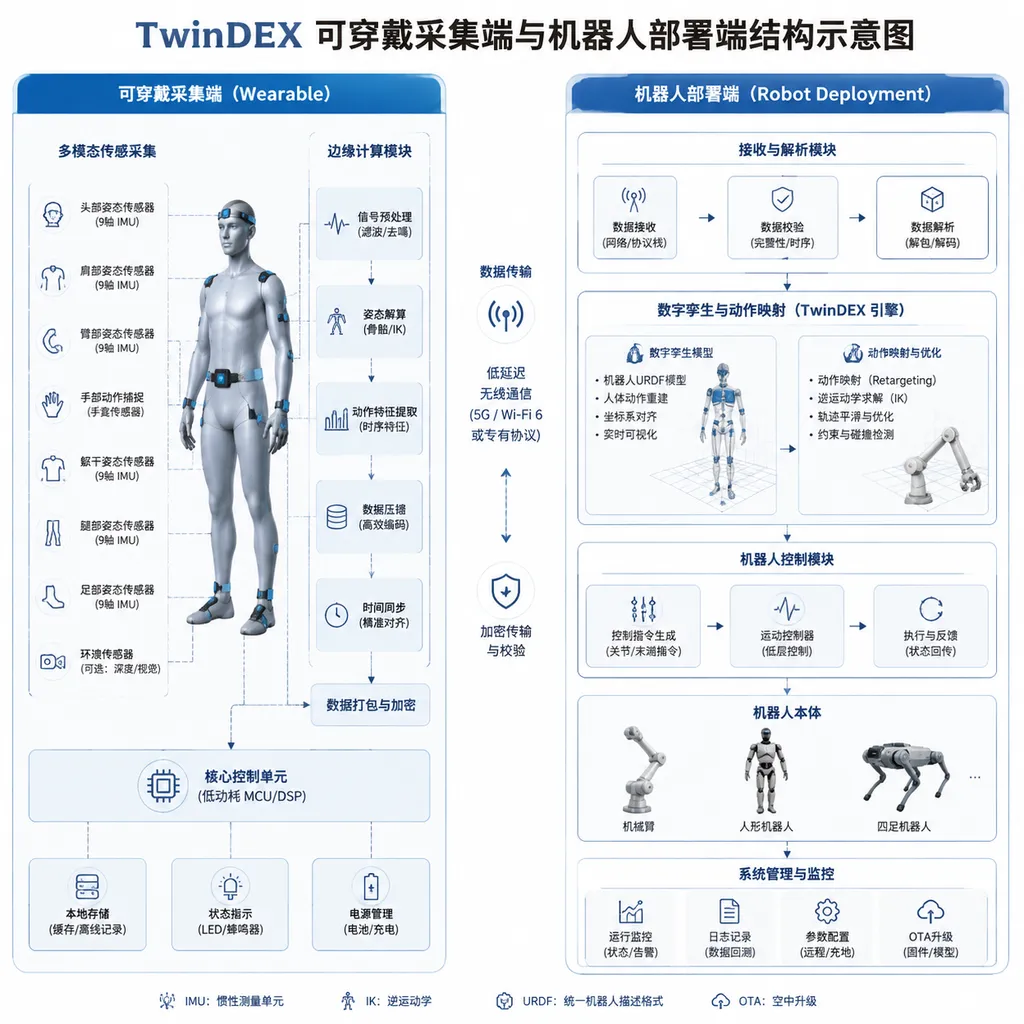
TwinDEX’s approach is to decouple the collection device from the robot itself. A person can wear a three-fingered exoskeleton-style device and perform actions on an ordinary tabletop; the system then maps those actions to a robot dexterous hand with the same structure. According to evaluation results published by X Square, TwinDEX collects embodiment-free data at 5.3 times the efficiency of physical-robot teleoperation. In model training, embodiment-free data can “almost completely replace 100%” of physical-robot teleoperation data.
Here, “embodiment-free” does not mean hardware-free, nor does it mean training solely on simulation data. Rather, it means that data collection does not depend on the robot platform on which the policy will ultimately be deployed. It is closer to a data-production model built around “human operators plus lightweight collection devices.”
Three Fingers and Nine Degrees of Freedom, Aiming First to Address Most Tasks
TwinDEX uses a three-fingered, nine-degree-of-freedom design, with seven actively actuated degrees of freedom. Compared with a five-fingered dexterous hand, this solution is clearly not intended to mechanically replicate the human hand in full. Instead, it represents a trade-off among dexterity, reliability, and cost.
X Square believes that coordinated use of the thumb, index finger, and middle finger can already cover most basic operations in everyday settings, including grasping, pinching, rotating, pushing, pulling, and repositioning small objects. The three-finger configuration is therefore defined as the “minimum viable solution” for dexterous manipulation.
This assessment is not overly aggressive. For robots, more fingers mean more joints, actuators, sensors, control loops, and potential points of failure. In theory, a five-fingered structure can support a broader range of poses, but if the control model cannot keep up, the additional degrees of freedom may simply enlarge the search space. For today’s robotic systems, which still rely heavily on vision-language-action models, the ability to perform key manipulation primitives reliably is often more important than having more fingers.
However, the three-finger approach also has clear limitations. For actions involving palm support, simultaneous force application by several fingers, complex enveloping grasps, or participation by the ring and little fingers, whether a three-fingered hand can maintain comparable stability still requires further verification through public testing. In industrial settings in particular, task success rates, continuous operating life, and adaptability to objects of different sizes will ultimately matter more than whether the hand can complete a single demonstration.
In other words, three fingers and nine degrees of freedom may be a highly reasonable engineering starting point, but they should not yet be equated with a general-purpose dexterous hand.
TwinDEX’s Real Technical Core: Making the Collection and Execution Units as Similar as Possible
The greatest challenge with embodiment-free data is not recording human actions, but ensuring that those recorded actions can be accurately executed by another device.
Kinematic differences naturally exist among human hands, wearable exoskeletons, and robotic dexterous hands. Differences in finger length, joint axes, and wrist position can all cause the same motion trajectory to shift when executed by the robot. For tasks requiring only coarse grasping, these errors may be acceptable. In dexterous manipulation, however, a deviation of just a few millimeters can mean missing a button, pinching an object off-center, or applying force in the wrong direction.
X Square’s approach is to design the collection unit backward from the desired deployment outcome, rather than first building a general-purpose data collector and then trying to “translate” its data for the robot. Its consistency-oriented design spans several dimensions:
- Kinematic consistency: The collection and execution units maintain, as closely as possible, the same degrees of freedom, joint axes, and link proportions, allowing actions to be mapped without complex cross-embodiment transformations.
- Contact-mechanics consistency: Contact materials, geometry, and surface properties are matched as closely as possible, with corresponding tactile sensors added so that the collection unit records not only finger positions but also mechanical information during contact.
- Visual-appearance consistency: The collection and execution units are made visually similar, reducing the domain gap that the model encounters when dealing with two different appearances.
- Control-precision optimization: Metrics such as joint error, wrist positioning, jitter, and long-term drift are optimized to reduce accumulated deviations when motions are reproduced.
- Training-strategy adaptation: The model architecture and training pipeline are designed to make the policy more tolerant of residual errors within an acceptable range.
This design explains why TwinDEX is not merely an ordinary “motion-capture glove.” Motion-capture gloves typically record human joint angles or spatial trajectories. Whether that data can directly drive a robot depends on subsequent kinematic retargeting, dynamic modeling, and policy learning. TwinDEX, by contrast, treats the collection device and the robot end effector as a paired system, prioritizing the reduction of differences between the two.
The advantage is a shorter data pipeline with one less complex alignment step during training. The trade-off is potentially lower generality. The more closely the collection and execution units match, the easier it is to transfer data directly to the paired robot. But if the data is used with a dexterous hand of a different structure, size, or number of degrees of freedom, its reusability will need to be reassessed.
From a “Robotics Laboratory” to a “Data-Collection Unit”
Another shift introduced by TwinDEX is its attempt to free dexterous-manipulation data collection from fixed robots and fixed locations.
X Square positions the wearable three-fingered exoskeleton as the collection unit, emphasizing that “one operator, one table, and one exoskeleton constitute a complete data-collection unit.” The exoskeleton can also provide force feedback, helping operators perform contact-intensive and fine-grained operations naturally. In theory, companies can scale data collection in parallel simply by adding devices and operators, without simultaneously purchasing large numbers of expensive robots.
This is critical for embodied AI companies. The bottleneck in physical-robot teleoperation is often not just the cost of data, but also production efficiency: one robot can collect only one trajectory at a time, while equipment failures and environmental resets interrupt the process. Wearable collection devices function more like “data-entry terminals,” enabling multiple people to demonstrate tasks simultaneously and potentially collect actions across a wider variety of household, warehouse, and industrial environments.
However, large-scale collection does not automatically produce large quantities of useful data. Operators differ in their movement habits, the forces they apply during contact, and their understanding of what constitutes successful task completion. To involve more people in collection, companies must also address operator training, data-quality stratification, failed-sample management, privacy, and scenario standardization.
Moreover, embodiment-free collection inherently lacks some of the constraints present at the deployment site. In actual operation, robots may encounter different table heights, lighting conditions, object materials, joint friction, and end-effector loads. No matter how closely the collection unit resembles the execution unit, it cannot fully reproduce the physical-robot environment. Accordingly, TwinDEX’s claim that it can “replace nearly 100%” of physical-robot teleoperation data should be interpreted more precisely: for its tested tasks, paired hardware, and training pipeline, embodiment-free data achieved training results close to those obtained with physical-robot data—not that physical-robot data is no longer needed for any robotic task.
Can It Replace Physical-Robot Teleoperation? For Now, It Appears More Likely to Replace Most of It, Not All of It
The industry values physical-robot teleoperation data because it captures real physical interactions. The instant a robot finger contacts an object, friction, slippage, collision, elastic deformation, and force feedback all arise. This information is difficult to fully reconstruct from visual trajectories or simulation alone.
TwinDEX’s approach does not fundamentally deny the importance of such information. Instead, it uses hardware consistency and tactile sensing to transfer some of those physical interactions to the collection unit. As long as the collection and deployment units are sufficiently similar in their key contact properties, the model has an opportunity to use those signals directly for policy learning.
A more realistic industry pathway may therefore be:
- Embodiment-free data handles large-scale pretraining and skill coverage, rapidly collecting basic operations such as grasping, rotating, pushing, pulling, and organizing.
- Simulation data supplements long-tail scenarios, expanding the range of object types, arrangements, and environmental variations.
- A small amount of physical-robot data calibrates deployment discrepancies, addressing friction, load, latency, and safety constraints on the real device.
- Online operational data supports continuous iteration, feeding failed examples back into the training loop.
If TwinDEX can maintain performance close to that of physical-robot data across a broader range of tasks, its greatest contribution will not be eliminating physical-robot data altogether, but relegating physical-robot teleoperation from the “primary data source” to “critical calibration data.” That alone would be enough to transform the cost structure.
Compared with the industry’s common “pretrained foundation model plus post-training adaptation” approach, TwinDEX focuses more specifically on the efficiency of producing post-training data. Embodied foundation models trained primarily on human videos can provide action priors and scene understanding, but adapting them to a specific dexterous hand still requires device-specific data. TwinDEX aims to make this step cheaper and faster while reducing the losses introduced by cross-embodiment mapping.
The Real Test Lies Beyond the Publicly Disclosed Metrics
The information currently available focuses primarily on collection efficiency and the rate at which embodiment-free data can replace physical-robot data. However, it does not disclose enough testing details, such as:
- Which specific tasks, number of operators, and statistical methodology underlie the “5.3×” figure;
- Whether the nearly 100% replacement rate is calculated based on success rate, convergence speed, or final policy performance;
- The size of the training dataset, model architecture, and training duration;
- Whether generalization was tested on new objects, new environments, and new operators not involved in data collection;
- How force-control, tactile-sensing, and latency metrics between the collection and deployment units are quantified;
- Whether the data remains effective when used with robots of different sizes or configurations.
The answers to these questions will determine whether TwinDEX represents a reproducible technical paradigm or a solution deeply coupled to a specific end-effector design.
For embodied AI developers, the most important issue is not whether a system is “purely embodiment-free,” but the total cost of the data loop and the ultimate task success rate. Even if a system requires no physical-robot teleoperation, its overall benefits may be diminished if the collection unit is expensive, calibration is complex, or substantial manual correction is still needed during deployment. Conversely, if it can reduce the cost of collecting and training each effective skill by an order of magnitude, it will have commercial value even if a small amount of physical-robot calibration remains necessary.
Conclusion: Dexterous Manipulation Is Shifting from a “Hardware Problem” to a “Data-Engineering Problem”
The signal sent by TwinDEX is clear: competition among dexterous hands will not remain limited to the number of degrees of freedom, appearance, and payload capacity. The efficiency of data collection and transfer is becoming an equally important product metric.
Three fingers and nine degrees of freedom represent an engineering compromise. Consistency between the collection and execution units is the prerequisite for embodiment-free training. Wearability and modularity, meanwhile, provide the infrastructure needed to expand data production beyond a small number of robotics laboratories to a much larger pool of operators.
X Square’s claim that TwinDEX can almost completely replace physical-robot teleoperation data still requires validation through more public benchmarks and cross-task results. But the direction of this approach is sound: transform expensive, scarce, and difficult-to-parallelize physical-robot teleoperation into easily replicable collection units, then use a small amount of physical-robot data for real-world calibration.
The true scaling law of embodied AI may not be merely about adding more model parameters, but about making each useful manipulation trajectory inexpensive to produce, transfer, and reuse. That is precisely what TwinDEX is betting on.
References
- ITHome: X Square Launches the TwinDEX Three-Fingered, Nine-DoF Dexterous Manipulation Hand: Introduces TwinDEX’s product form, three-fingered nine-degree-of-freedom design, embodiment-free data-collection efficiency, and official technical details.