<think>**Translating project title accurately**</think> Meta Muse Spark 1.3 Sprint Agent
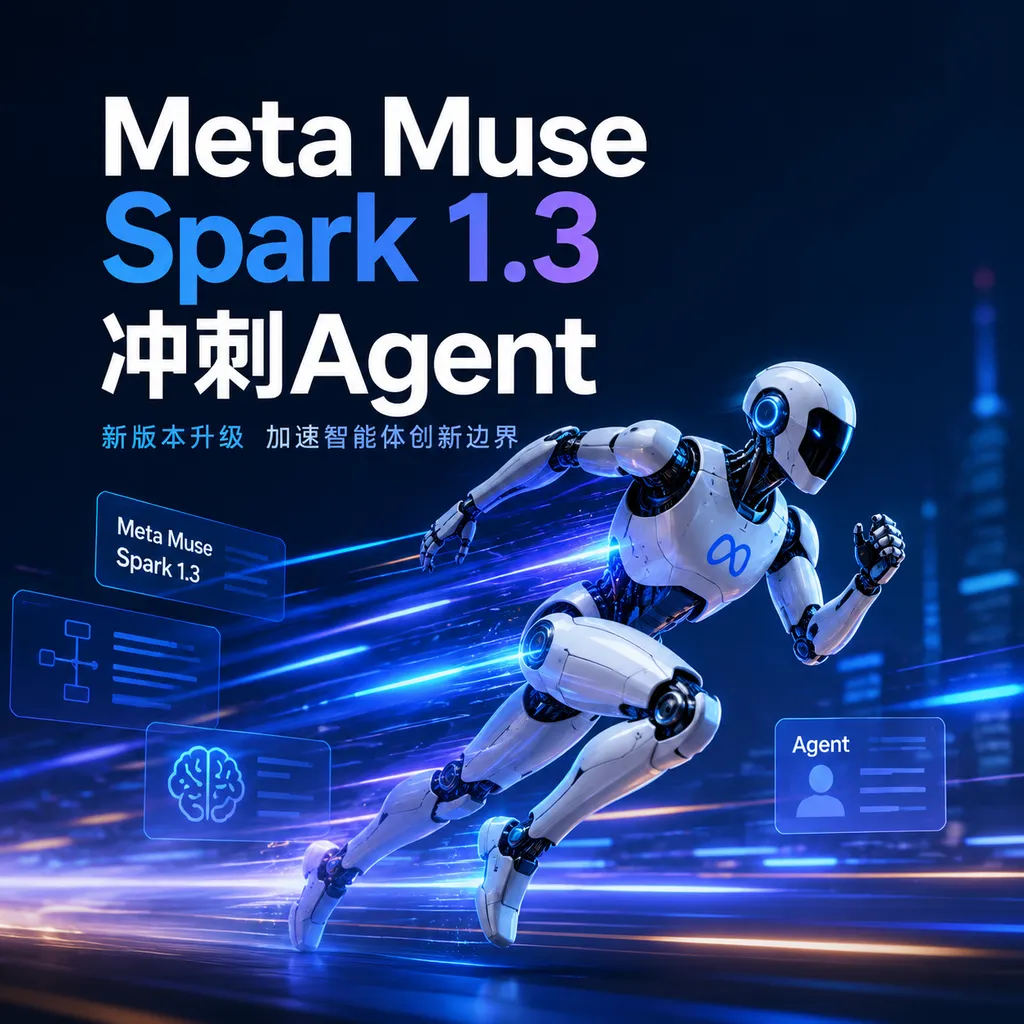
<think>**Identifying product names and translation needs**</think> Meta releases Muse Spark 1.3, focusing on major upgrades to long-running agents and coding capabilities. It claims coding performance surpasses GPT-5.6 Sol and matches Claude Fable 5.1. API pricing remains unchanged at $1.25 per million input tokens.
<think>Planning markdown-preserving translation</think>
Meta Muse Spark 1.3: A Long-Running Agent Workflow Sprint, at the Same Price
Meta released Muse Spark 1.3 on September 2. This is not simply a routine model upgrade, but a clear iteration focused on how Agents work: the model is expected to retain goals over longer task chains, manage tool calls, revise plans, and pause to ask for human input when intervention is genuinely needed.
Meta Chief AI Officer Alexandr Wang said that Muse Spark 1.3’s coding capabilities have surpassed those of OpenAI GPT-5.6 Sol and are on par with Anthropic Claude Fable 5.1. However, this conclusion currently comes primarily from comparisons conducted by Meta. External developers still need to validate it using real-world codebases, complex refactoring tasks, and long-running workflows.
The model is already becoming available through the Meta Model API and Muse Code. More notably, Meta has not raised prices alongside the capability upgrade: Muse Spark 1.3 retains Muse Spark 1.2’s pricing.
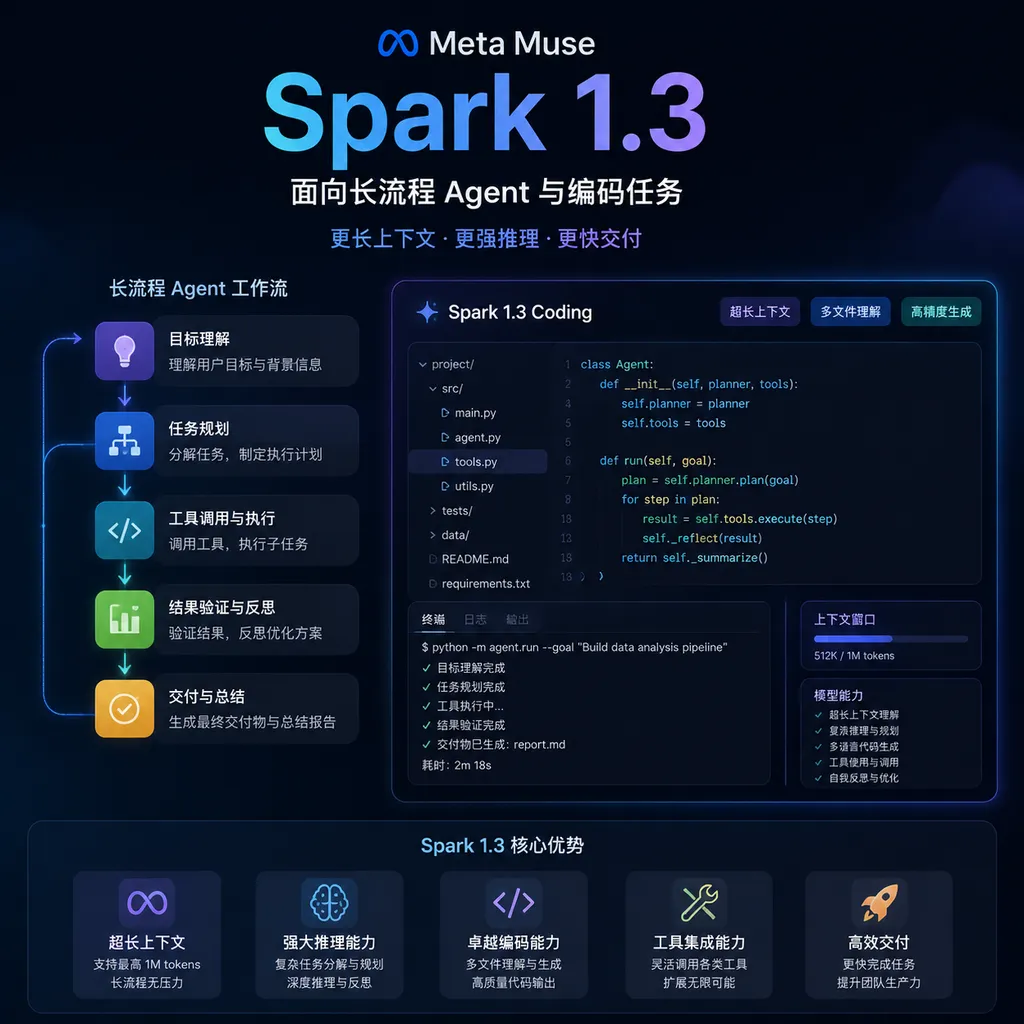
This Upgrade Is Not Mainly About Having the Model Write More Lines of Code
According to the official description, Muse Spark 1.3’s core improvements focus on three areas: fewer ineffective iterations, more stable execution of long-running tasks, and more accurate multi-task management.
For coding tasks, Meta says that compared with Muse Spark 1.2, Muse Spark 1.3 delivers:
- Fewer unnecessary code iterations;
- More concise generated code and clearer coding style;
- Approximately 20% fewer tool calls;
- Approximately 25% fewer Tokens required to complete the same task.
The practical significance of these figures for developers is greater than that of single-turn code completion accuracy.
Traditional coding models often fall into an inefficient pattern: they modify one file first, discover a problem after running tests, and then repeatedly rewrite the code. When they encounter dependency, type, or environment errors, they may keep trying similar approaches. When a task involves multiple directories and services, they may also forget changes made in earlier steps during subsequent stages.
Muse Spark 1.3 is designed to address precisely these problems. Rather than merely generating code, it aims to reduce the number of times it has to shuttle back and forth among the terminal, editor, testing tools, and version control system. A 20% reduction in tool calls does not mean the model is doing less work; rather, it means the model is expected to form a more complete judgment before calling a tool.
For coding Agents billed by Token usage, this also directly affects costs. Suppose an automated migration task originally consumes 1 million Tokens. If the upgraded model can genuinely reduce usage to 750,000 Tokens, then even with unchanged unit prices, the inference cost per task will fall accordingly. More importantly, fewer rounds of tool calls usually mean lower end-to-end latency.
Long-Running Agents: The Model Starts Managing Tasks Instead of Merely Responding to Them
Muse Spark 1.3 targets workflows that continue for hours or even longer. Here, “long-running” does not simply mean expanding the context window. It means enabling the model to maintain multiple interrelated tasks within the same thread.
The capabilities officially listed include:
- Collaboratively handling multiple workflows in a single long thread: The model can track different tasks within one continuous conversation, without having to rebuild the context after every completed step.
- Proactively identifying gaps in plans: If the original plan does not cover testing, deployment, rollback, or permission configuration, the model will attempt to fill in the missing steps.
- Tracking learned results: During continuous execution, the model retains conclusions that have already been verified, reducing redundant exploration.
- Asking clarifying questions when instructions are ambiguous: It will not simply guess at a solution and proceed when information is insufficient.
- Requesting user assistance when blocked: For example, when environment variables are missing, permissions are insufficient, or internal services cannot be accessed, the model will hand the blocking issue over to the user.
- Seeking confirmation before executing critical operations: For high-risk actions such as deleting resources, modifying production configurations, or merging code, the model will add a human confirmation step.
This design is closer to that of a project collaborator than a smarter chatbot.
The Agents developers actually care about generally do not stop after a single question-and-answer exchange. An Agent may need to read requirements documents, analyze existing code, modify multiple services, run tests, handle failure logs, update database migration scripts, and finally generate release notes. Each step may change the decision made in the next one. If a model can only remember the most recent rounds of dialogue, or cannot determine which newly issued instruction belongs to which subtask, a long context window alone has limited value.
The multi-task mapping capability emphasized by Muse Spark 1.3 addresses this exact problem: when a user adds a new requirement within a thread, the model must determine whether it modifies the current task, starts a parallel task, or adds a global constraint, rather than mixing everything together.
Coding Capability Comparison: Meta Begins Directly Challenging Leading Models
Meta’s external positioning is highly aggressive: Muse Spark 1.3 surpasses GPT-5.6 Sol in coding capability and matches Claude Fable 5.1. If this result can be reproduced in third-party evaluations and real production tasks, Meta will no longer be merely a follower in the code Agent space.
However, developers should not focus only on a single score on a leaderboard. Competition among coding models has shifted from single-question accuracy toward metrics that more closely reflect production environments:
- Whether the model can understand a large, multilingual codebase;
- Whether it can preserve architectural constraints after multiple rounds of modification;
- Whether it can identify problems in the tests themselves instead of mechanically optimizing for them;
- Whether it can adjust its strategy when tools fail;
- Whether it can reduce meaningless patches and repeated calls;
- Whether it can clearly identify risks and request confirmation before modifying production-related files.
For this reason, Meta’s claims of reduced tool calls and lower Token usage may be more worth watching than a simple benchmark ranking. For coding Agents, efficiency is often not about whether the model can complete a task, but how many rounds it needs, how long it takes, and how much context it consumes to do so.
Of course, fewer tool calls could also introduce another risk: the model may reach conclusions too early and skip necessary checks. Whether Muse Spark 1.3 is ultimately more reliable will depend on its performance when tests fail, requirements change, or hidden constraints emerge—not merely on its average number of calls.
Pricing Remains Unchanged, Giving Meta More Room to Expand Developer Trials
Muse Spark 1.3 is available through the Meta Model API with the following pricing:
| Item | Price (per million Tokens) | | --- | ---: | | Input | $1.25 | | Cache-hit input | $0.15 | | Output | $4.25 |
Compared with the previous generation, the prices for input, cached input, and output have all remained unchanged. Using a rough reference exchange rate, these are approximately RMB 8.4, RMB 1, and RMB 28.6, respectively.
This pricing structure is relatively well suited to long-running Agents. Agent scenarios often repeatedly read project context, system instructions, and tool results. With cache-hit input priced at only a small fraction of standard input, repeated costs across multi-step tasks can be reduced.
However, inexpensive input does not necessarily mean that total costs will be low. The bill for a long-running Agent is often determined jointly by output volume, the number of tool calls, repeated transmission of context, and failed retries. In particular, if a coding Agent that can run autonomously for hours has no maximum-step limit, budget cap, or human approval checkpoints, unchanged prices will not prevent total consumption from rising.
A more prudent approach is to treat Muse Spark 1.3 as an executor with budget controls, rather than an unrestricted autonomous program. Production environments should configure at least:
- A maximum Token budget per task;
- A maximum number of tool calls;
- Allowlists for read/write directories and network access;
- Human confirmation for database and production-environment operations;
- A limit on failed retries;
- Complete call logs and retention of intermediate artifacts.
What Scenarios Are Suited to a 1M Context Window and Multimodal Input?
Model information from Vercel AI Gateway indicates that Muse Spark 1.3 supports a 1-million-Token context window and can process text, images, and PDF inputs. If these specifications are made available through the Meta Model API in the same way, the model should be well suited to analyzing large codebases, migrating technical documentation, and organizing requirements across multiple files.
For example, a user could place a service migration request, legacy API documentation, existing code, test reports, and deployment configurations into a single task. The model could first analyze the scope of impact and then propose a migration plan. For tasks that previously required people to break materials into multiple segments and repeatedly remind the model of the context, this would make the experience much simpler.
However, 1 million Tokens is more of a capacity ceiling than a recommended working method. Stuffing every file into the context at once may increase costs, add retrieval noise, and make it harder for the model to distinguish key constraints from irrelevant legacy code. A more reasonable Agent architecture should still combine code indexing, file retrieval, structured summaries, and phased memory, allowing the model to read only the most relevant content when needed.
In other words, a large context solves whether the model can fit everything in view, while Agent orchestration determines whether it knows what to read, what to read first, and how to act after reading it.
Safety Mechanisms Are Present, but Their Practical Effectiveness Still Needs to Be Observed
Meta says that Muse Spark 1.3 has improved its awareness of its own capabilities and limitations, enabling it to reduce hallucinated output. The company also says that the existing reasoning mode will remain available, while max reasoning mode will be rolled out gradually after additional safety testing is completed.
This indicates that Meta is not focusing exclusively on benchmarks and speed. It recognizes that the risks of long-running Agents differ from those of ordinary chat models. When a model that only answers questions makes a mistake, the impact is usually limited to a piece of text. When an Agent can operate on code, terminals, cloud resources, and social platforms, a mistake may directly alter the state of a real system.
Proactive clarification, asking for help when blocked, and confirmation before critical operations are practical safety design choices. However, whether these mechanisms are truly effective also depends on whether the model can correctly determine what constitutes a high-risk operation. Some dangerous actions are not obvious. For example, modifying permission configurations, deleting old-version dependencies, or changing the order of data migrations may not produce consequences until several minutes later.
Developers therefore still need to establish permission isolation, sandboxes, approval workflows, and rollback mechanisms outside the model itself. A model’s self-restraint can reduce risk, but it cannot replace the hard boundaries of an engineering system.
Meta’s Next Step: Moving from API Models into Product Workflows
Meta says that Muse Spark 1.3 will gradually be integrated into Instagram, Facebook, and the Meta AI assistant. For Meta, this release follows two tracks: one is the Meta Model API for developers, and the other is embedding stronger Agent capabilities into its own products.
The former determines whether the model can build a developer ecosystem, while the latter determines whether it can translate into high-frequency user scenarios. Meta already has a large portfolio of social products, advertising systems, and user interaction entry points. If Muse Spark 1.3 can reliably handle cross-application tasks, the value of Agents will extend beyond code generation into content management, message organization, business operations, and personal assistance.
However, Meta still needs to answer one key question: Why should developers choose it over GPT, Claude, or Gemini?
Unchanged pricing is an advantage, particularly because cached input and the cost of long-running tasks are attractive. Improved coding efficiency is another advantage: fewer tool calls and lower Token consumption will directly affect the margins of Agent products. At the same time, Meta needs to demonstrate through public evaluations, API stability, rate limits, regional availability, and its tool ecosystem that Muse Spark 1.3 is more than a comparison result announced at a launch event.
Should Developers Switch Now?
If your application mainly handles ordinary question answering, short-form text generation, or structured information extraction, Muse Spark 1.3 may not deliver immediately visible benefits. The value of the upgrade is more apparent in continuous execution, complex coding, and multi-tool collaboration.
The following types of tasks are worth testing first:
- API migrations spanning multiple services;
- Refactoring and dependency upgrades in large codebases;
- Coding tasks that require running tests, reading logs, and repeatedly fixing problems;
- Tasks involving mixed inputs such as documents, code, and images;
- Long-running research, data organization, and operations Agents;
- Workflows that require managing multiple subtasks in parallel within a single thread.
When integrating the model, do not compare only whether its answers are correct. It is recommended to record four sets of data: task success rate, end-to-end latency, number of tool calls, and the actual Token cost of each task. A model upgrade is truly valuable only when all four improve simultaneously.
Muse Spark 1.3 can be integrated into OpenAI Hub through an OpenAI-compatible interface. For teams already using a unified SDK to manage multiple models, the business layer generally does not need to be rewritten. You only need to replace the model name and perform a round of regression testing focused on tool-call formats, context limits, and error codes.
import OpenAI from 'openai';

const client = new OpenAI({
  apiKey: process.env.OPENAI_HUB_API_KEY,
  baseURL: 'https://openai-hub.com/v1'
});

const response = await client.chat.completions.create({
  model: 'meta/muse-spark-1.3',
  messages: [
    {
      role: 'user',
      content: 'Analyze this service’s legacy API dependencies, develop a migration plan, and list the high-risk steps that require human confirmation.'
    }
  ]
});

console.log(response.choices[0].message.content);
Note that compatibility with the OpenAI format only means that the calling method can be reused; it does not mean that all advanced capabilities are fully equivalent. Long-context processing, multimodal input, reasoning modes, and tool calls should still be evaluated based on the actual gateway documentation and model responses. Before going live, it is best to prepare test cases covering failed retries, tool timeouts, context truncation, and human approval.
Conclusion: Model Competition Is Entering the Era of Execution Efficiency
The signal from Muse Spark 1.3 is clear: competition among models is shifting from who can provide the most polished answer in a single conversation to who can complete longer, more complex, and more production-like tasks in fewer steps.
Meta has not raised API prices. Instead, it has focused the upgrade on tool calls, Token consumption, and the reliability of long-running workflows. This is more closely aligned with developers’ practical interests than simply increasing parameter counts or refreshing leaderboard rankings. Whether it truly surpasses GPT-5.6 Sol and matches Claude Fable 5.1 still requires more independent testing. At least in the competition over Agent and coding models, however, Meta has moved from a follower’s position into direct competition.
For development teams, the most worthwhile action today is not to immediately replace the model in production, but to run an A/B test using their own codebases and real workflows. If Muse Spark 1.3 can take fewer wrong turns, make fewer calls, consume fewer resources, and know when to stop and ask a human at critical steps, it may become a production-grade foundational model for Agents worth using over the long term.