<think>**Translating title with geographic accuracy**</think> Spain’s Quasar 438B Tops Europe’s Model Leaderboard

<think>**Planning accurate markdown-preserving translation**</think> Spanish AI company Multiverse Computing has released the Quasar 438B reasoning model. With a 1M-token context window and an Intelligence Index score of 43, it ranks first among European models on Artificial Analysis, but its closed-source nature, model provenance, and global competitiveness remain to be verified.
<think>Planning markdown-preserving translation</think>
Spain’s Quasar 438B Reaches the Top of the European Model Rankings
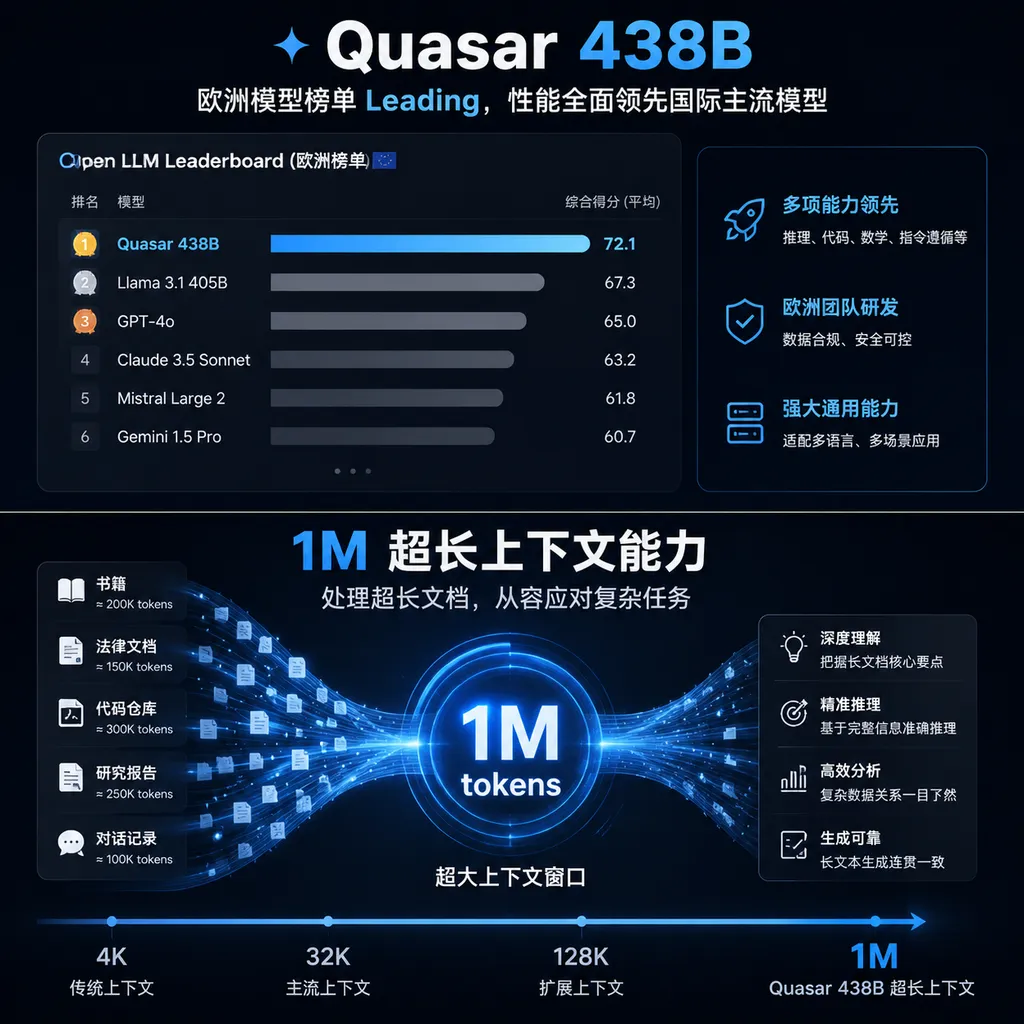
Spanish AI company Multiverse Computing released Quasar 438B on September 3. It is a proprietary reasoning model with 438 billion parameters and support for a 1-million-token context window. According to the Artificial Analysis Intelligence Index v4.1.1, Quasar 438B scored 43, ranking first among the European models currently included in the comparison.
This result is enough to raise its profile in the European model market, but it cannot be equated directly with being “globally top-tier.” Quasar 438B scored higher than Mistral Medium 3.5’s 30 points and NVIDIA Nemotron 3 Ultra’s 38 points, but it still trails the leading closed-source models globally by a clear margin. In other words, it looks more like a rebound for Europe’s homegrown model camp than yet another flagship capable of reshaping the global model landscape.
First in Europe—First Within the Ranking’s Scope
The Artificial Analysis Intelligence Index v4.1.1 is not a single benchmark. It combines nine evaluations covering agent tasks, coding, scientific reasoning, general knowledge, and long-context reasoning. Quasar 438B received an overall score of 43, exceeding the other European models currently listed, and was therefore described as “Europe’s strongest AI model.”
This conclusion rests on two premises.
First, it refers to the highest score among the “European models included in the comparison,” not all models available in Europe. The GPT, Claude, Gemini, Qwen, DeepSeek, and other models actually used by European developers are not automatically excluded from global capability comparisons simply because their providers are based elsewhere. Second, a score of 43 does not in itself mean that the model has entered the global first tier. For reference, supplementary information shows that the reasoning version of Claude Fable 5.1 max reached 66 points on the same type of Intelligence Index ranking. Alibaba’s Qwen3 27B also scored 43 points in its low reasoning mode, 44 points in medium mode, and 52 points in xhigh mode.
Therefore, the real significance of Quasar 438B is not that “438 billion parameters defeated every other model,” but that a European company has finally produced an enterprise-grade reasoning model capable of entering the mainstream spotlight in public, third-party evaluations. For a European model ecosystem long represented by only a handful of providers such as Mistral, this signal still matters.
438 Billion Parameters: Long Context and Reasoning Are the Core Selling Points
Quasar 438B is not positioned as a chatbot. It is a reasoning model designed for enterprise agents, software development, and complex multistep tasks. It supports English and Spanish, and currently accepts and produces text only; it does not support image input.
The model has a context window of 1 million tokens. Using common English token estimates, this is equivalent to loading several hundred thousand to nearly one million words at once. In Chinese-language scenarios, however, tokens do not correspond one-to-one with Chinese characters or words, and the actual amount of Chinese text that can be accommodated is also affected by the tokenizer design. Developers should not simply convert “1M tokens” into “1 million Chinese characters.” They should test chunking efficiency and costs against real-world business corpora.
The value of long context does not lie in stuffing every file into a prompt. Truly useful scenarios include:
- Analyzing multiyear contracts, procurement documents, and legal appendices to identify mutually referenced clauses;
- Having a coding agent read a large repository, Issues, logs, and deployment configurations simultaneously;
- Processing lengthy policy documents, research reports, and technical specifications while establishing connections across chapters;
- Tracking relationships involving dates, people, versions, and conditions across multiple documents in an enterprise knowledge base.
Quasar 438B scored 75.0 on the Artificial Analysis Long Context Reasoning evaluation. This test focuses on whether a model can extract information from long documents, establish connections, and perform reasoning, rather than merely measuring whether it can fit text into its context window. This is also one of Quasar 438B’s most persuasive metrics: it at least indicates that the 1M context is not merely a marketing specification, and that the model has a degree of competitiveness on long-text cross-reference tasks.
However, long-context capability still requires distinguishing between “being able to fit something in” and “being able to use it well.” Many models experience diluted attention, missed key information, confused citation locations, or sharply increased reasoning costs as context length grows. Enterprises processing hundreds of pages of contracts will still need document hierarchies, evidence tracing, citation validation, and output evaluation. A 1M context window should not be treated as a maintenance-free, universal retrieval system.
Terminal-Bench 69.3 Shows That It Is Targeting Agents That Can Get Work Done
Quasar 438B scored 69.3 on Terminal-Bench v2.1. This benchmark simulates continuous agent tasks in a real terminal environment, including inspecting code repositories, running commands, locating errors, modifying files, and completing multistep operations.
For developers, this type of score is more informative than traditional knowledge-based question answering. Whether a model is suitable for a coding agent depends not only on whether it can generate a function that appears correct, but also on whether it can understand repository structure, select appropriate commands, adjust its approach based on execution results, and maintain consistent state after multiple rounds of operations.
Quasar 438B’s score of 69.3 indicates that it has at least a usable foundation for the “tool call—observe results—continue acting” loop. But this is still not a pass to production. Between Terminal-Bench and real enterprise environments lie engineering issues involving access control, dependency installation, network isolation, private-code confidentiality, rollback mechanisms, and human approval. For reasoning models in particular, a model being willing to spend more time thinking does not necessarily mean it can complete tasks more reliably; incorrect operations in a long chain may result in higher remediation costs.
Speed and Pricing: It Looks Cheap, but Reasoning Costs Must Be Calculated Separately
Quasar 438B’s API is priced at $0.60 per 1 million input tokens and $1.80 per 1 million output tokens. Judging solely by its public pricing, it is quite attractive for long-document scenarios: when processing large amounts of contracts, code, or technical material, the input price is not high. If the model can reduce manual retrieval and the number of follow-up calls, an enterprise’s overall costs may fall further.
However, the cost of a reasoning model cannot be assessed by looking only at visible output. According to the available information, generating 500 output tokens takes 15.3 seconds, including reasoning time. Artificial Analysis records an output speed of 176.2 tokens per second and a time to first token of 1.08 seconds. These metrics should be interpreted cautiously: the public materials do not fully explain the reasoning process, hidden tokens, batching method, or test environment. The total time required to generate 500 output tokens and the apparent output speed are not measured on the same basis.
For real-time interactive applications, a 1.08-second time to first token is acceptable but not exceptional. For code repair, research analysis, and batch document processing, a complete response taking around 15 seconds is not particularly serious—provided that the model actually reduces subsequent rework. What developers should really focus on is “how many calls are needed to complete a task,” rather than how many tokens per second a single request produces.
The Biggest Question: Is It an Original Model or a Modified GLM-Series Model?
Quasar 438B is currently a proprietary model. Its weights are not public, and Multiverse Computing has not disclosed its complete architecture, training data, or actual number of active parameters. The official documentation lists it under “Original Models,” but background information in the replies to the official X post also suggests that the model may have been built on Zhipu’s GLM5.2.
The phrase “may be based on” is not an explicit confirmation in an official technical report and cannot be treated directly as fact. The fact that a closed-source model does not publish its weights is not itself a problem; many commercial models conceal their training details. However, when the model’s parameter scale, architectural approach, training data, and origins all lack verifiable information, it becomes difficult for developers to determine where its technical improvements come from or to assess its stability after version updates.
This affects several key questions in enterprise procurement: Can the model deliver consistent results in specific domains? Is its Spanish capability genuinely better than that of general-purpose models? Has it undergone an independent safety assessment? Will data be used for training? Are there hidden length limits on long-context requests? For enterprises that require compliance audits, these questions are often more important than a three- or five-point difference on a leaderboard.
Who Is It Suitable For—and Who Is It Not Suitable For?
Based on the currently available public information, Quasar 438B is better suited to the following users:
- Enterprise teams that need to process extremely long texts: For example, contract review, policy analysis, technical-document Q&A, and research-report summarization.
- Developers building coding agents: Especially in scenarios where the model needs to read repositories and perform continuous terminal operations.
- Teams with a high proportion of Spanish-language business: Native-language support may provide better terminology, contextual understanding, and document-processing performance, but this still needs to be benchmarked independently.
- API users seeking to reduce the cost of long-context input: The price of $0.60 per million input tokens is somewhat competitive.
For now, it is not well suited to the following scenarios:
- Document workflows requiring image, scanned-document, or multimodal input;
- Scientific research and complex planning tasks with strict requirements for the strongest reasoning capabilities worldwide;
- Teams that want to self-host, fine-tune, or audit the model weights;
- Customer service, interactive programming, and high-frequency workloads requiring extremely low-latency real-time responses.
OpenAI-Compatible Calling: Confirm Availability Before Integrating
Quasar 438B is currently accessible through the CompactifAI API. If it is subsequently launched on OpenAI Hub, developers will be able to continue using an OpenAI SDK-compatible calling method. The actual model name, gateway address, and available regions should be determined by the platform console. An example is shown below:
from openai import OpenAI

client = OpenAI(
    api_key="YOUR_OPENAI_HUB_KEY",
    base_url="https://api.openai-hub.com/v1"
)

response = client.chat.completions.create(
    model="quasar-438b",
    messages=[
        {
            "role": "system",
            "content": "You are a rigorous enterprise-grade analysis assistant. Cite the source text when answering."
        },
        {
            "role": "user",
            "content": "Please analyze the key obligations, exceptions, and potential risks in this long document:\n\n..."
        }
    ],
    temperature=0.2
)

print(response.choices[0].message.content)
For a 1M-context model, it is more advisable from an engineering perspective to begin with small-scale load testing. Measure time to first token, total response latency, input-token count, output-token count, task success rate, and citation accuracy separately before deciding whether to replace an existing model. In particular, do not abandon retrieval, chunking, and access-control filtering simply because the context window has become larger.
Assessment: A Ticket to Enter the European Model Competition, but Not Yet the Final Champion
Quasar 438B is worth watching. It advances the European model competition from “Does Europe have a homegrown large model?” to “Can a European model be measured by third parties on long-context, coding-agent, and enterprise reasoning tasks?” Its European-leading score of 43, long-context reasoning score of 75.0, and Terminal-Bench score of 69.3 all suggest that Multiverse Computing has not merely built a regionalized chatbot, but is attempting to enter the main arena of enterprise agents.
Its limitations are equally clear: the model is closed-source, and its weights and training details have not been disclosed; claims that it may have been built on another model have not yet been sufficiently verified; its global leaderboard performance still trails frontier models; and the practical stability and commercial viability of its 1M context also require more independent testing.
Thus, the most reasonable current positioning for Quasar 438B is: a long-context reasoning API in Europe’s model camp that is worth evaluating and integrating—not a global flagship that can unconditionally replace GPT, Claude, or Gemini. For developers, the truly worthwhile step is not to argue over the label “Europe’s number one,” but to run a real benchmark using their own code repositories, contract collections, and multilingual business data. Leaderboards generate attention; production environments provide the answer.
Sources
- ITHome: Spanish company launches the Quasar 438B model with a 1M-token context — Provides public information on the model’s parameter scale, Artificial Analysis evaluation scores, context length, pricing, and speed.