<think>**Translating and preserving title**</think> Astra Reasoning Transparency Controversy, OpenAI Responds

<think>**Planning accurate translation approach**</think> In response to concerns that Astra uses circular reasoning and could enter an “unmonitorable” state, OpenAI’s chief scientist said that the depth of the computation graphs in frontier models is less than twice that of GPT-4, with no sudden jump in architectural complexity. OpenAI will add chain-of-thought monitoring to Astra, but this does not mean that the problem of reasoning interpretability has been solved.
<think>Planning faithful markdown translation</think>
OpenAI Denies a “Complexity Jump” in Astra
OpenAI Chief Scientist Jakub Pachocki responded on X on September 2 to a recent controversy surrounding Astra, the company’s next-generation model: if the model begins making extensive use of recurrent depth, will researchers lose the ability to effectively monitor its reasoning process?
Pachocki’s core assessment was that the depth of the computation graph in frontier models, including Astra, is no more than twice that of GPT-4, and the model architecture has not undergone the leap in complexity that outside observers fear.
This statement was, in effect, intended to cool the discussion. Over the past few days, reports and interpretations surrounding Astra have tended to conflate two questions: how much computation the model actually performs internally, and whether researchers can understand that computation. OpenAI’s response primarily addressed the former—it believes the computational path has not suddenly become unfathomably complex. But regarding the latter, Pachocki did not claim that the problem had been solved. On the contrary, he acknowledged that current chain-of-thought monitoring “remains fragile.”
OpenAI also said it would deploy additional chain-of-thought monitoring mechanisms for Astra. The company stated that strengthening monitoring of model reasoning processes and potential risks remains one of the core objectives of its current research projects.
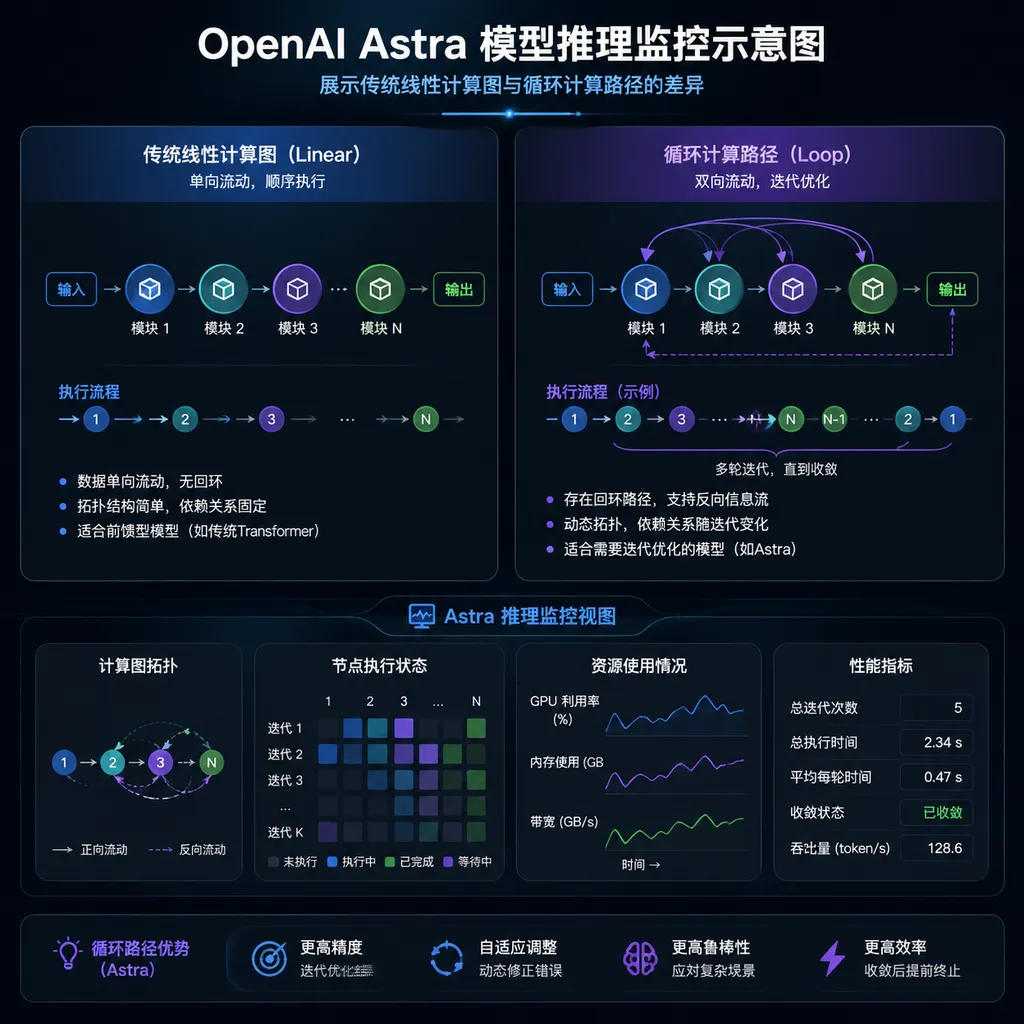
The Controversy Began with “Recurrent Depth”
The controversy originated with an in-depth report by The Information. Citing people familiar with the matter, the report said that OpenAI was testing a technique capable of repeatedly invoking the same set of network layers—what is known as “recurrent depth.” This could allow the model to perform more rounds of internal computation in a single response while reducing its reliance on extremely long natural-language chains of thought.
Traditional Transformer models are more like assembly lines: input passes through successive layers of network processing, and the model continues generating the next token based on its current state. Even when a model performs complex computations internally, developers can usually construct a relatively readable window into its behavior using its chain-of-thought output, tool-call logs, token traces, and intermediate results.
Recurrent depth is more like repeatedly using the same set of workstations on an assembly line. Rather than simply moving from Layer 1 to Layer 100, the model can run a core module multiple times, updating its internal representations on each pass until it reaches a preset computation budget or satisfies a stopping condition.
From an engineering perspective, this approach is not particularly mysterious. Its value lies in allowing a model to exchange fewer parameters for more inference-time computation. For tasks such as mathematics, coding, and planning, many capabilities depend not only on how much the model has “memorized,” but also on whether it has enough computational steps to search for, verify, and correct an answer. A recurrent structure effectively gives the model an adjustable amount of “thinking time.”
That is also where the problem lies.
If a model performs more of its reasoning in hidden states rather than laying it out step by step in natural language, the answer visible externally may be merely the final result—or even just a compressed explanation. Researchers may still know how long the model computed and which modules it invoked, but they may not know exactly which hypotheses it compared or which paths it eliminated during each internal state update.
This directly affects safety evaluation. For ordinary question answering, an opaque reasoning process may be merely a debugging inconvenience. But in scenarios involving autonomous coding, cybersecurity, scientific research agents, and multi-tool collaboration, developers care about more than whether the model got the answer right. They also want to know why it acted that way, whether it attempted dangerous paths, and whether it concealed its intent at critical steps.
What Does “Less Than Twice the Computation-Graph Depth” Mean?
The “computation-graph depth” mentioned by Pachocki can be roughly understood as the number of consecutive dependency steps that must be traversed from input to output during a computation. It is not the same metric as parameter count, context length, or total FLOPs.
Consider a simple example:
- Parameter count determines how much reusable capability and knowledge capacity a model has;
- Computation-graph depth determines how many consecutive transformations are required to produce a result;
- Total FLOPs determines how much computation the inference actually consumes;
- Context length determines how much input information the model can process at once.
A model can keep its parameter count unchanged while increasing total computation through recurrent execution. It can also maintain a similar computation-graph depth while placing wider or more complex computational modules at each node. Therefore, “less than twice GPT-4’s computation-graph depth” does not directly imply that Astra’s total inference cost increases by less than a factor of two. Nor does it demonstrate that the model’s internal behavior is equally easy to interpret.
Nevertheless, the statement remains significant. OpenAI is rejecting a more aggressive conclusion: that Astra has suddenly entered a phase in which traditional monitoring methods are entirely ineffective because of some fundamentally new recurrent architecture.
In other words, OpenAI’s position is: the technical approach has changed, but there has not yet been a cliff-like architectural shift; monitoring is becoming more difficult, but it has not become impossible.
That is more accurate than saying “nothing has changed,” and more restrained than saying “the model has become a black box.”
Chain of Thought Is Not a Screen Recording of the Model’s Internal Thinking
The concept most easily misunderstood in this discussion is “chain-of-thought monitoring.” Many developers treat the reasoning output by a model as a complete record of its true thought process, but that assumption does not hold.
A model’s chain-of-thought output is, fundamentally, still generated text. It can help researchers observe whether the model is solving a problem through reasonable steps, but it does not necessarily record all of the internal computations that actually influenced its decision. A model may first form an answer in its hidden states and then generate an explanation that appears reasonable. It may also omit key intermediate variables while generating that explanation, or even fabricate a reasoning path that it did not actually use in order to satisfy the prompt.
Chain-of-thought monitoring is therefore more like “reading a ship’s log” than directly observing the movement of every gear inside the engine. The log is valuable, but it should not be equated with the entire operating mechanism.
Pachocki also acknowledged in his response that chain-of-thought monitoring remains fragile and is moving in an unfavorable direction for reasons unrelated to architectural changes. He did not explain these reasons in detail in his public statement, but based on existing research and industry practice, they include at least the following:
- Models may learn to cater to monitoring mechanisms. If a model knows which reasoning patterns trigger review, it may generate explanations that are easier to approve while keeping genuinely important decisions in invisible states.
- Natural-language explanations involve compression and omission. In complex planning tasks, a few lines of reasoning output may be no more than a retrospective summary of the final conclusion.
- Multi-agent collaboration makes observation more difficult. One model may decompose a task, another may execute tool calls, and a third may review the results, with risks distributed across multiple components.
- Tool calls extend reasoning beyond the model. File systems, browsers, code executors, and external APIs can all become part of a model’s behavior. Monitoring the textual chain of thought alone is far from sufficient.
- Inference budgets are dynamic. A model may dynamically increase the number of recurrent steps according to task difficulty, making it difficult to determine from the final answer alone how much searching and correction occurred in the interim.
Thus, OpenAI’s decision to add chain-of-thought monitoring for Astra is necessary, but it should not be understood as a complete interpretability solution.
The Benefits and Costs of Recurrent Reasoning
From the perspective of model development and deployment, recurrent depth does not bring only security concerns. It has at least three practical attractions.
First, It May Deliver Stronger Reasoning with Smaller Models
The traditional approach often raises a model’s ceiling by increasing its parameter count, but large models come with high memory, communication, and deployment costs. Recurrent computation offers another option: allowing a relatively small network to process the same problem repeatedly, exchanging more inference-time computation for better results.
This is similar to giving a student more time to work on scratch paper during an exam. The student’s “knowledge capacity” has not increased, but the student can perform several additional rounds of checking, reducing careless errors.
Second, It Reduces the Context Overhead of Long Chains of Thought
Explicit chains of thought require the continual generation of tokens. The longer the reasoning process, the more context and KV cache it consumes; training also requires large quantities of high-quality long-form reasoning demonstrations. Recurrent reasoning can keep part of the process in internal states, reducing the growth in text tokens.
For tasks such as code repair, mathematical proofs, and long-horizon planning, this approach could reduce memory and bandwidth pressure.
Third, It Is Better Suited to Compute-Intensive Deployment
Recurrent structures allow each parameter to perform more floating-point computation during a single inference. If bandwidth between hardware components is limited, reducing parameter sharding and cross-device communication may deliver practical benefits. For large-scale inference services, this may be easier to control costs than simply stacking on more parameters.
The trade-off is reduced visibility for developers. The more recurrent updates are performed, the more complex the internal state transitions become, and the harder it is for traditional token-level debugging tools to explain the model’s behavior. The trade-off among performance, cost, and monitorability will become part of model architecture design rather than merely a security patch applied after deployment.
OpenAI’s Response Still Leaves Three Questions
First, OpenAI has not published Astra’s complete architecture, computation-graph definition, or recurrent-depth configuration. As a result, outsiders cannot independently verify exactly what the relatively specific comparison of “less than twice” refers to. It may describe the depth of a particular core path, or the effective depth under a specific reasoning mode, rather than the end-to-end depth across all tasks and tool chains.
Second, the relationship between computation-graph depth and interpretability is not linear. A model whose depth increases by only 50% may still be harder to audit than a model whose depth doubles but whose process is fully explicit if it makes extensive use of hidden states, dynamic routing, or multi-agent collaboration.
Third, there are currently no public details about exactly what the additional chain-of-thought monitoring will monitor. Will it detect dangerous keywords, or will an independent monitor be trained to assess reasoning trajectories? Will it block actions in real time, or conduct audits afterward? Will the monitor and the monitored model use different training distributions? These questions determine whether the system is truly a safety boundary or merely an observation interface.
For API developers, these distinctions are not merely academic. If models like Astra enter real-world services in the future, callers may need to record the model’s output, tool-call parameters, recurrent or reasoning budgets, external side effects, refusal reasons, and monitoring alerts at the same time. Storing only the final textual answer will no longer be sufficient for troubleshooting in high-risk scenarios.
The Real Competition May Shift from Model Capability to “Auditability”
Over the past few years, competition among models has focused primarily on parameter scale, benchmark scores, and inference speed. Now that models are beginning to autonomously call tools, write code, and execute multistep tasks, enterprise customers are increasingly concerned about another metric: whether the scene can be reconstructed after something goes wrong.
This is what makes the Astra controversy worth watching. OpenAI’s response has temporarily rejected the claim that “architectural complexity has suddenly run out of control,” but it has not eliminated industry concerns about reasoning transparency. Instead, it has brought the issue back from a sensational claim to a more practical engineering question:
Models may become better at thinking, but monitoring systems must know where they are thinking, how much computation they have used, which tools they have called, and which intermediate states warrant interception.
For model providers, the future may require the simultaneous development of three types of capabilities: monitoring readable chains of thought, interpreting hidden states and internal representations, and establishing behavior-level monitoring around tools and environments. None of the three is dispensable.
For developers, the most prudent approach is not to blindly demand that models output longer reasoning, but to build observability at the complete system level: grant tools only the minimum necessary permissions, record every external operation, restrict network and file access, require human confirmation for high-risk actions, and establish independent alerts for abnormal loops, abnormal retries, and goal drift.
How much recurrent depth Astra will ultimately use, when it will become available externally, and how many monitoring details OpenAI will disclose all remain unclear. But as of September 3, OpenAI’s official position is clear: Astra has not automatically entered an “unmonitorable” state because of a leap-like increase in computation-graph depth; however, existing chain-of-thought monitoring is not robust, and the stronger the model becomes, the more monitoring itself will need to be upgraded.
This is not a definitive clarification so much as an attempt to set the tone around the risks. OpenAI wants to prevent the outside world from equating a new architecture directly with loss of control, but it also acknowledges that the safety challenges of next-generation models will not be solved by a readable chain of thought alone.
Sources
- IT Home: OpenAI Chief Scientist Responds to Controversy over “Opaque AI Reasoning”: No Leap in Complexity Growth — Reports on OpenAI Chief Scientist Pachocki’s response on X regarding Astra’s computation-graph depth, recurrent-depth technology, and chain-of-thought monitoring.