<think>**Refining AI solar precursor title**</think> AI Heard the Sun’s Warning Signs 9.24 Hours in Advance

<think>**Summarizing EarlyDetect model findings**</think> The NJIT team has released the EarlyDetect model, which uses a Transformer to analyze solar acoustic-power and magnetic-field data collected by NASA’s SDO/HMI and identify formation signals an average of 9.24 hours before solar active regions become visible. However, it is not yet a mature system that can be directly used for space weather forecasting.
<think>Planning markdown-preserving translation</think>
AI “Hears” Solar Active Regions 9.24 Hours in Advance
A research team led by the New Jersey Institute of Technology (NJIT) recently announced a study on solar activity prediction: the machine-learning model EarlyDetect can identify precursors to the formation of active regions from extremely subtle acoustic activity and magnetic-field changes on the Sun’s surface. The best-performing version captured the relevant signals an average of 9.24 hours in advance.
The value of this study is not that it makes the phrase “AI predicts solar storms” sound more futuristic, but that it moves the warning window forward to a point before solar activity actually becomes visible. For systems such as satellite communications, power grids, navigation, and crewed spaceflight, an additional few hours is often enough to adjust operating strategies.
However, an important distinction must be made first: EarlyDetect currently predicts the formation of solar active regions, rather than directly predicting flares, coronal mass ejections, or geomagnetic storms. Active regions are areas of intense magnetic fields on the Sun’s surface. Sunspots typically appear there, and powerful flares and coronal mass ejections are also often associated with these regions. But between the appearance of an active region and determining whether it will erupt, when it will erupt, and how powerful the eruption will be, several stages of prediction still remain.
It Detects Not Sunspots, but the Changes That Precede Them
Solar active regions begin forming gradually inside the Sun before they appear on its visible surface. As magnetic structures rise upward, they alter the state of the surrounding plasma and may also affect how sound waves propagate inside the Sun and near its surface layers.
The problem is that these early changes are extremely subtle. Humans can directly see sunspots on the solar surface, but it is difficult to detect, with the naked eye or a single sensor, “what is happening inside the Sun before a sunspot appears.” The research team therefore adopted a helioseismology-based approach: treating vibrations on the solar surface as signals that can reveal the Sun’s internal structure, similar to how seismology infers underground structures from ground motion.
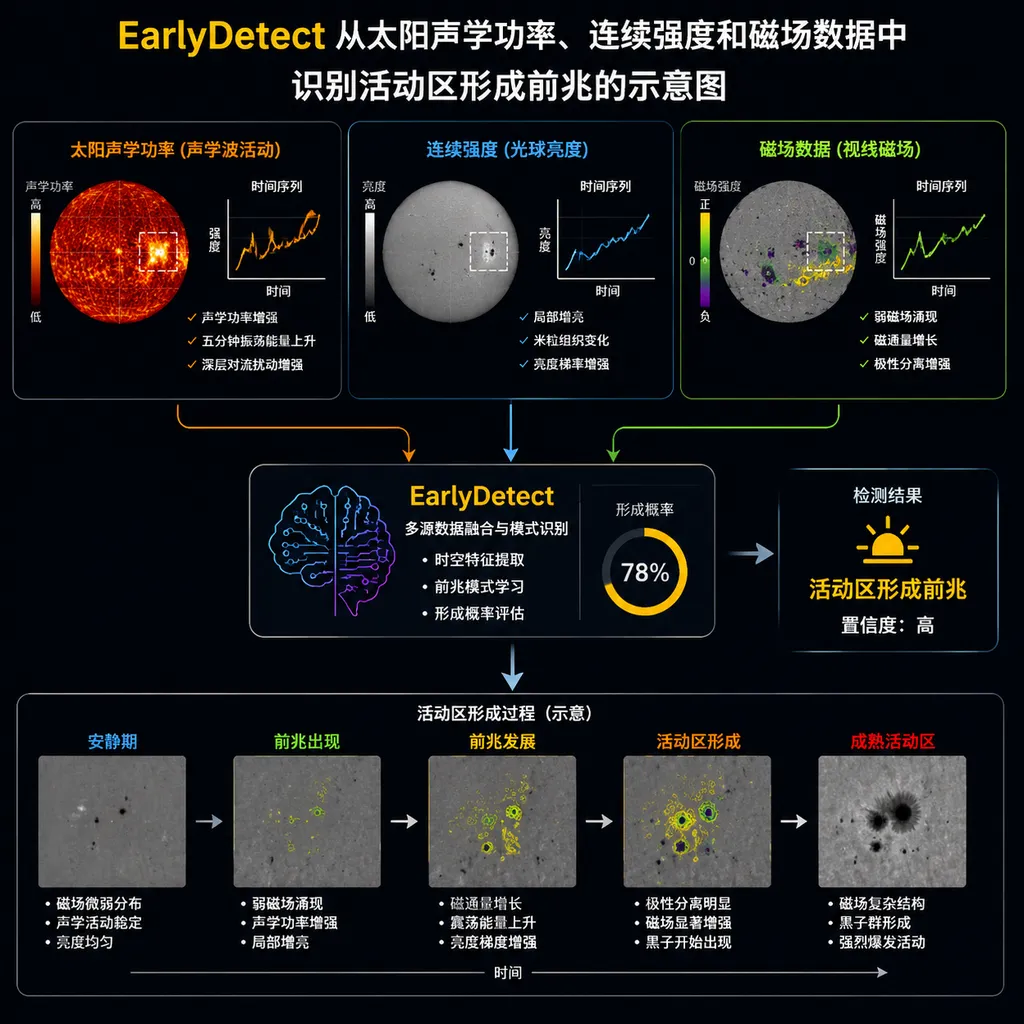
The data used in the study came from the Helioseismic and Magnetic Imager (HMI) aboard NASA’s Solar Dynamics Observatory (SDO). HMI records observations related to solar vibrations and magnetic fields every 45 seconds. Based on these continuous observations, the researchers generated acoustic-power maps and combined them with magnetic-field measurements and continuum-intensity data to track how different areas of the solar surface changed over time.
In a case involving the formation of an active region known as AR11158, the researchers observed a relatively clear sequence:
- Acoustic power decreased first;
- The Sun’s continuum intensity then changed;
- Magnetic-field signals gradually intensified or reorganized;
- The active region eventually became clearly distinguishable on the visible surface.
This sequence suggests that when the magnetic field inside an active region rises, it may first leave traces in the propagation of sound waves, and only later gradually alter the brightness and magnetic-field configuration of the solar surface. EarlyDetect’s task is to identify patterns associated with active-region formation from these small, continuous changes over time.
Applying Transformers to Solar Data: The Key Is Capturing “Temporal Relationships”
EarlyDetect uses a Transformer architecture. Transformers first became widely known through natural-language processing and large language models, but their core capability is not limited to “processing text.” Rather, they can establish relationships among different points in a long sequence.
For solar observation data, the model is not dealing with a sentence, but with a series of observations recorded every 45 seconds or aggregated hourly. Whether a change in acoustic power at a particular moment is meaningful often depends on trends over the preceding several hours or even longer. Similarly, slight changes in magnetic-field signals need to be assessed together with changes in continuum intensity and surrounding regions.
Traditional methods typically rely on manually defined thresholds—for example, issuing an alert when the magnetic field reaches a certain strength or when brightness changes exceed a specified range. But the noise, local variations, and time scales in solar observation data are highly complex, making a single threshold prone to both missed detections and false alarms. A Transformer is more like a system that searches for a “combined rhythm” in a long time series: which changes occur first, which follow, and whether they are spatially concentrated in the same region.
The research team also divided target areas into smaller patches and continuously tracked the acoustic power, continuum intensity, and magnetic-field changes in each patch. This helps prevent averages across the entire Sun from obscuring local anomalies. The solar surface naturally contains a large amount of normal fluctuation. If all regions are compressed into a single number, genuinely valuable signals may be diluted.
Notably, the study also produced a result contrary to common machine-learning experience: a filtering method originally intended to remove noise and help the model extract the primary signal actually reduced predictive performance.
This does not mean that “more noise is better.” Rather, it suggests that the discarded portions may not have been pure noise; they may have contained subtle information related to active-region formation. With scientific data of this kind, the signals a model needs to identify may be hidden in details that conventional preprocessing considers “unimportant.” Excessive smoothing may amount to deleting the answer along with the noise.
9.24 Hours Is Valuable, but It Is Not Yet a Warning System
An average lead time of 9.24 hours is the most widely circulated figure from this study—and also the figure that requires the most cautious interpretation.
First, it represents the average lead time achieved by the best-performing version in the study’s evaluation. It does not mean that every active region can be reliably detected 9.24 hours in advance. Solar activity varies significantly from one event to another. The size, magnetic-field structure, location, and rate of evolution of an active region all affect the model’s judgment.
Second, the model currently identifies signals associated with active-region formation. The appearance of an active region does not automatically mean that it will produce a powerful solar flare or coronal mass ejection. To turn EarlyDetect into a genuine component of a solar-storm warning system, several questions still need to be answered:
- Is the model equally effective for active regions of different intensities, latitudes, and morphologies?
- How many of the signals detected in advance will ultimately develop into space-weather events worth monitoring?
- Will the model produce frequent false alarms amid ordinary magnetic-field fluctuations that do not lead to eruptions?
- Will its performance remain stable when observation data are missing, instrument conditions change, or the solar activity cycle shifts?
- Can an average lead time of 9.24 hours be converted into actionable decision time in real-world operational systems?
These questions will determine whether the model can move from an offline experiment in a research paper into an operational system. There is usually still a gap between accuracy on a scientific dataset and practical usability in live operations. This is particularly true for space-weather forecasting: forecasting agencies need to know not only “whether an anomaly has appeared,” but also whether it will have an impact, when that impact will reach Earth, and in what direction and with what intensity.
EarlyDetect is therefore better viewed as a new layer of early-stage observation. Existing systems can continue to rely on solar-surface imagery, magnetic-field observations, flare monitoring, and solar-wind parameters, while EarlyDetect provides an additional signal before an active region becomes clearly visible. It may not be able to deliver a final conclusion on its own, but it could help forecasters identify areas that require closer attention at an earlier stage.
What Several Additional Hours Mean for Satellite and Grid Operators
Solar flares release intense electromagnetic radiation, while coronal mass ejections can propel large quantities of charged particles and magnetic structures into interplanetary space. When these disturbances reach Earth, they may affect shortwave communications, satellite operations, navigation and positioning, and power grids in high-latitude regions. Under extreme conditions, space weather can also increase the risk of damage to satellite electronics, radiation exposure for astronauts, and abnormal induced currents in power-transmission systems.
If future studies validate the model on larger datasets, an additional window of roughly nine hours could be used to:
- Enable satellite operators to adjust spacecraft attitude, payloads, and high-risk mission schedules;
- Allow communications systems to assess the stability of shortwave links and satellite communications in advance;
- Help grid operators inspect the risks to reactive-power compensation equipment, transformers, and high-latitude transmission lines;
- Allow airlines to reassess communications and radiation risks on polar routes;
- Enable space-weather forecasting centers to focus limited human analysis resources on high-risk active regions.
However, these actions depend on the model not only issuing alerts early, but also issuing them accurately. If the false-alarm rate is too high, and operators frequently adjust their operating plans, the warning system will become an expensive source of noise. For critical infrastructure, it may be preferable to sacrifice some lead time rather than ignore the costs of false alarms and missed detections.
The Real Importance of This Study: Turning AI into Part of a Scientific Instrument
EarlyDetect is not merely another conceptual demonstration that applies a Transformer to a dataset. Its more interesting aspect is that the model is helping uncover physical clues that humans do not yet fully understand.
Researchers previously knew that magnetic activity inside the Sun might affect the propagation of sound waves before an active region forms on the visible surface. But whether this influence is sufficiently stable, and whether it can be used to predict the appearance of an active region, has no simple answer. By capturing the pattern in which “acoustic power changes first, followed by changes in continuum intensity and magnetic fields,” the model provides a new empirical direction for investigating this physical hypothesis.
Of course, discovering a correlation through machine learning does not mean that a causal relationship has been proven. The model may have captured certain statistical features that have not yet been explained, or it may be exploiting hidden patterns in data collection or sample distribution. Further validation using physical models, data spanning multiple solar cycles, and independent observations will still be needed to determine whether these signals truly correspond to magnetic fields rising from inside the Sun.
From a developer’s perspective, this type of task also offers an important reminder: the difficulty of scientific AI usually lies not in deploying a popular architecture, but in defining the data, constructing labels, splitting data by time, and establishing evaluation criteria. Prediction tasks must especially guard against information leakage—the model cannot access data from after an active region has already formed and then claim to have predicted it in advance. The claim of “9.24 hours in advance” must be based on a strict temporal sequence and reproducible evaluation.
Conclusion: A Promising Early-Detection Instrument, Not Yet an AI Solar-Storm Forecaster
EarlyDetect demonstrates a clear direction: early warnings of solar activity do not necessarily have to rely solely on sunspots and magnetic fields that are already visible. Earlier internal changes may also be detected through acoustic observations. In this context, the role of the Transformer is not to generate text, but to process long, multichannel, noisy sequences of solar observations.
The practical value of this work is fairly clear: if the model can maintain stable performance across more active regions, more phases of the solar activity cycle, and independent datasets, detecting the formation of active regions several hours in advance could indeed provide an additional buffer for satellite communications and power-grid operations.
At this stage, however, it would be inappropriate to present it as proof that “AI can already predict solar storms in advance.” The model has not yet been deployed operationally. The 9.24-hour figure is not a guarantee for every event, nor does it directly solve the problem of predicting the timing, intensity, and terrestrial impact of flares and coronal mass ejections.
A more accurate description is this: EarlyDetect demonstrates that AI may be able to identify an active region beginning to form from subtle changes in acoustic waves and magnetic fields before obvious signs appear on the solar surface. It still faces two major hurdles—engineering deployment and physical validation—before becoming a true space-weather warning system. But at least it has moved the warning problem nearly nine hours forward.
References
- ITHome: Exploring Early Warnings for Solar Storms: AI Captures Solar Active-Region Signals 9.24 Hours in Advance — An overview of the NJIT team, the EarlyDetect model, SDO/HMI data, and the result of identifying signals 9.24 hours in advance.