<think>**Translating and refining title**</think> 3D Generation: From Single Objects to Complete Scenes

<think>**Interpreting product names and translation**</think> Yingmou Hyper3D released the world-generation model WorldGen on September 1. By uploading a single scene image, users can generate an editable 3D scene composed of independent assets. The deliverable for 3D generation is beginning to shift from individual models to scenes that can be integrated into game, film, and simulation pipelines.
<think>Planning markdown-preserving translation</think>
3D Generation Moves from Individual Objects to Complete Scenes
On September 1, Yingmou Hyper3D released WorldGen, a world-generation model. Rather than simply turning a chair, car, or character in an image into an individual 3D model, it attempts to reconstruct a complete, editable, and interactive 3D space directly from a single scene image.
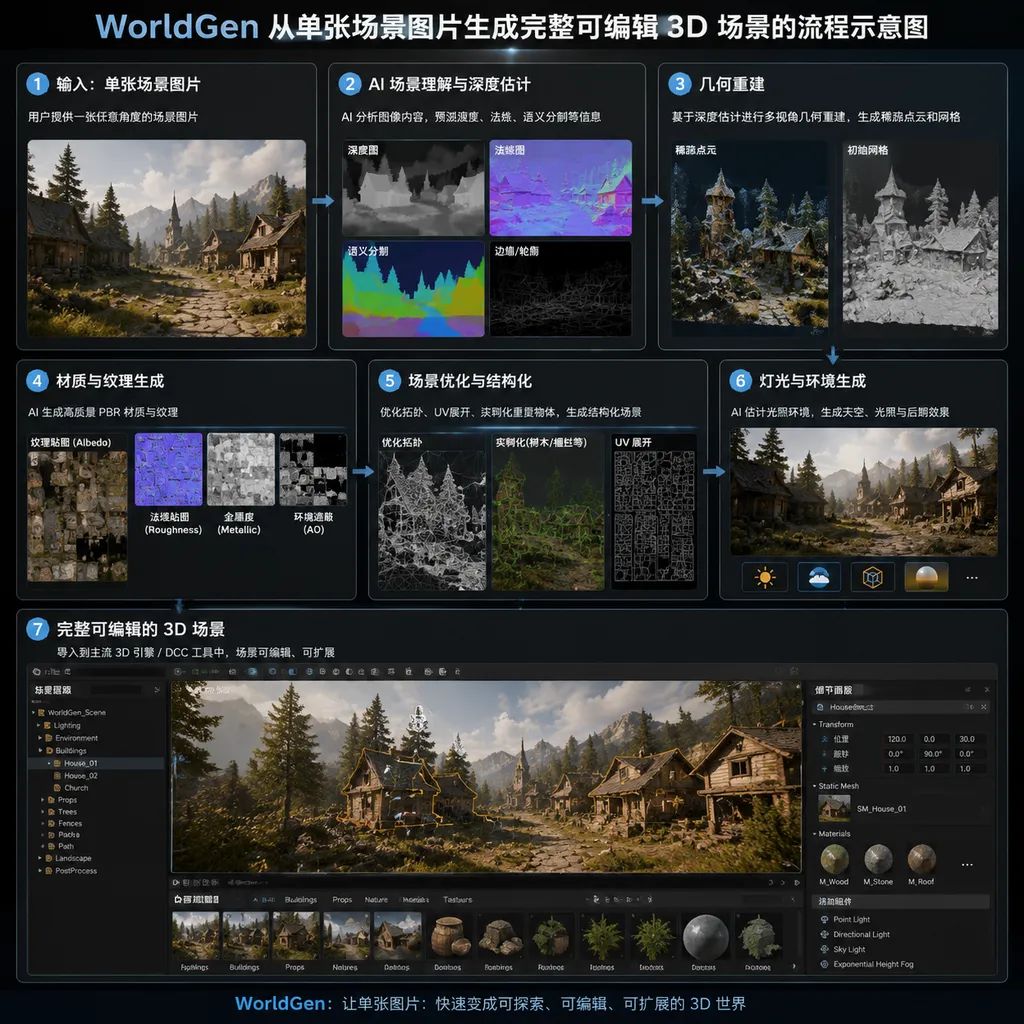
After a user uploads an image of an office, street scene, or ancient architectural complex, WorldGen identifies the main objects, infers their depth, scale, orientation, and spatial relationships, then generates independent 3D assets for each object before reassembling them into a scene. When necessary, users can also manually draw boxes around objects in the image to specify which elements need to be modeled.
This may sound like chaining together multiple single-asset generation models, but the real difficulty is not “generating a few more objects.” It lies in making sure those objects line up within the same space: the table must rest on the floor, the cup must sit on the tabletop, the door must not be embedded in the wall, and the scene must remain intact when the camera moves to a different angle.
WorldGen’s value lies precisely in beginning to address the spatial relationships and physical constraints that were previously left to humans. It indicates that the unit of delivery for 3D generation is evolving from an attractive model into a scene that can serve as a workable starting point.
From “Generating Assets” to “Generating Scenes”
Over the past year, most mainstream AI 3D-generation products have focused on individual assets: upload a product image to generate a model; input a character illustration to obtain a rotatable 3D character; provide multi-view images to reconstruct a more complete industrial object.
These tools have already compressed the first step of modeling from several hours or even days to a few minutes. But in real-world projects, an individual model is only the beginning. Game levels, film previsualization, and robotics simulation require a scene, and production teams still need to perform the following tasks manually:
- Clean up and separate models;
- Adjust the position, rotation, and scale of each asset;
- Handle occlusion, contact, and support relationships between objects;
- Add physical properties such as colliders, mass, and friction to objects;
- Import assets into Blender, Unity, Unreal, or a simulation engine;
- Recreate materials, LODs, and performance-optimized versions for the target platform.
If AI is only responsible for “making a chair” but cannot tell the engine where the chair is, whether a robot can push it, or whether it collides with the floor, then it is more of an ideation tool than a production tool.
WorldGen takes the opposite approach: it first breaks a scene down into a set of manageable assets, while preserving the spatial and physical relationships among them. The process is closer to building with blocks than generating an unmodifiable 3D screenshot.
Foreground objects in a scene are typically generated as independent meshes that can be replaced, moved, scaled, and edited individually. The background environment, meanwhile, is represented using methods such as 3D Gaussian Splatting, preserving the complex environmental details of the original image at relatively low cost. This approach achieves two goals at once: interactive objects have explicit geometric structures, while backgrounds that do not need to be edited individually prioritize visual completeness.
CAST: The Key to Scene-Level Generation Is Not “Looking Similar”
The core technical foundation of WorldGen is the CAST architecture proposed by the Hyper3D team. The paper CAST: Component-Aligned 3D Scene Reconstruction from a Single RGB Image received the Best Paper Award at SIGGRAPH 2025.
From an engineering perspective, CAST addresses one of the most challenging problems in converting a single image into 3D: an image contains only a 2D projection, while a scene requires a complete three-dimensional structure. The model must not only identify “what is in the image,” but also estimate “how those elements are organized in space.”
WorldGen’s generation process can roughly be divided into four steps:
- Scene parsing: Identify object categories, boundaries, occlusion relationships, and relative depth in the input image, producing an object list and a spatial layout graph.
- Component generation: Generate 3D geometry, textures, and materials for foreground objects such as tables, chairs, vehicles, and architectural components, while attempting to complete the unseen backsides omitted from the single image.
- Scene assembly: Predict the 3D position, scale, and orientation of each object, then place the independent assets back into the original composition.
- Physics correction: Build an object relationship graph and use methods such as SDFs to address intersections, floating objects, and incorrect contacts, giving the scene more reasonable spatial constraints.
The third and fourth steps are the easiest to overlook. A single-asset model generally only needs to answer “What does this object look like?” A scene model must also answer “Where should it be placed?” and “What is its relationship with the surrounding objects?” As a result, the evaluation criteria expand beyond geometric similarity to include layout accuracy, occlusion consistency, and interactivity.
In terms of its output form, WorldGen does not compress an entire image into an indivisible “scene model.” Instead, it attempts to preserve an asset-level structure. The table, chairs, and desk lamp in a room can be exported separately, allowing users to replace one chair without regenerating the entire room. This distinguishes it from many holistic scene-generation demos.
The Speed Is Already Sufficient, but “Usable” Matters More Than “Fast”
According to publicly available information, a single-asset preview takes approximately 2–3 seconds, while complete scene generation takes approximately 2–3 minutes. This speed is already compelling for concept design, grayboxing, and film storyboarding.
However, the real key to bringing 3D generation into production pipelines is not how quickly a result can be generated once, but how much rework that result requires.
The problem with traditional workflows is that generated models often require extensive manual fixes: deleting incorrect topology, rebuilding backsides, re-unwrapping UVs, adjusting materials, and correcting proportions before the assets can be placed in an engine. When a scene contains dozens of objects, small errors in individual assets continue to accumulate during assembly, ultimately requiring modelers and level designers to take over.
WorldGen’s technical approach attempts to incorporate this rework into the generation process from the outset: objects are modeled independently, positional relationships are explicitly recorded, scenes remain editable, and SimReady mode adds colliders and physical parameters to objects. It may not be capable of directly delivering final production-ready assets, but it can provide a structurally correct starting point for further production.
In terms more familiar to developers, WorldGen generates not a final render but an intermediate result containing a scene graph, asset nodes, transformation matrices, and some physical properties. It remains some distance from the final product, but it is beginning to approach the data formats actually consumed by DCC tools and real-time engines.
A simplified scene structure can be understood as follows:
{
  "scene": {
    "camera": {"position": [0, 1.6, 4.2], "rotation": [0, 180, 0]},
    "assets": [
      {
        "id": "chair_01",
        "mesh": "chair_01.glb",
        "transform": {
          "position": [1.2, 0, -0.8],
          "rotation": [0, 25, 0],
          "scale": [1, 1, 1]
        },
        "physics": {
          "collider": "convex",
          "mass": 6.5,
          "friction": 0.6
        }
      }
    ],
    "relations": [
      {"type": "supported_by", "subject": "lamp_01", "object": "table_01"}
    ]
  }
}
This kind of structured output is more valuable than a single mesh for game levels, robotics simulation, and spatial computing. Downstream systems care about more than vertices and textures: they also need to know what each object is, where it is, whether it can move, and how it relates to other objects.
For Games and Film, Preproduction Changes First
The most realistic current application for WorldGen is not the complete replacement of professional artists, but reducing the cost of early-stage scene construction and iterative experimentation.
For game teams, designers can first use a concept image to generate a draft level: the room layout, primary props, and camera angle are assembled initially, after which a level designer can refine them. Compared with placing dozens of assets from scratch, this approach is more like obtaining an editable blockout first and then carrying out professional refinement.
For film and advertising production, directors can first establish the spatial structure and shot relationships, then have a video model handle character motion, lighting style, and visual presentation. WorldGen has already been used together with video-generation models such as Seedance 2.5: the 3D scene provides a stable spatial framework, while the video model adds dynamic content on top of it.
The significance of this approach is that video-generation models excel at producing continuous imagery but struggle to maintain strict spatial consistency over time. Characters may deform after a shot change, the positions of tables and chairs may drift, and camera movement can easily lose realistic perspective. Locking down the space with a structured 3D scene first, then using a video model for visual expression, is a more controllable combination than relying solely on prompt-based generation.
Of course, this does not mean that scenes generated by WorldGen can be used directly for final rendering. Film-quality assets still require refinement of topology, materials, lighting, and animation rigging. WorldGen is more likely to become an “accelerator for storyboarding and previsualization” than an immediate replacement for mature asset-production pipelines.
Embodied Intelligence: Physical Correctness Matters More Than “Looking Good”
Embodied intelligence is the most ambitious—and one of the areas most likely to expose weaknesses—among the applications of scene-level 3D generation.
Robot training requires data covering large numbers of environments, objects, and layouts. If every simulation scene depends on manual construction, costs are high and coverage is limited. If video generation is used directly, the images may look realistic, but robots cannot actually grasp, push, or navigate around objects within them.
WorldGen takes a route more aligned with computer graphics and simulation: foreground objects are generated as complete meshes, object relationships are recorded in the scene, and properties such as colliders, mass, and friction are estimated. After adaptation, the generated results can be imported into simulation environments such as Isaac Sim for embodied-intelligence model training.
The advantage of this approach is clear: it provides an executable environment rather than merely an image that looks like an environment. Robots can identify a table, approach a chair, grasp an object, and adjust their actions based on collision feedback.
However, it is important to remain realistic. A single image inherently lacks information about backsides, and a model cannot determine the true internal structure, mass, or coefficient of friction of an object with complete accuracy from its appearance alone. For training-data generation, geometry and physical properties still require sampling and verification. Otherwise, incorrect parameters may cause robots to learn behaviors that do not exist in the real world.
Therefore, WorldGen is better suited to generating large-scale, diverse initial simulation environments, which can then be filtered using rule-based validation, manual spot checks, and simulation feedback. It addresses the question of “Where do scenes come from?” but has not yet fully solved the problem of ensuring that “every physical parameter is trustworthy.”
This Is Not the End of 3D Generation, but a Change in Product Form
It is important to distinguish WorldGen from the approaches represented by ByteDance’s Seed3D 1.0 and Seed3D 2.0, which are not entirely the same.
Seed3D 1.0 focuses on generating high-precision 3D models from a single image, emphasizing geometric quality, texture fidelity, and PBR materials, while supporting export to simulation environments such as Isaac Sim. Seed3D 2.0 further expanded its supported inputs to include text, images, multi-view images, and video, while also beginning to address part-level decomposition, joint modeling, URDF output, and scene layout.
WorldGen differs in that it makes the “complete scene” the core product deliverable and uses CAST to solve object alignment and relationship reconstruction. One approach focuses on establishing high-quality asset infrastructure, while the other places greater emphasis on organizing multiple assets into an editable world. Both approaches will ultimately face the same competitive question: which can integrate more reliably with downstream environments such as Blender, Unity, Unreal, Isaac, and browsers?
For developers, what is truly worth watching is not whether a demo can generate a beautiful street scene, but the following metrics:
- Whether the output preserves independent assets instead of producing an indivisible whole;
- Whether meshes, Gaussian Splatting, and textures can be combined as required by the scene;
- Whether common formats can be exported while preserving material, hierarchy, and transformation information;
- Whether colliders, joints, and physical parameters can be recognized by downstream tools;
- Whether spatial relationships remain stable after repeated edits to the same scene;
- Whether the generation results support automated batch generation rather than only a manual web-based experience.
These metrics determine whether a 3D-generation model is merely a showcase tool or infrastructure that can be integrated into an asset pipeline.
It Is Not Time for “One-Click Delivery” Yet
The release of WorldGen is a clear productization signal, but it should not be interpreted as meaning that 3D content production has already become fully automated.
First, single-image reconstruction still suffers from missing information. The backsides, hidden structures, and true scales of occluded objects must be inferred by the model. Perspective distortion, mirror reflections, and complex transparent materials in the image can also affect the result.
Second, scene-level generation amplifies errors. A slight discrepancy in the proportions of one object may cause mismatches between tables and chairs, intersections between doors and windows, or unreasonable character scale once the object is placed in a complete space. The more objects there are, the more complex the relationship graph becomes, making automated correction increasingly important.
Third, production pipelines impose strict performance requirements. A high-quality model is not necessarily a real-time model. Polygon count, texture size, material count, and collider complexity all need to be optimized for the target platform. If a generative model pursues visual detail without providing LODs, UVs, and batching capabilities, bottlenecks will still emerge at the engine stage.
So, the more accurate description at this stage is that scene-level 3D generation is beginning to enter production pipelines—not that it has already replaced them. It provides a better starting point, delegating large amounts of repetitive scene construction to models while leaving professionals more time for aesthetics, design, and final quality control.
Conclusion: The Next Competition in 3D Generation Is the Ecosystem
The shift from individual assets to complete scenes changes not only the scale of the generated content, but also the way products are organized.
Model companies now need to address more than geometric quality and texture realism. They must also establish scene graphs, physical properties, export formats, and editing capabilities. The company whose results can be read directly by the greatest number of engines, and whose tools can save creators the most rounds of cleanup and reconstruction, will have the best chance of becoming infrastructure for 3D content production.
For developers, what makes WorldGen worth watching is not how magical it is to upload an image, but whether it can turn the objects, relationships, and constraints within a scene into data that can be called, edited, and verified. Only when generated results can enter existing workflows such as Blender, Unity, Unreal, and Isaac Sim will AI 3D truly have moved from demos into production.
The path is still at an early stage, but the direction has changed: future 3D-generation products will not sell merely a model, but an entire world that can continue to be modified jointly by programs, engines, and people.
References
Due to restrictions on accessible domains, the following list retains searchable entry points for public projects and technical materials, enabling developers to locate the original papers, code, and model information.
- GitHub: Search for Seed3D-related projects — For locating publicly available Seed3D code, technical reports, and related implementations.
- GitHub: Search for WorldGen- and CAST-related projects — For locating publicly available materials related to WorldGen, CAST, and scene-level 3D reconstruction.
- GitHub: Search for 3D Gaussian Splatting-related projects — For learning about the 3DGS technology ecosystem involved in WorldGen’s background representation.