<think>**Translating headline for clarity**</think> WorkBuddy Launches on Homegrown Linux
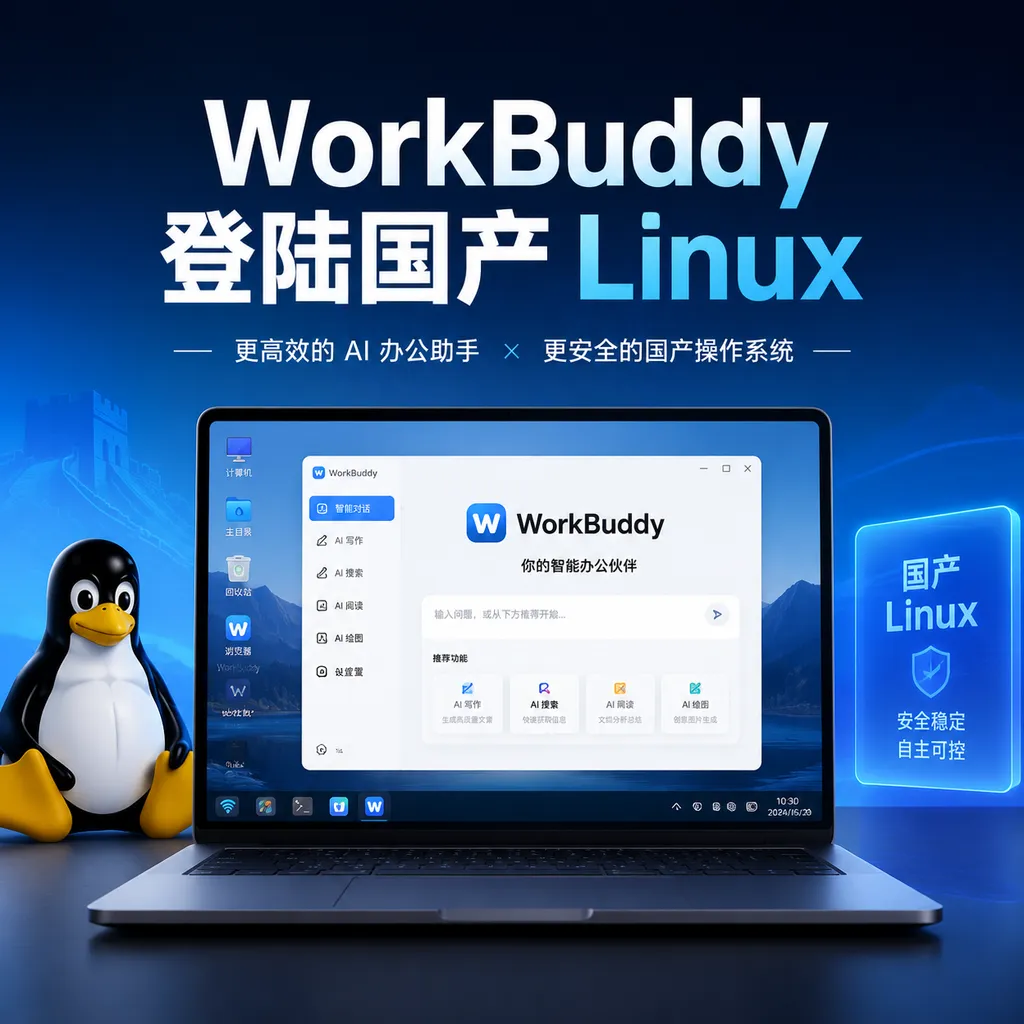
<think>**Researching WorkBuddy and 信创 context**</think> Tencent WorkBuddy is now available on Galaxy Kylin and UnionTech UOS, and has entered the openKylin and deepin software stores. AI agents are moving beyond cross-platform applications and further into real-world office environments involving government affairs, China’s domestic IT ecosystem, and homegrown Linux distributions.
<think>Planning precise markdown translation</think>
Tencent WorkBuddy Starts Supporting Chinese Linux Distributions Today
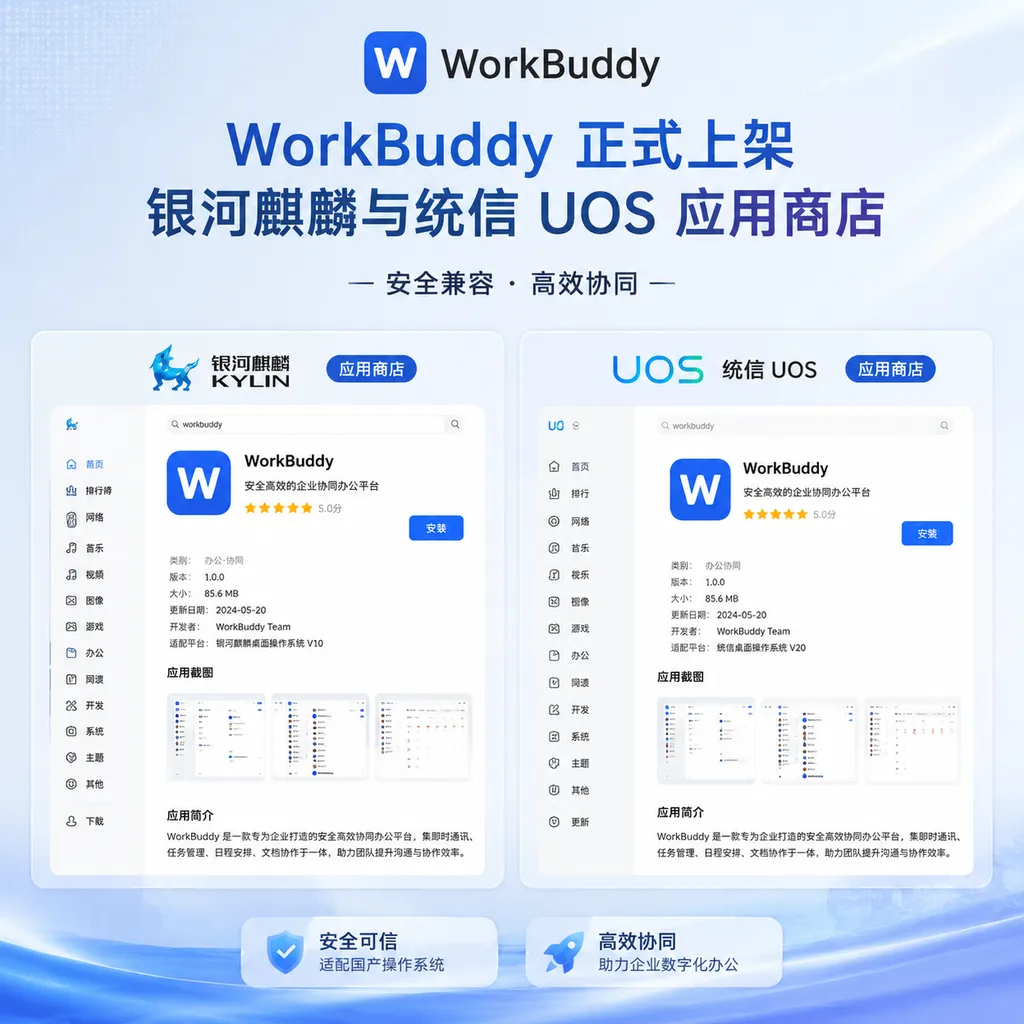
On September 3, Tencent’s all-scenario AI agent workspace WorkBuddy officially launched on Kylin OS and UnionTech UOS. It was simultaneously listed in the official app stores for both operating systems, as well as the openKylin and deepin community software stores.
Users can simply search for WorkBuddy in the corresponding app store to download and install it directly, with no additional configuration required. New users can still receive 2,000 free credits.
On the surface, this update merely adds support for two desktop platforms, but its actual significance is much greater: AI agents are moving beyond relatively mature consumer environments such as Windows, macOS, and the Web into Chinese operating systems, government office environments, and Xinchuang terminals—scenarios that place greater emphasis on system integration, permission isolation, and deployment stability.
It Is Not as Simple as Porting the Installer
For desktop software, releasing an installable package that can launch across Linux distributions is not difficult. The hard part is making it genuinely fit into users’ workflows.
According to the WorkBuddy team, this adaptation was not a simple code migration. Instead, it involved customized integration carried out jointly with Chinese operating system vendors. The parties refined core workflows across all usage scenarios, including system login integration, device connectivity and interaction, intelligent skill invocation, and task output previews, with the goal of delivering a native-level experience.
These capabilities are precisely what distinguish agent products from ordinary chat clients.
A conventional chat application can generally be considered usable as long as it can open a window and make network requests. But WorkBuddy is not positioned as a simple chat box. It needs to read and process local files, invoke office applications or external tools, run Skills and MCP capabilities, execute automated tasks, and deliver generated documents, spreadsheets, and analysis results back to the user. In other words, for an agent to actually get work done, it must integrate with the operating system’s login framework, file system, device capabilities, and windowing interactions.
For this reason, adapting WorkBuddy to Chinese Linux distributions is not merely about whether it can run on a given CPU architecture or desktop environment. It also involves several deeper issues:
- Seamless integration with the system account framework: Once users sign in to the operating system, can the application reliably link their identity and reduce the need for repeated logins and account switching?
- Handling local files and office assets: Can documents, spreadsheets, images, and business materials be securely read, analyzed, and previewed?
- Invoking system and third-party capabilities: When the agent executes a task, can it connect to printers, file managers, browsers, conference-room equipment, and other office tools?
- Reliable delivery of results: Can generated reports, spreadsheets, or presentations be properly previewed, edited, and passed along within Chinese desktop environments?
- Meeting enterprise deployment requirements: Application updates, access control, endpoint management, and data security must accommodate the operating practices of government and enterprise environments.
From this perspective, the value of WorkBuddy’s latest launch lies not in adding two more download channels, but in beginning to embed the agent execution workflow into Chinese operating systems.
What Problems Does WorkBuddy Need to Solve on Chinese Operating Systems?
Competition among AI agent products is no longer just about how accurately the model answers questions.
When users are simply asking a question in a web browser, model capability is almost the only variable. But when they ask an agent to organize a local folder, analyze a batch of business spreadsheets, generate meeting minutes, invoke multiple tools, and produce a final document, the factors that truly shape the experience often lie outside the model itself: permissions, connectivity, context, tool invocation, and the ability to recover from task failures.
This is also what distinguishes WorkBuddy from traditional office assistants. According to publicly available information, WorkBuddy covers workplace scenarios including document drafting, data analysis, coding assistance, and content creation. It also supports local file processing, parallel multi-agent execution, remote control, automated scheduled tasks, and the Skills and MCP ecosystems.
On consumer PCs, users may regard these capabilities simply as productivity features. In Chinese Linux environments such as Kylin OS and UnionTech UOS, however, they face more complex practical constraints: package management systems vary, desktop components and system APIs differ, enterprise endpoints have stricter permissions, and compatibility with certain third-party office applications and hardware must be verified separately.
Whether this adaptation can achieve scale in real-world government and enterprise environments will therefore ultimately depend on three metrics:
- Stability: Is it reliable during long-running operation, parallel task execution, and large-file processing?
- Controllability: Can enterprises clearly define data flows, tool permissions, and the boundaries of local file access?
- End-to-end execution: Can the agent move all the way from understanding a request to executing it and delivering the result, rather than merely generating a block of text?
The signals WorkBuddy has provided so far are positive. It has not treated Chinese Linux as a peripheral platform supported merely for the sake of claiming compatibility. Instead, it has worked jointly with vendors on system login, device connectivity, skill invocation, output previews, and other aspects. However, the native-level experience claimed by the company still needs to be validated through long-term use by more government and enterprise customers, especially in complex intranet, offline, and partially offline deployment scenarios.
From HarmonyOS to Kylin OS, WorkBuddy Is Filling Out Its Endpoint Portfolio
This is not WorkBuddy’s first entry into the Chinese operating system ecosystem.
In July this year, Tencent released the HarmonyOS PC edition of WorkBuddy, making it a desktop office agent for the HarmonyOS platform. WorkBuddy had previously launched a mobile edition for HarmonyOS. Its latest expansion to Kylin OS, UnionTech UOS, and the openKylin and deepin communities means that it is building a relatively comprehensive presence across Chinese endpoint platforms.
From a product strategy perspective, this expansion has a clear objective: preventing accounts, tasks, memories, and outputs from being tied to a single device.
Users may record requirements on a phone, process documents on a PC, continue executing tasks on another workplace terminal, and ultimately deliver the results to colleagues or business systems. If an agent exists on only one platform, it will struggle to become a persistent gateway for getting work done. It must preserve context across different endpoints and switch execution methods according to each device’s capabilities.
The open platform launched by WorkBuddy on September 2 also reinforces this direction. According to publicly available information, the platform exposes underlying agent capabilities to smart hardware vendors, industry applications, and developers. Its first group of ecosystem partners includes more than 100 companies across categories such as smart glasses, recording devices, headphones, keyboards and mice, PCs, tablets, and wearable devices.
This means that WorkBuddy is attempting to evolve from an AI office product into an agent foundation that connects devices, applications, and developers. Support for Chinese Linux distributions is a crucial foothold for this ecosystem within government and enterprise desktop environments.
Government and Xinchuang Markets May Offer a More Practical Point of Entry
With WorkBuddy’s arrival on Chinese Linux, its most immediate incremental market may not be ordinary individual users, but organizations with relatively high levels of Xinchuang procurement, including government agencies, educational institutions, financial firms, energy companies, and large enterprises.
These scenarios have two defining characteristics.
First, users are not free to choose their operating systems. Enterprises and government institutions have often already completed centralized procurement and deployment of endpoint operating systems. Whether an application can run reliably on the designated system is a prerequisite for being included on an approved software list. Even a highly capable agent that supports only Windows or macOS will struggle to become part of a complete office environment.
Second, users need workflow automation rather than chat.
For example, civil servants may need to give an agent policy materials, meeting records, and spreadsheet data, then have it extract key points, draft a report, and organize follow-up tasks. Teachers may need it to generate lesson plans, assessment rubrics, and differentiated exercises based on curriculum standards. Enterprise employees may need it to read local business files, perform data analysis, and produce reviewable results.
In these tasks, the model is only an intermediate component. What truly determines value is whether the agent can access materials under controlled permissions, invoke skills, execute multistep workflows, and leave behind traceable task results.
On June 16 this year, China’s first provincial-level intelligent government administration hub, Wanqing, began trial operations. Wanqing·WorkBuddy, customized for government use cases, has been made available to civil servants throughout Guangdong Province. By August, related government systems and provincial-level agencies had also begun integrating more scenarios and exploring pilot programs.
This development indicates that WorkBuddy’s adaptation to Chinese operating systems is not an isolated client update. It is progressing in parallel with intelligent government administration, Xinchuang endpoints, and the implementation of industry-specific agents. For Tencent, desktop adaptation determines whether WorkBuddy can enter organizations; the open platform determines whether it can connect to more business systems; and the government and industry editions determine whether it can create replicable use cases.
But “Operating System Coverage” Does Not Mean “Ecosystem Adaptation Is Complete”
It is important to remain clear-eyed: supporting multiple Chinese operating systems does not mean WorkBuddy has completed its adaptation to the Chinese Linux ecosystem.
The Chinese Linux landscape is not a single platform. Kylin OS, UnionTech UOS, openKylin, and deepin differ in their underlying distributions, desktop environments, software stores, hardware drivers, and enterprise management capabilities. Listing an application in software stores solves installation and distribution, but in large organizations, the truly complex issues also include unified accounts, endpoint policies, intranet access, data isolation, log auditing, private deployment, and integration with existing office systems.
Moreover, the permission boundaries of agents are more sensitive than those of traditional applications.
An agent capable of reading files, controlling devices, and invoking external tools inherently has greater operational power than chat software. Enterprise users will want to know: Which directories can it access? What data will be uploaded to the cloud? Does tool invocation require manual confirmation? Can tasks be rolled back? Can generated results be audited? How is responsibility assigned when the agent makes a mistake?
These concerns do not disappear simply because the application is listed in a software store. If WorkBuddy is to continue expanding in government and enterprise markets, it must not only continue adapting to low-level system capabilities, but also make its permission management, data governance, and enterprise deployment capabilities sufficiently granular.
For developers, this also serves as a reminder: cross-platform support for AI agents should not be understood merely as making the UI display properly on different operating systems. It should encompass the full migration of runtimes, tool protocols, permission models, task states, and data lifecycles.
AI Agents Are Evolving from “Applications” into System Gateways
The broader signal from WorkBuddy’s launch on Kylin OS and UnionTech UOS is that competition among AI agents is moving down from the model layer into the operating system and workflow layers.
In the past, adapting software to Chinese operating systems was primarily about ensuring that traditional applications could run. Today, agents must go further: they need to understand system states, connect to devices, orchestrate tools, and maintain continuity across different endpoints. This product model more closely resembles a new kind of system gateway. Rather than opening a particular application and searching for a function, users can directly tell the agent what they want to accomplish and let it decide which applications and capabilities to invoke.
Through WorkBuddy, Tencent is advancing three initiatives simultaneously: first, supporting Chinese operating systems such as HarmonyOS, Kylin OS, and UnionTech UOS; second, connecting hardware and industry applications through its open platform; and third, opening Skills, MCP, and agent capabilities to developers. The goal of this combined strategy is clear—not merely to build a more powerful office tool, but to become a workspace and infrastructure platform for the agent era.
This path presents opportunities, but it also places greater demands on execution. A platform’s value ultimately depends on ecosystem density and task success rates, not on the length of its compatibility list. For users, what truly matters is not how many operating systems can install WorkBuddy, but whether it can reliably complete a task within their own operating system, intranet, and business workflows.
At the very least, Chinese Linux is no longer merely a platform that AI applications must “reluctantly support.” As agent products such as WorkBuddy proactively enter the market, Kylin OS, UnionTech UOS, openKylin, and deepin are gradually becoming runtime environments that AI office applications and agent workflows must take seriously.
What This Means for Developers
If you are developing agents for government agencies, educational institutions, or large enterprises, WorkBuddy’s latest update is worth watching for reasons that go beyond the addition of several client platforms:
- Operating system adaptation for desktop agents will become a foundational capability. This is especially true in Xinchuang projects, where clients, browser extensions, and local toolchains must be considered together.
- The value of MCP and Skills will increasingly be realized within organizations. What enterprises truly need is connectivity to knowledge bases, file systems, business systems, and approval workflows—not another general-purpose chat window.
- Cross-device context synchronization will affect user retention. If tasks, memories, and outputs cannot flow between phones, PCs, the Web, and dedicated hardware, agents will struggle to become persistent gateways for work.
- Permissions and auditing must be designed from the outset. Agents capable of executing tasks require clearer authorization, confirmation, logging, and rollback mechanisms than ordinary SaaS applications.
- The differences among Chinese operating systems cannot be completely hidden by an abstraction layer. Installation and distribution, system notifications, file access, device invocation, and integration with office applications must all be verified individually in the target environments.
WorkBuddy’s arrival on Chinese Linux means that AI agents are entering a more pragmatic—and more difficult—stage: moving from demonstrating capabilities to genuinely taking over workflows. Next, the market will use real government documents, enterprise processes, and long-term operational data to determine whether this adaptation is merely an expansion of product coverage or the starting point of an AI ecosystem for Chinese operating systems.
References
- ITHome: Following HarmonyOS, Tencent WorkBuddy Launches on Kylin OS and UnionTech UOS — Details WorkBuddy’s launch in the Kylin OS, UnionTech UOS, openKylin, and deepin software stores.
- ITHome: Tencent WorkBuddy Gains Native Support for Kylin OS and UnionTech UOS, Achieving Full Coverage of Mainstream Chinese Operating Systems — Provides additional information about WorkBuddy’s operating system adaptation strategy and progress in supporting Chinese endpoint platforms.