<think>**Translating headline for Saudi Arabic model**</think> Saudi Arabic Model Adopts MiniMax

Saudi Arabia’s HUMAIN has released humain-m3, built on MiniMax M3 and natively pretrained on terabyte-scale Arabic data. A research preview is now available, with an open-weight release planned for the future.
<think>Preparing technical translation with markdown preservation</think>
Saudi Arabia’s Frontier Arabic Model Is Built on MiniMax
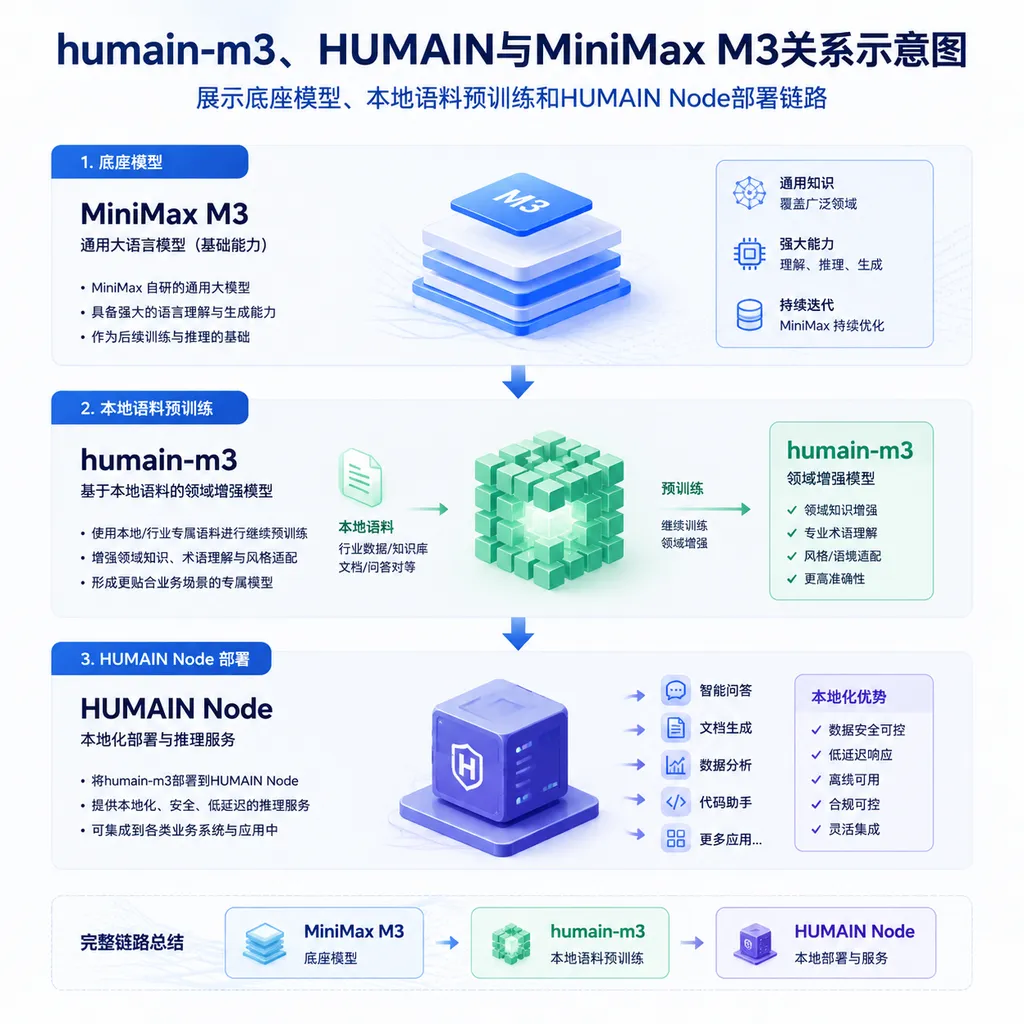
On September 3, HUMAIN, an artificial intelligence company backed by Saudi Arabia’s sovereign wealth fund, the Public Investment Fund (PIF), released the Arabic-language model humain-m3. Rather than being built from scratch, the model was commissioned from Chinese AI company MiniMax. It is based on MiniMax M3, released in June this year, and underwent additional pretraining on trillions of tokens of native Arabic text.
humain-m3 is now available on the HUMAIN Node platform, though only as a research and evaluation preview. HUMAIN says it will release an open-weight version in the future. As of September 3, 2026, the company has not announced a specific release date, license, parameter count, inference costs, or a complete technical report.
What makes this release noteworthy is not simply that “Saudi Arabia has built another national-level model.” More importantly, it demonstrates an increasingly clear division of labor in the AI model industry: organizations with capital, computing power, and local use cases do not necessarily need to train foundation models from scratch, while established model providers can adapt general-purpose models into “sovereign models” tailored to specific languages and regions.
Not Simple Translation, but Continued Arabic Pretraining
According to HUMAIN, humain-m3 underwent pretraining on trillions of tokens of native Arabic text. The key phrase here is “native text,” rather than English-language training data translated into Arabic at scale.
The difference between these two approaches is substantial.
Machine-translated corpora often retain the syntax and idiomatic patterns of the source language. Even with a large volume of data, they can easily produce Arabic that is grammatically correct but does not sound natural to local speakers. Native-language corpora are more likely to cover news, literature, government documents, social media, business content, and authentic expressions from different regions. This makes them more valuable for teaching a model to understand cultural context, implied meaning, and dialectal differences.
However, “trillions of tokens” remains a very broad official description. It indicates a substantial training scale but cannot be equated directly with high quality. Whether the data was deduplicated, how dialects were balanced, whether low-quality web content was filtered out, how much synthetic data was included, and whether the dataset contains biases toward particular regions or political contexts can all significantly affect the final results. HUMAIN has yet to disclose these details.
Arabic is also not a language that can be handled well simply by expanding the vocabulary. From a model’s perspective, there are at least several challenges:
- Complex morphology: Arabic densely combines roots and affixes, allowing a single root to generate many forms. Tokenization quality directly affects training and inference efficiency.
- Coexistence of Modern Standard Arabic and regional dialects: Media outlets and government documents commonly use Modern Standard Arabic, while users in chat, customer service, and social media are more likely to use Egyptian, Gulf, Levantine, Maghrebi, and other regional dialects.
- Widespread code-switching: Technical, financial, and business communications frequently mix in English, while French may also appear in North Africa.
- Arabizi usage: Some users write Arabic using Latin letters and numerals, a form that conventional written Arabic datasets struggle to cover comprehensively.
- Right-to-left engineering support: This is not merely a model-training issue. It also affects front-end rendering, punctuation, numerals, code snippets, and the reliability of structured outputs.
The real question humain-m3 must answer, therefore, is not whether it can respond to questions in Modern Standard Arabic, but whether it can remain reliable across dialects, multilingual mixed-language input, tool use, and long-horizon agent tasks.
Highest Average Score Across Seven Arabic Benchmarks, but It Is Too Early to Draw Conclusions
HUMAIN says humain-m3 achieved the highest average score among the frontier models evaluated across seven public Arabic-language benchmarks. This is an encouraging sign, at least demonstrating that after specialized Arabic training, the model is competitive on standardized tests.
However, these results are not yet sufficient to answer several key questions:
- Which specific test sets were used?
- Which versions of the comparison models were evaluated?
- Were the evaluations conducted in zero-shot or few-shot settings, or with specific prompt templates?
- Did they include tool use, long-context tasks, and real-world business scenarios?
- Could the test sets have been included in the training data?
- Did the average score obscure differences in performance across Arabic dialects?
“Ranking first on average across seven benchmarks” is not the same as “achieving globally frontier-level general capabilities.” It is not surprising for a language-specialized model to outperform general-purpose models in local knowledge Q&A, reading comprehension, and cultural knowledge. However, developers ultimately tend to care about a different set of metrics: whether it can produce valid JSON consistently, whether function-calling parameters drift, whether retrieval-augmented generation cites sources faithfully, whether it forgets constraints during long conversations, and exactly how much each million tokens costs.
Strictly speaking, humain-m3 is currently a preview model worth testing, but not one that should be deployed directly into production systems based solely on leaderboard results.
MiniMax M3 Provides the “General-Purpose Engine”
It is not difficult to understand why humain-m3 uses MiniMax M3 as its foundation. MiniMax M3 was designed for coding, agentic, and long-context scenarios. According to publicly available information, it supports context windows of up to one million tokens and uses the MiniMax Sparse Attention architecture to reduce the computational overhead of long sequences.
In other words, HUMAIN did not redesign the engine. Instead, it adapted the language, knowledge, and regional capabilities of a general-purpose system that already possessed long-context and agentic capabilities.
From a development perspective, this combination is more valuable than simply building an Arabic chatbot. Its potential use cases include:
- Long-document analysis of Arabic government documents, regulations, and contracts;
- Intelligent customer service for local banks, telecommunications operators, and airlines;
- Arabic-language search, knowledge-base Q&A, and enterprise RAG;
- Coding assistants and data-analysis agents for the Gulf region;
- Cross-lingual business research in Arabic and English;
- Localized applications in education, healthcare, and public services.
In government and large-enterprise scenarios in particular, a one-million-token context window—if used effectively—could accommodate large volumes of policy documents, tender materials, or internal regulations in a single request. However, a large context window does not mean the model can reliably locate information near the end of a million-token prompt. Long-context recall, cross-document reasoning, and citation reliability still need to be tested separately.
“Open Weights” Does Not Mean “Fully Open Source”
HUMAIN has promised to release an open-weight version of humain-m3 in the future. This is good news for developers and research institutions, but the wording deserves careful attention.
Open weights merely mean that the model parameters may be made available for download. It does not automatically mean that:
- Commercial use will be unrestricted;
- Further training and redistribution will be permitted;
- The composition of the training data will be disclosed;
- Complete training code and data-processing pipelines will be provided;
- The model may be used in every country, industry, or content domain;
- The model can run on ordinary GPUs or consumer-grade devices.
Its ultimate value will depend on the license. If the license permits commercial deployment, quantization, and distribution of derivative models, humain-m3 could become an important foundation for the Arabic-language development ecosystem. If it is restricted to research or imposes substantial limitations based on geography, user scale, or use case, it will be closer to a downloadable evaluation artifact.
The parameter count is equally important. Even with open weights, community deployment could remain difficult if the model is very large or uses a complex mixture-of-experts design or specialized sparse-attention implementation. Developers will also need to wait for official details on supported inference frameworks, VRAM requirements, quantization compatibility, and whether the model can run directly on common stacks such as vLLM, SGLang, and Transformers.
Saudi Arabia Wants Control of AI Infrastructure, Not Just a Chatbot
HUMAIN is backed by Saudi Arabia’s sovereign wealth fund, PIF, and its ambitions clearly extend beyond releasing a model. Making humain-m3 available as a research preview on HUMAIN Node indicates that the model, computing platform, and developer access point are being integrated into a single ecosystem.
This aligns with the typical path toward “sovereign AI”: keeping data local whenever possible, adapting models to local languages and regulations, and placing computing infrastructure and service access under the control of local institutions. In highly sensitive sectors such as government, finance, energy, and healthcare, this degree of control is often more important than leaderboard rankings.
Interestingly, the technical foundation for this sovereign AI initiative comes from a Chinese company. This shows that a sovereign model does not necessarily require every component to be developed domestically from scratch. A more practical approach is for local institutions to control data, deployment, and governance while procuring mature foundation-model capabilities from external providers.
For MiniMax, this also represents a significant overseas validation. Compared with simply selling API access, being commissioned to develop a national-level language model means its capabilities are entering deeper areas such as model customization, continued pretraining, and local deployment. Such projects have longer timelines and more complex delivery requirements, but they also offer stronger customer retention and greater strategic value.
What Developers Should Focus on Now
At this stage, humain-m3 is better suited for evaluation than for an immediate migration of production traffic. Teams preparing to test it should focus on the following areas:
| Evaluation Dimension | Recommended Tests | |---|---| | Dialect coverage | Comprehension and generation in Gulf, Egyptian, Levantine, and Maghrebi dialects | | Multilingual mixed input | Inputs combining Arabic with English, French, and code snippets | | Structured output | Reliability of JSON Schema, function arguments, and table generation | | RAG capabilities | Arabic document retrieval, citation faithfulness, and refusal behavior | | Long context | Multi-document retrieval, cross-section reasoning, and retrieval of information near the end of the context | | Safety and bias | Consistency of responses on religious, political, gender, and regional issues | | Engineering metrics | Time to first token, throughput, concurrency limits, and API pricing |
The only officially confirmed access point is the research and evaluation preview on HUMAIN Node. There is currently no public information on whether model aggregation platforms such as OpenAI Hub will support it. Until the model ID, API protocol, and pricing details are confirmed, developers should not assume compatibility with the OpenAI API.
A Promising Start, but the Technical Report Matters More Than the Slogans
humain-m3 is moving in the right direction. Arabic has hundreds of millions of speakers, yet it has long received less investment in frontier models than its population and economic significance would warrant. Large-scale continued pretraining on a mature foundation model using local-language data is more meaningful in practice than simply repackaging a general-purpose model.
It also illustrates how Chinese AI companies are changing their approach to global expansion: rather than only providing cloud APIs or downloadable weights, they can also serve as technical contractors for national-level AI projects overseas.
However, humain-m3 remains at a stage where the results are impressive but the available information is incomplete. Its leading average score across seven benchmarks is worth noting, but its model size, data composition, license, real-world task evaluations, and deployment costs have yet to be disclosed. Whether the promised open-weight release materializes—and how open it actually is—will determine whether humain-m3 becomes a genuinely usable foundation model for the Arabic-language ecosystem or primarily a showcase project serving a national AI strategy.
For developers, the most important things to wait for are not the next leaderboard results, but the weights, license, and technical report.
References
- ITHome: Saudi Arabia’s HUMAIN Unveils Frontier Arabic Model humain-m3 — Reports the model’s release date, MiniMax’s role as the commissioned developer, the scale of Arabic-language pretraining, benchmark performance, and plans for a future open-weight release.