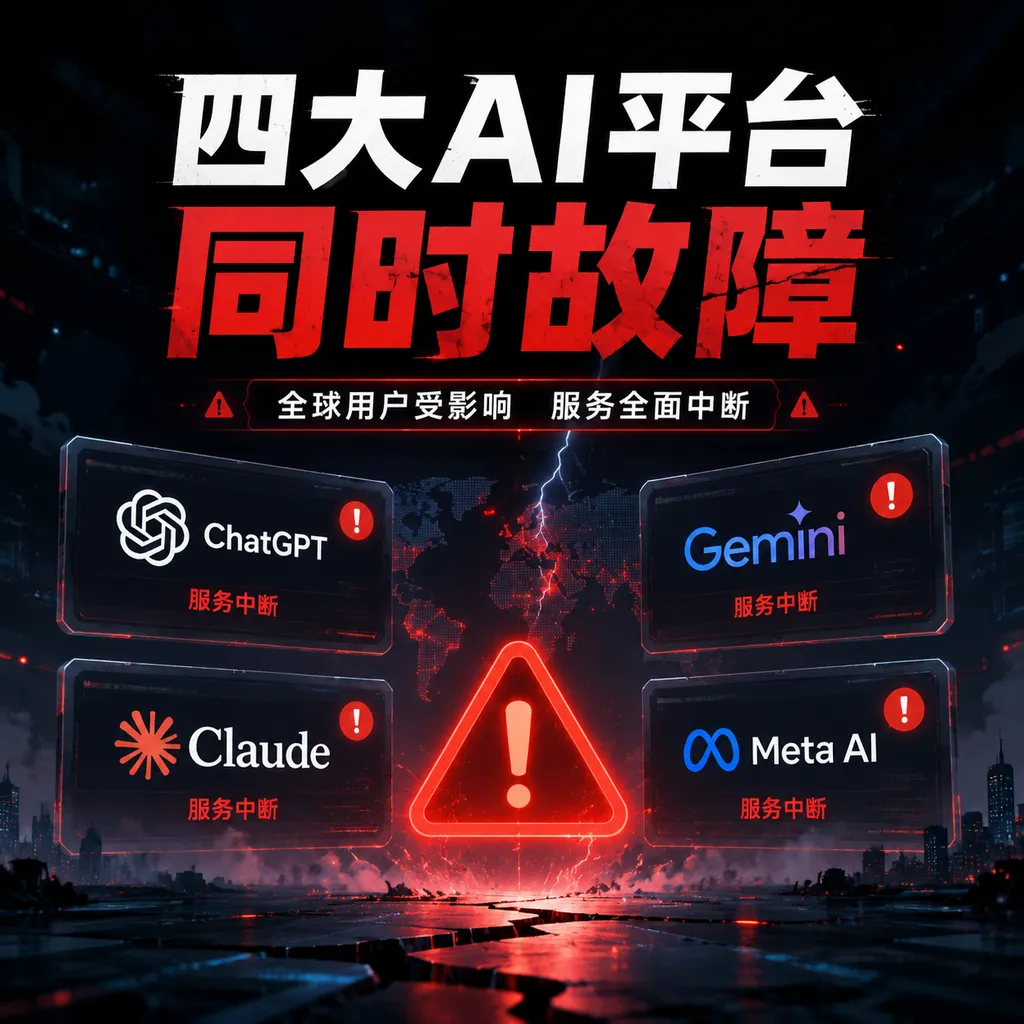
<think>**Translating headline text**</think> Four Major AI Platforms Fail Simultaneously
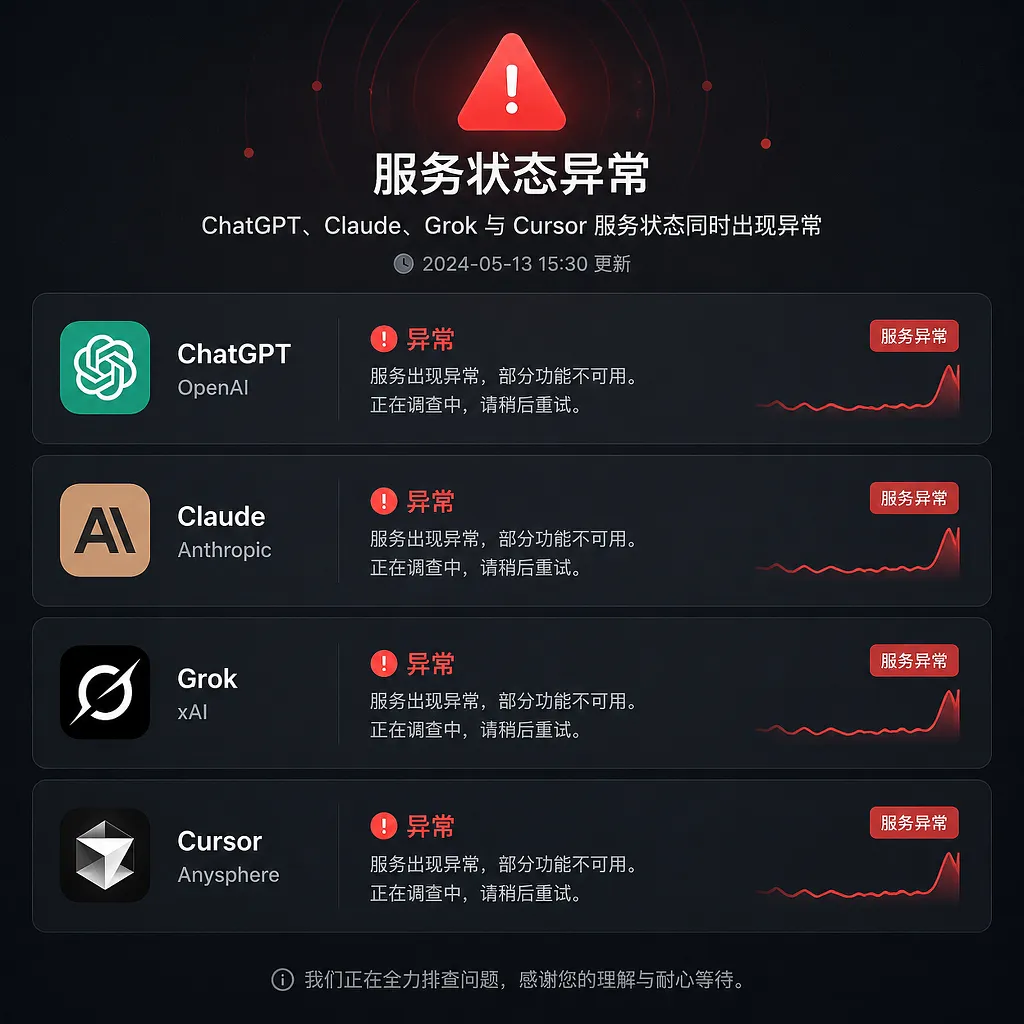
<think>**Summarizing service disruption details**</think> On the evening of September 3, ChatGPT, Claude, Grok, and Cursor experienced service disruptions in succession. Requests to OpenAI’s ChatGPT and Codex were affected, with “404 Not Found” errors appearing. Simultaneous errors across multiple platforms once again exposed AI workflows’ dependence on a single vendor and shared infrastructure.
<think>Planning literal SpaceXAI translation</think>
ChatGPT, Claude, Grok, and Cursor All Became Unreliable at the Same Time Tonight
On the evening of September 3, several AI products, including ChatGPT, Grok, Claude, and Cursor, experienced a series of outages. User reports ranged from web pages failing to load and conversation requests failing, to coding agents being unable to execute tasks. The impact covered ordinary chats, model APIs, and the programming workflows developers rely on most, including Codex and Claude Code.
OpenAI-related issues were the most concentrated. Some users received 404 Not Found directly when calling Codex, while ChatGPT also experienced failed requests or problems generating content. OpenAI subsequently confirmed that ChatGPT and Codex were currently experiencing issues.
Anthropic said it was investigating errors affecting Claude and working on a fix. SpaceXAI also confirmed that Grok was experiencing an outage and that it was investigating the service interruption. On the Cursor side, users likewise reported widespread failures of model requests within the editor, interrupted code generation, or prolonged periods without a response.
Scale of the Outage: OpenAI Reports Exceed 12,000
Data from the third-party outage monitoring platform Downdetector indicates that this was not an issue affecting only isolated accounts or local networks.
As of press time, users in the United States had submitted more than 12,000 outage reports concerning OpenAI services. There were approximately 1,200 reports related to Claude and about 1,000 related to Grok. The peak times across the different platforms were close, and the phenomena users experienced were highly similar: requests could not be sent, pages repeatedly refreshed, models returned errors, or tasks became stuck midway through execution.
However, these figures only show that user-side anomalies surged at the same time. They cannot directly prove that the companies were using the same underlying services, much less establish that the root cause was a particular cloud provider, CDN, or network service provider. The failure chain of an AI service is longer than that of an ordinary website. From DNS, edge networks, authentication, and API gateways to model routing, GPU clusters, and tool calls, an anomaly at any layer can manifest as “the model is down.”
The publicly available information is still insufficient to confirm the root cause of the incident. It is premature to simply attribute multiple platforms experiencing problems simultaneously to an outage at a particular cloud service provider.
A 404 Response from Codex Does Not Necessarily Mean the Model Itself Has Failed
For developers, the most noteworthy signal was the appearance of 404 Not Found responses from Codex requests.
A 404 usually means that the request reached an HTTP service, but that the target path, resource, or route did not exist. This is not the same type of problem as insufficient GPU capacity, a request timeout, or a model generation failure. In other words, a 404 from Codex is more likely to indicate that the request was not correctly forwarded to the expected service endpoint, rather than that the model had generated an erroneous answer.
In a production system, the following types of changes could produce similar symptoms:
- The API gateway temporarily switched routes, while the client was still requesting the old path;
- Service discovery configurations in some regions were not synchronized during a gradual rollout;
- Codex-related interfaces, agent task services, or the authentication layer were being rolled back;
- A particular version of the client called a resource that had been taken offline or temporarily withdrawn;
- After an upstream service failure, the gateway replaced a more specific error message with a uniform 404 page.
This is also why developers cannot diagnose an outage simply by looking at the model name. From receiving a prompt to modifying code, a coding agent must pass through at least the session service, model routing, tool calls, the file system or sandbox, and result delivery. A failure at any layer may ultimately be wrapped in an HTTP error that appears inaccurate.
If you are troubleshooting your own application, you should record at least the following information:
- The request time and time zone;
- The HTTP status code and complete response body;
- The model, API path, and region used by the request;
- Server-returned identifiers such as
request_idand the trace ID; - The number of retries, backoff intervals, and final failure reason;
- Whether the failure occurred during model generation, tool invocation, or streaming transmission.
Do not write only “OpenAI call failed” in your logs. For multi-model systems, such a log entry has almost no diagnostic value.
Why Developers Notice Simultaneous Problems Across Four Platforms So Acutely
In the past, a brief AI platform outage usually meant that a chat window would not open. Today, however, models have been embedded into code review, autocomplete, test generation, document processing, and CI workflows. An outage no longer affects a single question-and-answer exchange; it affects an entire workflow in progress.
For example, a coding-agent task might involve reading a repository, analyzing dependencies, modifying multiple files, running tests, and continuing to make fixes based on the test results. If the model service fails during the third step, developers are not left with merely a failed response. Instead, they may face a partially completed state in which some files have already been modified, changes have not yet been committed, and the context has not been fully saved.
Cursor faces an even more pronounced risk. It is not simply a model API client; it integrates the editor, project indexing, context assembly, model routing, and agent execution. Users see “Cursor can no longer write code,” but the problem could originate with the built-in model provider or with the editor’s own request orchestration layer.
The convenience of these products is precisely what makes them vulnerable: developers do not need to care how the underlying services are connected, but once the connection chain breaks, it can also be difficult to quickly determine which layer has failed.
A Collective Outage Does Not Mean “AI Infrastructure Is Already Out of Control”
This incident could easily lead to the conclusion that, since ChatGPT, Claude, and Grok can all experience problems on the same evening, the entire AI industry must share a massive single point of failure.
There is currently insufficient evidence to support that inference. Multiple platforms experiencing outages at the same time could have at least three explanations:
First, Shared Dependencies May Exist
Multiple service providers may share dependencies in networking, identity authentication, cloud regions, data centers, CDNs, or monitoring systems. If a shared dependency fails, multiple products built on top of it may experience problems simultaneously.
Second, Outages May Have Traffic-Amplification Effects
When one platform begins returning errors, users quickly switch to other platforms. A sudden increase in traffic to alternative services may further cause queues, rate limiting, and timeouts, ultimately creating the impression that “all platforms are down.”
Third, The Outage Windows May Simply Have Overlapped
Releases, capacity expansions, model-routing adjustments, and regional failures occur frequently on large AI platforms. It is also impossible to completely rule out the possibility that several independent incidents happened to occur at roughly the same time.
Until the companies provide post-incident analyses, the most prudent conclusion is that this incident demonstrates the existence of complex shared dependencies among AI services, but does not yet prove that any specific infrastructure provider was the root cause.
For Developers, the Real Problem Is “Single-Model Dependence”
Many teams have already designed high-availability systems for traditional SaaS, yet still implement AI calls as a single hard-coded path: a fixed provider, a fixed model, a fixed timeout, and only one retry after failure.
This approach is convenient when model services are stable, but it quickly exposes its weaknesses during an outage window like today’s. The following scenarios are particularly risky:
- The production system makes model calls as part of a synchronous request;
- A coding agent directly modifies the main branch without an isolated workspace;
- After a streaming response is interrupted, the client cannot restore the context;
- Task state is stored only in the provider’s session;
- Automatic routing uses “Auto” mode but does not record which model was ultimately called;
- API keys, model names, and business logic are scattered throughout the codebase.
A more reliable design is not simply to “buy a few more keys.” Instead, model providers should be separated from business logic. The application should define the task type and capability requirements, such as “requires a long context,” “requires structured output,” or “requires code modification,” while an internal routing layer decides which model provider to call.
A minimally viable failover strategy should include at least the following:
- Timeout controls: Set separate timeouts for connection establishment, the first token, and the complete response;
- Limited retries: Retry only clearly transient errors, using exponential backoff;
- Backup models: Configure fallback paths from different providers for critical tasks;
- Idempotent tasks: Repeated execution must not result in duplicate charges, repeated file writes, or overwriting valid results;
- Externalized state: Store prompts, tool calls, task progress, and intermediate artifacts in your own storage;
- Human takeover: When an agent cannot complete a task, it should be possible to pause it and let a developer continue;
- Observability: Distinguish provider errors, network errors, business validation errors, and tool execution errors.
For coding agents, the most important rule is this: do not allow multiple agents to directly share an uncommitted workspace. Use separate branches, temporary directories, or Git worktrees at a minimum, and leave a rollback-capable commit point at every stage. Otherwise, once the model service is interrupted, recovery can cost more than rerunning the task from scratch.
What Multi-Model Aggregation Can and Cannot Solve
Multi-model access platforms compatible with the OpenAI format, such as OpenAI Hub, can reduce the engineering cost of switching providers. An application can retain a single calling method and switch among services such as GPT, Claude, Gemini, and DeepSeek through model names or routing configuration. For teams that need to quickly prepare alternative models, this is far more practical than temporarily rewriting an entire SDK integration.
However, an aggregation layer is not a magic high-availability switch. If an upstream model provider becomes entirely unavailable, or if the aggregation platform’s own gateway, billing, rate-limiting, or routing layer fails, the unified entry point may be affected as well. Genuine disaster recovery still requires the business side to implement timeouts, retries, degradation, state persistence, and result validation.
In addition, different models do not have identical tool-calling protocols, context windows, structured-output stability, or coding capabilities. Turning model switching into a one-line configuration change is easy; ensuring that behavior remains correct after the switch is much harder. Developers should prepare dedicated prompts, output validation, and evaluation sets for backup models rather than assuming that “switching models means everything can continue.”
What to Do Now
If you are using ChatGPT, Codex, Claude, Grok, or Cursor today, it is recommended that you first do three things:
- Check the official status pages to determine whether this is a platform-wide outage or a local network problem;
- Pause high-risk automated write and bulk-modification tasks, and save the current workspace and task context;
- Preserve the original logs for failed requests, and do not retry indefinitely without determining the type of error.
If a production service is currently running, immediately check whether its backup path is genuinely usable: whether the backup model has available quota, whether authentication works, whether the output format can pass validation, whether tool calls are compatible, and whether switching will increase costs and latency to unacceptable levels.
This collective outage may not develop into a prolonged incident, but it serves as a reminder to developers that AI models have already become infrastructure, yet are still often treated as external functions that cannot fail. For systems that rely on models to perform real business operations, model providers must be included in outage drills just like databases, message queues, and payment interfaces—not treated as an afterthought until all agents fall silent at once and teams begin searching for a backup plan.
Sources
- ITHome: ChatGPT, Grok, Claude, and Cursor Suffer Simultaneous Outages: Summarizes the disruptions affecting multiple AI services on the evening of September 3, Downdetector report data, and responses from the companies.