<think>**Translating article title**</think> Nvidia’s $12.9 Billion Bid to Control the Gateway to AI Models
<think>**Translating acquisition amount accurately**</think> Nvidia has agreed to acquire Hugging Face for $12.9303 billion, with the deal expected to close in the first half of 2027. It is acquiring not just a model repository, but also the distribution gateway and developer network for open-source AI.
Nvidia is reaching beyond GPUs.
On the evening of September 3, Beijing time, Nvidia announced that it had agreed to acquire Hugging Face for $12.9303 billion, equivalent to approximately RMB 87.1 billion at current exchange rates. The two companies expect to complete the transaction in the first half of 2027, subject to regulatory approval and other closing conditions.
This is no ordinary software acquisition. Hugging Face currently brings together more than 18 million developers, researchers, and creators. Its platform hosts over 3 million models, 500,000 datasets, and 1 million applications, while more than 200,000 companies use it to find, evaluate, fine-tune, and deploy models.
In other words, Nvidia is not buying a model download site, but one of the most important distribution gateways in open-source AI.
At $12.9 Billion, the Premium Is for Developers, Not Revenue
Hugging Face is often called the “GitHub of AI,” but that analogy tells only half the story.
GitHub’s core assets are code, version histories, and developer collaboration networks. In addition to hosting model files, Hugging Face has accumulated model cards, datasets, evaluation results, demo applications, dependency configurations, and workflows built around tools such as Transformers. Developers often rely on it throughout the process—from searching for and comparing models to downloading weights, fine-tuning, and deployment.
By now, Hugging Face is no longer merely a community. It has become a layer of infrastructure connecting model creators, cloud providers, chip companies, and application developers. Whether a model can quickly gain adoption depends not only on its capabilities, but also on whether it can be discovered, loaded directly, accompanied by standardized documentation, and run smoothly on mainstream hardware.
The $12.9303 billion price tag was clearly not based on the revenue multiple of a traditional SaaS company. Hugging Face was valued at roughly $4.5 billion when it raised funding in 2023, making the acquisition price nearly three times that figure. Based on previously reported annual revenue of approximately $150 million, the purchase price is equivalent to more than 80 times annual revenue.
That valuation is difficult to explain through short-term cash flow. What Nvidia is really paying a premium for are three scarce assets:
- An ecosystem network of 18 million developers: Developers go where model creators publish, and enterprises follow them when purchasing deployment resources.
- A distribution channel comprising 3 million models: Whoever controls the gateway through which models are discovered, evaluated, and deployed is closer to the computing orders of the future.
- De facto standards spanning models, frameworks, and hardware: Transformers, model cards, repository structures, and inference interfaces are already embedded in a vast number of development workflows, making the cost of switching far higher than that of migrating an ordinary code repository.
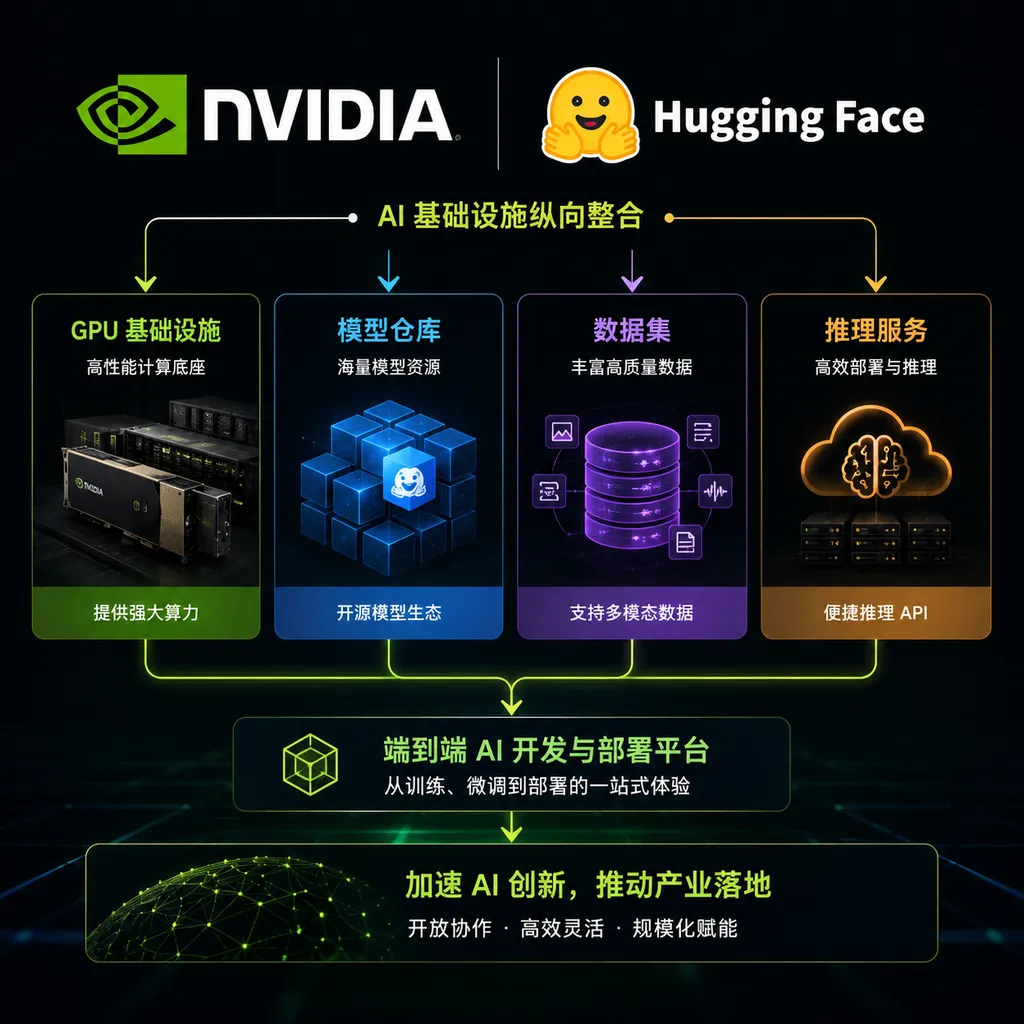
The logic behind this transaction, therefore, is not to “use the software business to subsidize chips,” but to connect GPUs, the CUDA software stack, model repositories, evaluation, and inference deployment into a more complete chain.
Why Nvidia Had to Secure This Gateway
Nvidia’s greatest advantage today lies in training and inference computing power, but it faces a long-term problem: demand for hardware does not automatically translate into control over the platform.
Model developers can train on Nvidia GPUs but deliver through other cloud platforms. Enterprises can purchase GPUs, or they can simply call proprietary model APIs without ever interacting with the underlying hardware. As inference optimization, model compression, and purpose-built accelerators mature, selling chips alone will make it increasingly difficult to capture every layer of the AI value chain.
Hugging Face fills precisely the gap where Nvidia has historically been relatively weak: the developer gateway.
A typical workflow looks like this: a developer finds a model on Hugging Face, loads it with Transformers, evaluates it locally or in the cloud, and then chooses GPUs, TPUs, or other accelerators for deployment. Once the acquisition is complete, Nvidia could offer default optimization options at multiple points along this path, including model evaluation, quantization, inference containers, enterprise support, and computing-resource orchestration.
It does not need to force developers to buy GPUs. As long as “running on Nvidia’s platform” consistently remains the path of least resistance—with the most complete documentation and the most stable performance—conversion will happen naturally.
More importantly, the more open-source models flourish, the more Nvidia can reduce its dependence on a small number of proprietary model companies. Closed-source labs may develop their own chips, switch to custom accelerators from cloud providers, or reduce GPU consumption through more efficient models. The open-source ecosystem, by contrast, is highly fragmented, and the many startups, universities, and enterprise teams within it generally lack the ability to develop their own hardware. They still need a versatile, mature computing platform.
From this perspective, supporting open models is not merely an ecosystem gesture by Nvidia; it is also a commercial strategy to hedge against customer concentration and the risks posed by custom chips.
“Remaining Open” Is Both a Promise and the Biggest Test
In their announcement, Nvidia and Hugging Face emphasized that Hugging Face would remain open to the entire AI ecosystem after the transaction is completed.
According to the information disclosed so far, developers will remain free to choose:
- Models and development frameworks;
- Cloud services and inference service providers;
- GPUs, TPUs, and other computing platforms;
- Open-source or open-weight models;
- Multi-cloud and multi-accelerator deployment options.
Developers will also not be required to use Nvidia computing resources in order to develop or deploy models on Hugging Face.
These commitments are crucial, but they are not enough. Hugging Face’s value rests on its neutrality, while Nvidia itself is both a hardware supplier and a participant in the markets for models, inference software, and cloud infrastructure. Following the acquisition, it would simultaneously become “a player, the venue operator, and a partial rule-maker.”
The real concern is not whether the platform will suddenly remove support for AMD or Google—such a heavy-handed move is almost inconceivable—but rather the subtler issue of default options:
- Will search and recommendation results prioritize models optimized for Nvidia GPUs?
- Will one-click deployment connect by default to Nvidia inference services or partner cloud resources?
- Will model evaluations place greater emphasis on metrics and configurations that favor the CUDA ecosystem?
- Will support, documentation, and bug fixes for non-Nvidia hardware receive equal resources?
- How will the download, deployment, and performance data accumulated by the platform circulate within Nvidia?
A platform does not need to explicitly exclude competitors. Simply making one path faster, cheaper, and more stable is enough to alter developers’ choices. This is also likely to be the area regulators scrutinize most closely when reviewing the transaction.
Infrastructure Integration Could Significantly Improve the Experience
It would be unfair to discuss only the risks. Hugging Face genuinely needs stronger infrastructure support.
Model repositories differ from traditional code repositories. A single model may contain tens or even hundreds of gigabytes of weight files, and the release of a popular model can generate enormous download and bandwidth pressure. Online demos and inference endpoints also require the continuous orchestration of expensive computing resources. With the number of models surpassing 3 million, malicious files, security scanning, license identification, model provenance tracking, and content moderation are also becoming increasingly complex.
Improvements Nvidia could directly deliver include:
- Greater capacity for storing and globally distributing large model files;
- Faster benchmarking of models at different precision levels and on different GPUs;
- Bringing quantization, compilation, and inference optimization forward to the model publishing stage;
- Stronger detection of malicious weights, supply-chain attacks, and dependency risks;
- More stable on-premises deployment and technical support for enterprises.
For ordinary developers, the ideal outcome would be this: after a model creator uploads weights, the platform automatically generates real-world performance reports across different hardware and precision levels, along with reproducible deployment artifacts, rather than forcing every team to repeatedly wrestle with GPU memory, operators, and dependency versions.
This type of work is expensive and difficult to sustain through community subscriptions alone. Nvidia’s funding and engineering resources could indeed help transform Hugging Face from a “model repository” into a more comprehensive AI delivery platform.
For Developers, Little Will Change in the Short Term, but Long-Term Default Lock-In Must Be Guarded Against
The transaction is still at least several months away from formal completion and must pass regulatory review. At this stage, there is no reason to migrate repositories in a panic, and Hugging Face’s open ecosystem will not change overnight.
Enterprise development teams should nevertheless use this opportunity to reassess their model supply chains. This is especially important for projects that have hard-coded Hugging Face repository URLs into production environments and dynamically pull the latest weights at startup. The risks come not only from the acquisition, but also from repository changes, license revisions, and the replacement of upstream files.
More prudent practices include:
- Pinning production models to explicit versions, commit hashes, and file checksums;
- Retaining reviewed copies of model weights in internal object storage or artifact repositories;
- Recording model licenses, training-data declarations, and relationships between derivative models;
- Decoupling model loading, inference backends, and cloud providers to prevent business code from becoming tied to a single platform;
- Regularly testing whether models can run in non-CUDA environments or on backup cloud resources;
- Exercising caution with remote custom code and prohibiting unreviewed code from running directly in production.
A distinction must be made between “using Hugging Face standards” and “depending on Hugging Face services.” The former generally improves compatibility, while the latter can result in platform lock-in. Using general-purpose formats for model files and making interfaces compatible with Transformers does not mean that production systems must depend in real time on Hugging Face’s public repositories or hosted inference services.
The Biggest Variable Is Not Technology, but Regulation and Community Trust
The transaction is not expected to close until the first half of 2027, indicating that the two companies have already allowed time for regulatory review.
Nvidia holds a dominant position in the AI accelerator market, while Hugging Face is a major distribution platform for open models. Regulators are therefore likely to examine whether this vertical integration could reduce competitive opportunities for other chipmakers, cloud services, and inference platforms. The focus of the review may not be the transaction price, but rather platform defaults, data-access privileges, and commitments to supporting competing hardware.
The community’s response will be equally important. Hugging Face’s hardest asset to replicate is not its servers, but trust. Developers are willing to publicly share models, datasets, and evaluation results because the platform has long maintained a relatively open stance. If core contributors believe the platform is beginning to clearly favor a single vendor, model distribution could fragment, and community tools could quickly be forked.
Open-source projects can copy code, but they cannot easily copy network effects. Once trust is depleted, however, those same network effects can work in reverse. That is something Nvidia cannot simply buy outright, even for $12.9 billion.
What This Acquisition Really Changes
Over the past two years, the industry’s attention has focused primarily on model parameters, training clusters, and data centers. Now, capital is beginning to reassess the “middle layer” between models and users: model repositories, evaluation systems, routing, inference services, and development tools.
The reason is straightforward. The number of foundation models is growing, and the period during which any single model holds the lead is becoming shorter. Once developer workflows take shape, however, they usually change much more slowly. Models will rotate in and out, but gateways and toolchains may endure for a long time.
Nvidia’s acquisition of Hugging Face signals that AI competition is shifting further—from “who can train the most powerful model” to “who controls the path through which models are discovered, evaluated, and deployed.” Nvidia used to sell the machinery for building roads. Now, it is preparing to bring model distribution centers, performance-testing stations, and some toll booths into its territory as well.
This transaction is not necessarily bad news for developers. More funding, more stable infrastructure, and more mature enterprise services all have tangible value. But it also makes one fact impossible to ignore: a central gateway to the open ecosystem is being absorbed by the most powerful commercial infrastructure company in the industry.
Whether the acquisition succeeds will depend not only on regulatory approval, but also on Nvidia’s ability to exercise restraint. The more Hugging Face resembles an Nvidia product, the less valuable it becomes as a neutral platform. Only by continuing to provide equal footing for competing models, competing clouds, and competing chips can Nvidia truly buy the future with its $12.9 billion.
References
- ITHome: Nvidia Announces Formal Acquisition of Hugging Face — Public information on the transaction value, expected completion date, and the two companies’ commitments to platform openness.
- Official Hugging Face Website — Background on the platform’s models, datasets, applications, and community ecosystem.
- Hugging Face Hub Documentation — Information on model hosting, datasets, applications, and collaboration mechanisms.