<think>**Translating company headline**</think> Moore Threads Completes the End-to-End Embodied Intelligence Pipeline
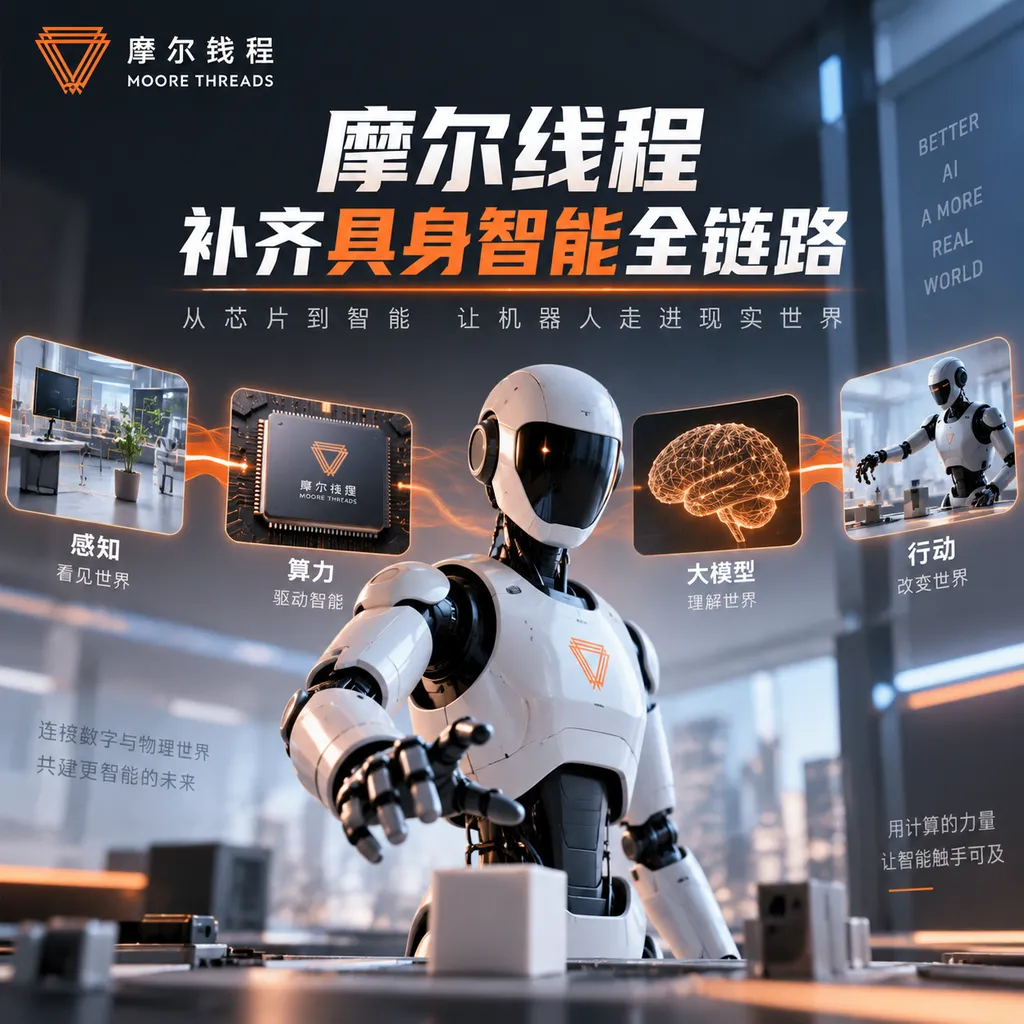
<think>**Selecting MUSA embodied AI platform**</think> Moore Threads announced progress on its embodied intelligence platform at its September 3 earnings briefing, covering synthetic data, model training, simulation validation, and edge deployment, and open-sourced MuJoCo Warp MUSA.
<think>Formulating polished technical translations****Deciding terminology for model features</think>
Moore Threads Completes the Full Embodied AI Toolchain
Moore Threads is turning embodied AI from a list of GPU products into a complete toolchain spanning cloud-based training to deployment on robots themselves.
On September 3, at its 2026 interim results briefing, Moore Threads co-founder, director, and deputy general manager Zhang Yubo said the company had completed the entire embodied AI pipeline, from synthetic data generation and foundation model training to simulation validation and edge hardware deployment. The company also unveiled MT Lambda, a full-stack simulation platform; open-sourced MuJoCo Warp MUSA, a GPU-accelerated physics simulation backend based on the MUSA architecture; and completed Sim-to-Real validation on physical quadruped robot dogs and bipedal humanoid robots.
This is not simply the addition of another robotics business line. For Moore Threads, embodied AI is more like a comprehensive test of its GPU capabilities: the same hardware and software stack must handle foundation model training, physics simulation, graphics rendering, and sensor simulation, before ultimately compressing and deploying models for real-time execution on robots. The ability to connect these stages matters more than individual benchmark scores in determining whether domestically developed GPUs can enter the mainstream robotics R&D workflow.
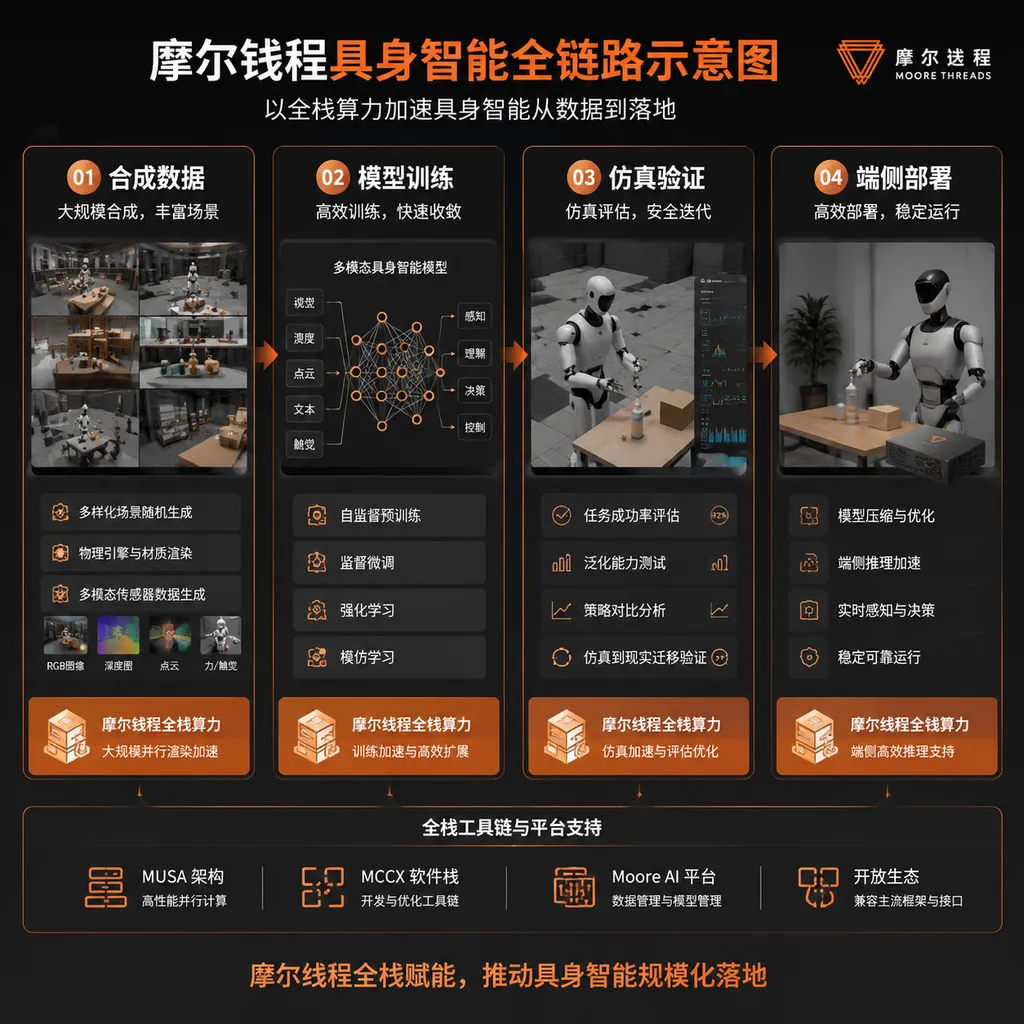
The Hardest Part of Embodied AI Is Not Training, but Transferring the Results to the Real World
The development workflow for conventional foundation models is relatively centralized: prepare data, train the model, evaluate its performance, and then deploy it to servers or API services. Embodied AI, however, must contend with a physical environment where collisions occur, objects slip, lighting changes, and sensors malfunction.
Robots need to understand images, language, and spatial relationships while making decisions within tens of milliseconds—or even less. A model that learns to grasp a cup in simulation will not necessarily be able to perform the same action in the real world. The cup’s coefficient of friction, joint errors in the robotic arm, camera latency, and changes in the tabletop material can all cause an action that works in simulation to fail in reality.
This is the Sim-to-Real problem often discussed in embodied AI development: training and validation are first performed in a virtual environment, after which the results are transferred to a physical robot. Simulation must be fast enough to generate vast amounts of interaction data, realistic enough to give the training results a chance of transferring, and sufficiently unified in terms of hardware and software interfaces across training, simulation, and inference to prevent teams from having to repeat integration work at every stage.
The end-to-end solution unveiled by Moore Threads is designed to address precisely these disconnects.
MT Lambda: Bringing Training, Simulation, and Data Generation onto a Unified GPU Stack
Moore Threads positions MT Lambda as a full-stack embodied AI simulation platform. Based on the architecture disclosed by the company, the platform contains at least two core components:
- MT Lambda-Lab: Designed for embodied policy development and training, it provides robot models and tasks while supporting training approaches including vision-language-action models, reinforcement learning, imitation learning, and world-action models.
- MT Lambda-Sim: Designed for high-fidelity physics simulation and rendering, it supports scene construction, sensor simulation, synthetic data generation, and benchmark validation.
The platform supports widely used asset and robot description formats such as USD, URDF, and MJCF. This may seem basic, but it is critical in robotics development: if assets, scenes, sensors, and control interfaces cannot flow seamlessly between systems, engineering teams can easily become bogged down in format conversion and data migration instead of iterating on models.
Moore Threads emphasizes that Lab and Sim can share the same GPU and enable zero-copy data transfer. Put simply, model training and simulation environments do not need to repeatedly copy data from one compute path to another, reducing memory movement and synchronization overhead. For reinforcement learning tasks that require thousands—or even more—simulation environments to run in parallel, this design has greater practical significance than merely increasing the peak speed of a particular physics engine.
Training embodied AI models often does not involve simply reading static data once. Instead, the model continuously interacts with its environment: the robot takes an action, the simulator returns a new state, and the policy model updates itself based on the outcome. Every interaction calls the physics engine, renderer, and inference framework. If data copying, context switching, and inter-device communication become bottlenecks, substantial GPU compute capacity is wasted on waiting.
Moore Threads therefore aims to use the unified MUSA system architecture to place physics engines, rendering engines, and AI frameworks on the same acceleration path. The platform includes three categories of engines:
- Physics engines: MuJoCo-Warp-MUSA, Newton-MUSA, and MT AlphaCore, used to simulate rigid bodies, joints, and robot dynamics.
- Rendering engines: MT Photon for ray tracing and hybrid rendering, along with MTAGR, which supports 3D Gaussian Splatting, to build visual environments that more closely resemble the real world.
- AI engines: Torch-MUSA and the PyTorch ecosystem, supporting model training, large-scale simulation, and inference workloads.
MuJoCo Warp MUSA has already been open-sourced. For developers, the value of open-sourcing a physics simulation backend is not merely that it gives a particular engine another GPU backend. More importantly, it lowers the barrier to migrating existing robotics algorithms to the MUSA ecosystem. The real test will be whether operator coverage is comprehensive, whether automatic differentiation and reinforcement learning workflows are stable, and whether compatibility with mainstream robot models, training frameworks, and data pipelines is sufficiently robust.
Two Types of Robots Have Completed Physical Validation, but Large-Scale Deployment Remains Some Distance Away
Moore Threads disclosed that it has completed Sim-to-Real validation on physical quadruped robot dogs and bipedal humanoid robots. This shows that the platform is not limited to demonstrations in virtual environments and has at least completed a closed loop from simulated policies to execution on real robots.
However, there is still a clear gap between physical validation and mass deployment. A successful demonstration proves that the pipeline is feasible, but industrial customers are more concerned with whether the system remains stable across different robot models, factory environments, and extended periods of operation.
More specifically, several questions still need to be answered:
- Can dynamic discrepancies between simulation and physical hardware be continuously corrected through domain randomization or online calibration?
- Can edge models maintain sufficient perception and control accuracy under constraints on compute capacity, power consumption, and latency?
- Has integration with ROS 2, real-time kernels, robot drivers, and multiple communication protocols been standardized?
- How will model versions, data feedback loops, and safe rollback mechanisms be managed from cloud training through edge-side upgrades on robots?
- When customers use different sensors, actuators, and robot bodies, can the platform still reduce development costs rather than introducing another layer of lock-in?
The edge-side solutions disclosed by Moore Threads’ embodied AI community include MT Robot and AI modules based on the E300 edge SoC and the MUSA inference stack. The goal is to deploy policies trained in the cloud onto robots through a unified software stack spanning heterogeneous computing units such as CPUs, GPUs, NPUs, VPUs, ISPs, and DPUs.
The advantage of this approach lies in hardware-software co-optimization: perception, inference, control, and real-time workloads can all be optimized around the same chips and system software. But it also requires more extensive ecosystem development. The edge robotics market is highly fragmented, and equipment manufacturers often have their own controllers, sensors, and middleware. Moore Threads must prove not only that the E300 can run models, but also that it can help third-party developers integrate those models into physical robots more quickly.
From Training Foundation Models on the S5000 to Training Embodied Brains and World Models
Another signal from Moore Threads’ latest disclosure is that its embodied AI platform was not built in isolation, but on top of the training capabilities of its S5000 AI computing clusters.
The company said that ecosystem partners had used MTT S5000 AI computing clusters to train an MoE-236B foundation model from scratch on a corpus of more than 25 trillion tokens. Moore Threads also worked with the Beijing Academy of Artificial Intelligence to complete the end-to-end training of RoboBrain 2.5, an embodied brain model, on the S5000. Meanwhile, Peking University’s EvoPhys team completed end-to-end native training of the EvoPhys-World 5D world model on S5000 full-featured GPUs.
These two categories of models correspond to different core capabilities in embodied AI. An embodied brain serves more like a policy center responsible for understanding tasks, planning actions, and controlling execution. A world model attempts to predict changes in the environment, answering the question: “What will happen to the world after a particular action is taken?”
For a GPU vendor, training these models is more persuasive than simply releasing an accelerator card for robotics. Embodied AI training workloads are typically heterogeneous: they include matrix computations for Transformers or vision-language models, as well as physics simulation, graphics rendering, video data processing, and extensive interaction workloads in reinforcement learning. Whether a full-featured GPU can switch among these workloads while maintaining a stable software stack directly affects customers’ R&D cycles.
Moore Threads also said it had achieved deep optimization and performance breakthroughs for DeepSeek-V4 on the S5000, while rapidly supporting recent models such as MiniMax H3, Kimi-K3, and Zhipu GLM-5.3-Flash, with the goal of providing support as soon as models are released. Although support for these models is not equivalent to embodied AI capability, it provides more validation scenarios for Moore Threads’ general-purpose AI software ecosystem and helps reduce customers’ dependence on any single model or workload.
The Real Competition Is Not About Whether It Can Run, but Whether Developers Are Willing to Migrate
As domestically developed GPUs enter the embodied AI market, their competitors are not limited to other chipmakers. They must also compete with the CUDA ecosystem already widely used by robotics teams, mature simulation platforms, and cloud service toolchains.
Moore Threads’ end-to-end strategy therefore has a clear business rationale. If it sells only training cards, customers can simply compare single-card performance and procurement costs. If it also provides simulation, data generation, training, deployment, and edge-side solutions, the company has an opportunity to become an infrastructure provider for robotics projects and increase the overall benefits customers gain from migration and replacement.
An end-to-end offering, however, also imposes higher requirements. The platform must be open rather than locking customers into a closed system. The tools must be stable rather than requiring fresh integration every time a model changes. The community must have real projects rather than only samples and demonstrations. In particular, embodied AI currently lacks relatively unified interface standards comparable to those for large language model APIs. Customers use different robot bodies, sensor configurations, control frequencies, and safety constraints, making the platform’s abstraction capabilities more important than the chip’s peak compute performance.
This is also why the open-sourcing of MuJoCo Warp MUSA deserves attention. At the very least, it shows that Moore Threads is attempting to enter the existing developer ecosystem through a low-level backend rather than requiring robotics teams to learn an entirely different toolset from scratch. Whether it can attract community contributions, cover more operators and tasks, and achieve sustained adoption in real-world projects will be more revealing than the open-source announcement itself.
Wuxi Innovation Center and Joint Laboratory: Moving from Demos to Industrial Scenarios
On the application side, Moore Threads announced that it would establish an Industrial Embodied AI Innovation Center in Wuxi together with ecosystem partners. It has also created a Joint Laboratory for Embodied AI Computing and Simulation with the National Embodied AI Application Pilot-Scale Base.
Industrial embodied AI requires more than strong model performance. It must also address equipment safety, production cycle times, fault recovery, and long-term operational stability. The significance of the innovation center and pilot-scale base lies in validating the platform in real industrial environments and establishing a feedback loop among simulation data, model training, robot control, and application delivery.
Moore Threads generated RMB 1.736 billion in revenue in the first half of 2026, up 147.42% year over year and already exceeding its full-year 2025 revenue of RMB 1.506 billion. Its gross margin during the period was 56.95%, while the net loss attributable to shareholders of the listed company narrowed to RMB 11.5631 million. S5000 AI computing clusters have also been deployed and delivered in Beijing, Wuxi, Hangzhou, and other cities, becoming among the first to pass China’s national “Secure and Reliable Evaluation.”
These business figures indicate that Moore Threads is no longer competing solely through standalone accelerator cards, but is expanding into clusters, platforms, and industry solutions. The company’s disclosed plans for the MTT C256 supernode architecture extend this strategy further toward training and inference clusters comprising tens of thousands or even hundreds of thousands of accelerator cards.
Strategically, embodied AI puts several of Moore Threads’ capabilities to the test at the same time. Large-scale cloud training tests cluster interconnects and the software stack. Simulation tests general-purpose GPU computing, rendering, and physics engines. Edge deployment tests chip power consumption, real-time performance, and hardware-software co-optimization. Compared with focusing on only one of these stages, a complete pipeline offers greater scope for differentiation.
Still, restraint is warranted. The company’s disclosed progress currently centers on platform capabilities, collaborative projects, and physical robot validation. This cannot yet be equated directly with large-scale commercial delivery. Embodied AI typically has a longer path to industrial adoption than internet-based models, as customer validation, robot integration, and safety certification all take time.
The most noteworthy aspect of Moore Threads’ latest move is not that it has “released yet another embodied AI platform,” but that it has expanded competition among domestically developed GPUs from the isolated task of model training to system-level competition spanning data, simulation, training, deployment, and application delivery. Only if MT Lambda and MT Robot can continue reducing migration costs for robotics teams and produce stable results in industrial settings will Moore Threads have a chance to turn its end-to-end narrative into a genuine ecosystem moat.