Roland Uses AI to Create Melodies First—Not to Write the Whole Song for You

Roland has officially launched Melody Flip, an AI music plug-in that shifts generative AI away from delivering complete tracks and back toward creative building blocks such as melodies, chords, basslines, and drum patterns. It supports MIDI export in a DAW for further editing and is included free with Roland Cloud membership, though its training data and output quality remain key concerns.
Roland Uses AI to Start with Melodies, Not to Write the Whole Song for You
Roland has officially entered the generative AI music market, but it has not chosen the attention-grabbing path taken by Suno and Udio: enter a single prompt and receive a complete song with vocals, arrangement, and structure a few minutes later.
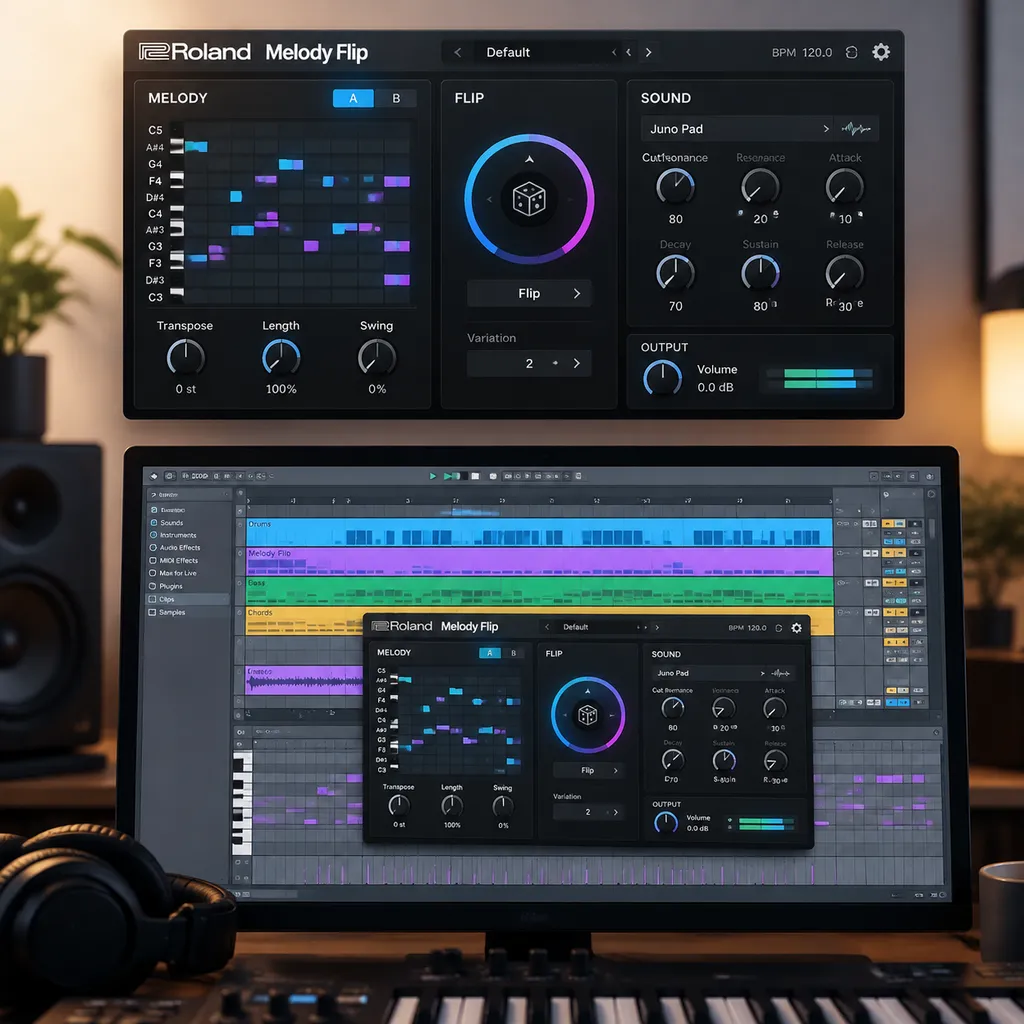
The synthesizer and drum machine manufacturer’s new Melody Flip is more like an “idea engine” embedded in a digital audio workstation (DAW). It generates short musical material such as melodies, chord progressions, basslines, and drum patterns, which users can then import into their own projects for further arranging, orchestration, sound design, and mixing.
This may not be Roland’s most radical move in the AI era, but it could be the choice that better understands the music production workflow. For producers who actually use DAWs, an editable MIDI clip is often more valuable than a complete-sounding AI track that is almost impossible to break apart.
It Does Not Generate “Songs”—It Generates a Starting Point You Can Continue Working With
Melody Flip includes around 250 collections of thematic ideas organized by musical genre, which Roland calls Palettes. Users can start from scratch and have the system combine melodies, chords, bass, and drums, or import a reference audio track and let Melody Flip offer creative suggestions based on its melodic direction.
Its operational logic is fairly straightforward. Users mainly select the following parameters:
- Musical genre or Palette;
- Note density;
- BPM;
- Key;
- The desired combination of melody, chords, bass, or drums.
From familiar categories such as “’80s Disco” and “’90s R&B” to more specialized styles like Kawaii Future Bass and Anime World, Melody Flip’s style tags are quite specific. However, it does not provide a chat box where users can freely enter lengthy text prompts, nor can it interpret natural-language requests such as “make a sad, cinematic pop song suitable for nighttime driving” and directly deliver a finished work.
The generated results appear as music loops and MIDI data. Producers can drag the MIDI directly into a DAW, rewrite notes, replace chords, adjust velocity and quantization, and then rebuild the sound using existing software instruments or Roland’s own synthesizer plugins. In other words, the AI is responsible for “offering a few initial directions,” while the human decides which direction is worth pursuing.
This distinction matters. Full-song generation tools solve the problem of “I need something listenable right now”; Melody Flip solves the problem of “I have production skills, but I’m stuck on the initial musical idea.” They are not aimed at the same users and should not be judged by the same standards.
Why Roland Did Not Simply Make a Suno
From a product-strategy perspective, Melody Flip continues Roland’s longstanding hardware-oriented philosophy: placing tools within musicians’ workflows rather than replacing the workflow entirely.
The advantage of Suno and Udio is that they reduce the barrier to creating music to an extremely low level. Even users who cannot play an instrument or arrange music can obtain a structurally complete song through prompts. Such products are suitable for rapid experimentation, making demos, producing social media content, and quickly turning a vague idea into shareable audio. The trade-off is that users have little control over the intermediate process. You can ask for “another version,” but it is difficult to precisely move the bass note in bar 17 forward by half a beat, as you could in a DAW.
Melody Flip instead places AI at the front end of the creative chain. It does not handle vocal recording, sound selection, section development, automation, mixing, or mastering for you, nor does it decide what a song should ultimately become. For professional producers and people with a clear aesthetic vision, this restraint is actually an advantage: what is generated is not a final draft, but raw material that can be modified, separated, and recombined.
However, this positioning also means it will not inspire the same “wow” effect on first use as full-song generation services. If a user simply wants to hear a polished song, Melody Flip may feel limited; if a user is already familiar with Ableton Live, Logic Pro, FL Studio, or another DAW, then the value of an editable MIDI clip becomes much greater.
250 Palettes Solve the Question of “Where Do I Start?”
AI music tools often focus on how large their models are or whether they can generate several minutes of audio, while overlooking a practical problem producers encounter every day: it is not that they have no ideas, but that they do not know which key to press first.
The significance of Palettes lies in turning a “blank project” into a set of bounded choices. After choosing a style, tempo, and key, the user does not face infinitely many possibilities, but rather a creative space that can be immediately auditioned and filtered. For those who need to continuously produce advertising music, game music, short-video background tracks, or electronic music demos, this structured starting point is easier to integrate into a workflow than completely open-ended prompts.
Of course, the more granular the style tags become, the more likely they are to create another problem: generated results may remain at the level of genre templates. A Palette called “’90s R&B” can help the system quickly approach a certain rhythm, harmony, and note density, but that does not mean it can understand an individual producer’s personal vocabulary. For experienced users, the real value is not receiving an untouched loop, but treating it as a sketch and then slicing, rearranging, transposing, changing time signatures, and re-orchestrating it into their own version.
As a result, Melody Flip is more like a combination of “random inspiration + genre-based templates” than an AI collaborator that can continuously remember personal preferences. It can reduce the friction of starting from zero, but it has not yet solved the problem of helping a work develop a distinctive personality.
Free Access Lowers the Barrier to Trying It, but Does Not Mean There Are No Costs
Based on currently public information, Melody Flip supports macOS and Windows and requires Roland Cloud Manager 3.1.23 or later. It is available through Roland Cloud membership tiers, including the free tier. This pricing strategy is smart: Roland has not initially packaged its AI functionality as an expensive subscription, but instead allows more musicians to first incorporate it into their production workflows.
For Roland, this is both product promotion and an entry point into its ecosystem. Once users manage plugins, content, and membership benefits through Roland Cloud, they are more likely to encounter Roland’s synthesizers, samplers, and other software services. Roland Cloud has previously drawn complaints from some users over subscription management, software experience, and feature configurations. Whether Melody Flip can bring about a positive change will ultimately depend on installation, licensing, DAW compatibility, and actual generation quality—not the “AI” label itself.
Plugin products also face a practical threshold: music producers do not only care whether something can generate content. They also care about latency, project stability, whether MIDI export is clean, support for commonly used hosts, parameter automation, and whether generated material can be safely used in commercial projects. If any one of these areas is handled poorly, free access may still fail to produce long-term adoption.
The Real Controversy Is Not Whether It “Sounds Human,” but Where the Data Comes From
Because Melody Flip uses generative AI technology, it cannot avoid some of the music industry’s most sensitive questions: What is the source of the training data? Has the model absorbed unauthorized works? Could generated results imitate certain artists too closely? Who bears copyright liability when the output is used in commercial projects?
Roland developed Melody Flip in collaboration with Sony Computer Science Laboratories and describes it as placing “human intent” at the center of creation. This wording suggests that Roland is trying to distinguish itself from full-song generation platforms: AI does not complete the work for users, but participates in the early ideation stage.
However, “only generating melodic material” does not automatically eliminate copyright risks. An eight-bar melody can still be too close to an existing work; the editability of model output also does not prove that the training process itself received sufficient authorization. What music professionals need most is not a statement that this is “AI-assisted creation,” but clear explanations of data sources, terms of use, commercial licensing boundaries, and traceable generation records.
If Roland wants Melody Flip to be adopted by professional users over the long term, it will need to continue explaining how the model is trained, what material has been included in the system, whether output can be used for commercial releases, and what responsibility the platform will assume when disputes arise. Musicians are willing to let AI participate in creation, but they are generally unwilling to gamble their release plans on a vague licensing statement.
Who Is It For, and Who Is It Not For?
Melody Flip’s target users are relatively clear:
- Producers familiar with DAWs who occasionally need to quickly find a melodic or harmonic starting point;
- People creating advertising, game, or short-video music who need editable material in volume;
- Users who want to learn arranging by observing how melodies, basslines, and drum patterns combine across different styles;
- Musicians who do not want to give up final control but are willing to use AI as a tool for random inspiration.
It is less suitable for the following scenarios:
- General users who only want to enter a prompt and directly receive a complete song;
- Those who need finished music that is unique, complex, and strongly personal in style;
- People unwilling to enter a DAW to continue editing MIDI, orchestrating, and mixing;
- Teams with strict compliance requirements regarding training data, commercial licensing, and material sources, but which cannot obtain more detailed documentation.
From this perspective, Melody Flip is neither a replacement for Suno nor the end state of “AI composition software.” It is more like a plugin inserted into a traditional production workflow: it is not responsible for ending the creative process, only for helping it begin faster.
Assessment: The Direction Matters More Than the Specifications
What deserves the most attention about Roland’s move is not the 250 Palettes, nor the number of styles it can generate, but the relatively pragmatic entry point it has chosen. Generative AI music has already moved beyond the question of “Can it make a song?” and into the stage of “Can people continue working with this song?”
Full-audio generation still delivers a powerful demonstration effect, but professional production requires results that are controllable, separable, editable, and reusable. MIDI material may be less immediately impressive than a finished song, but it is closer to the intermediate layer that DAW users actually work with. It compresses AI capability into a narrower scope while preserving human judgment, aesthetics, and production responsibility.
The question is whether this type of product will ultimately become a collection of “melody buttons” that feel fresh for only a few days. That depends on two indicators: first, whether the generated results are stable enough to genuinely save production time; second, whether Roland is willing to clearly explain its training sources and commercial-use rules. The former determines whether users stay; the latter determines whether professional users dare to include it in formal projects.
For developers and AI product observers, Melody Flip also sends a clear signal: AI creative tools do not necessarily need to pursue full automation. Embedding model capabilities into professional software and providing editable results around a specific stage of the workflow may have more staying power than building a chat-style entry point that can generate everything but control almost nothing.
Roland is currently testing the waters with melodies and arrangement material. If it can further strengthen personal preference learning, project-context understanding, version management, and copyright verification, Melody Flip may have a chance to evolve from a “free AI inspiration plugin” into a tool that is repeatedly opened in real music workflows.
Sources
- IT Home: Synthesizer Giant Roland Enters the AI-Generated Music Field, Focusing on “Melody Creation” — Introduces Melody Flip’s launch information, Palette library, adjustable parameters, and MIDI workflow.
- Roland’s official product information and public materials from its partner — Used to cross-check Melody Flip’s product positioning, platform support, and the background of its collaboration with Sony Computer Science Laboratories.
Note: This article is based on publicly available information as of September 6, 2026. For model training data, output copyright, and commercial licensing, users should consult Roland’s latest terms of service and licensing documentation before use.