<think>**Translating product title preserving brand name** </think> Zhixiang Releases the Embodied World Model HiDream-O1-Embodied
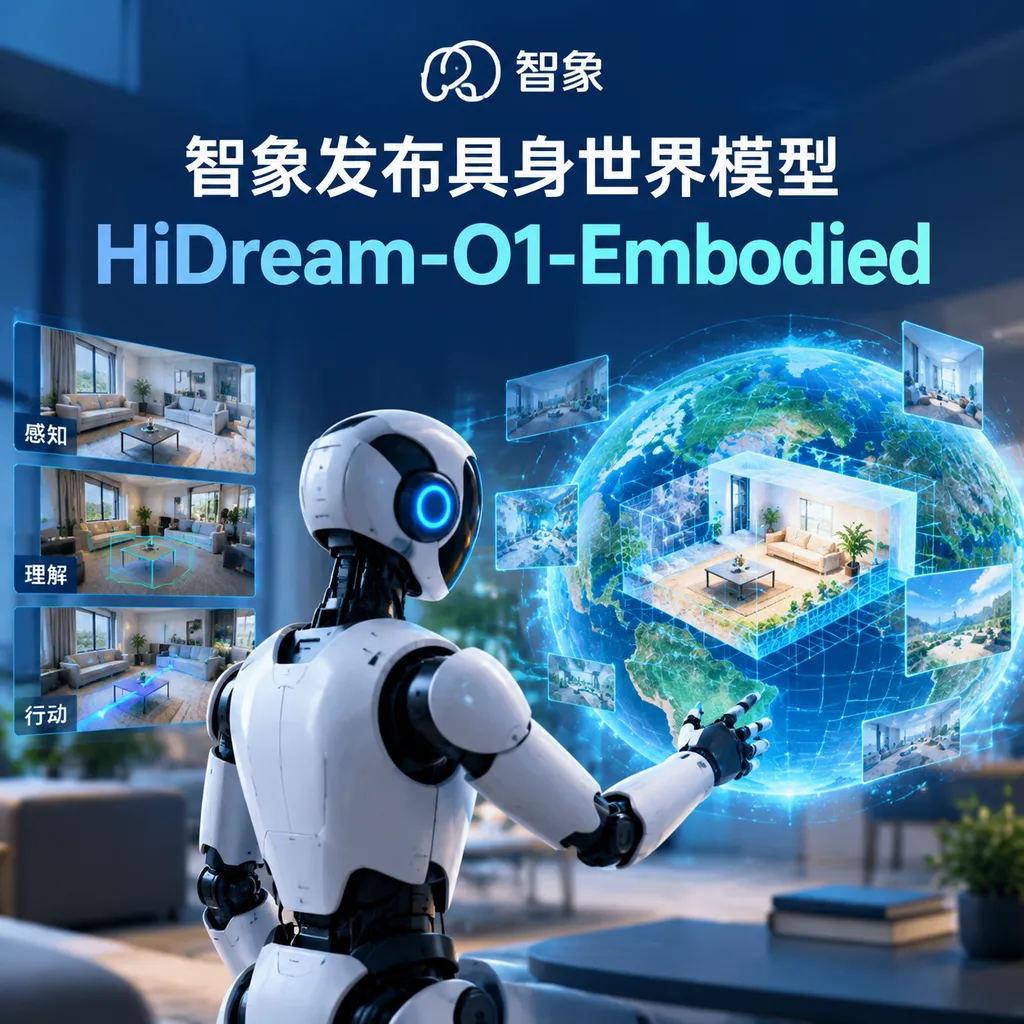
<think>**Refining technical translation terms** </think> Zhixiang Future today released HiDream-O1-Embodied, an effort to unify text, images, video, and actions within a single native omni-modal architecture, taking world models beyond “generating scenes that can be viewed” toward “understanding and executing actions.”
HiDream.ai Releases an Embodied World Model: World Models Begin to Take Over “Action”
On September 7, HiDream Future (HiDream.ai) officially released its embodied world model, HiDream-O1-Embodied. This is not an ordinary upgrade to a video generation model. Rather, following the release of its interactive world model HiDream-O1-World in August, it represents HiDream.ai’s attempt to productize its capabilities for embodied intelligence and robot interaction.
Its core change can be summed up in one sentence: The model is no longer responsible only for generating a world that looks real; it must also understand what exists in that world, how objects move, and what consequences an action will produce.
This is also a crucial step in the evolution of world models from “content generators” to “environment simulators.”
From HiDream-O1-World to Embodied, HiDream.ai Fills in the Missing Action Component
Over the past year, competition in world models has intensified significantly. Model developers are no longer satisfied with generating videos lasting only a few seconds. They have begun trying to build virtual environments with spatial structure, temporal continuity, and interactivity.
HiDream.ai’s HiDream-O1-World, released in August, already supports first-person and third-person exploration of generated worlds. Users can also change scenes through text instructions: making characters grasp, run, crouch, and jump, or triggering environmental events such as rain and falling objects.
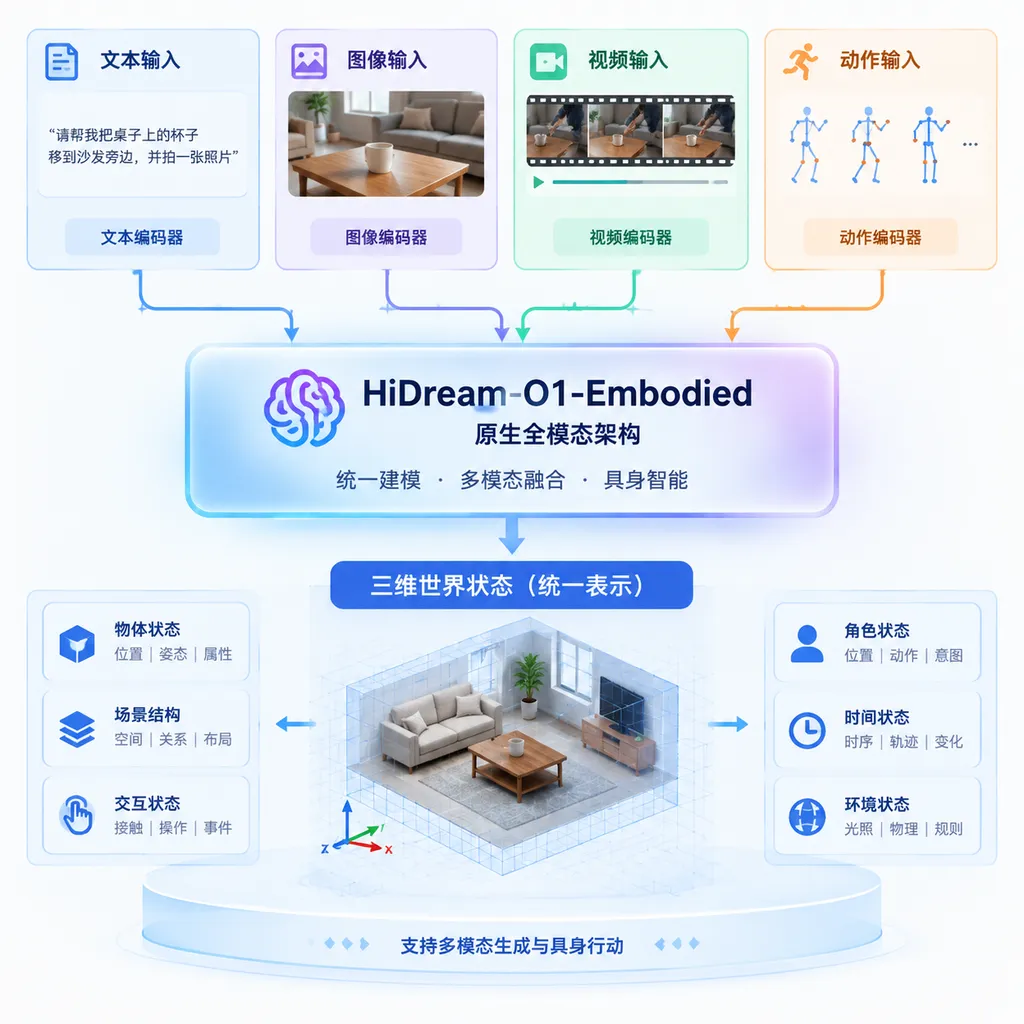
HiDream-O1-Embodied goes a step further. It is designed for “embodied” scenarios—in other words, for creating a closer connection between a model’s understanding of the world and its action decisions. Here, action does not simply mean showing a running pose in a video. The model must answer a series of questions more closely related to robot control:
- Where is the target object, and what are its distance and orientation?
- After a robotic arm or character takes a particular action, will the object be occluded, collide with something, or fall?
- Will the current action alter the subsequent state of the environment?
- After changes in viewpoint, continuous operations, and long-term execution, can the scene remain consistent?
Traditional visual generation models are generally good at predicting “what the next frame should look like,” but they do not truly maintain a stable world state. As a result, videos may exhibit object drift, shape changes, mesh penetration, failed gravity, and other problems. To ordinary users, these are flaws; to robots, such errors directly become incorrect training signals.
The value of HiDream-O1-Embodied lies precisely in its attempt to establish, beyond content generation, an environment representation that can be invoked by actions and continuously updated.
Native Multimodality Is Not Simply Stitching Multiple Models Together
The technical approach emphasized by HiDream.ai is its self-developed native multimodal UiT (Unified Transformer) architecture.
“Native multimodality” is not the same as the multimodal systems commonly seen today. The latter are often composed of multiple specialized modules: text is processed by a language model, images by a vision encoder, video by an additional temporal module, and actions by an independent policy network. Different modules exchange information through tokens, embeddings, or interfaces.
This approach is easier to implement from an engineering perspective, but it also creates a problem: the “table in the image” and the “graspable object in the action space” perceived by the model may not be the same internal entity. The vision module may determine that the table exists, while the control module may not understand its spatial position, material, or motion constraints.
The goal of UiT is to process text, images, video, actions, and other forms of information together within a unified Transformer framework. In other words, action is no longer an additional control interface attached after generation is complete. It enters the world-state modeling process from the outset of model design.
This can be compared to two different ways of working:
- A traditional generative model is like a painter who draws the next frame based on the previous one;
- A native multimodal world model is more like a director and script supervisor, continuously recording scene structure, character positions, object relationships, and event outcomes before determining the next shot and action.
This does not mean that UiT is already equivalent to a mature robot control system. Actual robot deployment still requires sensor calibration, low-latency inference, safety constraints, task planning, and a hardware control loop. But from the perspective of the model foundation, placing action, vision, and language within the same representation is indeed better suited to handling complex interactions than retrofitting a control module onto a visual generation model.
Two Core Problems: Remembering Space and Obeying Physics
World models have long been constrained by two problems: spatial consistency cannot be maintained over long periods, and physical laws are prone to breaking down.
1. Using 3D Priors to Prevent the Scene from Changing as the Camera Moves Away
When users continuously move the camera through a virtual scene, a model that regenerates the view from scratch each time can easily produce familiar problems: objects that were just visible disappear, building structures change, the positions of doors and windows drift, character proportions become inconsistent, and after turning around, the room is no longer the same room.
According to HiDream.ai, HiDream-O1-Embodied continues and strengthens the spatial-memory approach used in HiDream-O1-World. It encodes scene geometry and spatial relationships between objects as 3D priors and injects them into the Memory context.
The purpose of this mechanism is not simply to save several historical frames, but to record, as much as possible, “what the world is made of.” For example, a table is located in the center of a room, a cup is on the right side of the tabletop, and the walls maintain fixed connections with the floor. As the camera moves, the model does not need to guess the current viewpoint from scratch; it can retrieve the corresponding state from the spatial structure it has maintained.
This is especially important for embodied tasks. When a robot executes the instruction “walk around the table and pick up the cup,” what matters is not whether a particular frame looks realistic, but whether the table, cup, robot body, and target path can remain consistent over continuous time.
2. Using Test-Time Training to Maintain a Dynamic World
HiDream-O1-Embodied also introduces a Test-Time Training (TTT) mechanism that makes online adjustments to lightweight adapters during inference.
Put simply, rather than remaining completely fixed after training when facing every new environment, the model makes small adaptations to its internal representations when entering a new environment, encountering a new object, or observing a new state, allowing it to remain aligned with the geometry and physical constraints of the current scene.
The advantage of this type of mechanism is that it can reduce the accumulation of errors during long-sequence rollouts. The drawbacks are also clear: online updates increase inference complexity and introduce new issues involving stability, reproducibility, and safety verification. For robotic systems, the fact that a model “can adapt” does not automatically mean that it “adapts reliably.”
Regarding physical consistency, HiDream.ai says that during training it used a generative world simulator to construct synthetic data covering phenomena such as rigid-body collisions, fluid motion, soft-body deformation, and gravitational projectile motion. During inference, TTT dynamically improves the model’s ability to adapt to new objects and materials.
This design targets the most common failure modes in world models: floating objects, interpenetration after collisions, liquids moving like solids, misalignment between a hand and an object during grasping, and objects suddenly disappearing after continuous interaction.
The Evaluation Results Look Good, but They Cannot Yet Be Equated Directly with Robot Capabilities
Based on the information currently disclosed, HiDream-O1-Embodied achieves a 13.6% improvement over the industry average on visual plausibility evaluations and a 12.7% improvement on causal fidelity evaluations. This indicates that beyond image quality, it is beginning to emphasize “why an action produces a particular result.”
However, these two figures need to be interpreted cautiously.
First, the materials do not fully disclose the evaluation benchmarks, the range of models included for comparison, the composition of the test sets, or the statistical methodology. “Compared with the industry average” is not a sufficiently standardized description and cannot be directly used for comparison with an SOTA model on a public leaderboard.
Second, visual plausibility and causal fidelity remain model evaluation dimensions; they do not equal real-world robot task success rates. Robotic systems must contend with far more demanding conditions: camera noise, changes in lighting, occlusion, uncertain coefficients of friction, actuator errors, and control deviations caused by model prediction latency.
Therefore, what is most worth watching about HiDream-O1-Embodied at this stage is not whether it can already directly replace robot policy models, but whether it can become a lower-cost, higher-coverage virtual training environment. For robotics companies and autonomous driving teams, the ability to generate large numbers of simulated scenarios with action feedback, physical constraints, and long-term memory is often more valuable than simply generating higher-resolution videos.
Beyond Embodied Intelligence, Which Other Industries Could It Affect?
If the model’s long-term consistency and interactive capabilities reach a usable level, its potential applications will not be limited to robotics.
Robotics and Autonomous Driving Training
This is the most direct direction. R&D teams can use natural language, images, or demonstration actions to generate different scenarios and then have agents repeatedly perform tasks within them. Compared with real-world data collection, virtual environments offer advantages in cost, scale, and coverage of dangerous operations.
Of course, a “sim-to-real” gap still exists between simulated and real environments. If the physical rules generated by the model differ from those of the real world, the resulting policies may fail in practice. Therefore, world models are better suited as tools for data augmentation and pretraining rather than as the sole validation environment.
Interactive Film, Television, and Games and Game Development
HiDream-O1-World has already demonstrated scene exploration and real-time editing capabilities. With stronger action modeling, developers may be able to use natural language to describe tasks, character relationships, and environmental events, rapidly building playable interactive prototypes.
However, whether it can truly serve industrial-scale game production will depend on the editability of scene assets, engine compatibility, frame rates, multiplayer synchronization, and copyright governance. There is still a complete toolchain between generating a demonstration video and generating a maintainable game world.
Virtual Production and Spatial Content Creation
World models can allow directors and designers to explore camera shots, spatial layouts, and action choreography without first completing all 3D assets. This is particularly useful during the early concept-validation stage, when the model can quickly provide multiple interactive versions.
These applications place greater demands on “stability” and “controllability” than on single-frame image quality. As long as spatial relationships remain consistent, content teams can continue modifying the results; if the room structure changes every time content is generated, the model’s production value will be greatly reduced.
The Real Competition Is Not Just About Parameter Scale, but Whether World States Can Be Invoked
Competition among world models is shifting from “who can generate more realistic images” to “who can maintain a sustainable, continuously running world state.” This will introduce several new technical metrics:
- Long-horizon consistency: Does the scene remain stable after running for several minutes or longer?
- Spatial queryability: Can the model accurately answer questions about object locations, distances, occlusion, and reachable paths?
- Physical causality: Do actions produce consequences that conform to physical laws?
- State editability: Can users precisely alter objects, weather, characters, and environmental parameters?
- Inference cost: Under high resolution, long contexts, and real-time interaction, are latency and compute requirements acceptable?
- Interfaces with control systems: Can the model’s outputs be reliably converted into planning, navigation, and low-level control commands?
From this perspective, the release of HiDream-O1-Embodied has clear strategic significance: HiDream.ai is attempting to extend its accumulated expertise in image generation, video generation, and native multimodal modeling into the environmental understanding and action-interaction capabilities required by embodied intelligence.
Its technical approach is imaginative and addresses the industry’s genuine pain points. However, the currently available information still focuses primarily on architectural concepts, demonstration capabilities, and evaluation improvements. Details regarding model size, inference latency, release format, training data, real-robot deployment, and reproducible experimental results remain insufficiently disclosed.
Assessment: An Important Upgrade in Direction, but Not the End Point of Embodied Intelligence
The most commendable aspect of HiDream-O1-Embodied is that it does not interpret “embodiment” simply as adding a set of action labels to a video model. It jointly models vision, language, environmental states, and actions at the foundational level, while using spatial memory and online adaptation to maintain consistency during long-term interaction. This is closer to the actual requirements of embodied intelligence than simply pursuing clearer images that look more like the real world.
At the same time, it should be recognized that world models are still some distance away from becoming the “brains” of general-purpose robots. Physical consistency in a generated world and verifiable control in the real world are not the same problem; a single successful interaction in a demonstration does not represent stable generalization in an open environment.
What is truly worth watching next is whether HiDream.ai will open callable APIs, simulation environments, or developer tools, and whether HiDream-O1-Embodied can be integrated into real workflows by robotics, autonomous driving, and game development teams. If it can only generate attractive interactive videos, its significance will be closer to that of a content tool. If it can provide stable, editable, and batch-operable environmental states, it may become part of the infrastructure for embodied intelligence.
Based on today’s release, HiDream.ai has already placed its bet on the latter path. The next competition among world models may no longer be about “whose generated images look more like reality,” but rather “who can enable AI to truly act in a world that persists and obeys the laws of physics.”