<think>**Translating headline naturally** </think> Unitree Uses a World Model to Enable Humanoid Robots to Fight Autonomously
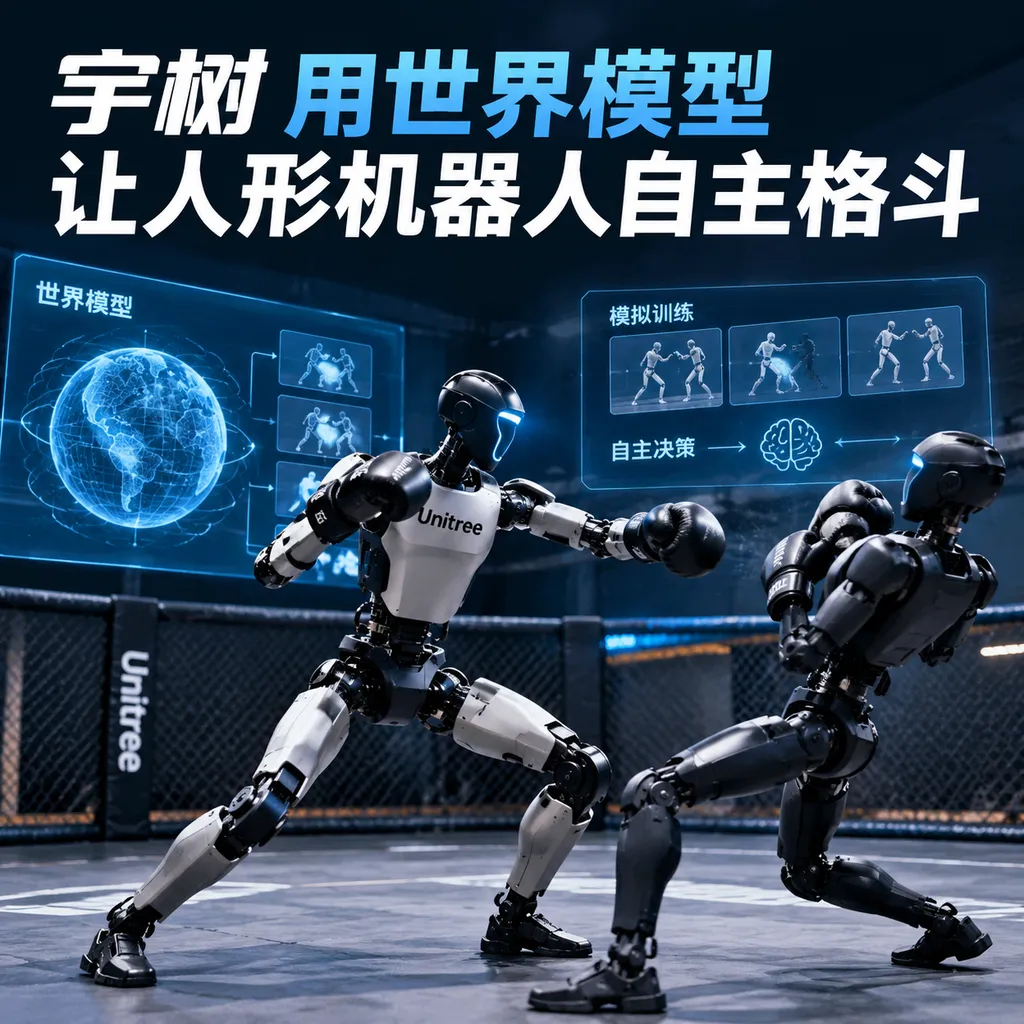
<think>**Translating UnifoLM-X2-1.0 announcement** </think> Unitree Robotics today unveiled UnifoLM-X2-1.0, announcing the world’s first fully autonomous humanoid combat system driven in real time by a world model. The robot no longer relies on preset movements or manual teleoperation; instead, it predicts future states in real time and performs decision-making and dynamic interaction execution.
<think>Planning markdown-preserving translation
</think>Unitree Uses a World Model to Enable Autonomous Combat for Humanoid Robots
Unitree Robotics announced today that it has achieved “the world’s first fully autonomous humanoid combat driven in real time by a world model,” and released related footage filmed in real-world conditions.
The core of this demonstration is not whether the robot can perform a polished sequence of punches, but whether Unitree can prove that, in the highly dynamic and strongly interactive scenarios that are most difficult for humanoid robots, a robot can operate without manual teleoperation or fixed action scripts—predicting what will happen next based directly on the situation at hand, making decisions, and then executing the corresponding actions.
The system is powered by Unitree’s newly announced UnifoLM-X2-1.0. According to the company, the model overcomes bottlenecks faced by world-action foundation models in instantaneous planning, decision-making, and dynamic interaction execution. It enables real-time prediction and planning of future states, and uses these capabilities to perform fully autonomous combat.
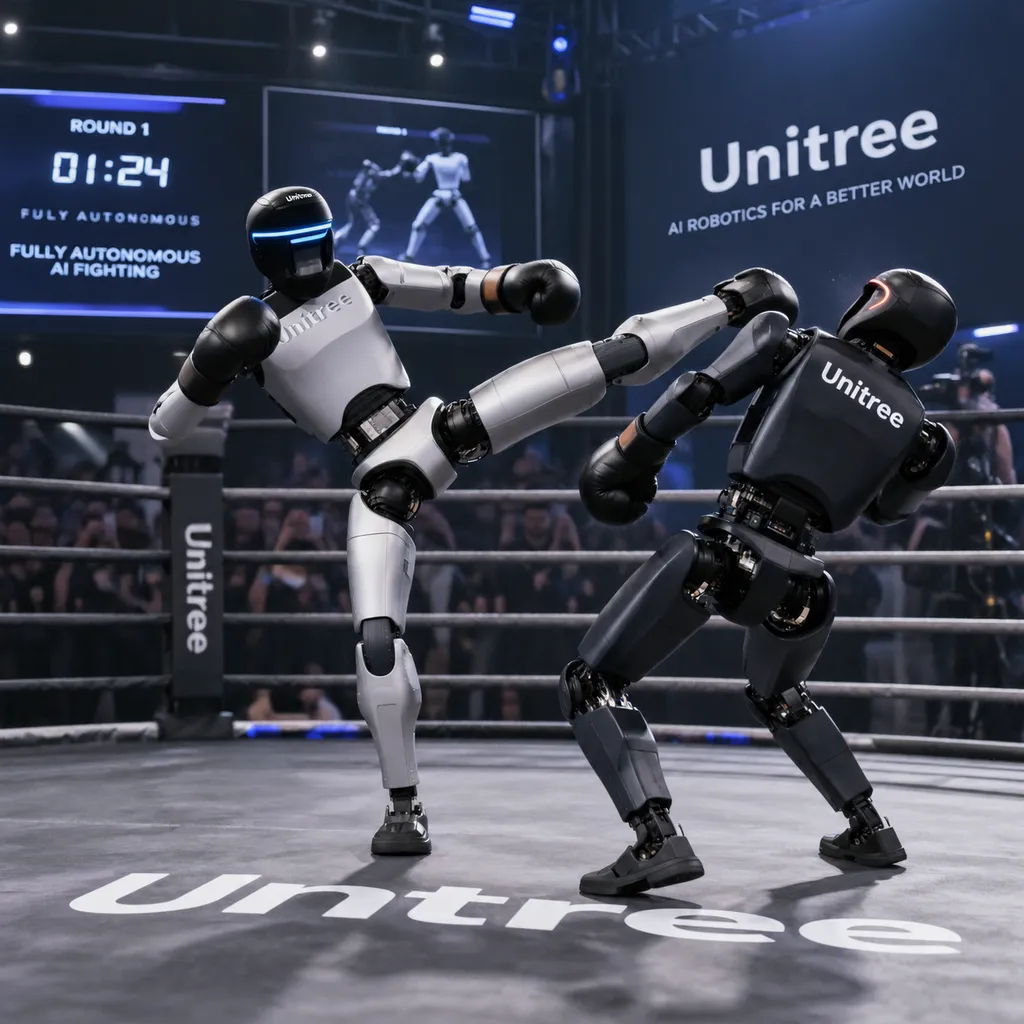
The technical significance of this development is greater than the fact that “robots are fighting.” In the past, humanoid robot combat demonstrations were more like stage performances for robots: the movements could be complex, but most were choreographed in advance. What Unitree emphasizes this time is that the robot must complete closed-loop control on the fly in an environment where the opponent is constantly changing, its own body is continuously losing balance, and contact forces can change abruptly at any moment.
From “Predefined Actions” to “Predicting the Future”
It is not new for humanoid robots to perform fixed movements. By collecting trajectories in advance, designing controllers, and then using teleoperation or motion playback, robots can perform a series of actions such as punching, kicking, dodging, and even getting up after falling. What the audience sees is a continuous sequence of behavior, but the robot may not actually understand what is happening around it.
The truly difficult part is that an opponent will not move according to a script, and the robot cannot be expected to stand in exactly the same posture every time. During a confrontation, a slight shift in the body or an unexpected collision can alter the balance state in the next instant. In such circumstances, prewritten action sequences can easily fail, while a control system relying solely on reactive responses may not have enough time to cope.
The idea behind a world model is to enable the robot to form an internal representation of the environment that can “simulate the future.” It does not necessarily need to reconstruct the entire world pixel by pixel, as a traditional simulator might. Instead, it focuses on predicting task-relevant states: where the opponent might move, how the body will change after contact, whether the current posture will lead to a loss of balance, and whether the next action will result in a better position.
This can be understood as anticipation when a person plays ball. A person does not wait until the ball has already hit their hands before deciding how to catch it. Instead, based on the ball’s speed and direction, as well as their own body posture, they estimate what will happen over the next few hundred milliseconds and then adjust their footwork and arms. For a humanoid robot, the world model serves as this internal simulator for “thinking a few steps ahead.”
Unitree has not disclosed the parameter size, inference latency, sensor configuration, training-data volume, or specific control frequency of UnifoLM-X2-1.0. It is therefore not yet possible to determine its complete technical specifications solely from a demonstration video. However, judging from the company’s official description, the model must handle at least three categories of tasks simultaneously:
- Instantaneous planning: Generating executable action plans within an extremely short period, rather than outputting only abstract objectives.
- Dynamic decision-making: Continuously modifying its strategy based on changes in the opponent, its own posture, and the environment.
- Interactive execution: Converting the model’s output into joint-level actions while handling collisions, friction, impacts, and loss of balance.
Only when these three capabilities are combined can the result be called “autonomous combat.” A system that can only predict images cannot keep the robot standing; one that can only plan actions cannot respond to external forces; and one that can only control joints cannot understand the opponent’s movement tendencies. The selling point of UnifoLM-X2-1.0 lies in linking the world model with the action-execution pipeline.
Why Combat Is a Rigorous Test for World Models
Among embodied-intelligence tasks, combat is not the most commercially valuable scenario, but it is an environment that readily exposes weaknesses in a system.
First, it requires high-frequency decision-making. The robot cannot replan only once every few seconds; it must rapidly update its assessment of the environment and its own state during continuous movement. Second, it is a strongly interactive task. The robot must not only recognize objects, but also predict the mechanical consequences after contact occurs. Third, its tolerance for error is low. If a robotic arm fails to grasp something, the usual consequence is simply that the object falls. If a humanoid robot loses its balance, however, it may fall outright and even damage its hardware.
More importantly, combat distinguishes between whether an action merely looks human and whether it is genuinely effective. A robot can use an action-generation model to produce a realistic video of a punch, but a real robot must simultaneously process visual perception, foot pressure, joint positions, inertia, collision forces, and motor output. No matter how accurate the model’s predictions are, if inference latency is too high or the actions are not subject to dynamic constraints, they will still turn into an animation that cannot actually be executed.
Therefore, if Unitree’s claims of “high dynamics, strong interaction, and real-time prediction and planning” can be stably reproduced on real hardware, the value lies not in adding another stage performance, but in demonstrating that world models are beginning to enter the closed loop of real-robot control.
How Does This Differ from Previous “Robot Combat” Demonstrations?
This is not the first time Unitree’s humanoid robots have publicly engaged in combat. On November 5, 2025, the first day of the eighth China International Import Expo, two Unitree humanoid robots performed a ring-fighting demonstration at an exhibition booth, attracting attention from attendees.
However, the technical implications of the two demonstrations are not the same. The earlier event focused more on showcasing the robots’ mobility and product form. Whether the movements were produced by preset programs, teleoperation, or other auxiliary systems was difficult for outside observers to determine from the footage alone. This time, Unitree has explicitly placed “fully autonomous” in the title, emphasizing that the robots use a world model to predict future states in real time and carry out autonomous decision-making and dynamic interaction execution.
The distinction can be compared to autonomous driving: traveling along a fixed route is not the same technical level as handling other vehicles, pedestrians, and unexpected situations in real time on open roads. A robot performing a prechoreographed sequence of punches is equivalent to following an already planned trajectory. A robot that adjusts its movements instantaneously according to an opponent’s actions during a confrontation is closer to the problem that embodied intelligence genuinely needs to solve.
Of course, “fully autonomous” still requires more rigorous verification. For example, was there absolutely no human teleoperation, what sensors were included in the perceptual input, was the action policy trained specifically for combat scenarios, can the robot adapt to opponents of different body types, speeds, and attack styles, and can it remain stable over multiple consecutive bouts? Unitree has not yet fully disclosed this information. Subsequent test data will be more worth following than the promotional wording.
The UnifoLM Approach: Turning a World Model into a Robot’s “Internal Simulator”
This is not Unitree’s first attempt at building a world model. According to its previously publicized UnifoLM-WMA-0 project, Unitree applies a world-model–action architecture to general-purpose robot learning and has designed two functional modes for its world model.
One is decision mode: the model predicts possible outcomes when the robot interacts with the environment, providing a reference for the policy module in selecting its next action. The other is simulation mode: based on actions the robot has already executed, the model generates environmental feedback for constructing or expanding training data.
This design is critical. Traditional robot learning often depends on large volumes of real-world operation data, which is costly and slow to collect, while dangerous actions are particularly difficult to gather. A sufficiently reliable world model can first “try out” actions internally, filter for strategies that are more likely to succeed, and then hand them over to the real robot for execution. It can serve both as a simulator during training and as an aid for short-term planning during deployment.
From this perspective, the combat demonstration involving UnifoLM-X2-1.0 may be no more than a validation of an extreme scenario: first teaching the model to predict rapid movements and contact outcomes, and then using that predictive capability for real-time policy selection. Similar capabilities could eventually be transferred to tasks such as recovering from shoves, walking through confined spaces, complex material handling, industrial collaboration, and operations in disaster environments.
But a world model is not an all-powerful “robot brain.” The quality of its predictions is affected by the coverage of its training data. Ground surfaces, lighting conditions, collision modes, and object shapes not encountered in the training data can all increase the risk of model mismatch. In robot control especially, a prediction error of just a few hundred milliseconds can lead to significant errors in posture. Therefore, whether a world model can ultimately serve as a general-purpose foundation depends not only on model scale, but also on the design of the data loop, dynamic constraints, real-time inference efficiency, and safety-control layer.
The Real Competition Lies in the End-to-End Closed Loop
Two increasingly clear approaches are emerging in the field of embodied intelligence. One is the vision-language-action model, or VLA: the robot understands images and instructions, and then outputs actions. This approach is good at translating “what I want” into “what should be done,” making it suitable for tasks such as grasping, organizing, and multistep manipulation.
The other is the world-model approach: the robot must not only understand the current scene, but also predict the future state after an action is executed. It addresses the question, “If I do this, what will happen next?” For dynamic movements and strongly interactive tasks, the latter is clearly more important.
However, the two approaches are not mutually exclusive. A usable humanoid robot system will generally still require visual perception, language understanding, a world model, task planning, motion control, and safety policies to work together. A world model is responsible for prediction, but that does not mean it can directly replace low-level controllers. A foundation model may handle abstract decision-making, but it cannot bypass motors and dynamic constraints.
Unitree’s advantage this time lies in its control over the robot platform, data, and deployment pipeline. For embodied-intelligence companies, model capabilities and hardware capabilities amplify each other: without real robots, it is difficult for models to obtain high-quality interaction data; without models, hardware can easily remain at the stage of action demonstrations. If Unitree can continue deploying the UnifoLM series across different humanoid platforms such as the G1, H1, and H2, and develop the ability to train and transfer across embodiments, it may have a chance to turn a one-off demonstration into a platform capability.
What Does This Release Mean?
In the short term, UnifoLM-X2-1.0 looks more like a demonstration of technical capabilities than a general-purpose robot model that can already be directly purchased and deployed. Unitree has not yet released the complete model weights, interfaces, hardware requirements, inference costs, or public benchmarks, nor has it explained whether the system will be made available to developers. Developers therefore cannot yet connect it directly to their own robot projects in the same way they would call an ordinary model.
In the medium term, this demonstration shifts the focus of competition from “how many actions can a robot perform?” to “can a robot continuously predict and correct itself in the real world?” If more data is disclosed in the future—such as end-to-end latency, prediction horizons, success rates, disturbance-resistance tests, cross-scenario generalization, and transfer results across different robot platforms—the industry will be able to determine whether this is a specialized system optimized for combat scenarios or a world-model foundation with broader transfer capabilities.
In the long term, world models may become one of the key components in the large-scale deployment of humanoid robots. Factories, warehouses, homes, and outdoor work environments are not fixed-script settings; robots must possess some ability to “rehearse actions in advance.” But moving from laboratory demonstrations to large-scale deployment still requires overcoming several hurdles, including reliability, data costs, safety responsibility, and hardware lifespan.
The most noteworthy aspect of Unitree’s announcement today is not that “robots have finally learned to fight,” but whether robots are beginning to possess an internal world that can predict the physical consequences of their actions in real time. If this direction continues to advance, the next stage of competition among humanoid robots may no longer be about whose action library is richer, but about who can enable machines to fall once less, collide once less, and recover quickly after failure in unfamiliar environments.
Conclusion
UnifoLM-X2-1.0 has been tested in an extremely dynamic real-robot scenario using a world model. The signal Unitree is sending is clear: humanoid robots are moving from “executing actions” toward closed-loop systems of “prediction–decision–execution.”
At this stage, however, it is more appropriate to regard this as an important engineering milestone rather than evidence that world models have solved general-purpose embodied intelligence. Going forward, whether the model can be open-sourced, transferred across tasks, and operated stably over the long term in non-demonstration environments will determine its practical impact far more than a single combat video.
References
- ITHome: Unitree Robotics Announces the World’s First Fully Autonomous Humanoid Combat Driven in Real Time by a World Model — Source for the release of UnifoLM-X2-1.0, the company’s official statements, and footage information.
- Unitree Robotics UnifoLM-WMA-0 GitHub Project — Unitree’s previously public world-model–action architecture, code, and project documentation, providing background on its technical approach.