
OpenAI launches GPT-Rosalind, AI officially enters drug discovery
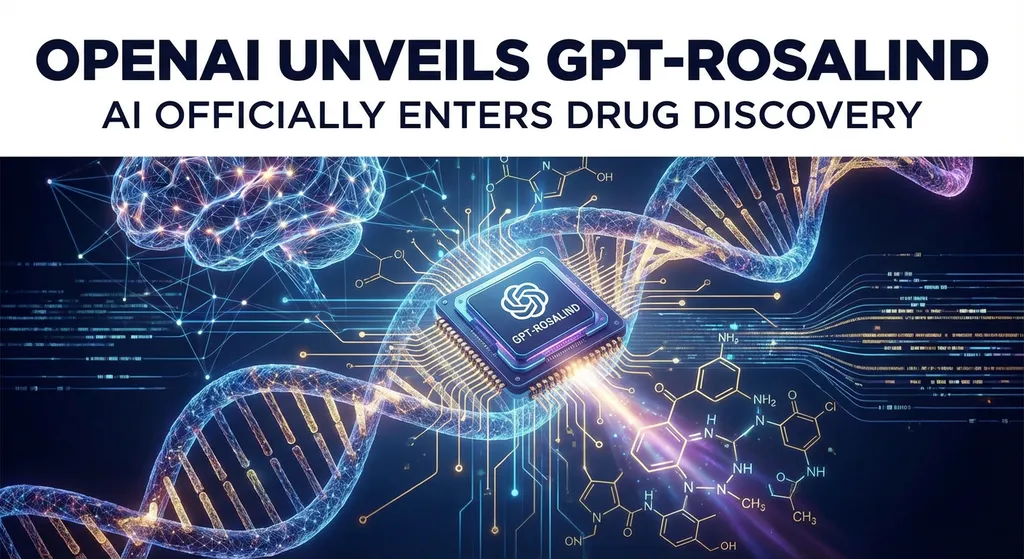
On April 16, OpenAI released a new model focused on life science reasoning — **GPT-Rosalind** — covering biochemistry, genomics, and translational medicine. Named after the late scientist Rosalind Franklin, it marks a key step in the transition of large models from general intelligence to specialized scientific research fields.
Not GPT-6, but Something You Might Want to Pay More Attention To
The community waited six months for GPT-6—it didn’t come. GPT-5.5 didn’t come either. On April 16, OpenAI released a name no one predicted—GPT-Rosalind.
A reasoning model built specifically for the life sciences.
The name comes from Rosalind Franklin, the British scientist who captured the crucial X-ray diffraction image of the DNA double helix but was long overlooked in Nobel Prize narratives. OpenAI’s choice of name is clear: this isn’t a routine model iteration—it’s a statement of direction.
According to Joy Jiao, OpenAI’s head of life sciences research, GPT-Rosalind is designed to achieve stronger fundamental reasoning capabilities in areas such as biochemistry, genomics, and drug discovery. Pay attention to the keywords—fundamental reasoning. This isn’t about simple literature search or summarization—it’s about truly understanding molecular mechanisms, protein interactions, and pathway analyses: the hard-core problems.
This deserves serious discussion.
Why Life Sciences?
Let’s start with a background number: a new drug takes an average of 10–15 years and over $2 billion to go from target discovery to market. More than 90% of failures occur in the preclinical stage. Massive time and money are consumed in repeated trial and error—compound screening, target validation, toxicity prediction, and molecular optimization.
All these steps have a common feature: they are inherently reasoning-intensive tasks.
You need to find disease-associated targets from massive genomics data, understand how a folded protein’s 3D conformation influences drug binding, and predict a candidate molecule’s metabolic pathway and potential side effects in the human body. These aren’t problems solvable by simple retrieval—they require deep, multidisciplinary reasoning.
Over the past two years, AI has made hallmark breakthroughs in life sciences. AlphaFold solved protein structure prediction, but that’s a relatively closed problem—sequence in, structure out. Real-world drug discovery is far more complex—it’s open-ended, requires judgment under uncertainty, and integration of literature, experimental data, and clinical knowledge from heterogeneous sources.
That’s exactly what large language models excel at.
OpenAI clearly saw this opportunity. Instead of competing with Anthropic or Google on general model benchmark scores, it’s smarter to create a defensible position in a vertical domain with real commercial and social value. Life sciences is that domain.
What Can GPT-Rosalind Actually Do?
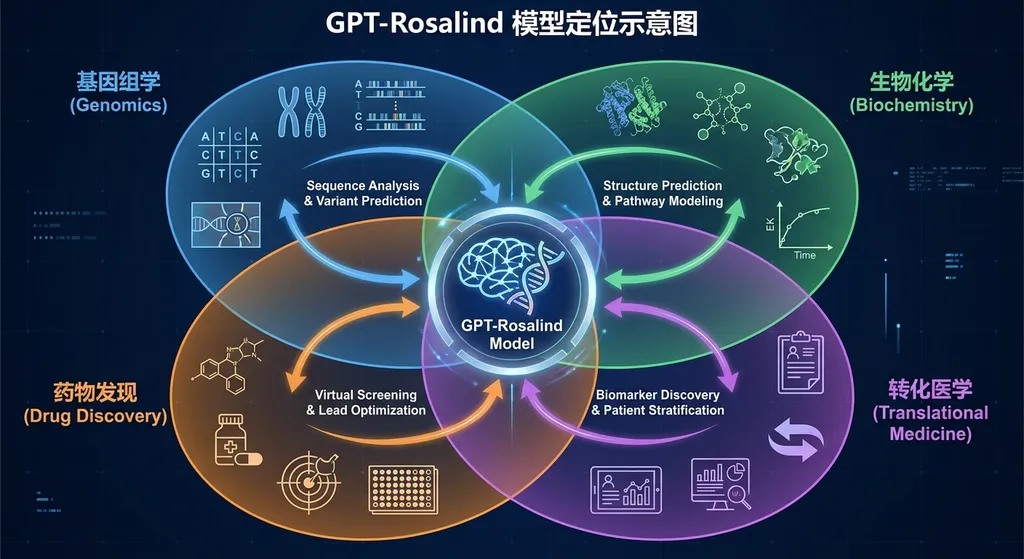
Based on currently available information, GPT-Rosalind covers three core scenarios:
Biochemical Reasoning
This is the foundational capability layer—understanding the relationship between amino acid sequences and protein functions, analyzing enzymatic reaction mechanisms, and predicting molecular interactions. To make an analogy: if a general model understands biochemistry like a college student who has read a few textbooks, GPT-Rosalind aims for the level of a postdoc with years of lab experience—knowing not just what, but why, and what’s next.
Drug Discovery Support
This is where the direct commercial value lies. Several bottlenecks in the drug discovery process are particularly suitable for AI intervention:
- Target identification & validation: Screening potential drug targets from genomic and proteomic data and evaluating their druggability
- Lead optimization: After identifying candidate molecules, predicting ADME (absorption, distribution, metabolism, excretion) properties and guiding structure modifications
- Toxicity prediction: Estimating a candidate molecule’s potential toxicity before animal testing
- Indication expansion: Analyzing known drugs’ mechanisms to find potential applications in other diseases (“old drugs, new uses”)
Even a few percentage points of accuracy improvement in these stages translates into hundreds of millions in R&D savings.
Translational Medicine
This bridges basic research and clinical practice. How does a biomarker discovered in a lab become a viable diagnostic tool? How do you design a proper clinical trial to validate a treatment effective in animal models? These questions require an understanding of both fundamental science and clinical application, and GPT-Rosalind aims to provide reasoning support at that intersection.
The Technical Path—Educated Guesswork
OpenAI hasn’t disclosed technical details of GPT-Rosalind, but we can make reasonable guesses.
First, this is very likely not a brand-new model trained from scratch. More plausibly, it’s based on the latest GPT foundation model, adapted through large-scale life sciences corpus training (domain adaptation), then enhanced for reasoning capability—perhaps using chain-of-thought reinforcement techniques similar to the o1/o3 series.
Potential data sources include:
- Millions of biomedical papers from PubMed
- Protein databases such as UniProt and PDB
- Drug chemistry databases such as ChEMBL and DrugBank
- Clinical trial data from ClinicalTrials.gov
- Public genomics and transcriptomics datasets
But the real key lies in reasoning training. Life sciences reasoning differs fundamentally from mathematical reasoning—math can be formally verified, but biological reasoning is probabilistic, multifactorial, and full of exceptions. Enabling reliable judgments amid uncertainty is the true challenge.
OpenAI likely used expert annotation—biologists, medicinal chemists, and clinicians evaluating and feeding back on the model’s reasoning process, fine-tuning scientific judgment through RLHF or similar mechanisms. That explains why Joy Jiao emphasized “fundamental reasoning”—they aim to go beyond surface-level Q&A to deep scientific thinking.
Competitive Landscape—Who Else Is Doing This?
Life sciences AI isn’t new, but the entry of large-model players is changing the game.
Google DeepMind is the earliest and most successful player. The AlphaFold series has become the backbone of structural biology, and AlphaFold 3 extends predictions to complexes of proteins, small molecules, nucleic acids, and ions. However, DeepMind’s approach favors specialized models—one model per problem—not a general scientific reasoning engine.
Anthropic’s Claude series performs well in scientific reasoning, especially in long-context understanding and multistep reasoning. But Anthropic hasn’t launched a life sciences–specific model so far—its focus is on general reasoning. Some community members mention Anthropic’s “Mythos” series, but those are for general reasoning enhancement, not domain specialization.
Specialized players like Insilico Medicine, Recursion Pharmaceuticals, and Isomorphic Labs (a DeepMind subsidiary) are already using AI for drug discovery, with some candidate drugs in clinical trials. Yet their models target specific tasks (e.g., molecule generation, target prediction) rather than general scientific reasoning.
GPT-Rosalind’s differentiation lies in its attempt to build a general reasoning layer for life sciences. Not to replace tools like computational chemistry or molecular dynamics simulators, but to operate at a higher abstraction level—helping researchers understand problems, form hypotheses, design experiments, and interpret results.
Smart positioning? I’d say yes—it avoids direct competition with task-specific tools and fills a gap those tools don’t cover: assistance in scientific thinking.
Community Reaction—Excitement and Disappointment
Community feedback has been split.
Some developers are clearly disappointed. They were expecting GPT-5.5 or GPT-6—a major leap in general capability—but got a vertical-domain model instead. “Is this what I asked for?” sums up many sentiments. Given Anthropic’s continual Claude updates and Google’s evolving Gemini, OpenAI’s silence on general models feels unsettling.
Others—especially those in life sciences—are thrilled. “Researchers are going to be happy,” one joked—but the underlying anticipation is real. If GPT-Rosalind truly reaches expert-level reasoning in molecular biology, it could revolutionize research productivity.
A practical question remains: Who gets access? OpenAI hasn’t clarified usage—will it be available to all ChatGPT Plus users, API-only, or enterprises via partnership? Considering the specialization and regulatory aspects (e.g. patient data), restricted access makes sense—but it also means most developers won’t get hands-on experience soon.
What It Means for Developers
Even if you’re not in life sciences, GPT-Rosalind’s launch signals something big: vertical-domain models are becoming mainstream.
For two years, large-model competition has centered on generality—“the stronger, the better.” But top players now realize that in many high-value contexts, the ceiling of general models isn’t high enough. You need domain knowledge, domain reasoning, domain-specific evaluation metrics—and you can’t simply fix that with a prompt.
For AI application developers, this means:
- Model selection gets more complex. You might have relied on GPT-4 for everything—now you’ll route tasks to different models: one for general conversation, one for code, one for scientific reasoning. Model routing will become core infrastructure.
- More opportunities for vertical AI applications. When foundation models gain domain-level reasoning, the space for upper-layer applications expands—bioinformatics tools, clinical-decision aides, drug R&D platforms will see new waves of innovation.
- Higher value in API aggregation. When your app needs multiple specialized models, unified interfaces and management become critical.
Regarding API usage—if GPT-Rosalind later opens API access, developers could connect via OpenAI Hub–compatible aggregation platforms, simplifying integration. Here’s a possible example (based on OpenAI-compatible format; actual model name subject to release):
from openai import OpenAI

client = OpenAI(
    api_key="your-openai-hub-key",
    base_url="https://api.openai-hub.net/v1"
)

response = client.chat.completions.create(
    model="gpt-rosalind",  # Actual model name to be confirmed
    messages=[
        {
            "role": "system",
            "content": "You are a life sciences research assistant with expertise in biochemistry, genomics, and drug discovery."
        },
        {
            "role": "user",
            "content": (
                "Analyze the oncogenic mechanism of KRAS G12C mutation in non-small-cell lung cancer, "
                "and evaluate the principles and potential resistance mechanisms of covalent inhibitors such as Sotorasib."
            )
        }
    ],
    temperature=0.2  # Low temperature for scientific reasoning
)

print(response.choices[0].message.content)
// Node.js example
import OpenAI from 'openai';

const client = new OpenAI({
  apiKey: 'your-openai-hub-key',
  baseURL: 'https://api.openai-hub.net/v1',
});

const response = await client.chat.completions.create({
  model: 'gpt-rosalind',
  messages: [
    {
      role: 'system',
      content:
        'You are a life sciences research assistant specialized in drug target identification and validation.',
    },
    {
      role: 'user',
      content:
        'Based on current transcriptomics data, analyze PD-L1/PD-1 pathway expression in triple-negative breast cancer and suggest potential combination therapy strategies.',
    },
  ],
  temperature: 0.2,
});

console.log(response.choices[0].message.content);
Note that the temperature is set low. In scientific reasoning, you want rigor and determinism—not freeform creativity. This is the opposite of writing marketing copy, where higher temperature encourages creativity.
The Bigger Picture
Zooming out, GPT-Rosalind’s release reflects a strategic shift at OpenAI.
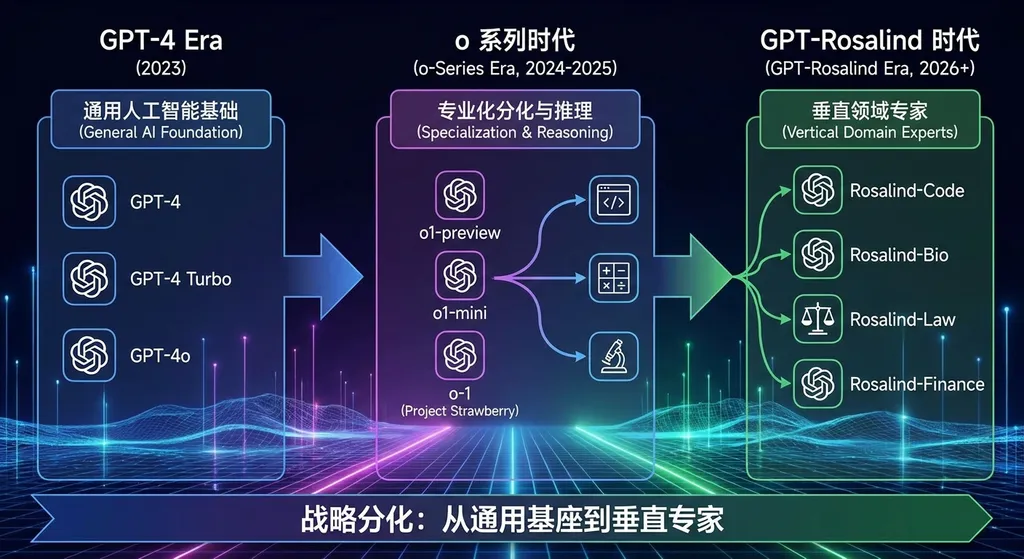
Over the past year, OpenAI’s model lineup has clearly diversified—the o series for deep reasoning, the GPT series for general conversation, and now a vertical domain series. This isn’t random—it responds to market need. Enterprise clients don’t want one general model that does everything mediocrely; they need precise tools that excel in their business context.
Life sciences is the first—but probably not the last. Finance, law, materials science, climate modeling—each knowledge-intensive field has similar demands. If GPT-Rosalind proves that the “foundation + domain‑specialization” approach works, expect more GPT‑[scientist‑name] models to follow.
Of course, that all depends on GPT-Rosalind actually performing well. So far we’ve seen press releases and coverage—but no benchmark data, no user testing, no head‑to‑head comparison with existing tools. In a domain as unforgiving as life sciences, hallucination risk is especially deadly—an incorrect target prediction or toxicity assessment could waste millions in research.
So a cautiously optimistic attitude is reasonable. The direction is right—but it’s a long road ahead.
Final Thoughts
The community meme “Bro, where’s my GPT‑6?” captures an interesting perception gap.
For ordinary users and most developers, model value is reflected in version numbers—the bigger, the better; the more general, the better. But for OpenAI, the next billion‑dollar revenue driver may not come from GPT‑6’s general capability boost, but from vertical-domain models like GPT‑Rosalind.
The pharmaceutical industry spends over $200 billion annually on R&D. Capturing even 1% of that market is a $2 billion opportunity.
GPT‑6 will come eventually—but OpenAI chose to make the smart money first.
References
- Linux.do Community Discussion: GPT-Rosalind, OpenAI’s New Model — user discussions and feedback on GPT‑Rosalind’s release


