DeepSeek Flash price will drop tomorrow, with output costing 4 yuan per million tokens.

DeepSeek announced that starting at 12:00 on September 10, it will reduce the API prices for its Flash series. During off-peak hours, output will cost as little as 4 yuan per million tokens, while cache-hit input will cost just 0.02 yuan; prices will double during peak hours.
DeepSeek Flash Price Cut Tomorrow, Output at 4 Yuan per Million Tokens
DeepSeek has lowered the API prices for its Flash series by another tier.
On September 9, the DeepSeek Open Platform announced that, starting at 12:00 p.m. Beijing time on September 10, deepseek-v4-flash and deepseek-v4-flash-vision-exp would adopt new prices. During off-peak hours, cached input will cost 0.02 yuan per million tokens, uncached input will cost 1 yuan, and output will cost 4 yuan. During peak hours, all prices will be twice the off-peak rates.
This is not a merely symbolic adjustment. For Agent applications that rely heavily on long contexts, code repositories, and tool calls, the 60% drop in cached input prices is more significant than the output price cut when considered in isolation. However, DeepSeek has retained peak and off-peak pricing, so if a company runs most of its workloads during weekday daytime hours, its final bill may not be calculated at the lowest advertised rates.
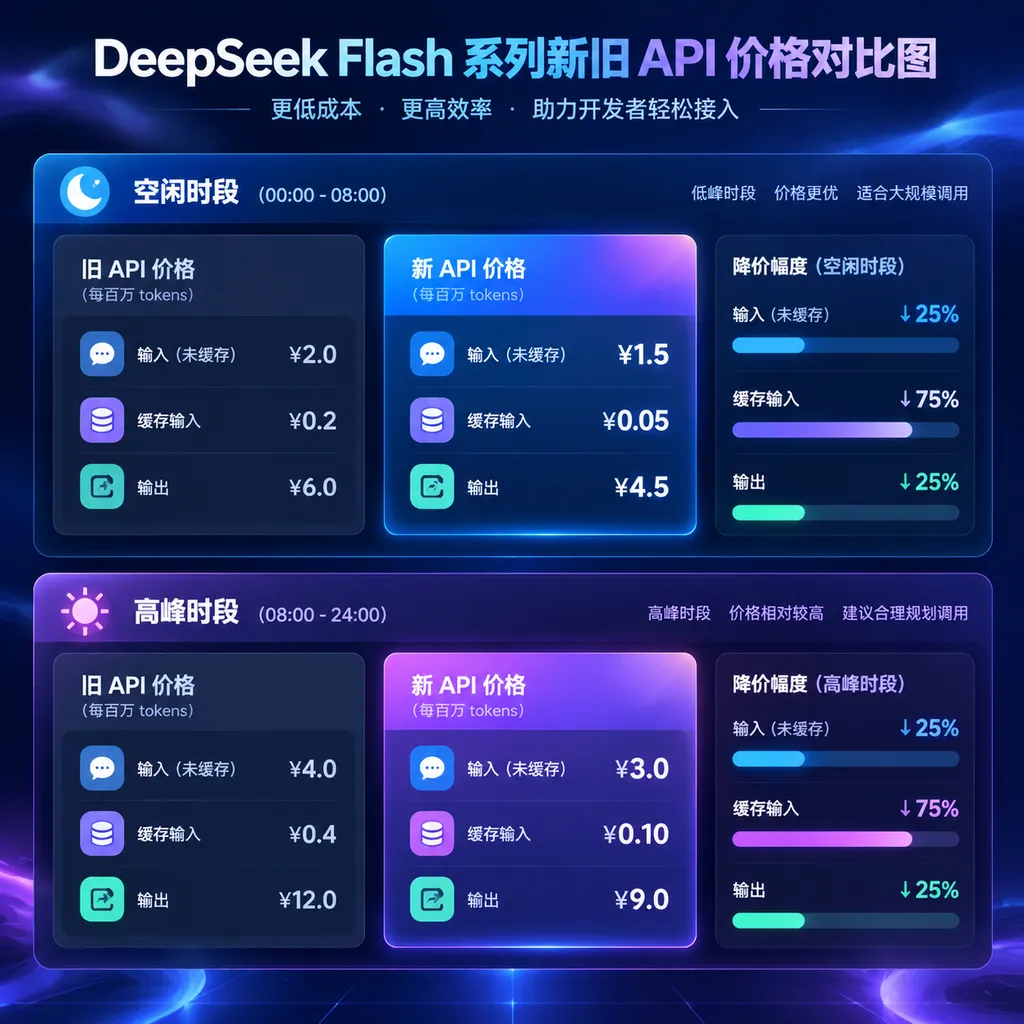
New Prices Take Effect Tomorrow at Noon
According to DeepSeek's announcement, the Flash series price adjustments taking effect at 12:00 p.m. Beijing time on September 10 are as follows:
| Billing item | New off-peak price | New peak price | | --- | ---: | ---: | | Input, cache hit | 0.02 yuan / million tokens | 0.04 yuan / million tokens | | Input, cache miss | 1 yuan / million tokens | 2 yuan / million tokens | | Output | 4 yuan / million tokens | 8 yuan / million tokens |
DeepSeek's peak hours are 9:00–12:00 and 14:00–18:00 Beijing time, Monday through Friday. All other times are considered off-peak. In other words, September 10 from 12:00 to 14:00 will be billed at off-peak rates, while weekday calls after 14:00 will be charged at twice the rate.
The official Flash series currently consists primarily of two models:
deepseek-v4-flash: Designed for general text, coding, and reasoning tasks.deepseek-v4-flash-vision-exp: Supports visual input in addition to Flash's existing capabilities. Images are converted into tokens based on their dimensions and billed together with text tokens.
Both models are receiving identical price adjustments this time. Cached input is dropping from 0.05 yuan to 0.02 yuan per million tokens, a 60% reduction; uncached input is dropping from 1.5 yuan to 1 yuan, a reduction of approximately 33.33%; and output is dropping from 4.5 yuan to 4 yuan, a reduction of approximately 11.11%. The price changes during peak hours follow the same proportions.
The Real Savings Are in Caching, Not Output
If you look only at output prices, this is not an especially aggressive cut. Output is falling from 4.5 yuan to 4 yuan per million tokens, a saving of just 0.5 yuan, or approximately 11%. In model usage costs, output is usually the component developers pay the most attention to. However, for coding Agents, customer-service Agents, and long-running automation workflows, input is often the largest part of the bill.
An Agent task may need to repeatedly read the same system prompts, tool definitions, project files, conversation history, and intermediate results. The answer actually generated by the model may not be very long each time, but the context attached to requests can quickly reach hundreds of thousands or even millions of tokens. As long as this content hits the cache, the unit price drops from 1 yuan to 0.02 yuan per million tokens, a 50-fold difference.
Consider an example closer to engineering practice: a coding Agent task generates 100 million input tokens in total, 90% of which are cache hits, along with 10 million uncached input tokens and 10 million output tokens. At the new off-peak rates:
- Cached input: 90 million tokens × 0.02 yuan / million tokens = 1.8 yuan
- Uncached input: 10 million tokens × 1 yuan / million tokens = 10 yuan
- Output: 10 million tokens × 4 yuan / million tokens = 40 yuan
- Total: approximately 51.8 yuan
In this example, output remains the largest cost item, but cached input has fallen to a nearly negligible amount. For workflows with longer contexts and a lower proportion of output, caching strategy will have an even more pronounced effect on total costs.
This is also the clearest signal from this round of price adjustments: DeepSeek is placing its pricing leverage on “repeated computation.” Developers who simply replace the model name with the newly priced version may see limited benefits. Actual costs will fall noticeably only if they also implement prompt caching, context reuse, and task decomposition.
Peak and Off-Peak Pricing Creates a Time Window for Savings
It is important to note that the 4-yuan output price applies only during off-peak hours. During peak hours, output costs 8 yuan per million tokens. Compared with the previous peak price of 9 yuan, this is a reduction of only approximately 11.11%. Cached input is falling from 0.10 yuan to 0.04 yuan, which remains a substantial reduction; uncached input is falling from 3 yuan to 2 yuan.
Different types of users will experience these changes differently.
Individual developers, asynchronous batch-processing tasks, and coding tasks run at night can generally benefit consistently from the lower rates. Enterprise online services are different: user requests typically occur during working hours, and customer service, retrieval-augmented generation, and business-system calls cannot simply be delayed until the early morning. In these scenarios, the relevant figure to calculate is the per-task cost at peak prices, rather than the off-peak price highlighted most prominently in the announcement.
A more practical approach is to divide workflows into two layers: use models and budgets that remain acceptable at peak rates for real-time paths, while scheduling non-real-time tasks such as batch summarization, index construction, log analysis, and data cleansing during off-peak hours whenever possible. For teams with queueing systems, this type of scheduling is not complicated. For applications that call models synchronously within Web requests, however, peak and off-peak pricing will force developers to redesign their task architecture.
For Agent Developers, Cache-Hit Rate Matters More Than Unit Price
The DeepSeek Flash series supports million-token contexts, making it suitable for codebase analysis, long-document processing, and multi-turn Agent workflows. However, a long context does not mean that all content can be placed into a request at no cost. The longer the context, the more directly cache hits, cache boundaries, and repeated submission of tool results affect the bill.
Developers should check at least the following:
- Whether fixed content is placed in stable locations. System prompts, tool schemas, and role definitions should remain as consistent as possible, avoiding cache invalidation caused by minor changes in every request.
- Whether the conversation history is continuously expanding. Long conversations can be compressed periodically, and tool-returned results should retain only the fields actually needed for subsequent tasks.
- Whether real-time and static content are mixed together. Project descriptions, rules, and foundational documents are suitable for caching, while timestamps, user input, and dynamic state should be organized separately.
- Whether million-token contexts are actually necessary. For simple question-and-answer tasks, shortening the input context is usually more effective than pursuing a lower token price.
- Whether visual input is included in the cost model. Images submitted to
deepseek-v4-flash-vision-expare first converted into tokens, so high-resolution images and multi-image tasks can quickly increase input consumption.
From a product perspective, this price cut will strengthen Flash's competitiveness in “high-frequency, repetitive, long-context” tasks. It may not change model choices for the most complex reasoning tasks, but it will affect which model developers use by default for large volumes of execution work. Planning, review, and final decisions can be assigned to more capable models, while file reading, structured extraction, batch rewriting, and tool orchestration are better suited to Flash.
The Focus of the Price War Has Shifted from Output to Per-Task Cost
In the past, comparisons of large-model prices often focused only on two figures: input and output. In the Agent era, however, the per-million-token price is only the first-level metric. What truly determines whether a product can operate at scale is how many model calls a complete task requires, how much context each call carries, how high the cache-hit rate is, and whether the model can complete the task in one attempt.
A model that is cheap but requires repeated retries may not be less expensive than a model with a higher unit price and a better one-shot success rate. Conversely, if a model offers a sufficiently long context, reliable tool calling, and a high task-completion rate, low caching prices will further amplify its advantage in batch-processing and long-running tasks.
By reducing cached input to 0.02 yuan per million tokens, DeepSeek is effectively encouraging developers to retain more repeated content in the model context while using caching to reduce the cost of repeated computation. This is particularly important for coding Agents: the same repository structure, dependency files, and tool definitions may recur across dozens of calls, and cache-hit rate can determine the final bill more than the input length of any single request.
At the same time, this reminds developers that “low price” should not be understood as an unconditional free allowance. Peak-hour multipliers, caching rules, concurrency limits, and the actual method used to calculate tokens will all affect production costs. Before launch, it is best to replay a set of real request logs, separately calculate costs during off-peak and peak hours, and then decide whether to make Flash the default model.
OpenAI Hub Users Do Not Need to Change Their Call Format
For developers already using DeepSeek through OpenAI Hub, this change mainly affects platform-side price synchronization and billing calculations. The model-calling method does not need to be redesigned because of the price cut. OpenAI Hub supports the OpenAI-compatible format, allowing a single key to switch among models from GPT, Claude, Gemini, DeepSeek, and other providers. This is suitable for routing models within the same business based on task difficulty and cost.
It is important to note that a lower model price does not mean every task should be switched to Flash. For real-time interaction, complex planning, and high-risk outputs, success rate, response speed, and context utilization efficiency still need to be evaluated together. A more reasonable strategy is to place Flash in the high-frequency execution layer, use more capable models for a small number of critical steps, and monitor token consumption and failed retries across models through a unified gateway.
Conclusion: Flash Returns to the “Scaling Execution” Track
The most valuable part of this DeepSeek Flash price cut is not the reduction in output from 4.5 yuan to 4 yuan, but the reduction of cached input to 0.02 yuan per million tokens. It further lowers the often-overlooked cost of repeated input in long-context Agents while giving developers more room for engineering optimization.
Of course, peak and off-peak pricing means developers cannot look only at off-peak rates. Online businesses need to budget according to peak prices, while batch-processing tasks can obtain lower costs through queueing and off-peak scheduling. Ultimately, whether a model is cost-effective is determined by how much it costs to complete a real business task, not by any single number on a price sheet.
After the new prices take effect on September 10, the Flash series will become even more attractive for code processing, batch document processing, knowledge-base construction, and multi-turn tool calls. For teams working to control Agent inference costs, this price adjustment is worth another round of cost testing. For applications that handle only short-text question-and-answer tasks, however, the practical benefit of the cut will be limited.
Sources
- ITHome: DeepSeek Officially Announces Price Cut for Flash-Series AI Models Starting Tomorrow — Introduces the new prices taking effect on September 10 and the price reductions for the two Flash models.
- Zhihu: After DeepSeek's Price Increase, Who Is the Cheapest Domestic Flagship Model? — Provides industry context on previous DeepSeek price changes, Agent costs, and developer billing.
- Zhihu: DeepSeek V4 Pro Permanently Discounted by 75% — Summarizes previous pricing and capability information for the DeepSeek V4 series to supplement the background on pricing changes.