<think>**Drafting Huawei headline translation** </think> Huawei flagship smartphones begin downloading local large models.
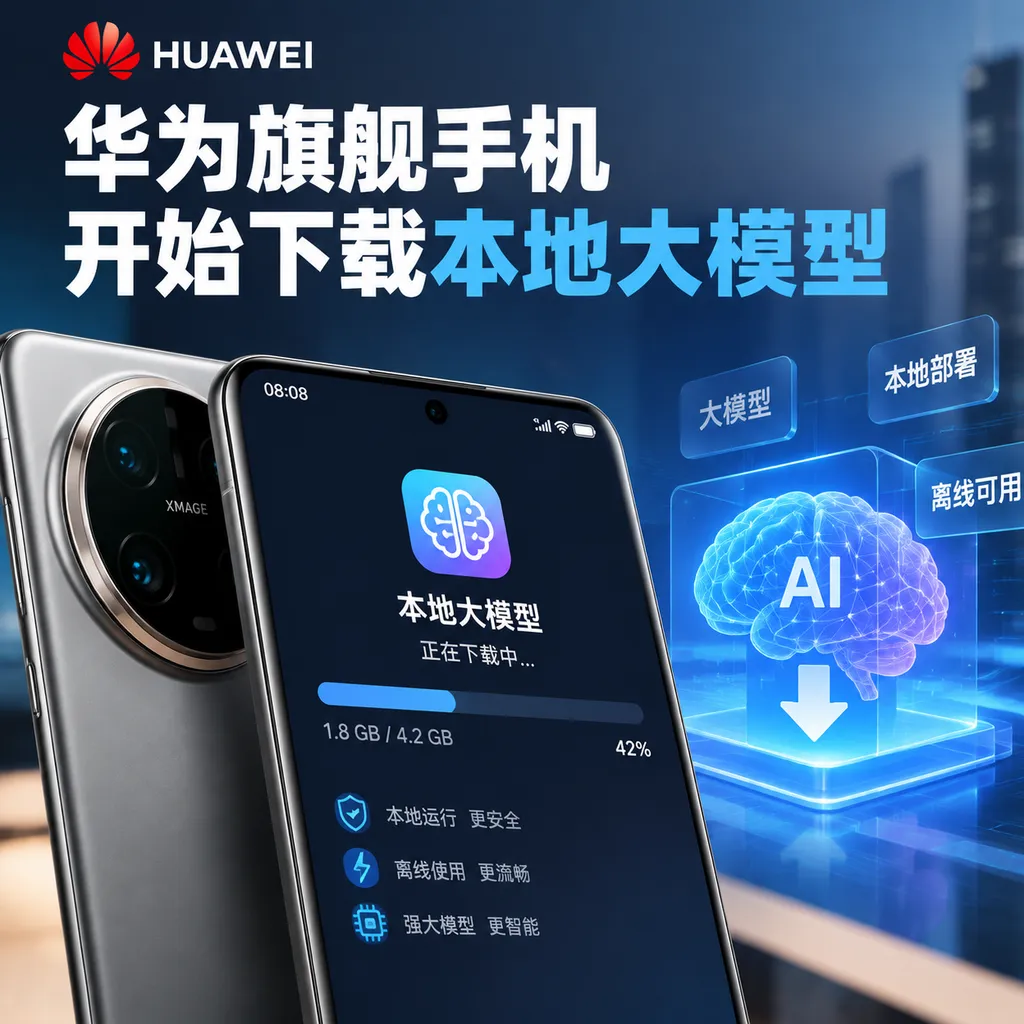
<think>**Verifying product name translations** </think> According to a blogger, the Huawei Pura X View and Mate XT 2 Ultimate Design support downloading and deploying two on-device multimodal large models, enabling offline image generation, speech synthesis, photo library editing, and app control. Huawei has yet to officially confirm this capability.
<think>Planning Markdown-preserving translation
</think>Huawei Downloads Large Models Directly to Phones
Huawei is taking on-device large models beyond being a system capability, turning them into local components that users can actively download, select, and manage.
On September 9, blogger @超维界 revealed that Huawei’s Pura X View and Mate XT 2 Ultimate Design flagship phones support downloading and deploying on-device local large models. Users can independently choose between two types of models on their devices: a multimodal enhanced large model with a capacity of approximately 6 GB, and a multimodal mixture-of-experts large model with a capacity of approximately 15 GB.
Based on the information disclosed so far, this is not simply a matter of giving cloud-based AI features a different entry point. Instead, the model files are stored directly on the phone, with inference performed locally by the device. Even when the phone is offline, certain image, voice, and system-operation tasks can still be performed.
It should be emphasized that this information currently comes from a blogger’s report. Huawei has not yet provided a complete explanation of the model names, specific parameters, supported device range, or official release date. At this stage, the more accurate description is that the two devices are reportedly capable of downloading and deploying on-device models—not that Huawei has officially released a local large-model platform open to all users.
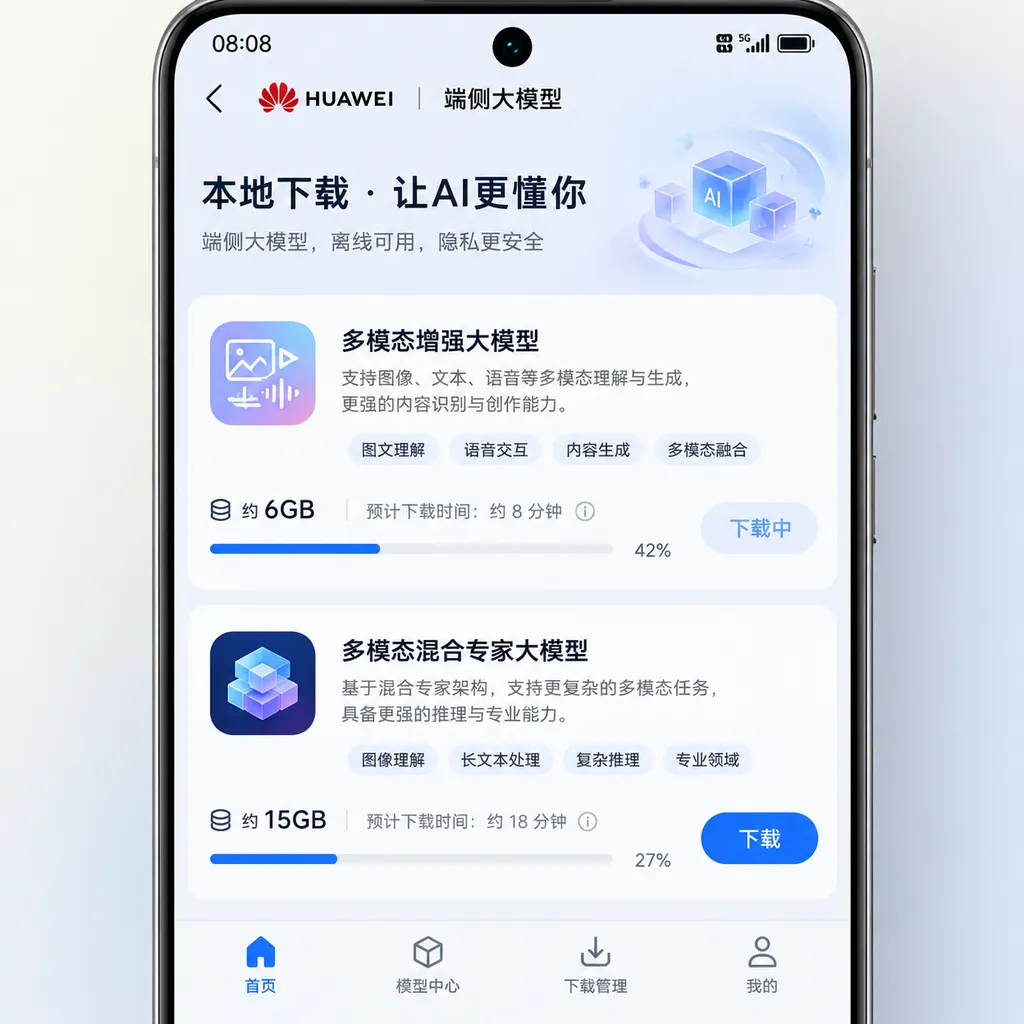
The Two Models Serve Different Purposes
The disclosed information indicates that Huawei’s two types of local models are not simply differentiated by size; they correspond to two distinct product directions.
6 GB Model: More Like a Collection of Local AI Capabilities
The multimodal enhanced large model is primarily intended for high-frequency functions such as image, voice, and photography processing, including:
- Local image generation;
- Speech synthesis and voice playback;
- AI super-resolution enhancement for the camera;
- Photo editing in the gallery;
- Local intelligent processing related to images and photography.
The key characteristics of these capabilities are their high frequency of use and relatively well-defined task boundaries. For example, when users are in a subway, on an airplane, or outdoors without a signal, they can enhance, remove elements from, or apply styles to a photo, or have the phone convert text into speech, without uploading the original image or audio to the cloud.
However, “local image generation” should be interpreted cautiously. The disclosed information does not specify the supported resolutions, generation speed, or editing capabilities, nor does it clarify whether the model supports text-to-image, image-to-image, or inpainting. The 6 GB figure refers approximately to the space occupied by the model files or service package; it does not mean that the model is only 6 GB in size, nor that it can match the image-generation quality of cloud-based large models.
A more realistic assessment is that Huawei may have compressed, quantized, and task-customized generative visual capabilities for smartphone scenarios, producing a version capable of running on Kirin platforms under smartphone thermal constraints. Its first challenge is “whether it can run locally,” and only afterward “whether it can perform as well as a cloud-based model.”
15 GB Model: Focused on Understanding Complex Tasks and Controlling Apps
The multimodal mixture-of-experts large model is closer to a system-level agent. According to the report, it can handle complex task understanding and app control, such as organizing photos offline.
This means the model must do more than identify what appears in an image. It also needs to understand user intent, read local content, and invoke system or app functions according to a series of steps. A user might simply say, “Find the pet photos I took last week and organize them by scene,” after which the system would need to complete several steps, including time-based filtering, content recognition, album categorization, and result presentation.
The difficulty with these tasks lies not in single-turn question answering, but in whether the model can reliably complete an entire task chain. It must process text, images, and system state simultaneously, while also knowing which operations can be executed, which require user confirmation, and how to roll back after a failure.
MoE, or mixture of experts, models typically select different expert subnetworks to participate in computation based on the task. This does not mean that the entire 15 GB model runs during every inference, so in theory it can balance capability and computing-resource consumption to a certain extent. However, once the model files reach approximately 15 GB, storage usage, initial loading time, memory pressure, and sustained power consumption will all become significant.
15 GB Does Not Mean “Only 15 GB Is Needed to Run It”
For developers, the easiest point to misinterpret in this report is to equate the model download size directly with the hardware requirements for running it.
The actual resource consumption of an on-device model includes at least the following:
- Model weights: The approximately 6 GB or 15 GB download package may also contain quantized weights, vocabularies, and runtime files;
- Runtime memory: During inference, some or all of the weights must be loaded into memory, while additional space must be reserved for intermediate activations and the KV cache;
- Multimodal components: Modules such as visual encoders, speech recognition, and speech synthesis may consume additional resources independently;
- System and app overhead: The model does not run on an otherwise empty phone. HarmonyOS, the gallery, the camera, and other apps will continue to occupy memory;
- Caches and data indexes: Photo understanding, vector retrieval, and task history also require local storage.
Therefore, 15 GB is more likely to represent the size of the model package than a requirement meaning that a phone with just 15 GB of free space can run it smoothly. Flagship phones generally have more powerful NPUs, more memory, and better thermal management, but the actual experience will still depend on quantization precision, context length, concurrency strategies, and system scheduling.
If the model uses low-precision quantization such as INT4, the space occupied by the weights can be significantly reduced. If the system activates only a subset of the experts, the computational workload may also be lower than that of a conventional dense model. However, the bottlenecks of on-device AI are usually not determined by a single metric. Whether the model needs to frequently swap data between memory and storage, whether the NPU can operate efficiently, and whether the device throttles under prolonged workloads will all directly affect the user experience.
In other words, users may see “15 GB to download,” but what they actually experience is how long they have to wait, how much heat is generated, how reliably the gallery organizes photos, and whether the model quietly consumes substantial resources in the background.
The Value of Offline Capabilities Lies First in Privacy and Availability
The most certain value of on-device models is not that they are smarter than cloud-based models, but that data does not have to leave the device.
Photos, recordings, contacts, documents, and app-operation histories are all highly sensitive data. In the past, AI photo-editing, image-understanding, and intelligent-assistant features offered by phone manufacturers often required an internet connection to invoke cloud-based models. On-device models can process this data locally, reducing the risk of uploads while also lowering network latency and dependence on cloud services.
Local inference is particularly meaningful in the following scenarios:
- Organizing travel photos or generating simple images in environments without a network connection;
- Recognizing screenshots, contracts, identification documents, and chat histories containing private information;
- Using voice playback and offline assistance on airplanes, in underground parking garages, or in remote areas;
- Searching local recordings, photo galleries, and documents without sending the original content to a server;
- Performing basic system operations when network quality is unstable.
However, “available offline” does not mean that every function works offline. The model itself may run locally, while app-control permissions, cloud-based assets, online searches, account synchronization, and certain content-safety checks may still require a network connection. Huawei will ultimately need to clearly indicate in the settings which services are fully offline and which fall back to the cloud; otherwise, it will be difficult for users to determine where their data is actually going.
App Control Is More Significant Than Image Generation
From a product-impact perspective, offline image generation is not the most important part of this report. Smartphone-based image generation already has a number of mature local or cloud-device collaborative solutions. What can truly make a difference is whether a local model can become a system-level agent.
App control means that a model moves from “answering questions” to “doing things for the user.” Traditional phone assistants can often only open an app or pass a voice command to an app’s internal search function. A more advanced system agent, by contrast, needs to perform a sequence of actions across multiple apps, including the gallery, files, calendar, notes, and sharing.
This capability can be abstracted as a local task chain:
User instruction
  -> Intent recognition
  -> Local content retrieval
  -> Task planning
  -> Invoke system capabilities or app interfaces
  -> Verify execution results
  -> Provide feedback to the user
The most difficult part is not intent recognition, but verifying the execution results. Did the model really find all the photos? Did it accidentally delete similar images? Did it mistakenly share a private album? Did it modify a file without the user’s authorization? For operations involving deletion, sending, payments, or exporting private data, the system must establish clear confirmation mechanisms.
Therefore, if Huawei wants to turn this capability into a usable product, it will need not only better model performance, but also a robust permission system, operation rollback, execution logs, and inter-app interfaces. The more capable a model is of operating a phone, the less the system can rely on a simple “Please confirm” prompt. Instead, it should clearly show users what the model is about to access, modify, or share.
For Huawei, This Is an Expansion of HarmonyOS AI
Huawei has already been advancing Xiaoyi, the gallery, the camera, and system-level intelligent services within HarmonyOS. In August 2026, Huawei began rolling out HarmonyOS 7.0.0.102 SP8, which introduced features such as 3D spatial wallpapers, Close Friends, and Outdoor Exploration mode. After the upgrade, devices supporting on-device AI could also view local model versions, parameter sizes, and service scenarios.
The download-and-deployment mechanism revealed this time suggests that on-device models may no longer be fixed, preinstalled, invisible underlying components. Instead, they may be moving toward something resembling a “model store” or “system AI capability package.” Users can choose models based on their available storage and needs, while Huawei can continue updating the models without relying entirely on full-device system upgrades.
This model has three clear advantages:
- More flexible updates: Models can iterate independently of system versions;
- Layered capabilities: Lightweight models can serve everyday functions, while larger models handle complex tasks;
- Manageable resources: Users can choose to download, delete, or switch between local models.
The costs are also clear: model downloads can consume anywhere from several gigabytes to more than 10 GB of storage, updates require additional data usage, and different model versions may vary in capabilities and compatibility. For manufacturers, maintaining stability and power efficiency and explaining issues to users after the model is released will also be considerably more demanding than simply launching a cloud-based API.
Compared with Competitors, Huawei’s Approach Emphasizes “System Control”
On-device large models are not unique to Huawei. Apple, Google, and several other smartphone manufacturers in China are all advancing local inference on devices. The main differences lie in three areas: model capabilities, hardware optimization, and system-level access permissions.
Google places greater emphasis on integrating Gemini Nano with Android system services, while Apple packages on-device models, Private Cloud Compute, and system features into Apple Intelligence. Chinese manufacturers generally use local models for gallery editing, document summarization, voice processing, and cross-app services.
The feature reportedly being introduced by Huawei is distinguished by allowing users to directly view local model versions, sizes, and service scenarios, while also providing the option to independently download different models. This level of transparency goes beyond having an invisible AI inside the phone and is closer to the model-deployment logic familiar to developers.
However, whether Huawei can establish an advantage will not depend on the model-download interface itself. The real points of competition are:
- Whether local models can cover a sufficient range of system data and apps;
- Whether app developers are willing to integrate with a unified calling interface;
- Whether the success rate for complex tasks is higher than that of traditional voice assistants;
- Whether local inference can run continuously while maintaining acceptable battery life and temperature;
- Whether cloud-device collaboration is sufficiently clear and users can control the boundaries of their data.
If the result is merely to package several imaging features as local large models, users will still feel that they have simply gained “a few more AI buttons.” Only when a model can reliably complete cross-app tasks will on-device AI truly evolve from a feature upgrade into an operating-system capability.
The Three Answers Most Worth Waiting For
First, will Huawei disclose the official names, parameter sizes, and quantization schemes of the two models? The 6 GB and 15 GB figures only describe file sizes and are insufficient to determine model capabilities. Developers will be more concerned with context length, supported input modalities, NPU utilization, time to first token, and sustained inference power consumption.
Second, what specific tasks will offline image generation and app control actually support? Whether the models can only execute fixed workflows or have the ability to plan open-ended tasks will determine whether they are merely “local AI capability packages” or genuine “phone agents.”
Third, will support be expanded to more Huawei devices? If this capability is limited to the Pura X View and Mate XT 2 Ultimate Design, it will look more like a showcase for flagship hardware. Only if it is later extended to the Mate, Pura, and foldable product lines will it have the potential to create greater ecosystem value.
As of today, this feature should still be regarded as an important disclosure concerning Huawei’s on-device AI, rather than an industry standard that has already been fully implemented. At minimum, it sends a clear signal: smartphone manufacturers are shifting from “calling cloud-based models” to “letting users manage local models.”
This also has direct implications for developers. Future smartphone AI applications will need to consider not only how to integrate with cloud-based large models, but also whether models can run on the device, which data can be processed locally, how to invoke system agents, and how to degrade gracefully when the device is offline or has low battery. Competition among on-device models will ultimately come down to whether the model, chip, operating system, and app permissions can truly work together—not simply to who has the largest model files.