<think>**Translating article title** </think> OpenAI Bets on Luna, Directly Taking on Open-Source Models
<think>**Clarifying translation scope and style** </think> OpenAI CFO Sarah Friar said the company has cut the price of its low-cost Luna model by 80%, driving approximately tenfold growth in usage, and is expanding its AI business into specialized industries such as chip design, life sciences, and finance.
<think>Planning markdown-preserving translation
</think>OpenAI Bets on Luna to Take On Open-Source Models Head-On
OpenAI is responding to the continued pressure that open-source models are exerting on the enterprise market with lower prices and stronger industry-specific adaptation.
On Monday local time, OpenAI CFO Sarah Friar said at the Goldman Sachs Communacopia + Technology Conference in San Francisco that the company is focusing on expanding into specialized fields such as chip design, life sciences, and financial services. It is also cutting the price of its low-cost Luna model to address pressure from open-weight models and competitors such as Anthropic.
Friar revealed that OpenAI recently cut Luna’s price by 80%, after which usage of the model increased approximately tenfold. She also said that OpenAI is exploring charging based on the business outcomes ultimately achieved by customers, rather than billing solely according to the number of model calls or tokens consumed.
The key point here is not simply the “price cut.” For OpenAI, Luna is more like a bargaining chip in a price war aimed at the enterprise market. As more companies become capable of deploying open-source models locally or building their own AI systems with open-weight models, closed-source model providers must prove that hosted services are still worth paying for in terms of total cost, performance stability, and delivery speed.
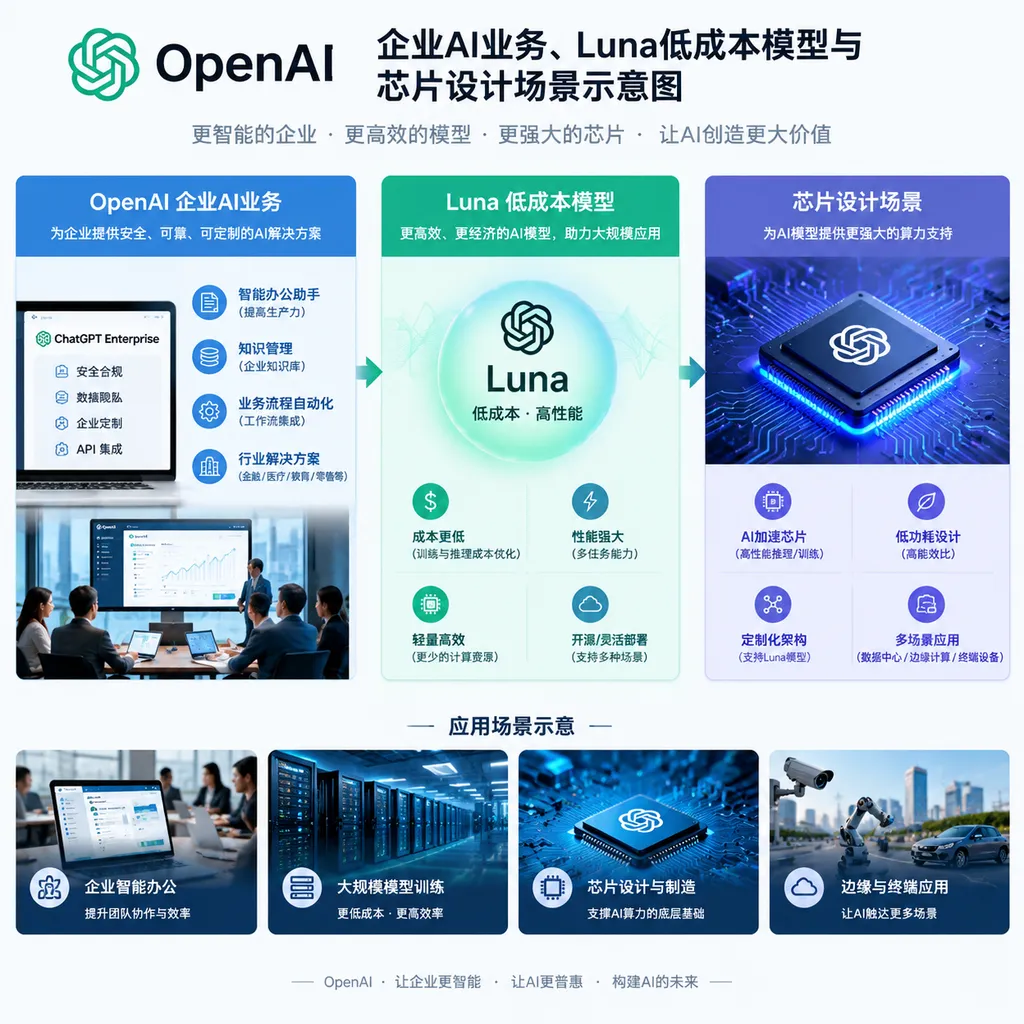
What Does an 80% Price Cut for Luna Mean?
Open-source models are often viewed as low-cost alternatives to cutting-edge closed-source models. Once enterprises obtain the model weights, they can deploy them on their own clouds, private clusters, or dedicated hardware, avoiding ongoing API fees paid to model providers. For data-sensitive customers in finance, manufacturing, and healthcare, local deployment also means stronger control over data.
But “free models” do not mean “free systems.” The actual costs enterprises must bear typically include the following:
- Inference hardware costs: GPUs, networking, storage, and data-center resources all require ongoing investment;
- Engineering and operations costs: Including model quantization, parallel inference, elastic scaling, incident handling, and version upgrades;
- Security and compliance costs: Enterprises must independently implement access controls, auditing, data masking, log retention, and risk assessments;
- Model adaptation costs: To bring a general-purpose model into real-world business operations, enterprises often still need retrieval-augmented generation, tool calling, fine-tuning, and workflow orchestration;
- Talent costs: Engineering teams capable of running open-weight models reliably in production are not inexpensive.
Therefore, when OpenAI’s CFO says that the deployment cost of its self-developed Luna model is lower than that of open-source solutions, she is not comparing the price of downloading models. She is comparing the total cost of achieving the same business objective. For companies without large-scale GPU resources that are unwilling to maintain a complete inference infrastructure, directly deploying an optimized low-cost closed-source model may indeed be cheaper than building and maintaining an open-source model in-house.
This also provides a reasonable explanation for the rapid growth in usage after Luna’s price reduction. An 80% price cut means that tasks previously blocked by cost become viable again, such as batch document extraction, customer-service quality inspections, code reviews, internal knowledge-base Q&A, and Agent workflows that are more sensitive to latency and cost.
However, this conclusion has clear prerequisites: the enterprise must be using standardized capabilities, its call volume must be sufficient to generate stable scale, and it must not require complete control over the model weights. For large companies that already have GPU clusters and mature model teams, or for government and financial customers that require highly customized and strictly offline operations, open-source solutions may still be more attractive.
In other words, OpenAI has not proven that closed-source models are cheaper than open-source models in every scenario. What it aims to prove is that when enterprises are building AI capabilities from scratch, Luna can package infrastructure, model tuning, and operations into a service, ultimately enabling customers to achieve results faster.
From “Selling Models” to “Selling Outcomes”
Another change mentioned by Friar is that OpenAI is exploring business-outcome-based pricing.
In the past, most enterprise AI services charged according to tokens, call volume, concurrency, or subscription seats. This approach is transparent and makes it easy for providers to calculate revenue, but it shifts the risk of model usage to customers: the more enterprises use the service, the higher their bills become. Whether the model actually saves labor or improves conversion rates is usually left for customers to assess themselves.
Outcome-oriented pricing attempts to change this relationship. For example, a customer-service Agent could charge based on the number of tickets resolved, a sales assistant could be tied to qualified leads or completed transactions, and a coding Agent could bill according to completed tasks, merged code, or developer hours saved.
This model is closer to software outsourcing and business-process services than to traditional API sales. Its advantage is that it can be more easily linked to business metrics in enterprise budgets, making it easier for customers to answer the question, “Is this AI investment worthwhile?” But the challenges are equally clear:
- Attribution is not simple. The eventual conversion of a sales lead may be influenced simultaneously by pricing, channels, the sales team, and market conditions, making it difficult to attribute the result entirely to the model.
- Providers take on greater operational risk. If model performance is unstable, OpenAI may need to incur higher infrastructure and human-service costs to deliver the same business outcomes.
- Contracts and data interfaces become more complex. Outcome-based pricing requires access to customers’ CRM, ERP, ticketing, and financial systems, which also raises issues involving data permissions, auditing, and the boundaries of responsibility.
- Business baselines differ across enterprises. The value generated by the same Agent may vary significantly from one customer to another, making standardized pricing difficult.
Regardless of whether this pricing model is ultimately adopted at scale, the exploration sends a clear signal: enterprises are no longer satisfied with purchasing “smarter models.” They expect AI projects to be accountable for revenue, costs, efficiency, and risk.
Which Specialized Industries Is OpenAI Betting On?
The chip design, life sciences, and financial services sectors mentioned by Friar were not selected at random. They share several characteristics: high knowledge density, complex processes, concentrated professional data, and sufficiently high commercial value per task.
Chip Design: AI First Becomes an Internal Customer
OpenAI is already using its self-developed models to assist with the development of the Jalapeno chip, completing tape-out within nine months. Here, “tape-out” is not simply a code submission. It means sending the final layout to a wafer foundry for actual production after the chip design has completed verification. It is a critical milestone in the transition from chip design to manufacturing.
AI can participate in code generation, hardware description language development, verification test-case construction, design-space exploration, document retrieval, and error analysis throughout the chip-design process. It cannot replace chip engineers’ final judgment regarding physical constraints, power consumption, timing, and yield, but it can reduce a substantial amount of repetitive search and verification work.
The value of OpenAI using its own chip project as a case study lies in demonstrating that its models are not suited only to generating text or software code; they can also enter highly specialized, long-cycle work such as hardware R&D. More importantly, the company itself is the first customer, allowing it to validate internally how much practical assistance the model can provide in complex engineering workflows.
Life Sciences: High Value, but with Longer Validation Cycles
The life sciences field contains vast amounts of research papers, experimental records, patents, and structured data, making it suitable for information retrieval, experimental-design assistance, analysis of relationships among publications, and candidate-molecule screening. But these tasks have far lower tolerance for error than ordinary office scenarios, and model outputs must be reviewed by experiments and professionals.
Therefore, in this field, OpenAI is more likely to begin with research assistants, knowledge management, and laboratory-process automation rather than directly promising that models can independently complete drug development. What enterprises purchase will not simply be a chat window, but a professional Agent system capable of connecting to internal data, permission structures, and laboratory tools.
Financial Services: Clear Value, but Stronger Regulatory Constraints
Financial institutions’ AI needs have expanded beyond customer-service Q&A to include the processing of investment-research materials, compliance reviews, risk monitoring, programmatic operations, and internal knowledge management. If a model can reduce manual review time or improve the efficiency of report generation, its commercial value is relatively clear.
However, the financial industry has stringent requirements for explainability, data isolation, and audit trails. A model that performs well in public testing may still struggle to enter core production workflows if it cannot produce stable outputs, preserve the basis for its decisions, or meet regulatory requirements. OpenAI therefore needs to provide not only more capable models, but also access management, logging, evaluation, monitoring, and clearly defined boundaries of responsibility.
Enterprise Business Growth Is Becoming OpenAI’s New Main Engine
Friar disclosed that OpenAI’s enterprise revenue grew 32% from June to July this year, while overall annualized revenue increased by 20% during the same period. By midyear, enterprise and consumer revenue each accounted for roughly half of the company’s total, reaching this milestone six months earlier than the company’s original year-end target.
Another figure worth noting is Codex. Friar said that OpenAI’s coding tool Codex now has 25 million users. Regardless of whether this figure refers to registered users, reachable users, or a broader definition of product users, it indicates that code generation and software-engineering Agents have become important entry points for OpenAI’s commercialization efforts.
Competition in the developer market is particularly direct. Anthropic’s Claude Code gained attention earlier in complex programming tasks, and OpenAI is attempting to catch up with Codex. For developers, what really matters is not whether a model scores a few additional points on a benchmark, but whether it can understand large codebases, call tools reliably, reduce rework, and keep bills within the team’s budget.
This also explains why low-cost models and coding tools appear together in OpenAI’s commercial narrative: the former is responsible for expanding call volume, while the latter captures high-frequency, high-retention productivity scenarios. Models themselves may increasingly resemble infrastructure. The real moat will lie in the combination of models, tools, data, and enterprise workflows.
Can OpenAI’s Price-Cutting Strategy Really Hold Back Open-Source Models?
In the short term, Luna’s 80% price cut will prompt enterprises to recalculate the boundary between building in-house and outsourcing, and may also pressure other closed-source model providers to continue lowering prices. For applications requiring large volumes of low-complexity inference, price changes will directly affect whether a product can be commercialized.
But price wars are not a weapon OpenAI can use indefinitely. The lower the cost of inference, the greater the call volume may become, which in turn increases the pressure of infrastructure investment and service-quality guarantees. If enterprise customers ultimately treat Luna merely as an inexpensive base model while retaining control of critical data, Agent orchestration, and business systems themselves, OpenAI may still become trapped in commoditized competition.
The outcome will ultimately depend on whether OpenAI can do all three of the following at the same time:
- Make Luna sufficiently stable for common enterprise tasks, rather than merely inexpensive;
- Make deployment and integration simple enough, transforming the engineering complexity of open-source models into an advantage for hosted services;
- Enable customers to quantify returns, demonstrating that the labor saved, delivery time shortened, or additional business revenue generated exceeds the model bill.
If OpenAI can only cut prices without providing industry-data integration, reliability guarantees, and measurable outcomes, enterprises will continue to choose open-weight models or purchase services from multiple model providers and route requests among them. Conversely, if OpenAI can establish complete solutions in specialized industries, Luna will no longer be merely a “cheap version of a model,” but will become the cost layer of enterprise AI infrastructure.
Assessment: OpenAI Needs to Shift from Model Leadership to Delivery Leadership
The core change revealed by these remarks is that OpenAI’s competitors are no longer limited to the GPT series of models. They now include the entire AI technology stacks being built inside enterprises.
Faced with open-source and open-weight models, OpenAI cannot rely forever on differences in model capabilities to sustain a premium. Enterprise customers will compare API prices, deployment timelines, data security, system stability, and ultimate business outcomes on the same scorecard. Luna’s 80% price cut is essentially an acknowledgment of this reality.
What OpenAI is increasingly selling is not a general-purpose model, but a delivery chain spanning models, Agents, development tools, and industry solutions. The chip-design case demonstrates that the company is validating this chain internally, while the rising share of enterprise revenue indicates that the market has begun paying for these capabilities.
For developers, the changes ahead may be more important than any single model release. Model selection will become further segmented: high-end models will handle complex reasoning, low-cost models will handle large-scale execution, industry models will handle specific processes, and Agents and toolchains will embed these capabilities into real-world businesses.
Whether OpenAI can hold back open-source models with Luna will ultimately depend not on the 80% price reduction itself, but on whether it can convince customers that worrying less about infrastructure and paying more for models will genuinely deliver faster deployment, lower total costs, and clearer business returns.
Sources
- IT Home: OpenAI CFO: Self-developed AI Assists Chip Design, Luna Model Deployment Costs Less Than Open-Source Solutions — The primary source for this article’s information on Luna’s price reduction, usage growth, industry expansion, the Jalapeno chip tape-out, and enterprise business data.
- Sina Finance: OpenAI’s Annualized Revenue Accelerates; CFO Says Internally: One Month in July Exceeded the Entire Second Quarter — Provides additional information on OpenAI’s enterprise growth, Codex’s user base, and the competitive landscape.