MiniCPM5-2B Is Open Source, Advancing On-Device Agents Once Again

<think>**Deciding translation for key terms** </think> On September 8, ModelBest and OpenBMB open-sourced MiniCPM5-2B. With a score of 23, this 2B-parameter model ranked first among open-source foundation models under 4B parameters worldwide on the AA leaderboard, and demonstrated an early form of an on-device general-purpose agent through its tool-calling, search, and coding capabilities.
<think>Planning comprehensive technical translation
</think>MiniCPM5-2B Open-Sourced: 2B Models Begin Challenging On-Device Agents
面壁智能 and OpenBMB officially open-sourced MiniCPM5-2B on September 8. With only 2 billion parameters, it scored 23 points in the latest evaluation by the Artificial Analysis Intelligence Index (hereinafter referred to as the AA ranking), making it the top open-source foundational model globally among models with fewer than 4B parameters.
The focus of this release is not merely a smaller language model. Rather, 面壁智能 is attempting to bring Agent capabilities to smartphones, PCs, vehicles, and other edge devices. MiniCPM5-2B natively supports tool calling, deep search, code generation, and complex task execution. The company describes it as a high-density language foundation model with the rudimentary capabilities of a general-purpose on-device Agent.
For developers, the most noteworthy aspect is that this open-source release goes beyond model weights. The team has also released its training Recipe, the Meshy reinforcement learning framework, the JustRL II algorithm, and the UltraData series of datasets. In other words, 面壁智能 is not merely releasing a downloadable model; it is also attempting to hand the community the questions of why this small model works and how it can be trained further.
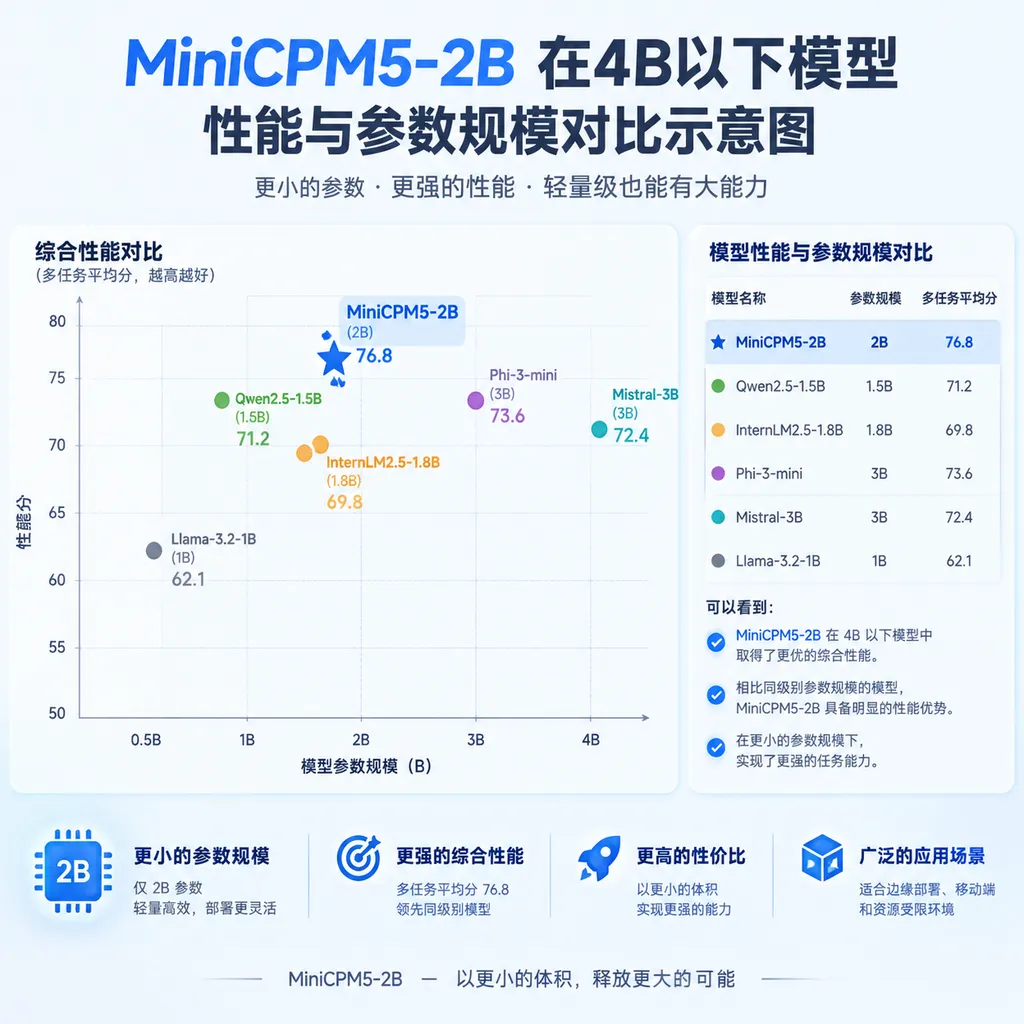
Why Can a 2B-Parameter Model Outperform 4B Models?
Judging from the ranking results, MiniCPM5-2B’s advantage does not come from any single benchmark.
According to official disclosures, across 34 benchmark evaluations covering code reasoning, mathematical reasoning, instruction following, general knowledge, long-context tasks, tool calling, and agent tasks, MiniCPM5-2B achieved an average score of 53.9 points, ranking first. By comparison, the second-place 2B model achieved an average score of 33.2 points, while the best-performing 4B model, Qwen3.5-4B, was also surpassed by it.
On the AA ranking’s composite metric, MiniCPM5-2B scored 23 points. Supplementary evaluation results show that it also outperformed larger models such as Qwen3.5 4B, Qwen3.5 9B, and Gemma 4 12B. However, it is important to consider the ranking’s evaluation scope, model versions, and testing methodology. A larger parameter count does not necessarily mean stronger performance on every task, and leading a single ranking should not be equated with comprehensively outperforming these models. More precisely, MiniCPM5-2B achieved an unusually high overall cost-performance ratio within a limited parameter budget.
This is also what 面壁智能 repeatedly emphasizes as “intelligence density”: rather than simply pursuing larger models, the goal is to make each parameter support as much useful capability as possible. For on-device deployment, this metric is more important than absolute capability. Cloud-based models can use more GPUs and larger context windows to offset efficiency issues, but smartphones, vehicles, and local PCs are typically constrained by memory, power consumption, heat dissipation, and inference latency. Every doubling of a model’s parameter count can lead to a significant increase in deployment costs.
MiniCPM5-2B follows a different path: within an acceptable model size, it uses more targeted Agent training, reinforcement learning, and data filtering to pack as much tool-use, task-planning, and long-chain reasoning capability as possible into a small model.
A Score of 20 on the Agentic Index: The Gap Is More Interesting Than the Overall Ranking
MiniCPM5-2B’s most compelling result for developers comes from the Agentic Index.
On this metric, which specifically measures agent capabilities, MiniCPM5-2B scored 20 points. The official comparison shows that models in the same class, including LFM2.5-2.6B, Granite 4.2 3B, and Mistral 3 3B, scored only around 2 points. Other supplementary evaluations also indicate that it maintains a lead in general-purpose agents, search agents, tool calling, and coding agents.
This gap means that the model is not merely better at answering questions; it is more likely to complete tasks composed of multiple actions. For example, a user might ask the model to first read a local meeting transcript, extract the key conclusions, call a search tool to verify an external fact, and then generate a structured report. Traditional small on-device models often fail at one of these stages: they may not know when to call a tool, may be unable to organize tool parameters correctly, or may fail to continue execution after receiving the tool’s results.
MiniCPM5-2B aims to give the model a more complete action chain:
- Understand the task: Identify the user’s actual objective rather than responding only to the final sentence.
- Break down the steps: Determine which information comes from the context and which requires searching or calling a local tool.
- Generate call parameters: Output executable, structured parameters according to the tool definition.
- Process feedback: Understand the tool’s returned results and revise the original plan when necessary.
- Deliver the result: Condense the intermediate process into an answer, code, or file that the user can use directly.
Of course, a score of 20 does not mean that on-device Agents can already replace mature cloud-based systems. Agent evaluations are often affected by the toolset, task length, error tolerance, and execution environment. In real smartphone systems, models must also contend with permission management, application compatibility, network fluctuations, and error recovery. Nevertheless, public results indicate that 2B models are no longer limited to classification, rewriting, and simple question answering. They are beginning to compete on whether they can independently complete an entire task.
A Score of 891 on Real-World Tasks—but Do Not Treat It as Equivalent to Human Performance
MiniCPM5-2B scored 891 points on the GDPval-AA v2 real-world work-task evaluation. The evaluation uses a human baseline of 1,000 points as its benchmark, and the official announcement described this as the highest score among models below 4B parameters.
This result could easily be interpreted as meaning that a “2B model is approaching human-level performance,” but a more cautious interpretation is that, within the set of tasks covered by the evaluation, its outputs were highly similar to those produced by humans and had already surpassed the practical threshold of many models of comparable size.
For on-device scenarios, this threshold is more valuable than a chatbot’s knowledge-based question-answering ability. If a local model can reliably organize meeting notes, draft emails, generate code snippets, extract information from tables, and search within applications, it can become part of a system-level assistant. It does not need to outperform a cloud-based flagship model on every open-domain question. As long as it is sufficiently reliable on frequent, well-defined, privacy-sensitive local tasks, there is a solid rationale for on-device deployment.
The 面壁 team has also previously announced progress on MiniCPM5-2B’s long-context capabilities and chip compatibility, including support for multiple types of CPUs, smartphone chips, and AI acceleration platforms. Public materials have mentioned support for a 512K context window, as well as Day 0 compatibility for multiple chip platforms. These capabilities are attractive for code repository analysis, processing lengthy meeting materials, and querying local knowledge bases. However, a long context window does not mean that a model can always use the entire context accurately. The actual experience still depends on the quantization scheme, KV cache usage, memory capacity, and optimization of the inference framework.
The Open-Source Scope Goes Beyond “Open Weights”
Another notable aspect of the MiniCPM5-2B release is the relative completeness of its open-source materials.
The team has released the model weights, the UltraData series of datasets, portions of its training recipes, as well as the Meshy framework and JustRL II strategy for reinforcement learning. This is important for both the research and engineering communities. Many models described as open source in fact provide only weights and an inference interface. Developers can deploy them, but it is difficult to understand how the models acquired their capabilities, let alone reproduce the experimental results.
Meshy is closer to a training infrastructure for reinforcement learning with large language models, while JustRL II improves reward assignment for long-chain reasoning in small models. The ideas disclosed by the team include three-stage training-data filtering and calibration, as well as introducing a Critic into GRPO-style methods to perform more fine-grained token-level credit assignment.
This addresses a very practical problem: for a reasoning chain containing thousands or even tens of thousands of tokens, a correct final answer does not mean that every intermediate step was correct; likewise, an incorrect final answer makes it difficult to determine exactly where the reasoning began to deviate. If the entire trajectory is treated as a single unit for reward assignment, the reinforcement learning signal becomes too coarse, and the model may learn exploitative patterns. Token-level or step-level credit assignment is more like marking the specific points where a student lost marks on a lengthy exam, rather than assigning only an overall score to the entire paper.
These training methods are also meaningful for large models, but they are especially critical for models in the 2B class. Small models have limited capacity, making them more susceptible to being led astray by noise in the data and reward signals. Whether higher-quality data and more precise reinforcement learning can be used to direct limited parameters toward genuinely useful behavior may ultimately matter more than continuing to add parameters.
The Value of On-Device Agents Is Not Limited to Lower Inference Costs
On-device deployment is often simply summarized as “cheaper and faster,” but its real value also includes data boundaries and system permissions.
With user authorization, a local Agent can directly process screen content, files, calendars, contacts, and application states without uploading all raw data to the cloud. For sensitive information such as corporate documents, personal bills, medical records, and in-vehicle voice data, this is an experience that cloud-based Agents cannot easily replicate in full. On-device models can also continue working when the network is unstable or completely unavailable, while response latency is easier to control.
However, on-device Agents have clear limitations as well:
- Limited model capacity: A 2B model may still underperform larger cloud-based models on complex knowledge-based question answering, open-domain reasoning, and multi-turn planning.
- Significant device variation: The same model may have entirely different speeds and memory footprints on a flagship smartphone, an ordinary laptop, and an automotive chip.
- Tool calling requires system support: A model’s ability to generate function parameters does not mean that the operating system can execute them safely. Permissions, sandboxing, and rollback mechanisms are essential.
- Higher cost of errors: An incorrect answer in a cloud chatbot is usually just an experience issue, whereas an on-device Agent that accidentally deletes a file or sends a message incorrectly creates a system security problem.
Therefore, a more realistic product architecture is not for “the on-device model to replace the cloud model,” but for the two to work together. An on-device MiniCPM5-2B can handle wake-word detection, intent recognition, privacy-sensitive data preprocessing, simple tool calls, and frequent tasks. When complex reasoning, large-scale knowledge retrieval, or high-risk operations are required, sanitized and authorized data can then be passed to a cloud-based model.
This is also the role for which MiniCPM5-2B is best suited: it is not trying to challenge flagship models on every ranking, but to serve as a low-latency execution layer within the system, bringing Agents out of browsers and cloud servers and onto real devices.
What Should Developers Pay Attention to Now?
For developers preparing to experiment with on-device Agents, MiniCPM5-2B’s open-source release provides at least three verifiable paths.
The first is to deploy the model directly and test its stability in local document question answering, code completion, structured information extraction, and tool calling. Do not run a conversational demo only once. Instead, build a test set that includes incorrect parameters, tool failures, overly long contexts, and multi-turn corrections.
The second is to study the officially released training recipes and data. For many teams, what they truly lack is not model weights, but knowledge of how to construct Agent trajectories, filter effective data, and design reward functions. By making some of these materials public, MiniCPM5-2B may reduce the cost of trial and error in post-training small models.
The third is to evaluate how tasks should be divided between on-device and cloud-based processing. A usable solution typically needs to consider model quantization, inference frameworks, context caching, tool permissions, and task routing simultaneously, rather than simply downloading the model files onto a device. Model rankings demonstrate the upper limit of capability; product engineering determines whether the model can continue working reliably on real devices.
At present, MiniCPM5-2B is more like a demonstration of a technical boundary than proof that general-purpose on-device Agents have matured. Its results are impressive, especially given that it achieves relatively complete tool-use and agent capabilities at the 2B parameter scale. However, much will still depend on community reproduction, actual throughput on different chips, long-term runtime stability, and the model’s safety performance within real-world application permission systems.
Regardless, this open-source release on September 8 sent a clear signal: competition among on-device models has moved beyond “who can compress the parameter count further” and entered the stage of “who can preserve a complete task loop within a smaller parameter budget.” If MiniCPM5-2B’s evaluation results hold up in real-world deployment, a 2B model will no longer be merely a lightweight substitute for a large cloud-based model. It could become a foundational component of the next generation of local Agents.
Related Open-Source Links
- MiniCPM series Hugging Face model collection: Provides MiniCPM5-2B and other models, along with related open-source resources.
- OpenBMB/MiniCPM GitHub repository: Provides model code, usage instructions, and community maintenance information.
- OpenBMB/Meshy GitHub repository: An open-source framework for reinforcement learning training with large language models.
- ITHome report: Introduces MiniCPM5-2B’s open-source release, ranking results, and supporting resources.