<think>**Translating model approval headline** </think> The 100-billion-parameter weather model “Fenghe” has been approved for access.
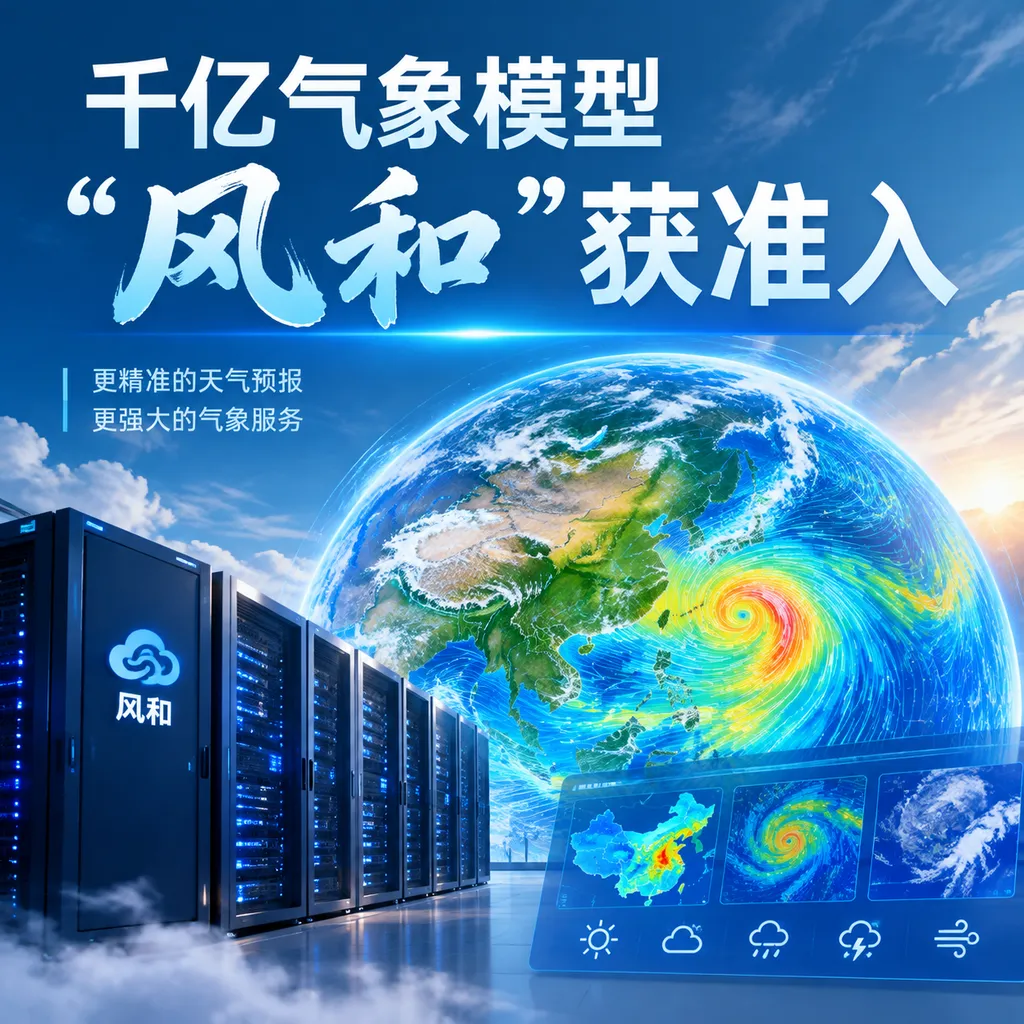
The China Meteorological Administration announced that “Fenghe” V1.0, a meteorological service domain-specific model with hundreds of billions of parameters, has passed expert review and been approved for operational use. It supports requirement understanding, meteorological reasoning, content generation, and tool calling.
<think>Planning markdown-preserving translation
</think>“Fenghe” V1.0 Passes Operational Access Review
On September 9, the China Meteorological Administration announced that “Fenghe” V1.0, a generative AI meteorological service system, had passed expert review and achieved operational access.
This means that “Fenghe” is no longer merely a model project used to demonstrate meteorological question-answering capabilities. It has formally entered the meteorological service system and begun providing foundational model support for public services, industry applications, and warning scenarios. Officials describe it as the world’s first meteorological service domain-specific model with hundreds of billions of parameters.
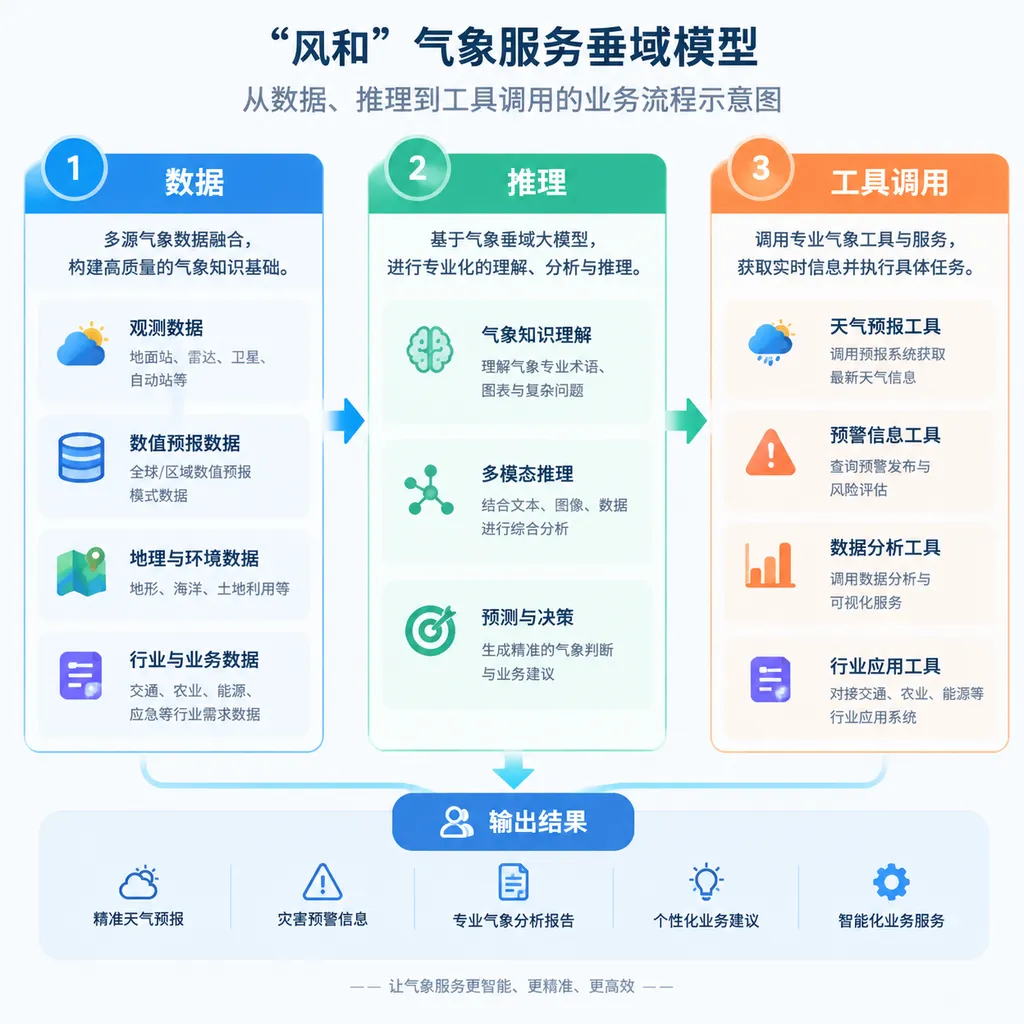
“Fenghe” V1.0 currently has four core capabilities: understanding meteorological service requirements, generating meteorological service content, meteorological reasoning and decision-making, and meteorological tool calling. Compared with simply connecting a general-purpose large model to weather data and having it answer questions directly, this system is closer to an intelligent middleware layer for meteorological operations: it must understand what users are asking, determine what meteorological professionals need, call the appropriate data sources and tools to complete analysis, and finally generate content that can be used for service delivery or decision support.
For Operational Access, the Key Is Not “Hundreds of Billions” but Usability
“Hundreds of billions of parameters” is the most easily circulated label associated with this announcement, but for a meteorological model, operational access is more significant than parameter scale.
The more parameters a large model has, the stronger its knowledge representation and complex-task modeling capabilities generally are. However, parameter size alone cannot solve several core problems in weather forecasting: whether the data is authoritative, whether it is sufficiently timely, whether the reasoning conforms to physical laws, whether conclusions are traceable, and whether the system can reliably serve large numbers of users.
The results of this review indicate that “Fenghe” outperforms general-purpose models in areas including service requirement understanding, service content generation, and meteorological reasoning and decision-making. At the same time, the model has completed filing with the Cyberspace Administration of China and stable trial operations, meeting the requirements for operational access.
Here, “access” can be understood as a threshold for meteorological AI to move from the laboratory into production systems. It indicates at least three things:
- The model’s capabilities have undergone specialized evaluation for meteorological services. The focus was not general knowledge question-answering, but whether the model could accurately understand meteorological service requirements and generate results that meet operational standards.
- The system has a certain compliance and operational foundation. Filing and stable trial operations indicate that the model’s application is no longer entirely at the stage of technical validation.
- The model can be embedded into existing meteorological operations. It is positioned as a foundational model for nationwide meteorological services, rather than as an independent chatbot.
In other words, the most important progress represented by “Fenghe” this time is not the release of yet another larger model, but the completion of the transition from “model release” to “operational integration.” For domain-specific models, the latter is usually more difficult and more decisive in determining whether a project ultimately delivers practical value.
Why Meteorological Scenarios Need a Domain-Specific Model
General-purpose large models excel at language, but weather services are not purely language tasks.
When a user asks, “Is tomorrow suitable for travel?” the question may involve precipitation probability, thunderstorms and high winds, high temperatures, visibility, road conditions, and travel-time windows. When a government department asks, “Do we need to escalate our response in the next few hours?” the answer may require combining multisource observations, numerical forecasts, disaster-risk thresholds, and historical cases. Although both questions appear to be natural-language queries, the time scales, spatial dimensions, and operational rules on which they depend are entirely different.
If a general-purpose large model is allowed to answer solely based on its training data, it may produce conclusions that are fluent but insufficiently timely. In scenarios involving severe convection, typhoons, rainstorms, flash floods, and geological disasters, changes in data over even a few hours—or several dozen minutes—can alter the final judgment. A large model cannot treat “remembered knowledge” as real-time weather, nor can language generation replace observation data and forecasting systems.
The domain-specific approach taken by “Fenghe” is primarily reflected in three areas.
1. Using Earth System Data as the Foundation
According to information previously released by the China Meteorological Administration, “Fenghe” was trained on an Earth system data resource base and integrates authoritative meteorological data. In theory, this means that the model’s knowledge sources and data interfaces are more closely aligned with meteorological operations themselves, rather than relying on generalized information from Internet text.
Meteorological data has clear temporal and spatial attributes: temperatures, wind speeds, precipitation, and risk levels at the same location may all change over time; the impact of the same weather system also varies across different regions. A domain-specific model must learn to process this kind of “knowledge with coordinates and timestamps,” rather than merely learning static descriptions in natural language.
2. Specialized Training for Meteorological Services
“Fenghe” previously disclosed that it had been trained on 50 million tokens of high-quality meteorological service data. Compared with Internet-scale general-purpose corpora, this is not a particularly large volume. However, the value of a domain-specific model does not depend entirely on the total amount of training data; it depends more on whether the data has been screened, annotated, and validated against operational requirements.
Key components of meteorological service data may include warning information, weather analysis, risk assessment, service language tailored to different audiences, and the decision-making processes used by meteorological personnel in actual work. The real challenge for the model is to learn the chain connecting “meteorological phenomenon” to “risk impact” and then to “service recommendation.”
3. Supporting Meteorological Tool Calling
Tool calling is one of the key capabilities enabling “Fenghe” to move toward operational use.
A mature meteorological intelligence system should not rely solely on the model’s internal parameters to provide answers. Instead, it should call real-time observations, forecast products, risk maps, historical data, or professional analysis tools when necessary. The model determines what information the current question requires, the tools provide verifiable data, and the system then organizes the results into service content that users can understand.
This approach is similar to retrieval-augmented generation, but the tools used in meteorological scenarios are not limited to document retrieval. They may include time-series queries, spatial-range analysis, threshold assessment, disaster-risk calculations, and warning-rule matching. The model’s value lies in converting natural-language requirements into tasks that these tools can execute and then explaining the results returned by the tools.
From “Asking About the Weather” to “Risk Analysis”
According to the official introduction, “Fenghe” can provide the public with personalized and intelligent meteorological information queries, meteorological service recommendations, and meteorological risk warnings.
These capabilities may appear similar to those of an ordinary weather app, but there are significant differences. Traditional weather apps primarily display fixed fields such as temperature, precipitation, wind strength, and air quality. Model-based services can go further by answering the question, “What do these data mean for me?”
For example, users may not simply want to know whether “it will rain today.” They may want to know:
- Which period, the morning or evening rush hour, is more suitable for commuting;
- Whether outdoor construction or logistics arrangements should be adjusted;
- Whether current rainfall could affect low-lying roads;
- How high temperatures, strong winds, or lightning might affect agriculture, tourism, and outdoor work;
- Whether a particular event requires a contingency plan.
In these situations, the model cannot assume responsibility for decisions on behalf of users, but it can organize scattered meteorological information into recommendations that are more closely tied to practical action. Its role is not to replace forecasters, but to reduce the cost of information interpretation and service orchestration.
For meteorological authorities, another benefit is the large-scale generation of service content. The same weather system may require different explanations for the public, transportation, power, agriculture, emergency management, and local governments. In the past, this work depended heavily on manual compilation. If the model can call the correct data and generate content according to operational templates, it may help deliver professional capabilities to different channels more quickly.
The International Version and the “Mazu” Solution Are Already Online
“Fenghe” is not intended solely for domestic services. Officials say that its international version is already online and has been integrated into China’s “Mazu” intelligent meteorological warning solution, providing users worldwide with bilingual Chinese-English intelligent question-answering, weather queries, and risk analysis services.
This information is noteworthy because meteorological warnings have an inherently international public-service dimension. Many disasters cross administrative boundaries, and typhoons, rainstorms, heat waves, and droughts are not confined to a single country. The China Meteorological Administration says that “Fenghe” has also been deeply integrated into the United Nations Early Warnings for All initiative. This indicates that the model’s goal is not merely to improve the interactive experience of domestic weather apps, but also to communicate warning information to more regions and groups of people with lower barriers to access.
Of course, internationalizing the service involves more than translating Chinese into English. The geographical environments, warning standards, disaster classifications, unit systems, and public administration procedures of different countries vary. Chinese-English question-answering can address information presentation, but genuine adaptation for global users will also require solving issues involving data coverage, risk definitions, and localized rules. The information currently disclosed by officials mainly demonstrates that the international version has the foundation for deployment. Its coverage, call volume, and actual effectiveness remain to be verified by subsequent data.
Open Source Does Not Mean It Can Directly Replace Professional Systems
The “Fenghe” large language model was officially released in July this year, alongside the launch of a global open-source initiative. Open source is attractive to researchers and developers to some extent: the meteorological field has long lacked a large-parameter domain-specific model with broad public influence, and opening model weights, data-processing methods, or evaluation systems could help promote secondary development in weather analysis, risk assessment, and meteorological service applications.
However, developers need to distinguish between several concepts:
- An open-source model does not mean that all meteorological data is open. Real-time observations, high-resolution forecasts, and professional products often involve licensing, interface permissions, or boundaries imposed by operational systems.
- A model’s support for tool calling does not mean that a complete tool ecosystem already exists. A truly deployable system still needs to integrate data services, access management, call orchestration, logging and auditing, and fault-degradation mechanisms.
- A model passing operational access review does not mean that all high-risk scenarios can be automated. Disaster warnings and emergency decisions still require review by professionals and a clearly defined chain of responsibility.
- The superiority of a domain-specific model over a general-purpose model is scenario-dependent, not universal. Being stronger at meteorological service tasks does not mean that it is also stronger at coding, general reasoning, or other knowledge domains.
For teams hoping to integrate “Fenghe,” a more practical approach is not to initially treat it as an all-purpose chat model, but to evaluate it around specific tasks: Is user-question identification accurate? Are real-time data references correct? Are tool parameters reliable? Does the output include the relevant time and spatial range? Does the risk-related wording comply with standards? And can the system clearly refuse to answer when data is missing?
The Practical Significance of This Update
From an industry perspective, “Fenghe” V1.0 passing operational access review sends a clear signal: competition among meteorological large models is shifting away from parameter scale and demonstration effects toward closed-loop data, tool connectivity, and responsibility in production environments.
A general-purpose large model can quickly generate a seemingly reasonable weather explanation. However, meteorological operations require the system to know which data source an answer comes from, which time window it corresponds to, which region it applies to, and whether human confirmation is required. Only when a model can be reliably embedded in these processes has it truly entered the industry.
“Fenghe” has the advantages of a parameter scale in the hundreds of billions, domain-specific meteorological training, authoritative data integration, and a focus on tool calling. It has also passed expert review and completed filing. Its limitations are equally clear: publicly available information still focuses primarily on capability descriptions and the operational access result. Specific evaluation sets, accuracy, latency, tool-calling success rates, the scope of open sourcing, and the actual scale of business use have not yet been fully disclosed.
Therefore, this announcement deserves recognition, but it should not be simply interpreted to mean that “large models have solved meteorological problems.” A more accurate assessment is that a foundational model designed for meteorological services has taken an important step from release to operational access. What will truly determine its influence in the industry is its stability during extreme weather, its effectiveness across regions, and whether it can be continuously used by meteorological systems at different administrative levels.
For developers, the most important question is not how many parameters “Fenghe” has, but whether it can genuinely connect real-time meteorological data, professional tools, and natural-language services. If this chain can be made to work, a meteorological domain-specific model may evolve from a model project into reusable industry infrastructure.
References
- IT Home: The World’s First Meteorological Service Domain-Specific Model with Hundreds of Billions of Parameters, “Fenghe” V1.0, Achieves Operational Access — Introduces the China Meteorological Administration’s operational access announcement, the model’s capabilities, its filing status, and progress in international-version applications.