
Claude Opus 4.7 fully launched—Anthropic raises the bar once again.
Anthropic releases its flagship model **Claude Opus 4.7**, featuring significant improvements in programming autonomy, image recognition, and logical reasoning. The update also includes enhancements to the **Claude Code** desktop app and **Routines** automation capabilities, accelerating the transition from a model-based tool to a task execution platform.
Anthropic has no intention of letting its competitors catch their breath.
Late at night on April 15, Claude Opus 4.7 quietly went online. API aggregation platforms followed almost immediately, and by midnight, the developer community was in an uproar. Someone ran $70 worth of tokens overnight for real-world testing and concluded that it’s “roughly 20% stronger than 4.6, truly unbeatable.” Of course, others were tormented by repeated 429 and 503 errors, retrying ninety times before they could barely get access.
That’s Anthropic’s pace — releases come fast, production capacity can’t keep up, but the model itself is undeniably advancing.
Core Upgrades: Not Chasing Scores, Fixing Weak Spots
The improvements in Opus 4.7 have a clear focus—not just adding points on benchmarks, but targeting the most painful issues in developers’ daily workflows.
The first is logical reasoning and bug detection. Community testers widely report that “Opus 4.7 is noticeably stronger than 4.6” in identifying complex bugs. This isn’t hype—the model’s self-verification ability in long-chain tasks has substantially improved. Using 4.6 for complex refactoring often meant errors were only exposed at the end; 4.7 actively back-checks during the process, effectively acting as a built-in junior code reviewer.
The second is image recognition. Opus 4.7 supports image processing with up to 2,576 pixels on its long edge—over three times its predecessor’s resolution. That means it can directly interpret complex engineering blueprints, dense UI screenshots, and even hand-drawn architecture sketches. Developers used to throwing screenshots at the AI saying “can you see what this error means?” will notice a qualitative difference.
The third is instruction comprehension and long-task stability. Simply put: when you give it a multi-step complex instruction, it no longer easily veers off track or forgets what step 3 said when it reaches step 15.
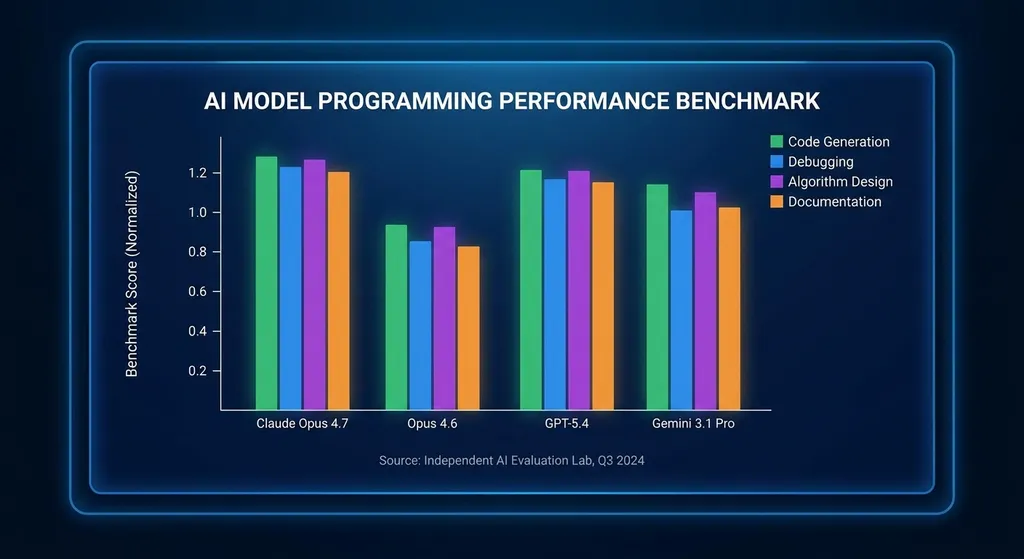
According to Anthropic’s official data, Opus 4.7 has outperformed Opus 4.6, GPT-5.4, and Gemini 3.1 Pro in multiple tests, though it still ranks below the preview-stage Mythos Preview. This result shows two things: the ceiling for public models has been raised again; and Anthropic is keeping something even stronger under wraps.
New Tokenizer: Smarter, but Pricier
Opus 4.7 comes with a new tokenizer—a detail easy to overlook but with major implications for usage cost.
The new tokenizer offers more rational text segmentation and fuller comprehension; in high-compute modes, its “thinking” is more thorough. The tradeoff: identical input content may yield a different token count.
Community math already exists—“spent about $70, feels better than 4.6, just more expensive.” If your workflow is sensitive to token usage, monitor your actual consumption carefully. More attentive models are great, but budgets and throughput need rebalancing.
For developers calling via API, this change matters: identical prompts may cost notably more to run on 4.7 than on 4.6. The good news: if you use an aggregation platform like OpenAI Hub, switching models only requires changing one parameter, making A/B testing between 4.6 and 4.7 easy to find your optimal efficiency-to-cost ratio.
Making Calls: One Parameter Change
Opus 4.7 is already online across major platforms. If you use OpenAI Hub, the interface is fully compatible with the OpenAI format; switching models simply means updating the model parameter:
import openai

client = openai.OpenAI(
    api_key="your OpenAI Hub API Key",
    base_url="https://api.openai-hub.net/v1"
)

response = client.chat.completions.create(
    model="claude-opus-4-7-20260415",
    messages=[
        {"role": "system", "content": "You are a senior software engineer."},
        {"role": "user", "content": "Please review the following code for potential bugs and suggest fixes."}
    ],
    max_tokens=4096
)

print(response.choices[0].message.content)
To test its image recognition abilities, you can directly pass an image:
response = client.chat.completions.create(
    model="claude-opus-4-7-20260415",
    messages=[
        {
            "role": "user",
            "content": [
                {"type": "text", "text": "What does the error message in this screenshot mean? How should I fix it?"},
                {
                    "type": "image_url",
                    "image_url": {
                        "url": "data:image/png;base64,{your image base64 encoding}"
                    }
                }
            ]
        }
    ],
    max_tokens=4096
)
It works with direct domestic connections—no need to fiddle with network configurations. One key gives you access to Claude, GPT, Gemini, DeepSeek, and other mainstream models. For developers who want to try Opus 4.7 immediately without dealing with foreign payments or network setups, this may be the easiest path.
Major Claude Code Overhaul: From Tool to Workbench
The model upgrade is only half of this update—the other half is just as important: Claude Code’s desktop client has been nearly rebuilt.
This time, Anthropic added three major features to Claude Code:
Routines: Let Claude Work for You in the Background
Routines are an automation workflow system supporting three triggers:
- Scheduled: hourly, daily, weekly, workdays, or custom via cron
- GitHub: automatically run on PRs, pushes, issues, workflow runs
- API: triggered externally via API calls
A typical use case: run a nightly log summary to label and assign new issues, delivering a tidy digest for the team in the morning. Humans can do this too—but it’s tedious and easy to forget.
Crucially, Routines run on Anthropic’s cloud infrastructure, independent of your computer’s online state. Close your laptop and tasks keep running.
Currently, Pro users get up to 5 runs per day, Max users 15, Team and Enterprise users 25.
Desktop Multi-Session Parallelism
The new Claude Code supports multiple sessions in one window, managed via a sidebar with drag-and-drop splits—no more juggling piles of terminal windows.
It also includes a terminal, file editor, HTML/PDF preview, and a faster diff viewer. Operations that previously required switching between Claude Code, an editor, and a browser are now all handled in one interface.
/ultrareview Command
The new /ultrareview command does far more than glancing through a diff—it tries to mimic what a diligent reviewer would do: detect logic flaws, check edge cases, and spot performance issues. Combined with Opus 4.7’s stronger reasoning, this feature should be significantly more useful than on 4.6.
Anthony Morris, the Claude Code desktop lead, says he hasn’t touched a traditional IDE in weeks. There’s marketing spin, of course, but the direction is clear: Anthropic is turning Claude Code from “a chatty terminal AI” into a full-fledged task execution platform.
Verification Controversy: Anthropic Wants ID Checks
Alongside Opus 4.7 comes less pleasant news—Anthropic is introducing identity verification for some usage scenarios.
Officially, this applies when accessing specific capabilities, during integrity audits, or to satisfy security and compliance requirements. However, many suspect it’s a form of “real-name policy” targeting certain regions. Users have already reported being prompted for ID verification when attempting to subscribe to Max membership.
This poses a practical issue for developers in China: the threshold for using official services just rose again—foreign credit cards, network conditions, and now identity checks. In contrast, calling via API aggregation platforms seems increasingly stable.
Cost Pressure: Anthropic Is Counting Too
The stronger the capability, the higher the cost—and Anthropic hasn’t solved that contradiction.
Recently, Anthropic revised its enterprise pricing: from per-seat fees to “$20 per user monthly + usage-based billing.” For teams using Claude Code heavily, costs may multiply two to threefold.
Uber’s CTO revealed that by early 2026, Uber had already exhausted its annual AI budget, mainly due to surging Claude Code usage. Anthropic itself lowered its profit margin forecasts—model inference expenses are growing faster than revenues.
This explains both why Opus 4.7 tokens are pricier and why Routines have daily usage caps. Anthropic walks a tightrope between capability and cost, and that balance keeps shifting.
The Competitive Landscape: Triple Showdown Benefiting Developers
Looking at Opus 4.7 in the market context, the current scene is a three-way fight among Anthropic, OpenAI, and Google for high-end models.
Opus 4.7 surpasses GPT-5.4 and Gemini 3.1 Pro, but not overwhelmingly. The real differentiator lies in Anthropic’s investment in developer tooling—Claude Code’s Routines, new desktop experience, and /ultrareview collectively create an ecosystem more sticky than model capability alone.
OpenAI has its vast Codex/GPT user base, Google integrates Gemini with its cloud arsenal, while Anthropic’s differentiation strategy is to deeply bind model capability to developer workflows—turning Claude from a simple conversational assistant into a system that continuously works for you in the background.
Whether that’s the right path, the market will decide. For now, though, developers are the biggest winners—competition drives model improvement, and a price war is only a matter of time.
Should You Switch to Opus 4.7 Now?
A few practical tips:
If your key use cases involve complex code refactoring, large-scale bug auditing, or interpreting screenshots in context, Opus 4.7’s improvements are real and worth switching to.
If you mostly rely on simple code completions, documentation generation, or everyday Q&A, 4.6—even Sonnet—will do just fine; paying extra for a 20% boost isn’t necessary.
If you’re cost-sensitive, test small first—compare token usage and output quality between 4.6 and 4.7 under identical tasks before deciding to fully switch.
Anthropic has mentioned that future Opus updates may come roughly every two months. So 4.7 isn’t the endpoint—but it is one of the strongest publicly available options yet.
References:
- Linux.do - Opus 4.7 Field Test Discussion — Community developers’ feedback on real-world Opus 4.7 performance and comparisons
- Linux.do - Platform Launch Discussions — Timing and stability of Opus 4.7 launch across API aggregation platforms
- Linux.do - Public API Channel Launch of claude-opus-4-7 — Status of community-operated API channels


