<think>**Translating headline text** </think> Wanxun Releases NOVA 2.0 Embodied Brain

Wanxun Technology today announced the release of NOVA2.0, its second-generation flexible embodied brain, with more than 1 billion parameters, support for 20 ms trajectory generation, and compatibility with a variety of robotic platforms, including flexible single-arm and dual-arm robots, dexterous hands, and bionic humanoids.
<think>Planning accurate markdown-preserving translation
</think>Wanxun Launches NOVA 2.0: 1B+ Parameters, 20 ms Trajectory Generation
Wanxun Technology today announced the launch of NOVA 2.0, its second-generation flexible embodied brain. According to the company, it is an embodied intelligence architecture designed for open-world environments, all-weather operation, and commercial deployment. Its core selling point is not simply increasing the model’s parameter count, but enabling the same “robot control hub” to adapt to more types of flexible embodiments and generate motion trajectories faster in real-world environments.
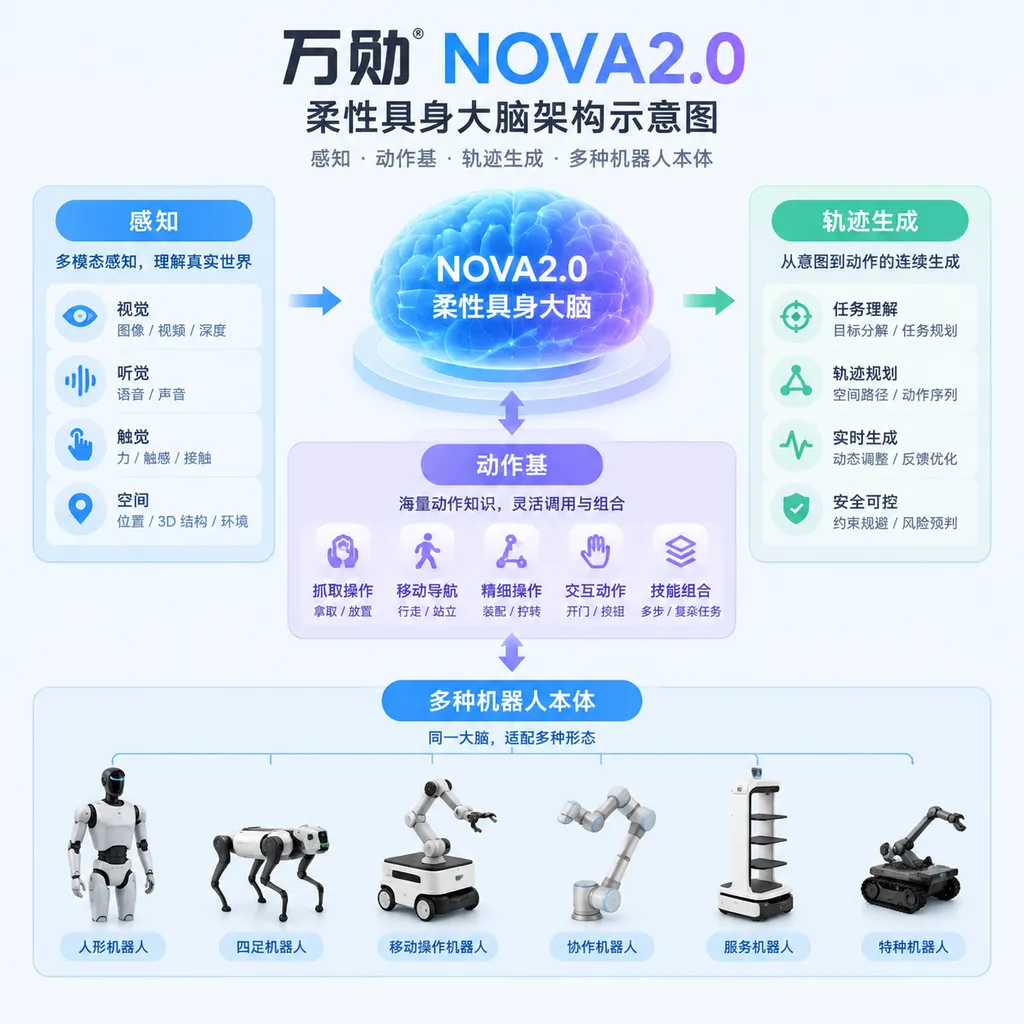
Publicly disclosed specifications for NOVA 2.0 include more than 1 billion parameters, trajectory generation in as little as 20 ms, and support for multiple robot configurations, including muscle-like joints, flexible single arms, flexible dual arms, flexible dexterous hands, and humanoid robots. Wanxun also says the architecture has already been deployed in more than 40 real-world scenarios across sectors such as real estate and construction, electric power and energy, transportation, autonomous driving, and industrial manufacturing. It has reportedly completed more than 10 million operations under multidimensional extreme working conditions.
However, in embodied intelligence, “parameter count,” “inference speed,” and “real-world deployment” need to be considered separately. More than 1 billion parameters does not mean it has the same breadth of knowledge as a general-purpose foundation model; nor does 20 ms mean the robot’s total end-to-end latency from perception to execution is only 20 ms. What makes NOVA 2.0 truly noteworthy is Wanxun’s attempt to integrate model capabilities, flexible robotic hardware, and low-level motion control into a system that can transfer across embodiments.
An Embodied Brain Must Do More Than “Understand” and “Respond Correctly”
Over the past two years, discussion of embodied intelligence has largely centered on VLA, or vision-language-action models. A robot receives a natural-language instruction, uses cameras to understand its environment, and then outputs a sequence of actions. This approach is well suited to tasks such as “pick up the cup on the table.” But once robots enter unstructured environments such as construction sites, power facilities, and transportation infrastructure, the question quickly shifts from “Can it understand?” to “Can it execute actions continuously, reliably, and with low latency?”
When a robot cleans exterior walls, maintains power facilities, or performs energy replenishment operations outdoors, the environment does not change according to a dataset script. Wind can alter the robotic arm’s posture, wall curvature can introduce contact errors, obstacles may suddenly appear, and flexible mechanisms can deform. It is not enough for a high-level model to provide only a rough intent. The system must also continuously correct its trajectory based on tactile feedback, proprioceptive state, and environmental changes.
Wanxun’s solution is a hierarchical architecture for a tactile-native, multimodal, flexible embodied brain designed around the concept of “muscle intelligence.” Put simply, it does not hand every decision over to one massive end-to-end model. Instead, it separates the system into layers resembling different levels of the human nervous system: the high level handles task understanding and strategy, the middle level handles action organization and adaptation to the environment, and the low level generates executable trajectories based on real-time tactile feedback and proprioceptive state.
The difference from traditional robot control systems is that the low level is no longer limited to fixed rules or preprogrammed kinematic routines. It must rapidly assess the current state from continuous tactile, pose, joint, and environmental signals, then dynamically adjust the trajectory during execution. This is also what the company calls a “subconscious multimodal motion primitive”: rather than invoking high-level reasoning again for every minor correction, the robot uses a foundational capability closer to action execution to perform local control quickly.
The Primary Value of 20 ms Is Making Actions More Like “Reflexes”
Trajectory generation in 20 ms is another key metric for NOVA 2.0. For developers, the significance of this number is not simply that it looks faster on a marketing page, but that it could change how robots respond to sudden changes.
Suppose a flexible robotic arm is inspecting a wall while maintaining surface contact, and it suddenly encounters a protrusion. If the system updates its path only once every few hundred milliseconds, the robot may already have collided with it. If trajectories can be generated quickly enough, the controller can rapidly adjust direction, speed, and pressure after detecting the change in contact, allowing the robot to continue operating without interruption.
Similarly, in environments shared by humans and robots, rapid trajectory updates can help reduce movement lag. This alone may not solve safety issues, but it can shorten the window between detecting an anomaly and correcting the motion. This is especially important for flexible robots: although flexible structures are safer and better able to adapt to complex surfaces, they also involve more complicated deformation and dynamic states and cannot rely entirely on the fixed trajectories used in the era of rigid robotic arms.
Of course, 20 ms most likely refers to trajectory generation or local motion updates under specific conditions, rather than the total latency of visual acquisition, data transmission, model inference, control command delivery, and mechanical execution. Actual system performance also depends on sensor frequency, controller architecture, edge-computing hardware, communication links, and the robot itself. Wanxun’s currently available public information does not disclose the full test conditions, input and output definitions, latency distribution, or comparative data across different embodiments. As a result, this metric cannot yet be directly compared with other vendors’ end-to-end response times.
From an engineering perspective, however, reducing trajectory generation to the 20 ms range at least indicates that Wanxun’s goal is not merely to build an offline planning model, but to bring the model into continuous closed-loop control. That is one of the dividing lines between laboratory demonstrations and commercial deployment.
“One Brain for Multiple Embodiments”: The Challenge Is Transfer, Not Compatibility
NOVA 2.0 claims to support multiple embodiment configurations, including muscle-like joints, flexible single arms, flexible dual arms, flexible dexterous hands, and humanoid robots. On the surface, this may appear to mean that its input and output interfaces are more universal. In practice, however, the real challenge is that different robots have different dynamics, degrees of freedom, load capacities, sensor layouts, and safety limits.
The same task—“reach out and touch the wall”—cannot use the exact same control strategy on a flexible single-arm robot and a humanoid with two arms. A single-arm system may need to rely on its body or a tethered structure to remain stable, while a dual-arm system must coordinate its two arms. A dexterous hand must additionally handle fingertip contact, gripping force, and local deformation. A humanoid introduces still more complex challenges involving balance, walking, and whole-body coordination.
Cross-embodiment adaptation therefore requires solving at least three layers of problems:
- Unified action representation: Describe actions in a way that is only loosely coupled to the specific number of joints or mechanical structure, such as through contact points, end-effector trajectories, body posture, or local motion primitives.
- Mapping embodiment differences: Convert general action intent into joint control, flexible actuation, and force-control commands that a specific robot can execute.
- Correction during execution: Adjust actions based on real-time tactile feedback and proprioceptive state, preventing model outputs that work in simulation from failing on physical hardware.
The “subconscious multimodal motion primitive” emphasized by Wanxun may be intended to handle the second and third layers. Compared with training a separate model for every embodiment, a unified motion primitive could reduce the cost of repeatedly collecting data and retuning parameters. For commercial customers, this kind of value is often more tangible than a model’s score on public benchmarks: when equipment changes, tasks expand, or deployment environments shift, can the system still be adapted quickly?
Low Data Requirements and Strong Generalization Will Determine Whether It Can Move Beyond Prototypes
One of the greatest costs in embodied intelligence is not training the model, but obtaining enough reliable real-world action data. Text and image data can be collected at scale, but robot data requires physical machines to execute each action. Equipment wear, environment setup, human teleoperation, and safety reviews all increase data costs.
The logic behind Wanxun’s emphasis on low data requirements, ultra-high speed, and strong generalization is relatively clear: combine the inherent adaptability of flexible embodiments with tactile feedback and multimodal state signals so that the model does not require a separate dataset for every wall surface, angle, obstacle, and movement detail. If a robot can perceive changes in contact and make local adjustments on its own, some generalization problems can be shifted from “retraining the model” to “correcting actions online.”
This approach is more pragmatic from an engineering perspective. For tasks such as building cleaning, wind-power maintenance, and transportation infrastructure servicing, customers generally care less about how many abstract concepts a robot has learned than whether it can keep working across different materials, weather conditions, and equipment states. Combining flexible mechanisms with tactile control may also reduce collision risks and lessen dependence on highly precise visual localization and complex force sensors.
Its limitations, however, are equally clear. A tactile-native approach cannot replace vision for understanding distant surroundings, nor can it automatically solve complex task planning, long-horizon memory, or recognition of human intent in human-robot collaboration. A more realistic system will likely remain multilayered: visual or language models determine “what to do,” motion primitives determine “how to move right now,” and conventional control and safety modules determine “when the robot must stop.” If NOVA 2.0 is to become a general-purpose platform, the key will be whether these layers can work together reliably—not whether any single metric is sufficiently impressive.
Ten Million Operations: A Highlight That Still Needs to Be Broken Down
According to official disclosures, NOVA 2.0 has completed more than 10 million operations under multidimensional extreme working conditions across more than 40 real-world industry scenarios. For a robotics company, this is more persuasive than a one-off trade-show demonstration, because real-world deployments expose problems involving equipment durability, data feedback loops, exception recovery, and maintenance costs.
However, the number of “operations” must be understood in conjunction with how a task is defined. A complete task, a local action, and a contact cycle could each be counted differently. The success rate in different scenarios, human intervention rate, mean time between failures, range of environmental coverage, and scale of deployment also directly determine how meaningful this figure is.
If Wanxun later discloses task success rates across different embodiments, average response latency, the scale of data collection, exception-recovery mechanisms, and cost changes compared with conventional solutions, developers and buyers will be better able to assess NOVA 2.0’s commercial value. For an embodied intelligence platform in particular, developers do not need a grand slogan; they need clear interfaces, reproducible metrics, and transferable deployment experience.
Assessment: NOVA 2.0 Is Heading in the Right Direction, but Delivery Capability Will Be the Competitive Focus
From a product-positioning perspective, NOVA 2.0 does not present itself as yet another large, all-encompassing robotics foundation model. Instead, it focuses on flexible embodiments, tactile multimodality, rapid trajectory generation, and adaptation across configurations. This positioning has practical value.
The embodied intelligence industry does not lack models capable of completing tasks in demonstration environments. What it lacks are systems that can operate reliably outdoors, under severe interference, for extended periods, and under stringent safety requirements. Wanxun already has experience in flexible robotic hardware and industry deployments, so NOVA 2.0’s advantage may lie not in model size, but in hardware-software integration and closed-loop data from real-world scenarios.
It nevertheless faces three tests. First, can the 20 ms figure be reproduced consistently across different hardware platforms and complex tasks? Second, can its cross-embodiment capability genuinely reduce adaptation costs, rather than merely requiring retuning in a different form? Third, can the more than 40 scenarios and 10 million operations be translated into standardized products, developer tools, and sustainable delivery capabilities?
If all three hold true, NOVA 2.0 will look more like an “action operating system” for robot manufacturers and industry customers than merely another model release. It may not become a universal brain for every embodied intelligence task, but it could become a critical control layer as flexible robots enter commercial scenarios at scale.
For developers, the next thing to watch is not how far the parameter count grows beyond 1 billion, but whether Wanxun opens up a more complete SDK, simulation environment, data interfaces, and embodiment-adaptation tools—and whether NOVA 2.0 can integrate smoothly with upper-layer VLA systems, vision models, and industry business systems. Ultimately, embodied intelligence will not be decided by model terminology at launch events, but by whether robots can keep working in the real world with less downtime, less human intervention, and lower costs.
References
- ITHome: Wanxun Technology Launches the NOVA 2.0 Flexible Embodied Brain: Reports on the launch of NOVA 2.0, its parameter count, 20 ms trajectory-generation capability, and application-scenario data.