The 1.3B world model is now running on a single GPU.

<think>**Clarifying translation targets** </think> Ant Lingbo recently open-sourced the lightweight version of LingBot-World 2.0, reducing the model size to 1.3B parameters. Designed for consumer-grade single-GPU setups, it can generate interactive worlds in real time locally. While it lowers the deployment barrier for world models, image quality, stability, and actual frame rates still need to be assessed separately from the advertised specifications.
<think>Planning markdown-preserving translation
</think>A 1.3B World Model Now Runs on a Single GPU
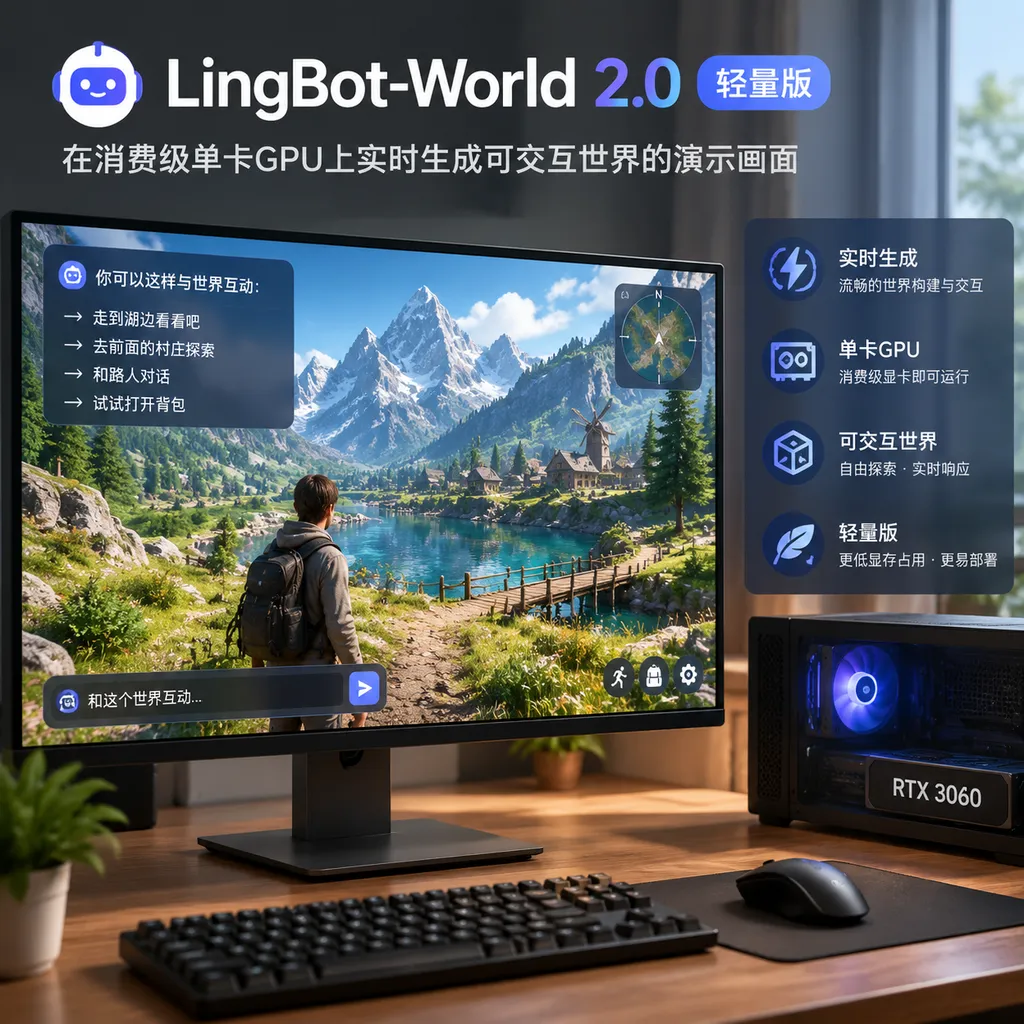
Ant Group’s LingBot recently open-sourced the lightweight version of LingBot-World 2.0. With only 1.3B parameters, its goal is clear: to ensure that world models no longer belong exclusively to data centers and high-end multi-GPU servers, but can run locally on a consumer-grade single-GPU system and generate interactive video worlds in real time.
This is not simply a matter of shrinking a large model. The lightweight version of LingBot-World 2.0 aims to address several of the most difficult problems facing world models: whether scenes will drift during continuous generation, whether user input can change the world, whether the model can drive events forward on its own, and whether sufficiently low latency can be maintained under limited computing resources.
Based on the currently available demos and technical materials, the significance of the 1.3B version lies not in replacing the 14B flagship model, but in taking world models one step further from showcase demos toward deployable and experimentally accessible systems. For developers, this may be more noteworthy than yet another video-generation model that can only be experienced online.
From the 14B Flagship Model to the 1.3B Lightweight Version
In July this year, Ant Group’s LingBot open-sourced the 14B flagship model of LingBot-World 2.0. It targets higher image quality, more complex interaction, and longer-duration world generation. Under the corresponding inference configuration, the official demonstrations showed a real-time experience at 720p and 60 fps, with scene evolution continuing for several hours.
The 14B version has a higher capability ceiling, but its deployment costs are correspondingly greater. For ordinary developers, the real obstacles are not limited to GPU memory capacity. They also include inference throughput, video caching, long-context management, and the accumulated computational pressure caused by multi-turn interaction. Each frame generated by a world model often requires the previous frame to be fed in as input for the next one. The larger the model, the more difficult it becomes to reduce the hardware and engineering costs of continuous operation.
The positioning of the 1.3B lightweight version is therefore clear: it is not merely pursuing a smaller parameter count, but is designed to enable more people to run the model locally.
According to the publicly available materials, this version is designed for consumer-grade single-GPU systems and can generate worlds in real time. The technical page also discloses a runtime speed of approximately 24 fps on a single GPU, as well as a test result of approximately 10 fps on an RTX 4090. The apparent discrepancy between these figures is generally related to resolution, quantization method, VRAM configuration, sampling steps, and the specific hardware environment. They should not be interpreted directly as meaning that the model can stably achieve 24 fps or 60 fps in all scenarios.
This is also something developers need to pay particular attention to when evaluating such models: the real-time performance of a world model is not an isolated frame-rate figure. Input latency, time to first frame, VRAM consumption after prolonged operation, the degree of visual drift, and the recovery speed after interactive events are injected will all directly affect the user experience.
What Makes World Models Difficult? It Is Not Simply Continuing to Generate a Video
A traditional video-generation model is more like a director who shoots clips according to a script: given a prompt, it can generate a visually coherent video, but that coherence often exists only within a short time window. A world model is more like a real-time simulator. It must continuously maintain the state of a scene and respond to user actions.
When the user moves forward, the spatial relationships among the ground, buildings, and distant objects need to remain consistent. When the user rotates the camera, areas that were previously out of view need to be filled in. When the user attacks a target, the target’s movement, collisions, lighting, and surrounding environment must continue coherently. The model must not only predict the next frame, but also implicitly maintain a continuously changing world within every frame.
LingBot-World 2.0 follows a causal world-modeling approach. In simple terms, “causal” means that when generating the current state, the model can use only visual information from the past and user input provided up to the current moment; it cannot peek at future content.
This is consistent with the basic requirements of real-time interaction, but it introduces a classic problem: the model’s generated output becomes part of the subsequent input. Even a slight discrepancy at the beginning may gradually be amplified as the autoregressive process continues. After a long period of operation, textures may become blurry, object boundaries may deform, and the positional relationships between characters and scenes may slowly drift.
For ordinary video generation, such errors may be hidden by editing after a dozen seconds or so. For a world model, however, users may remain in the same scene for several minutes or even longer, and drift can directly undermine playability.
MoBA: Bringing Training Context Closer to Real-World Operation
To address stability issues in long contexts, LingBot-World 2.0 introduces MoBA, or Mixture of Bidirectional and Autoregressive Attention Mask. This can be understood as a mixed masking mechanism that combines bidirectional attention with autoregressive attention.
In pure Teacher Forcing training, the model typically sees clean and accurate historical context. This is beneficial for learning the target distribution, but it does not fully match the model’s actual deployment conditions. Once deployed, the model usually receives the results it generated in the previous round, rather than perfect historical frames from the training data.
If a model relies on clean context over an extended period, it may perform well during training but encounter what is known as a training–inference distribution shift once it begins autoregressive operation. The core idea behind MoBA is to expose the model to different types of context at different stages of training, preserving the benefits of bidirectional information for learning quality while strengthening its ability to adapt to autoregressive scenarios.
This design is not a standalone magic module, but it highlights the fundamental difference between world models and ordinary image or video models: the latter often only need to make a clip look realistic, whereas the former must keep the world intact as much as possible even when errors are inevitable.
From Multi-Step Sampling to Few-Step Real-Time Generation
Whether a large model can run in real time depends not only on its parameter count, but also on how much computation the generation process requires. Distillation is one of the key components of LingBot-World 2.0’s lightweight approach.
The team uses consistency distillation to compress the denoising trajectory that originally required the teacher model to take multiple steps into fewer steps, enabling the student model to generate results at a lower inference cost. For diffusion-based video-generation models, this is equivalent to compressing a drawing process that originally required repeated corrections into a small number of large update steps.
However, consistency distillation alone is not enough. After deployment, the student model continuously enters states generated by itself, whereas the teacher model typically sees more ideal and cleaner states during training. If the student model deviates in a given round, errors may still accumulate afterward.
LingBot-World 2.0 therefore also incorporates DMD, or Distribution Matching Distillation, and continues training on the student model’s own long-horizon autoregressive trajectories. In other words, the model must not only learn how the teacher generates results, but also adapt in advance to the states it may enter after running for a period of time.
This process can be summarized in four steps:
- Establish a causal world model that can rely only on past information through Causal Pretrain;
- Use mechanisms such as MoBA to improve the stability of long-context and autoregressive generation;
- Compress the multi-step generation process through consistency distillation to reduce inference costs;
- Train on the student model’s long-horizon self-rolled trajectories to reduce cumulative drift after deployment.
This is the most noteworthy technical aspect of the 1.3B version. Lightweight design is not simply about removing parameters; it requires rethinking how a model can maintain state, respond to input, and operate continuously under limited computational resources.
It Generates Not a Video, but a Scene That Can Be Rewritten
The difference between LingBot-World 2.0 and ordinary video-generation models is also reflected in the way users interact with it.
In public demonstrations, users can control characters with a keyboard or directly enter natural-language events. For example, entering “a swarm of bats suddenly appears” in a cave scene causes new creatures and corresponding motion feedback to be generated. Entering “turn it into an ice cavern” changes the environmental materials, color palette, and spatial atmosphere accordingly.
Going a step further, users can define interaction rules while creating the initial world, binding events such as “wings glitter,” “a storm approaches,” and “perform a sharp turn” to different keys. The result is no longer just a fixed video, but a real-time space with input interfaces and changing states.
Technically, this means the model needs to process at least three types of information:
- Visual state: what objects are currently present in the frame and where they are located;
- User actions: what intervention the keyboard, mouse, or text input is requesting from the world;
- World changes: how the characters, environment, and other objects should continue to evolve after the action occurs.
The project also provides an interface for multiple users to enter the same world simultaneously. Multiplayer interaction places greater demands on consistency, because the system must not only show each user a reasonable scene, but also ensure as much as possible that different users are seeing the same world state. For game prototyping, virtual production, and collaborative Agent experiments, this type of interface offers more room for exploration than a single-user demo.
Agentic Harness: Letting the World Continue on Its Own
Many earlier real-time world models had an implicit assumption: once the user stopped providing input, the world would stop as well. If the user did not move, the character remained still; if the user issued no command, the environment generated no new events. This was more like an interactive video manually driven by a human than a world capable of evolving independently.
LingBot-World 2.0 introduces Agentic Harness in an attempt to give the world a certain degree of autonomous progression. Its framework contains two roles: Pilot Agent and Director Agent.
The Pilot Agent is responsible for planning and executing character behavior, such as exploring forward, riding a horse, avoiding obstacles, or completing a goal. The Director Agent is more like an invisible director. Based on the current world state, it continuously generates and injects new events and environmental elements in real time, such as changing the weather, arranging for enemies to appear, or moving the scene into its next phase.
The importance of this design lies in the fact that it takes the world model one step away from being a frame-by-frame predictor and toward becoming an event-driven system. The model must not merely respond to what the user has just done; it must also determine what should happen next in the world.
Of course, Agentic Harness does not mean that the model already possesses a genuinely stable understanding of physical worlds. It is more like a control framework responsible for planning and event scheduling, while the underlying visuals are still produced by the generative model. For complex collisions, precise physics, long-term task objectives, and multiplayer synchronization, developers still need additional state management and external tool support.
What Has the 1.3B Version Really Changed?
One of the biggest problems with world models has been that both the research and usage barriers are too high. Large-parameter models require high-end GPUs, substantial VRAM, and complex inference configurations. Even if developers only want to validate a simple idea, they may be blocked by deployment costs before they can begin.
The 1.3B version lowers this barrier and brings at least several practical benefits.
First, Local Experimentation Becomes Feasible
Developers can study the input/output interfaces of video world models, scene-state maintenance, action-conditioned generation, and event injection on a single consumer-grade graphics card, without first building a multi-GPU inference cluster.
Second, It Provides a Foundation for Real-Time Interactive Prototypes
Game prototypes, virtual-reality scenes, digital-human spaces, interactive advertising, and educational simulations all require low-latency feedback. A lightweight model that can run locally in real time is better suited to experiments involving edge or near-edge inference.
Third, Community Fine-Tuning and Secondary Development Become Less Expensive
With the open-source weights, code, and technical report released together, researchers can continue training the model for specific scenarios, such as driving environments, robotic manipulation, virtual production, or indoor navigation. Although the 1.3B model has limited capacity, it is better suited to serving as a modifiable public foundation.
Fourth, World Models Are Beginning to Develop a Clear Hierarchical Structure
The 14B flagship model is responsible for the capability ceiling and complex scenes, while the 1.3B version is responsible for accessibility and deployment. This combination—in which a large model serves as the teacher and a small model handles real-time execution—may become an important engineering approach for world models. More realistic systems in the future may not rely on a single model to do everything. Instead, a high-capability model may handle planning, while a lightweight world model handles continuous rendering and response.
But Do Not Treat It as a Low-End Game Engine
Expectations for the lightweight version of LingBot-World 2.0 should remain measured.
First, real-time generated visuals are not equivalent to the deterministic rendering of a traditional game engine. Engines such as Unity and Unreal calculate scenes using explicit geometry, materials, and physical rules, so the same input will generally produce a reproducible result. A world model, by contrast, predicts possible visual states. Its output is more flexible, but it is also more prone to changes in object shape, detail flicker, and declining long-term consistency.
Second, although the 1.3B model’s parameter count makes it suitable for deployment, this also means that its capability ceiling in complex scenes, dense interactions, and long-duration tasks may be lower than that of the 14B flagship model. Real-time operation on a single GPU often requires trade-offs among resolution, frame rate, context length, and visual quality.
Third, the official demo’s 60 fps cannot be directly equated with 60 fps for the lightweight version on any consumer-grade graphics card. There may be significant differences between the flagship and lightweight models, as well as between different resolutions and sampling strategies. When deploying the model, developers should focus on end-to-end latency and long-term stability rather than peak frame rate alone.
Finally, world-model applications still lack mature evaluation standards. For text-to-video systems, clarity and motion quality can be compared relatively clearly. World models must also be evaluated for spatial consistency, event response, state memory, physical plausibility, multiplayer synchronization, and long-term drift. These metrics are still evolving rapidly.
Is It Worth Trying Now for Developers?
If your goal is to build a commercial-grade game or a high-precision simulation system, the answer may be no. At present, world models are better suited to generating dynamic content and interactive prototypes than to replacing mature engines and taking over all underlying logic.
However, if you are researching any of the following areas, the lightweight version of LingBot-World 2.0 is worth watching:
- Enabling Agents to act continuously in visual environments;
- Studying natural-language-driven scene and event generation;
- Rapidly prototyping games or virtual spaces;
- Exploring visual prediction for robotics, autonomous driving, and embodied intelligence;
- Studying state consistency in long-duration video generation;
- Evaluating world-model inference performance in a single-GPU environment.
Its greatest value is that it turns capabilities previously observable only in papers and online demos into something developers can download, deploy, modify, and measure.
OpenAI Hub currently aggregates models such as GPT, Claude, Gemini, and DeepSeek. LingBot-World 2.0 is an open-source world model that requires local deployment, so it is not suitable for direct replacement through a generic text API. Developers who want to quickly invoke closed-source large models for scene planning, event orchestration, or multimodal control can use an API model as the upper-level brain and the local world model as the real-time visual execution layer—the former decides what should happen next, while the latter continuously generates the world.
This may be the more pragmatic combination in the near term: rather than asking one model to handle everything, let a large model take responsibility for low-frequency decisions and a lightweight world model handle high-frequency feedback.
Conclusion: The Next Challenge for World Models Is Moving from “Runnable” to “Useful”
The lightweight version of LingBot-World 2.0 brings the hardware barrier for world models down to 1.3B parameters and single-GPU deployment. This is undoubtedly an important step toward engineering practicality. It demonstrates that world models do not necessarily need to exist only at 14B parameters or larger, nor do they have to be experienced exclusively through the cloud.
But the real competition is only beginning. Whether a 1.3B model can maintain spatial stability for tens of minutes or even hours, provide credible feedback to complex actions, allow multiple users to see a consistent world, and be integrated by developers into real products—these questions matter more than parameter count.
In the short term, it is more like a runnable, dissectable, and extensible public foundation for continued research than a mature replacement for a game engine. In the long term, if lightweight models can further reduce latency, improve long-term consistency, and integrate with Agents, rendering engines, and robotic control systems, world models may finally evolve from impressive demos into infrastructure for next-generation interactive software.