<think>**Translating headline while preserving markdown** </think> Unitree Open-Sources a New Foundation Model: One Model Handles 64 Tasks

<think>**Formulating polished translation approach** </think> Unitree has fully open-sourced UnifoLM-WLA-1.0 today, using a single model to coordinate both desktop manipulation and whole-body mobile manipulation, and covering 64 tasks on real robots. What truly deserves attention is not the number of tasks, but that it is beginning to attempt to unify robots’ perception, reasoning, and action interfaces.
<think>Planning markdown-preserving translation
</think>Unitree Open-Sources the “Brain” of Its Humanoid Robots
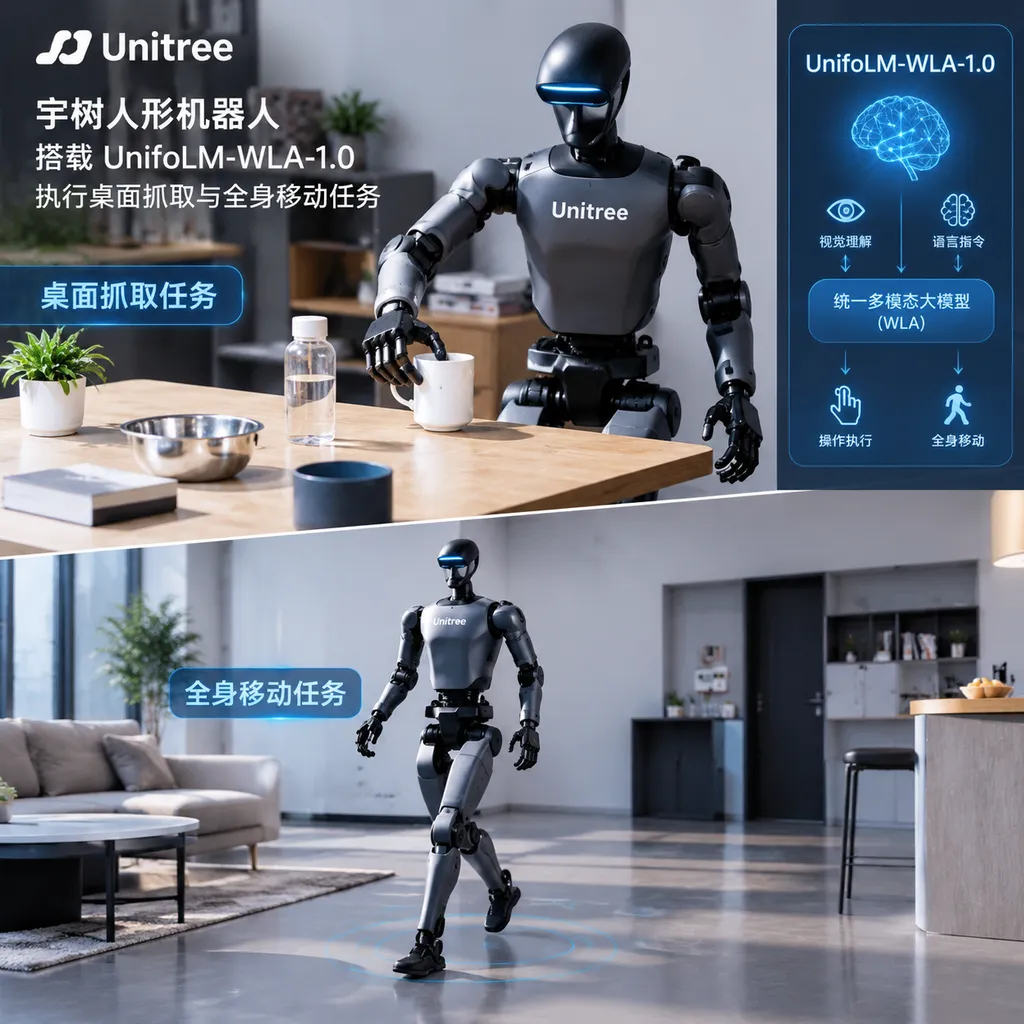
On September 10, Unitree Robotics announced the full open-sourcing of its next-generation general-purpose humanoid robot foundation model, UnifoLM-WLA-1.0. According to information released by Unitree, the model set new state-of-the-art results among open-source models across multiple embodied reasoning benchmarks, with some capabilities comparable to those of leading closed-source models. In real-robot evaluations, a single model was able to coordinate 64 tasks, covering both tabletop manipulation and whole-body locomotion, while also supporting cross-task and cross-end-effector generalization.
The most valuable aspect of this release is not another robot demonstration video, nor is it simply the number “64.” Rather, Unitree is attempting to address a more difficult problem in embodied intelligence: Can we avoid training a separate model for every action, every robotic arm, and every scenario, and instead use a unified foundation model to support multiple tasks?
If this approach can be reproduced in third-party environments, UnifoLM-WLA-1.0 will mean more than a set of model weights. It could become a common foundation connecting high-level semantic understanding, spatial reasoning, and low-level robot control, further lowering the barrier for developers to validate new tasks on humanoid robots.
64 Tasks—The Point Is Not Simply “Knowing More”
When robotics companies release models, the number of tasks can easily become the focus of publicity. But for developers, “supporting 64 tasks” is not by itself equivalent to general-purpose capability.
Traditional robotic systems are usually divided by task: grasping a cup requires one policy, folding clothes requires another, and moving to a shelf before picking up an object often requires coordination among multiple modules for navigation, localization, motion planning, and robotic-arm control. Such systems can certainly work, but their engineering structure resembles a collection of specialized tools held together with tape. A slight change in the environment, object position, or hardware may cause the original policy to fail.
UnifoLM-WLA-1.0 is attempting something different: placing tabletop manipulation and whole-body locomotion within the same model framework, allowing the model to determine the next action based jointly on visual input, language instructions, and the robot’s current state. Tabletop grasping tests hand-eye coordination, while whole-body locomotion involves the center of gravity, path planning, and collision risks. The two have very different requirements in terms of action space and control frequency. If one model can cover both categories of tasks, that at least suggests it is no longer merely an enlarged version of a “robotic-arm grasping policy.”
The real questions to ask are:
- How different are the 64 tasks from one another? Are they genuinely distinct tasks, or repeated counts of the same skill applied to different objects?
- What are the success rate, number of consecutive executions, and failure distribution for each task?
- How much does performance decline when the model encounters rooms, lighting conditions, occlusions, and objects outside the training set?
- Can whole-body locomotion and fine manipulation be connected continuously, rather than being recorded in separate segments or switched manually?
- After disturbances such as an object slipping or a target being moved, can the model correct itself online?
Therefore, 64 tasks is a noteworthy coverage metric, but it is not yet a graduation certificate for a general-purpose robot. The greatest danger for embodied models is that “the demonstration looks smooth, but the system fails as soon as the table is changed.” Whether complete evaluation protocols, per-task success rates, and third-party reproduction results are provided will matter more than the task list itself.
From VLA to WLA: The Key Is Understanding the Consequences of Actions
Over the past two years, robot foundation models have generally adopted the VLA paradigm—that is, the vision-language-action framework: the model observes the environment, understands a natural-language instruction, and then outputs robot actions. Its difference from multimodal large language models is that the output is not merely text, but joint positions, end-effector poses, or discrete action sequences.
Unitree emphasized that UnifoLM-WLA-1.0 incorporates interaction-centered world modeling. Judging from the name and the official description, the focus of WLA is not merely mapping images and language to actions, but also enabling the model to learn “what will happen in the world after this action is taken.”
This distinction can be understood through the example of picking up a cup.
A conventional vision-action policy may learn to move the hand near the cup handle and close the gripper after seeing the cup. With world modeling, the model must also implicitly predict whether the arm will collide with the kettle on the table along its current path, whether the grasping angle will cause the cup to tip over, whether the robot’s center of gravity will remain stable after lifting the cup, and where the cup should be placed next.
In other words, VLA is more like “directly making a move based on the scene in front of it,” while a world model attempts to have the robot internally simulate the result before making the move. This does not mean the robot already possesses complete physical common sense, but it may help reduce the shortsightedness caused by relying solely on action imitation.
This is especially true for humanoid robots. When a robotic arm is fixed to a workbench, the control system does not need to constantly worry about the body falling over. A humanoid robot’s reaching, turning, stepping, and bending, however, all affect one another. Predicting only the trajectory of the hand is not enough; the model must also understand the overall relationship between the body and its environment. Placing tabletop manipulation and whole-body locomotion within a single foundation model is a reasonable direction for Unitree, and it aligns with the hardware advantages provided by its real-robot platforms, such as the G1.
Generalization Across End Effectors Is More Difficult Than Generalization Across Tasks
Another easily overlooked keyword in this release is cross-end-effector generalization.
An end effector can be understood as the robot’s “hand”—the part that actually comes into contact with the world. It may be a two-finger gripper, a multi-finger dexterous hand, or a tool designed for a specific industrial task. Different end effectors have different degrees of freedom, opening and closing mechanisms, force ranges, and control interfaces. A model trained for a two-finger gripper generally cannot directly control a five-finger dexterous hand, just as knowing how to use pliers does not mean one can naturally play the piano.
If UnifoLM-WLA-1.0 can partially decouple task intent from the specific hardware control method, developers would not need to retrain all semantic and spatial capabilities from scratch when replacing the robot’s hand. Ideally, the foundation model would be responsible for understanding “what needs to be done” and “where the target is,” while a hardware adaptation layer would convert abstract actions into trajectories that a particular end effector can execute.
This is critical to the robotics ecosystem. One important reason large language models have spread so quickly is that text input and output are inherently standardized. Robotics, by contrast, has no standardized body. Different manufacturers use different numbers of joints, camera positions, control frequencies, and coordinate systems, and their data is difficult to mix directly. Generalization across end effectors is, in practice, a challenge to the “hardware fragmentation” of embodied intelligence.
However, this capability also requires more detailed supporting data. “Cross-end-effector” could mean replacing two grippers on the same robot, or spanning entirely different mechanical structures; these are not remotely comparable in difficulty. Developers will need to know what embodiment-adaptation methods the model provides, whether additional fine-tuning is required, and how much demonstration data a new end effector needs to reach a usable level of performance.
Unitree’s Advantage Is Not Just Model Parameters
When building robot foundation models, the hardware and data loop is often more important than model size.
Internet models can obtain vast amounts of text from public webpages, but robot action data must be collected through real robots, teleoperation, simulation, or manual annotation. Every high-quality trajectory carries equipment costs, operating time, and safety risks. More troublingly, data collected by one robot may not transfer to another robot without loss.
Unitree’s advantage lies in the fact that it not only trains models but also manufactures robot bodies. Models can be deployed directly on real hardware, failed trajectories can be fed back into training, and new control policies can then be further validated on real robots. This “hardware–data–model–deployment” loop is difficult for a pure software team to replicate in the short term.
However, hardware manufacturers also face a natural temptation: their models may be optimized primarily around their own robot platforms. After being open-sourced, they may appear general-purpose while still imposing substantial costs when transferred to other robotic platforms. Therefore, the most important thing to observe about UnifoLM-WLA-1.0 is not how smoothly it performs on Unitree’s official robots, but whether the community can deploy it on robots with different sizes, degrees of freedom, and control stacks.
“Fully Open-Source” Must Be Judged by the Deliverables, Not Just the Slogan
Unitree has used the phrase “fully open-source.” For developers, assessing the degree of openness requires looking at at least five layers:
- Model weights: Are complete, downloadable weights provided, rather than merely an online demonstration?
- Inference code: Does it include preprocessing, action decoding, control frequency, and the deployment process?
- Training code: Can the model be further trained, fine-tuned, or adapted to new robots?
- Data and recipes: Are the data format, data composition, collection methods, and training hyperparameters disclosed?
- License: Does it permit commercial use, modification, and redistribution, and does it restrict specific applications?
Robot models depend more heavily than language models on engineering details. Even if developers obtain the weights, it remains difficult to reproduce the system on a real robot without information on camera calibration, action normalization parameters, robot-state definitions, and control interfaces. Conversely, as long as the data format and adaptation interfaces are sufficiently clear, the community can build its own datasets around a common standard, even if the original training data cannot all be made public.
As of September 10, existing public reports confirm that Unitree announced the full open-sourcing of the model and presented claims involving multiple SOTA results, 64 real-robot tasks, and cross-end-effector generalization. More detailed information—including model size, training-data volume, individual benchmark scores, license boundaries, and the list of supported hardware adaptations—should be verified against the forthcoming official repository, model card, and technical report.
This is also the biggest caveat surrounding the release at present: Official demonstrations establish the ceiling; complete open-source materials are what will establish usability.
What This Means for Developers
If the subsequent deliverables are complete, UnifoLM-WLA-1.0 will have practical value for three categories of developers.
The first is robotics algorithm teams. They can skip the costly stage of training general-purpose visual and spatial representations from scratch and focus their resources on enterprise-scenario adaptation, safety constraints, and task-data collection.
The second is universities and research institutions. Embodied-intelligence research has often been constrained by closed models, expensive real robots, and overly long reproduction pipelines. Unitree’s combination of relatively accessible robot platforms and an open model could provide a comparatively unified experimental baseline.
The third is application-development teams. Common requirements in scenarios such as warehouse sorting, laboratory operations, and commercial services are not limited to having a robot perform a single action once. The robot must continuously understand instructions, move to the target location, manipulate objects, and handle anomalies. A unified foundation model can reduce errors caused by repeatedly passing state between modules, but bringing such systems directly into production still requires extensive engineering work involving safety layers, permission systems, task orchestration, and fault recovery.
It must be emphasized that a foundation model will not automatically eliminate the physical costs of robot deployment. If a language model gets a sentence wrong, it can simply generate another one; if a robot mishandles a glass, it may directly cause damage to equipment or injure personnel. Real products will still require deterministic motion control, safety boundaries, collision detection, and emergency braking. Embodied foundation models are well suited to expanding the boundaries of capability, but they should not be expected to bear sole responsibility for the final layer of safety.
Assessment: An Important Step, but Not a “General-Purpose Robot Moment”
The direction taken by UnifoLM-WLA-1.0 is sound: use a single model to coordinate tabletop and whole-body tasks, enhance spatial and interaction understanding through world modeling, and reduce adaptation costs through cross-task and cross-end-effector generalization. Compared with robot models that demonstrate only individual skills, it is closer to a genuine general-purpose foundation model.
More importantly, Unitree chose to open-source it. What embodied intelligence currently lacks is not merely larger models, but baselines that the community can repeatedly validate, unified data formats, and experience deploying real robots. A model that may not perform perfectly but can be downloaded, modified, and run on real robots will generally do more to advance the industry than a closed system that looks impressive only in a promotional video.
However, it is still too early to call this the “GPT moment” for humanoid robots. Sixty-four tasks cannot answer questions about long-duration operational stability, and official SOTA results cannot replace cross-laboratory reproduction. Whether the model can complete unseen tasks in unfamiliar environments, adapt to third-party hardware at low cost, and reliably recover from failures will determine whether it ultimately becomes a research baseline or infrastructure suitable for production environments.
Unitree has submitted an ambitious answer this time. Next, it will be up to the code, weights, license, and community reproductions to do the talking.
References
- IT之家: Unitree Open-Sources Its New-Generation General-Purpose Humanoid Robot Foundation Model UnifoLM-WLA-1.0 — Summarizes Unitree’s official release information, including full open-sourcing, 64 real-robot tasks, multiple SOTA results on open-source benchmarks, and cross-end-effector generalization.