Zhipu Launches Coding Subsidy in Hangzhou, Saving Up to 51% on Annual Plans

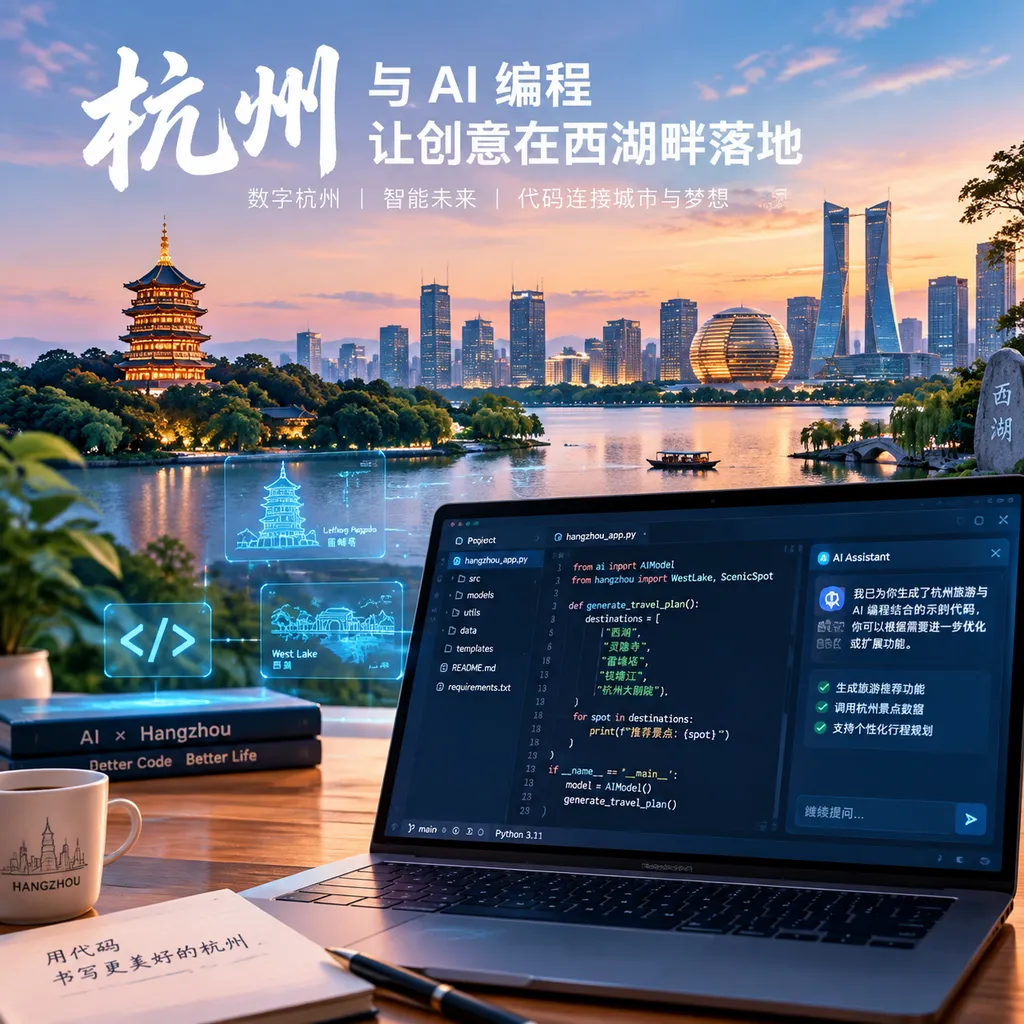
Zhipu has partnered with Hangzhou and Shangcheng District to launch a citywide inclusive AI coding program. Hangzhou government employees and university students can receive discounts of up to 51% when purchasing personal Coding plans, while businesses in Shangcheng District can receive a 55% subsidy on annual corporate plans. The campaign runs from September 10 through December 9.
Zhipu Brings AI Coding Subsidies to Hangzhou: Individual Annual Plans Save Up to 51%, Enterprises Capped at 1 Million Yuan per Company
Zhipu announced today the launch of the “Zhipu · Hangzhou Citywide Coding Plan.” This is a city-level inclusive AI coding initiative jointly introduced by Zhipu, Hangzhou Municipality, and Hangzhou’s Shangcheng District. The program runs from September 10 to December 9, 2026.
In simple terms, developers in Hangzhou, students at universities in Hangzhou, and enterprises in Shangcheng District can purchase Zhipu GLM Coding plans at prices significantly below the list price. Individual annual plans receive a combined reduction of 51%, while enterprises in Shangcheng District that purchase annual team plans can receive a combined subsidy of 55%, with the subsidy capped at 1 million yuan per company.
This is not an ordinary promotion. Zhipu is tying model subscription subsidies to local industrial policy, in an attempt to turn AI coding from a productivity tool used by a small number of technical teams into infrastructure serving urban developers and corporate R&D departments. For developers, what really deserves attention is not just “how much cheaper it is,” but whether fixed subscriptions, capped usage, off-peak deductions, and compatibility with multiple tools can lower the long-term cost of using coding agents.
Individual Users: Quarterly Plans Save 44%, Annual Plans Save 51%
The eligibility requirements for individual users are relatively clear: people working in Hangzhou or currently enrolled at a university in Hangzhou. The former must provide proof of social security contributions in Hangzhou, while the latter must verify their status as a student at a Hangzhou university through an online verification report from the China Higher-education Student Information and Career Center (CHESICC, commonly known as Xuexinwang).
After passing the review, individual users can choose between a quarterly plan and an annual plan. Each person may receive the benefit only once; users cannot purchase a quarterly plan first and then buy an annual plan again. The authorities have also set an overall subsidy ceiling. Once the quota reaches its limit, no further subsidies will be issued. Therefore, this program is not a permanently fixed pricing structure, and whether an applicant receives a subsidy depends on the remaining quota at the time of application and purchase.
The specific prices are as follows:
| Plan | List price | Combined reduction | Price after reduction | | --- | ---: | ---: | ---: | | Lite quarterly plan | 354 yuan / quarter | 44% | 198.24 yuan / quarter | | Pro quarterly plan | 1,614 yuan / quarter | 44% | 903.84 yuan / quarter | | Max quarterly plan | 3,234 yuan / quarter | 44% | 1,811.04 yuan / quarter | | Lite annual plan | 1,416 yuan / year | 51% | 693.84 yuan / year | | Pro annual plan | 6,456 yuan / year | 51% | 3,163.44 yuan / year | | Max annual plan | 12,936 yuan / year | 51% | 6,338.64 yuan / year |
In absolute terms, the Lite annual plan is the most suitable option for individual developers who want to test the waters. It costs less than 700 yuan per year after the discount, or about 58 yuan per month on average. The Pro annual plan costs about 263.62 yuan per month after the discount, making it suitable for developers who use coding agents daily and need frequent refactoring and debugging. The Max annual plan costs about 528.22 yuan per month after the discount, and is closer to the needs of high-frequency software engineering and long-running tasks.
However, plan prices cannot simply be equated with “unlimited calls.” The core of the Coding Plan is to provide a set of usage credits over each subscription period. Usage is also affected by five-hour windows, weekly limits, model type, cache hit rate, and peak periods. The official reference figures show that the Lite, Pro, and Max plans correspond to approximately 80, 400, and 1,600 prompts per five-hour period, respectively, and approximately 400, 2,000, and 8,000 prompts per week. MCP tool calls are approximately 100, 1,000, and 4,000 per month, respectively. Actual usage will vary depending on task length and cache hits.
Enterprise Users: 55% Subsidy on Annual Plans for Shangcheng District Enterprises
The enterprise program has narrower eligibility and is available only to companies registered in Hangzhou’s Shangcheng District. Enterprises may purchase annual team plans only; both the Standard and Advanced versions are eligible for a combined subsidy of 55%.
| Plan | List price | Combined subsidy | Enterprise price | | --- | ---: | ---: | ---: | | Enterprise Standard annual plan | 7,176 yuan / seat / year | 55% | 3,229.2 yuan / seat / year | | Enterprise Advanced annual plan | 14,376 yuan / seat / year | 55% | 6,469.2 yuan / seat / year |
The initial subsidy for an individual company is generally capped at 1 million yuan. For companies that have already purchased team plans, the official rules allow them to apply for subsidies for additional seats. Companies that have never purchased a team plan may also apply.
The enterprise application process differs from the individual process: first complete enterprise identity verification on the BigModel platform, then submit an application. After eligibility review, the company enters business discussions, subsequently signs a contract agreement, and finally purchases the plan at the subsidized price. In other words, enterprises cannot place an order directly after completing verification like individual users can. The procurement timeline, number of seats, and subsidy amount all need to be confirmed further with the platform.
For a team with 20 R&D staff, purchasing the Standard plan for everyone would cost 143,520 yuan per year at the list price, or approximately 64,584 yuan at the subsidized price—a direct reduction of 78,936 yuan in spending. If the team needs higher quotas and stronger model capabilities, 20 seats of the Advanced plan would cost 287,520 yuan at the list price and approximately 129,384 yuan after the subsidy. This price difference is genuinely attractive to startups and small and medium-sized businesses that are incorporating AI coding into their daily R&D workflows.
However, enterprises should not focus solely on the discount. The real cost of AI coding tools also includes permission management, code repository integration, log auditing, sensitive-data handling, team collaboration, and quality control of model output. If a company merely deploys individual plans in bulk without code-review and data-isolation mechanisms, the larger the subsidy, the faster errors may spread.
The Practical Value of the GLM Coding Plan Goes Beyond the Subscription Price
Zhipu’s current Coding Plan covers GLM-5.3 and GLM-5.3-Flash. Reference materials indicate that GLM-5.3 is designed for complex code generation, system design, debugging, and long-running workflows, while GLM-5.3-Flash places greater emphasis on response speed and cost efficiency and supports visual understanding as well as related MCP capabilities. The plans also cover tool calls for web search, webpage reading, open-source repositories, and more.
Model calls are measured using deduction coefficients: for GLM-5.3, the deduction coefficients for Input, Cached Input, and Output are 6.9, 1.7, and 24, respectively; for GLM-5.3-Flash, the corresponding figures are 2.3, 0.56, and 8. A lower coefficient does not directly mean that a model is less capable. Rather, it means that the same plan quota is consumed differently depending on the model and token type. When cache hits occur, the cost of repeated context is generally lower. For long-context tasks, good cache utilization can also significantly increase the amount of work that can actually be completed.
The platform also provides additional deductions during off-peak hours: Monday through Friday from 2:00 p.m. to 6:00 p.m. is considered peak time, while model calls at other times consume only 50% of the base credit deduction. In other words, running batch code analysis, test generation, and documentation tasks at night, early in the morning, or on weekends can theoretically accomplish more work with the same quota.
The significance of this mechanism is that it shifts AI coding subscriptions from a “pay per request” model toward something more like reserved resources in cloud computing. Developers do not need to calculate the cost of every request; instead, they manage usage intensity through five-hour windows and weekly quotas. For budget-conscious teams, waiting for the quota period to refresh after reaching a limit—and not having the account balance charged automatically—is also easier to control than usage-based billing.
Of course, limits also define the boundaries of reliability. An agent task that runs continuously for several hours and processes a large codebase in batches may quickly consume its window quota. If team members concentrate their usage on weekday afternoons, the difference in deductions during peak hours may also become more pronounced. Developers need to reserve peak periods for interactive development and use off-peak periods for automated tasks in order to fully benefit from the plan.
Who Should Apply in Hangzhou?
The first group consists of developers who already use tools such as Claude Code, OpenCode, TRAE, CodeBuddy, and Kilo Code on a long-term basis. They generally do more than occasionally ask a model to complete a few lines of code; instead, they integrate models into the full workflow, including requirements decomposition, codebase Q&A, refactoring, testing, and pre-commit checks. For these users, a fixed plan makes costs easier to estimate than sporadic API calls.
The second group consists of individual developers working on independent products or startup projects. The Lite annual plan has a relatively low barrier to entry and is suitable as a low-cost productivity tool. If a project involves substantial front-end and back-end integration, database migrations, and automated testing, the Pro plan may be more appropriate.
The third group consists of students at Hangzhou universities. The discount associated with student status lowers the barrier to accessing large-model coding tools. For students, the truly valuable uses are not having the model write assignments for them, but using it to understand unfamiliar codebases, generate test cases, explain compilation errors, or build prototypes for course projects.
For enterprises, the program is better suited to Shangcheng District companies that already have clearly defined R&D processes and want to deploy AI coding tools at scale. If a team has only two or three people, the management capabilities of the enterprise version may not justify the additional procurement process. For R&D teams of more than ten people, however, seat-based subscriptions and enterprise verification have more practical value.
Three Things to Note Before Applying
First, prepare your eligibility documents in advance. People working in Hangzhou need proof of social security contributions, while students at Hangzhou universities need a verification report from Xuexinwang. Incomplete materials will prolong the review process, and the subsidy is subject to an overall cap, so it is advisable to complete verification before planning which plan to purchase.
Second, you can choose only one of the individual quarterly and annual plans. If you simply want to determine whether GLM Coding suits your workflow, the quarterly plan carries less risk. If you have already decided to use it continuously and the quota of the Lite, Pro, or Max plan matches your workload, the annual plan’s 51% reduction is a better deal.
Third, do not treat the plan quota as unlimited productivity. Before using it, it is best to assess your task types: How many rounds of interaction do you need each day? Do you frequently process context windows of a million tokens or more? Do you need web access and MCP? Will team members make calls simultaneously? Long-running and batch tasks in particular may consume far more quota than simple code completion.
From a product perspective, the biggest highlight of Zhipu’s initiative is that it extends competition over “model capabilities” into competition over “urban developer ecosystems.” Subsidies can quickly attract users, but whether those users stay will ultimately depend on the model’s reliability in real codebases, the continuity of agent execution, and how easily errors can be located and rolled back.
Zhipu’s selling points—including GLM-5.3, a 1M-token context window, and Agentic Engineering—target developers moving from Vibe Coding toward engineering-oriented collaboration. This is the right direction: when models are no longer merely code generators in a chat window but begin participating in planning, implementation, testing, and iteration, price, quota, concurrency, and tool compatibility become just as important as model benchmark scores.
However, the Hangzhou program also has clear limitations: individual subsidies are restricted to people working in Hangzhou and students at Hangzhou universities, enterprise subsidies are restricted to entities in Shangcheng District, and the overall quota is limited. It is more like a regional large-scale experiment than a nationwide price reduction. Developers outside Hangzhou cannot directly replicate the discount in the short term. For Zhipu, the real report card will be whether it can convert local subsidies into long-term active users and enterprise renewal rates.
Overall, if you meet the eligibility requirements for individuals in Hangzhou and already use AI coding tools regularly each week, the 51% annual-plan reduction is worth serious consideration. If you only generate code occasionally, the quarterly plan is the safer choice. Enterprises in Shangcheng District can view the program as an opportunity to deploy team AI coding tools at low cost, but before signing, they should pay particular attention to seat quotas, team permissions, data compliance, and renewal prices after expiration.
Sources
- IT Home: Zhipu Launches Hangzhou Citywide Coding Plan: Introduces the program period, the scope of individual and enterprise users, subsidy ratios, and plan prices.
Note: The prices, eligibility requirements, and quotas described in this article are subject to the activity page and latest rules on Zhipu’s BigModel platform. The program’s subsidies are subject to an overall cap, and the specific review results, purchasable plans, and remaining quota may change at any time.