Ideal Mach VLA 2.0 Reaches Nearly One Million Vehicle Owners
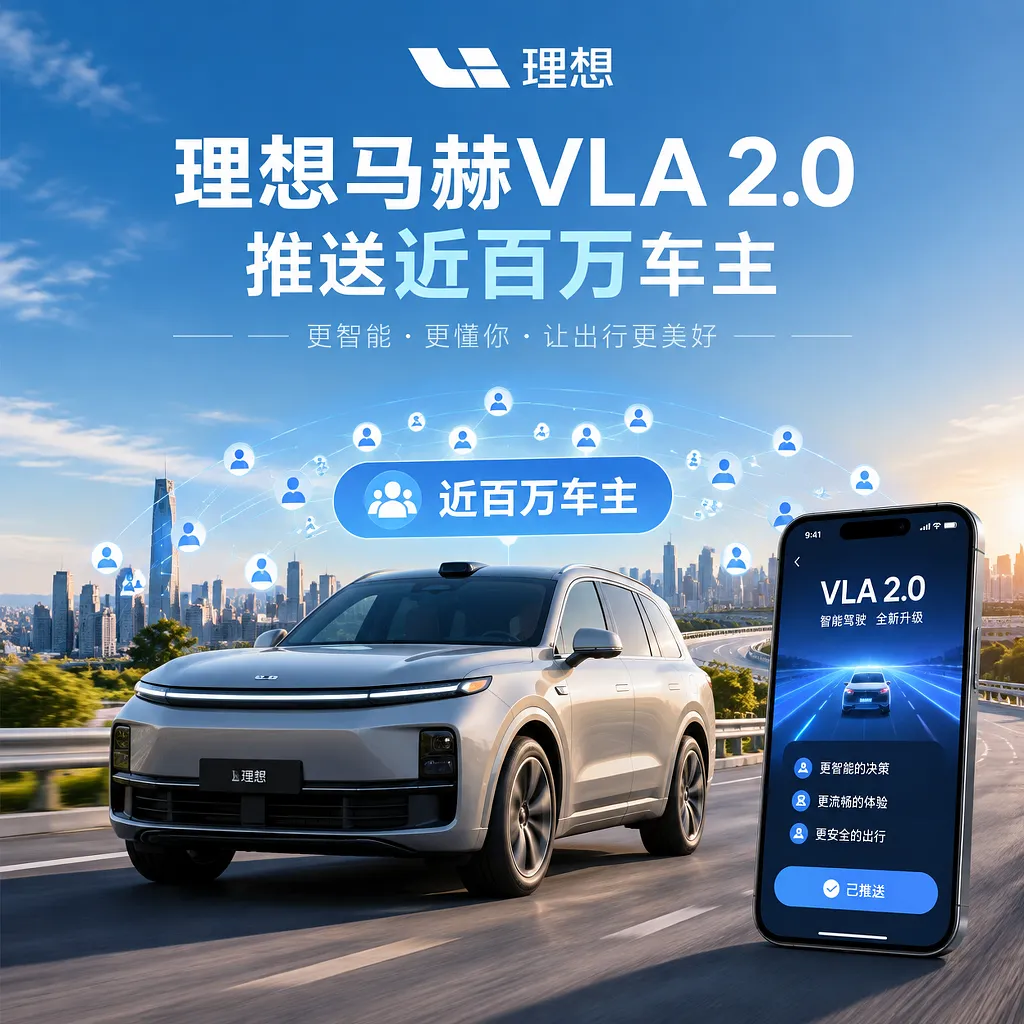
Li Auto announced that Maher VLA 2.0 will begin rolling out on September 10 to delivered AD Max-equipped models, covering nearly one million owners of vehicles based on the Orin and Thor platforms, and will launch as part of OTA 8.6.
Li Auto Pushes Mach VLA 2.0 to Nearly One Million Vehicle Owners
Li Auto has begun delivering its next-generation end-to-end driving model to existing vehicle owners.
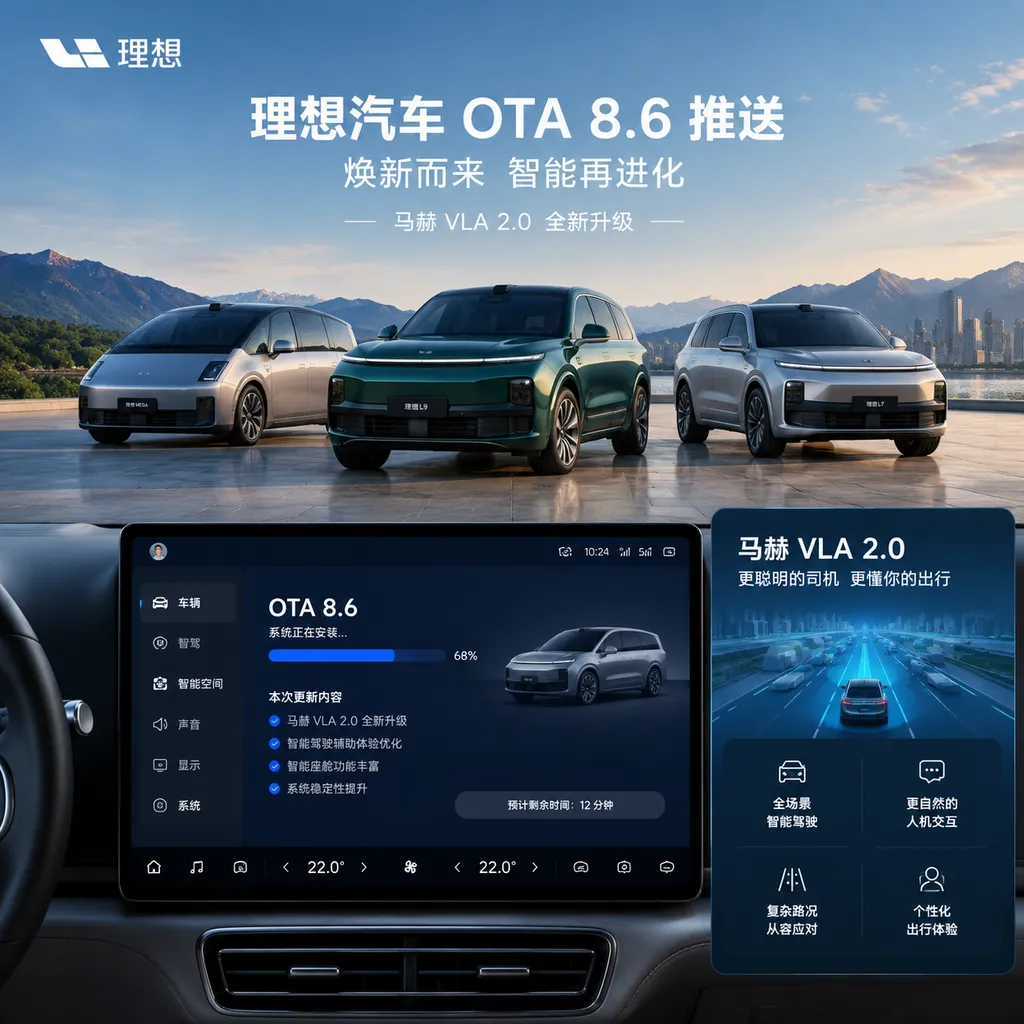
On September 10, Li Auto CEO Li Xiang announced that Mach VLA 2.0 would begin rolling out that day to Li Auto models equipped with the delivered AD Max version, with coverage expected to reach nearly one million vehicle owners. Li Auto also officially launched OTA 8.6, which includes Mach VLA 2.0, Livis AI Glasses command parking, large-screen turn-view imagery, and other features.
The key point of this update is not simply that “another OTA has been released,” but that Li Auto is trying to prove something: upgrades to autonomous driving models do not necessarily have to be tied to buying a new vehicle. For owners of older vehicles equipped with the Orin or Thor platforms, but not with the latest-generation hardware, whether VLA 2.0 can genuinely improve the experience will directly determine the credibility of Li Auto’s “continuous evolution” narrative.
Not Exclusive to New Vehicles: Nearly One Million Existing Vehicles Receive the Upgrade First
According to information released by Li Auto, this update is aimed at models already delivered with the AD Max version. It covers the 2024–2025 Li MEGA, Li i-series, and 2022–2025 Li L-series models. The specific functions supported may vary by model and hardware version, with some capabilities limited to AD Max versions.
Li Auto has not released precise rollout batches, completion dates, or a detailed comparison of features by model. Therefore, “covering nearly one million vehicle owners” is closer to the overall target scale of this upgrade than an indication that all vehicles will receive the update simultaneously on September 10. Following the standard process for automotive OTA updates, systems are generally rolled out in batches. Whether a vehicle owner can install the update immediately will also depend on the model, hardware platform, software version, and rollout batch.
In his public remarks, Li Xiang said that Li Auto hoped new technologies would not come at the expense of existing users, describing the nearly one million Orin and Thor platform vehicle owners as Li Auto’s most valuable asset. This statement has clear product-strategy implications: as the smart vehicle market enters a phase of competition for existing users, automakers are delivering not just a hardware configuration at a particular point in time, but also the ability to receive continuous software upgrades over the following years.
However, this should not be interpreted simply as older vehicles gaining all the capabilities of new vehicles. The final performance of an autonomous driving system is determined jointly by chip computing power, sensor configuration, actuator response, software models, and the data loop. The fact that a model can be adapted to run on older hardware does not mean it is completely equivalent to a version running natively on a newer platform. Li Auto’s use of terms such as “model distillation” and “platform adaptation” itself indicates that VLA 2.0 needs to be compressed, trimmed, or recompiled for different hardware.
The Focus of VLA 2.0: Coordinating Perception, Reasoning, and Planning in One Model
VLA is short for Vision-Language-Action and can generally be understood as a “vision-language-action” model. Rather than merely identifying objects ahead and passing the results to a set of relatively fixed rules and modules, it attempts to let the model directly understand road scenes, the intentions of traffic participants, and driving tasks, then output more continuous driving decisions.
In real-world driving, this change is mainly reflected at three levels.
- Perception: The system needs to identify vehicles, pedestrians, road boundaries, traffic lights, and temporary obstacles, while also determining what they might do next.
- Reasoning: The system needs to place the current image within a longer sequence and determine “why it needs to slow down,” “whether the vehicle ahead is preparing to change lanes,” and “whether there is a potential conflict at the intersection.”
- Planning and control: The system ultimately needs to decide whether to maintain its lane, go around an obstacle in advance, yield, change lanes, or stop, and then convert that decision into smooth steering, acceleration, and braking actions.
Traditional driver-assistance systems are often assembled from multiple modules. Modular solutions make validation and troubleshooting easier, but information transfer between modules can result in a loss of context. For example, a perception module may output only that “there is a stationary vehicle ahead,” while the planning module may not know whether it is a temporarily parked vehicle, an accident vehicle, or a vehicle waiting to enter the main road. VLA-type models aim to preserve more scene context and reduce the disconnect in situations where the system “sees something but does not know how to handle it.”
Li Auto’s official description of Mach VLA 2.0 focuses on distillation and adaptation across multiple vehicle models for perception, reasoning, and planning capabilities, with the goal of making driving smoother and less demanding. This description does not provide specific figures for takeover rates, success rates at complex intersections, or performance in long-tail scenarios. It is therefore premature to interpret the update as a comprehensive leap in autonomous driving capability. For vehicle owners, the more meaningful indicators remain whether the system makes fewer meaningless emergency braking maneuvers, handles vehicles cutting in and road construction earlier, and remains stable in unprotected left turns, narrow roads, and mixed-traffic environments.
The Real Challenge Is “Bringing a Large Model into Older Vehicles”
The most noteworthy technical aspect of this update is not the term VLA itself, but how Li Auto deploys the new model across the different hardware platforms already delivered to customers.
Li Xiang said that Li Auto’s long-term investment in self-developed chips, self-developed models, the self-developed Xinghuan OS operating system, Harness engineering, compilers, and other areas was the reason VLA 2.0 could be deployed to the Orin and Thor platforms. This involves at least three categories of engineering challenges.
The first is model compression. Larger models generally require more computing power, memory, and bandwidth, but the resources of an in-vehicle chip are fixed and cannot be temporarily expanded like a cloud service. Model distillation typically involves using a larger and more capable teacher model to guide the training of a smaller model, allowing the latter to retain as much of its key capability as possible at a lower computational cost. This is not simply a matter of deleting parameters; it involves retraining a student model better suited to in-vehicle operation.
The second is heterogeneous hardware adaptation. Chips from different generations may vary in their computing architectures, memory access, operator support, and power constraints. Even if the same model can run at the framework level, it may still fail to achieve the stability required for real-world driving because of mismatched operators, inefficient data transfer, or latency fluctuations. As a result, compilers, runtimes, and low-level operator optimization directly affect the final experience.
The third is safety validation. If a mobile application stutters, the impact is generally limited to the user experience. Unstable latency in a driving model, however, can affect vehicle decisions. In addition to verifying whether the model can run, a software update must also be tested for new abnormal behaviors under different weather conditions, lighting conditions, road types, and traffic densities. The cost of multiple rounds of validation is often much higher than simply pushing a software package to vehicles.
This also explains why Li Auto has promoted the update in conjunction with its self-developed software and hardware ecosystem. For autonomous driving companies, training the model is only one part of the chain. The true dividing line for large-scale deployment is whether the model can be reliably installed on hundreds of thousands or even nearly one million vehicles.
Smart Features Tied to New Vehicles Are Becoming an Existing-Vehicle Service Capability
Over the past few years, automotive intelligence has often advanced through a pattern of “new models equipped with new chips and new models.” When launching a new vehicle, automakers can redesign the sensors, computing platform, and system software, making the technology relatively straightforward to demonstrate. But this approach is unfriendly to existing users: a high-end vehicle purchased the previous year may be unable to receive new features a year later, leaving the owner to buy another vehicle to regain an upgraded experience.
Li Auto’s decision to push VLA 2.0 to existing AD Max models is significant because it turns software updates from a marketing concept into a product service that users can actually experience. As long as an older vehicle still has sufficient computing power and a sufficient sensor foundation, the automaker has an opportunity to extend its intelligent lifecycle through model distillation and system optimization.
Of course, upgrading older vehicles also creates more complicated product-management challenges for automakers. Different model years, chips, and sensor combinations create numerous software branches, and the same function may provide different experiences on different vehicles. If an automaker emphasizes an “across-the-lineup upgrade” without explaining the specific boundaries, owners can easily confuse the capabilities described in promotional materials with those actually available on their vehicles.
Therefore, evaluating OTA 8.6 should not focus only on “how many vehicles received the rollout.” It should also consider whether Li Auto can clearly explain what has changed after the upgrade: which scenarios are handled by VLA 2.0, which functions remain limited by hardware, which capabilities are undergoing phased testing, and how owners can provide feedback when problems occur. For driver-assistance systems, transparency and clearly explainable capability boundaries are just as important as the model metrics themselves.
Livis Command Parking Is a More Noticeable New Feature
Compared with an upgrade such as VLA 2.0, which requires long-term use before vehicle owners can assess it, Li Auto’s Livis AI Glasses command-parking feature is easier to notice in everyday situations.
This OTA supports parking control through various voice commands. Its product logic is relatively straightforward: after getting out of the vehicle, the owner can use voice commands to have the vehicle park, exit a parking space, or move in certain scenarios, reducing the need to repeatedly get in and out of the vehicle in narrow parking spaces or crowded parking lots.
But the key to voice-controlled parking is not whether the system can understand a single sentence. It is whether the system can accurately confirm the vehicle’s status, surrounding environment, and the user’s intent. For example, when the owner says “come out a little,” the system needs to know the distance and direction of movement and whether pedestrians or other vehicles are present. If the vehicle is in a state unsuitable for executing the command, the system should reject the action rather than force it through.
From a product-priority perspective, Livis command parking is a low-speed feature with relatively clear boundaries, and its risks and validation challenges are generally lower than those of advanced driver assistance on open roads. By including it in the same OTA as the driving-model upgrade, Li Auto can both make the update more noticeable and allow owners to experience the value of continuous software iteration sooner.
What Else Has Changed in OTA 8.6
In addition to Mach VLA 2.0 and Livis command parking, OTA 8.6 also adds large-screen turn-view imagery, art frames, new games, and other features.
Large-screen turn-view imagery mainly serves scenarios such as low-speed turns, passing on narrow roads, and parking. Its practical value depends on when the imagery appears, its clarity, and how well it matches the vehicle’s steering state. If the screen switches too slowly, or if the image takes up too much space and interferes with other important alerts, the new feature could instead increase the driver’s workload. Therefore, although this type of feature may appear to be merely a change at the display layer, its ultimate value still depends on whether it genuinely reduces the cost of observing the surroundings.
Art frames and new games belong to the in-vehicle entertainment experience. They do not change the vehicle’s core driving capabilities, but they can increase the frequency with which the infotainment system is used by families and during long-distance travel. Li Auto has consistently emphasized family-oriented scenarios, so these features are consistent with its user positioning. However, their contribution to the value of the OTA is clearly lower than that of the driving-model and parking upgrades.
Is This Upgrade Really Worth Anticipating?
My assessment is that this rollout is worth watching, but the mere appearance of the four characters “VLA 2.0” should not lead anyone to assume that the experience will necessarily improve by an entire generation.
Its greatest significance lies in its scale. Whether the new model can cover nearly one million already-delivered AD Max vehicles will test Li Auto’s complete engineering capabilities, from training and distillation to compilation and OTA release. If the rollout is stable, experience differences across platforms remain manageable, and owners can clearly feel that driving decisions have become more natural, Li Auto can further establish the expectation that buying a vehicle also means continuing to receive capability upgrades after the purchase.
The biggest uncertainty is equally clear: the specific capability boundaries of VLA 2.0 on the Orin and Thor platforms have not yet been disclosed. Li Auto has not released reproducible quantitative metrics or explained the detailed differences among models. For developers and technically oriented users, promotional descriptions such as “smoother” and “less demanding” can serve only as directional descriptions and cannot replace real-world road testing.
Vehicle owners can focus on the following aspects:
- Whether complex intersections involve less hesitation, repeated braking, and unnecessary lane changes.
- Whether the system leaves space earlier when dealing with vehicles cutting in, road construction, and temporary obstacles.
- Whether following, stop-and-go, and steering actions are more continuous, and whether new abrupt maneuvers appear.
- Whether there are significant capability gaps among different hardware platforms and vehicle models.
- Whether the conditions for enabling driver assistance, alert methods, and manual takeover requirements change after the OTA is installed.
It is important to emphasize that VLA 2.0 is still an upgrade to driver-assistance capabilities. It does not mean that the vehicle can drive autonomously without driver supervision. Regardless of how the model is updated, drivers must continue to pay attention to the road environment and use the relevant functions in accordance with the vehicle’s instructions and local regulations.
What Li Auto is truly delivering this time is not merely a new model, but a test of the software lifecycle of existing vehicles. New vehicles can create selling points through hardware differences, while upgrades to older vehicles more effectively test an automaker’s technical foundation and ability to deliver on its service commitments. September 10 marks only the beginning of the rollout. The actual experience, fault reports, and upgrade pace over the following weeks will determine whether Mach VLA 2.0 is a substantial product update or merely another technical term confined to a launch event and promotional copy.
Sources
- IT Home: Li Xiang Says Mach VLA 2.0 Begins Rolling Out Today to Delivered Li Auto Models with AD Max: Report on Li Xiang’s public statements regarding the rollout scope, coverage scale, and technical investment.