<think>**Translating headline request** </think> NVIDIA Rebuilds Its Supply Chain with Nemotron
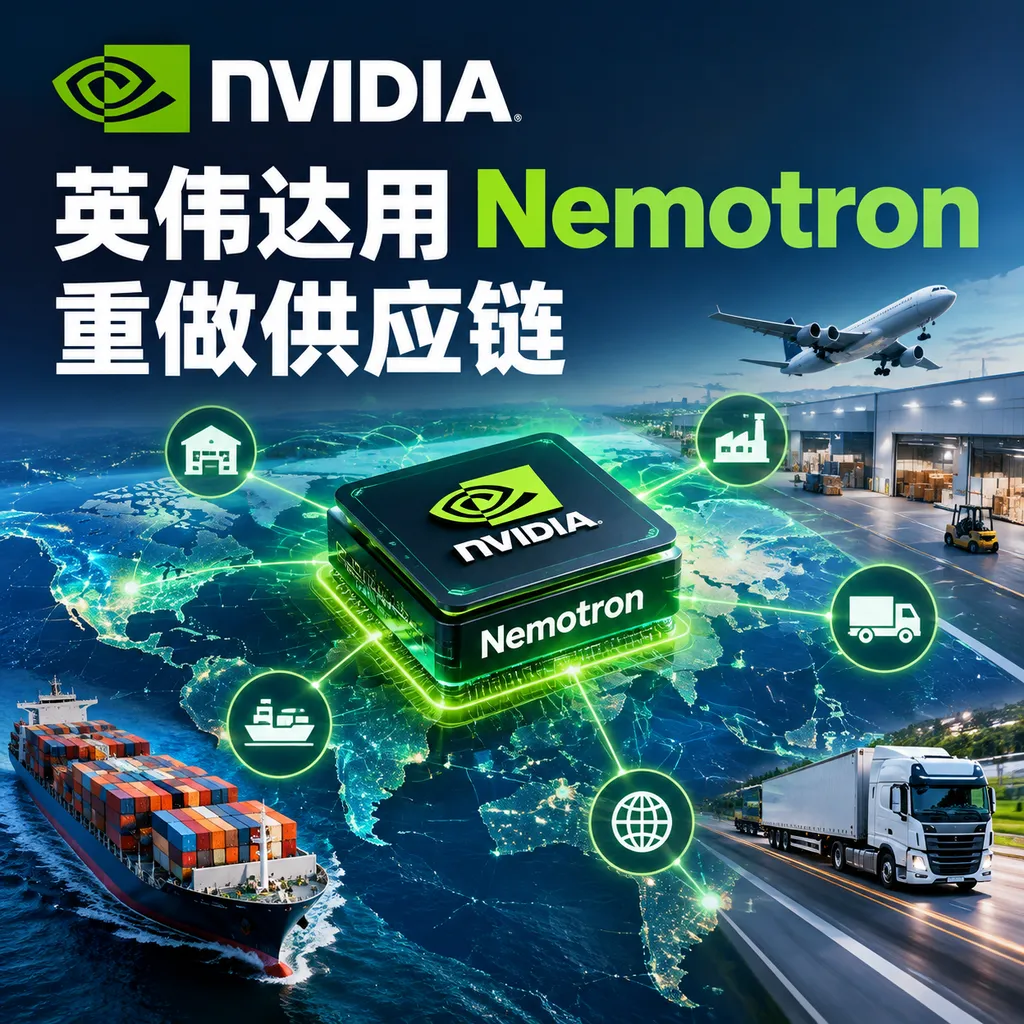
NVIDIA and Palantir announced a partnership to integrate the open-source Nemotron models into Foundry, AIP, and Ontology, initially serving NVIDIA’s own complex supply chain. The two companies seek to use deployable, auditable, data-controllable sovereign AI to advance model capabilities into materials allocation and production-capacity decision-making.
Nvidia Rebuilds Its Supply Chain With Nemotron: Sovereign AI Enters the Production Floor
On September 10, 2026, Nvidia and Palantir announced a partnership to integrate Nvidia's open-source Nemotron models into Palantir Foundry, the Artificial Intelligence Platform (AIP), and the Ontology framework, with validation beginning in Nvidia's own production operations.
This is neither a simple model listing nor the addition of a chat window to a supply chain system. The two companies are building a complete AI technology stack spanning data, business logic, optimization solving, and action recommendations. The goal is to help enterprises identify supply chain constraints earlier, compare alternatives faster, and move some decision support toward machine speed.
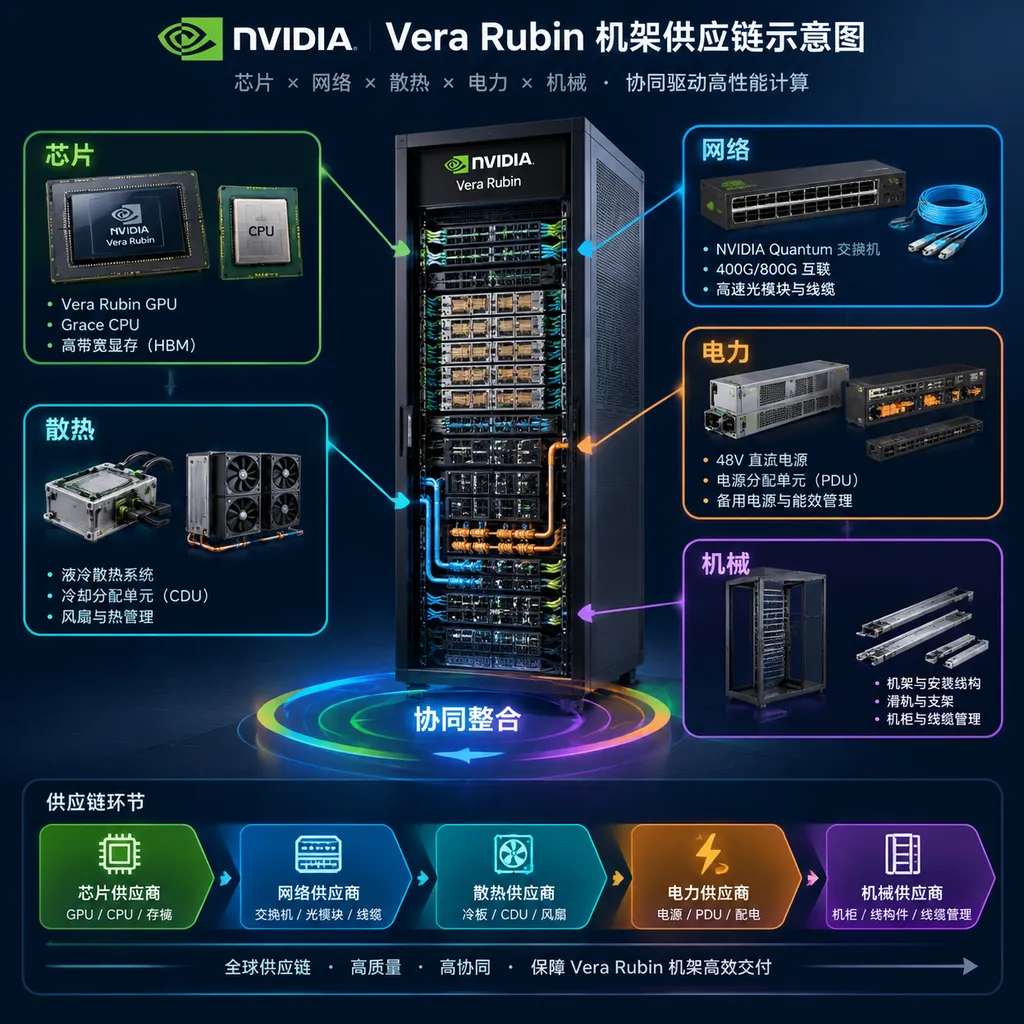
It is no surprise that Nvidia chose its own supply chain as the testing ground. The supply chain for AI servers and racks is far more complex than that of ordinary consumer electronics: it must coordinate compute, storage, networking, power, cooling, mechanical structures, and manufacturing services at the same time. Reference materials state that an Nvidia Vera Rubin rack contains roughly 1.3 million components, linked to thousands of suppliers and global manufacturing partners. A delay in any critical component can be amplified throughout the production network and ultimately affect delivery of complete systems.
From this perspective, the focus of the partnership is not whether Nemotron can answer supply chain questions, but whether the model can operate within real business constraints and participate in material allocation, capacity scheduling, and risk warnings.
The Difficulty of Supply Chain AI Is Not Whether It Can Talk, but Whether It Can Calculate
Large language models excel at understanding unstructured information, summarizing context, and generating proposals. But supply chain decisions are not language problems. They typically involve hard constraints such as inventory limits, supplier lead times, transportation capacity, production-line load, quality requirements, and customer priority. An answer that sounds reasonable but fails to meet those constraints may simply be "convincingly wrong" when placed into a production system.
Palantir's approach attempts to divide the problem into several cooperating layers:
- Foundry manages business data and operational processes. It can connect internal enterprise data on suppliers, inventory, orders, production, and logistics, placing fragmented information into a unified business environment.
- Ontology maps data into business objects and relationships. Suppliers, components, factories, orders, and production lines are no longer merely fields in a spreadsheet, but objects that can be understood through business rules.
- AIP handles application orchestration. Enterprises can use it to build AI applications for supply chain teams, allowing models to read authorized data and integrate recommendations into existing workflows.
- Nemotron handles understanding, reasoning, and recommendation generation. After post-training on an enterprise's own data, the model can work with proprietary business terminology, operational experience, and decision standards.
- cuOpt handles optimization solving and scenario planning. It is closer to a traditional operations-research optimization engine, used to compare resource-allocation options and analyze bottlenecks and tradeoffs among alternatives.
The key to this combination is that the language model no longer bears the entire task alone. Nemotron can explain why a recommendation is made, while cuOpt helps calculate whether the recommendation satisfies constraints and what it costs. The former clarifies complex information; the latter makes the proposal computationally sound. Palantir's data and ontology layers ensure that both operate within the correct business context.
This is much closer to the system enterprises actually need than calling a general-purpose large model by itself. What supply chain leaders need is not a polished analytical report, but answers to questions such as: What happens if a batch of materials is moved from Factory A to Factory B? Which orders will be affected? Does an alternative supplier have sufficient capacity? Will that action simply shift risk downstream?
Nemotron's Value: Enterprises Can Adapt It Instead of Merely Adapting to It
In this architecture, open-source models are an important choice. Enterprises can post-train Nemotron using their own business data so that the model adapts to proprietary product names, supplier hierarchies, historical operating experience, and internal decision policies.
Here, "post-training" does not mean indiscriminately feeding all data into the model. A more practical approach is for enterprises first to curate high-quality business samples and decision records, then use permission, isolation, and auditing mechanisms to determine which data the model may use. For critical supply chains, what the model can see, what recommendations it can make, and whether it can trigger subsequent actions should all be defined by the enterprise.
An adapted Nemotron can take on several kinds of work:
- Identify potential bottlenecks. Detect constraints that may affect deliveries from supplier lead times, inventory changes, production schedules, and logistics status.
- Compare alternatives. When material shortages, delays, or capacity shortfalls occur, generate candidate actions for further calculation by the optimization engine.
- Explain tradeoffs. Describe what a material-allocation decision sacrifices, what it protects, and how it affects end-to-end production.
- Continuously capture operating experience. Convert judgments previously made through the personal experience of supply chain experts into reusable processes and knowledge.
- Warn of risks. Alert relevant teams before problems become line stoppages or delivery delays.
However, a model making recommendations does not mean the model has decision-making authority. Under the partnership's approach, final judgment remains with supply chain experts. This is especially important in critical manufacturing: when multiple customers, factories, and suppliers are in conflict, the system can provide faster and more complete calculations, but responsibility cannot be handed over to a black box.
When "Sovereign AI" Is Implemented, Where Does the Sovereignty Lie?
Palantir has repeatedly emphasized sovereign AI in recent years. The term does not mean exactly the same thing for every vendor, but in this partnership it includes at least several concrete requirements.
The first is data control. An enterprise's supplier prices, inventory levels, capacity plans, and manufacturing know-how should not fall outside its control simply because it calls an external model. The second is customizability of models and business logic. Enterprises do not need to fully accept the default behavior of general-purpose models; they can adapt them around their own constraints. The third is deployment autonomy. Sensitive operations need support for on-premises deployment, isolated networks, and even air-gapped environments, rather than sending data to a public cloud by default. The fourth is an auditable action process. The system should be able to trace which data the model saw, which rules it referenced, what recommendations it generated, and who approved the final action.
Reference materials indicate that the solution is based on Nvidia reference architectures and a jointly developed Palantir Sovereign AI Operating System reference architecture. It supports local deployment on equipment from system vendors such as Dell and Cisco, and can also run in managed data center and cloud environments such as Rackspace and Nebius. For government agencies, critical infrastructure operators, and multinational manufacturers, deployment location is not simply a matter of cost, but of compliance, confidentiality, and business continuity.
This is also where Palantir differs from a pure model vendor. It does not merely sell a model API; it seeks to control the entire chain, from data authorization and business modeling to application execution. Nvidia supplies the model, accelerated computing, and optimization-software capabilities. Together, they are selling an implementable "model plus business system," rather than an isolated product.
Why Nvidia Is Transforming Its Own Supply Chain First
Nvidia's supply chain is a highly persuasive but difficult-to-replicate example. Its products iterate rapidly, demand is concentrated, rack-scale systems contain enormous numbers of components, and it depends on a global manufacturing network. For such a system, even making material allocation and bottleneck identification more timely could shorten the cycle from component movement to complete-system delivery.
Using it internally first has several additional benefits.
- Business objectives are clearer. Nvidia can directly define what counts as an improvement in supply chain efficiency instead of relying on customers to describe their needs abstractly.
- Feedback cycles are shorter. Supply chain teams can continuously test whether model recommendations are useful and feed expert corrections back into the system.
- The data loop is more complete. The model faces Nvidia's own business data, processes, and accountability structure.
- It is easier to form a reference architecture. Once internal validation succeeds, Palantir can package the experience into solutions for other complex industries.
But this also means that success inside Nvidia does not mean that ordinary enterprises can copy it directly. Procurement rules, data quality, supplier coordination capabilities, and IT foundations vary greatly across companies. Nemotron's weights may be open, but enterprise business data and decision processes do not become standardized automatically.
For Developers, the Model Name Is Not the Most Important Thing
The first lesson for developers is that enterprise AI is shifting from being "model-centric" to "system-centric." Previous discussions often focused on which model has more parameters, longer context, or higher benchmark scores. In supply chain scenarios, the model is only one component. Data permissions, business objects, optimization algorithms, workflow approvals, and deployment environments often matter more than the model itself in determining whether a project can go live.
Second, the way open-source models compete is changing. Open source is not merely about reducing API costs or enabling local execution. For enterprises, the greater value is being able to adjust models around their own data and rules, and deploy them in environments that better meet security requirements. The prerequisite is that the enterprise can complete data governance, evaluation, post-training, and operations. Otherwise, "customizability" simply becomes another integration burden.
Finally, generative AI and traditional optimization are not an either-or choice. Language models are suitable for processing complex, ambiguous, and unstructured business information, while optimization solvers are suitable for finding feasible solutions under explicit constraints. Connecting the two is what creates the possibility of moving AI from "giving recommendations" toward "helping make decisions."
What Are the Practical Limitations of This Solution?
It is necessary to remain measured. Public information currently describes the partnership direction, technical components, and initial application scenarios, but does not disclose how much supply chain cycles have been shortened, how much inventory has declined, or the accuracy and human adoption rate of model recommendations. It is more like a reference architecture being implemented than a standard answer that has already been fully validated.
At least four issues still require observation:
- Data quality. If supplier lead-time, inventory, and capacity data are not updated promptly, the model can only generate outdated recommendations faster.
- Constraint modeling. Real supply chain rules are often implicit in expert experience. Accurately mapping those rules into the Ontology and optimization models is an implementation challenge.
- Exception handling. Extreme events such as wars, disasters, export restrictions, and sudden supplier shutdowns may fall outside the coverage of historical data.
- Organizational adoption. Whether supply chain experts trust the model and are willing to change established processes will determine whether the system becomes a production tool or merely an AI dashboard for demonstration.
If Palantir and Nvidia intend to bring this solution to more customers, they must demonstrate value through measurable indicators, including forecast lead time, proposal-generation time, material turnover cycles, material-shortage rates, inventory utilization, and manual-approval efficiency. Only by clearly showing these results can "sovereign AI" avoid remaining a technical and political slogan.
From Nvidia's Supply Chain to More Industries
The two companies plan to further demonstrate this technology stack and its cross-industry applications at the Palantir AIPCon 11 conference. Agriculture, manufacturing, pharmaceuticals, retail, technology companies, and government agencies could all become potential users. Their commonality is not that they all need a chatbot that is better at conversation, but that they all face operational decisions involving multiple stages, multiple constraints, and strict compliance requirements.
If this technology stack can prove effective in Nvidia's supply chain, the next step may be more combinations of "industry-specific models plus operating systems": pharmaceutical companies focus on batches, quality, and cold chains; retailers focus on inventory and store replenishment; manufacturers focus on production lines and supplier coordination; and government agencies place greater emphasis on isolated deployment and data authorization. The underlying models may be similar, but the ontology, rules, optimization objectives, and approval processes must be redesigned for each industry.
This is also the most noteworthy aspect of the partnership: it does not portray AI as an autonomous driving system that replaces supply chain experts. Instead, it places the model within an authorized, explainable, and traceable decision loop. For critical operations, this path may be slower than pursuing full automation, but it has a better chance of actually entering production environments.
One-sentence assessment: The significance of integrating Nemotron into Foundry is not that there is one more model-access platform, but that Nvidia and Palantir are moving "sovereign AI" beyond a security narrative about local deployment and into material allocation, bottleneck identification, and capacity operations, where ROI can be calculated directly. Whether it can become an industry model will depend on whether it can produce real supply chain results, not architecture diagrams.
Sources
- Nvidia and Palantir partner to bring sovereign AI to critical supply chains: Introduces the partnership, the integration of Nemotron with Foundry/AIP, and the application context of Nvidia's supply chain.
Note: This article is compiled from publicly available materials. Deployment results, performance metrics, and commercialization scale should remain subject to subsequent disclosures by Nvidia and Palantir.