
Baidu Miaoda Turns AI Applications into a Business

On September 11, Baidu Miaoda announced a product upgrade, launching a no-code application outsourcing platform and enterprise capabilities to connect enterprise needs with OPC creators. It plans to facilitate deals worth RMB 100 million over the next three years. Miaoda is transitioning from an AI application generation tool into a platform covering development, delivery, acceptance, and monetization.
Baidu Miaoda Turns AI Applications into a Business
On September 11, Baidu Miaoda announced at the Baidu AI Day · Miaoda special event held in Hangzhou that the platform would launch the industry's first no-code application marketplace for commissioned projects, while simultaneously upgrading its capabilities in application design, generation, distribution, growth, and commercialization.
The focus of this upgrade is not simply the addition of a few more generation buttons. Rather, Miaoda is beginning to fill in a link that no-code products have generally bypassed: who will develop the application, how it will be delivered, how it will be accepted, and whether it can actually be sold after it has been built.
In the past, AI application platforms were more like highly efficient prototypes. Users entered their requirements, models generated pages, workflows, and some of the logic, and the applications could run. But between “can run” and “can be used” lie permissions configuration, data integration, business adaptation, deployment, and ongoing maintenance. For enterprises, this journey is often more difficult than generating a page.
Miaoda is now attempting to pave this road.
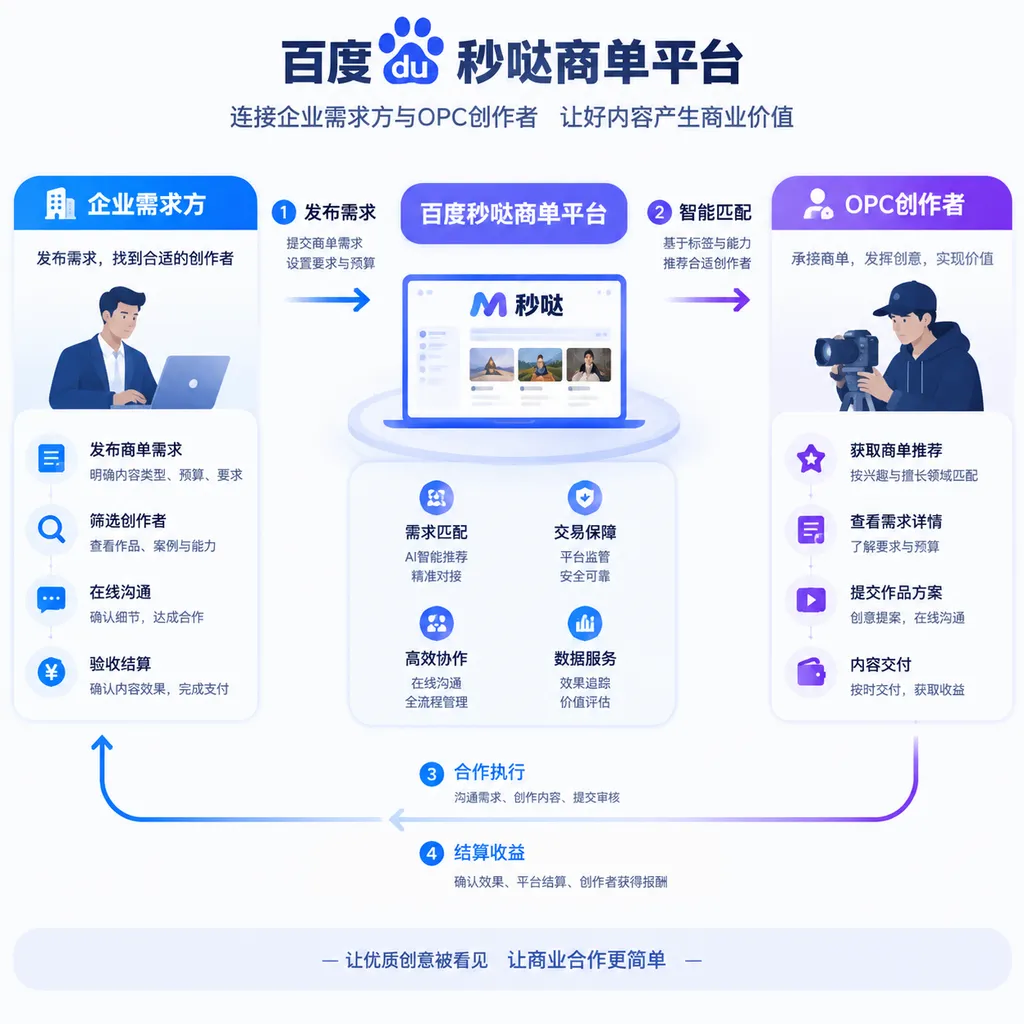
From Generating Applications to Delivering Applications
The commissioned-project platform is not complicated: Enterprises can post requirements for complete application development from scratch, or hand over applications already built with Miaoda to professional creators for takeover, refinement, or continued development. Creators, meanwhile, can respond to project requests after passing work reviews, completing professional certification, and opening a merchant account.
After a contract is signed, project funds are held securely in escrow by Alipay and settled after acceptance. Demanders can preview the application's progress in real time after the project is first posted. Before the project is accepted, both parties can also apply for after-sales service.
This mechanism may look like the basic rules of the software outsourcing market transplanted onto a no-code application platform. But that is precisely where its value lies: AI lowers the development threshold, but it does not automatically eliminate delivery responsibility. Who is responsible for the final result, how completion of the requirements is determined, and whom to contact when problems arise must all be handled by platform rules.
The launch event also featured a live project-acceptance experiment. An entrepreneur presented a genuine requirement, and a creator used Miaoda to complete and deliver the application on site. A demonstration, of course, cannot be equated with a real project, but it at least illustrates the product mindset Miaoda wants to establish: an application does not reach the end of its life once it has been generated; it can be commissioned, modified, accepted, and paid for.
This is also a key difference between Miaoda and ordinary AI web-page generators. The latter mainly solve the problem of “making one,” while Miaoda is attempting to solve the problem of “how to bring it into the business after it has been made.”
The Enterprise Edition Begins to Fill the Gaps
For enterprises, Miaoda has officially launched an enterprise edition, offering capabilities including one-click private deployment and updates, organization management, permission management, and collaborative team creation.
These features may sound less eye-catching than “generate an application with one sentence,” but they are closer to the issues enterprises genuinely care about when making purchases. Once an application enters a company's core processes, managers usually do not ask only whether it can generate pages. They will continue asking: Where is the data stored? What can different departments see? Who can make changes? How are versions updated? How are the permissions of departing employees revoked? Can problems be traced when failures occur?
If the personal edition emphasizes the path from ideas to prototypes, the enterprise edition is meant to solve the transition from prototypes to production. Private deployment enables enterprises to place applications in environments that better meet their own security and compliance requirements. Organization and permission capabilities determine whether the application can be embedded in complex collaboration structures. Collaborative team creation, meanwhile, ensures that applications no longer depend on a “super individual” who knows how to use AI.
Of course, the launch of enterprise capabilities does not mean that Miaoda has completed its transformation into enterprise software. Enterprise customers want stable integration capabilities, clear service boundaries, and sustainable operations and maintenance mechanisms. Generation speed alone cannot replace this infrastructure. Whether Miaoda can make private deployment, data connections, and long-term services robust will be the key to whether this route succeeds.
Five Million Applications: How Far Are They from Real Business?
The data disclosed by Baidu is highly ambitious: Miaoda's user base has grown 200-fold; users have created more than 5 million commercial applications in total; nearly 200,000 people use these applications every day to solve real-world problems; and the growth rate of enterprise paying users is 14 times that of the personal edition. According to a Sullivan report, in the first half of 2026, Miaoda ranked first in China's AI-native no-code application-generation platform industry, with a 33.4% market share.
These figures indicate that AI application generation has moved beyond the trial stage and entered a phase of broader-scale use. But “how many applications have been created” and “how many applications generate sustained value” are not the same metric. Many applications may remain in internal trials, personal experiments, or one-off event pages. Products that can operate over the long term, attract users, and generate revenue are the real currency of platform competition.
Another set of publicly released data from Miaoda better illustrates its commercialization direction: The number of applications on the platform equipped with payment plugins has reached 53,000; transactions completed through WeChat Mini Programs have reached 420,000; and the total value of projects delivered to business clients has exceeded RMB 30 million. Previously, some applications had already achieved a daily DAU of more than 2 million.
These cases cannot prove that every AI application can make money, but they do prove that application platforms do not have to monetize solely through subscription fees or model-call fees. Template transactions, project delivery, plugin payments, and application operations may all become new revenue points.
OPC Needs More Than Tools
Miaoda released the commissioned-project platform and the “Dream-Building Plan” together, with a clear objective: to serve not only individual developers, but also the emerging OPC community.
OPC, or One Person Company, generally refers to an entrepreneurial model in which one person uses AI and software tools to handle product development, operations, marketing, and even delivery. Its difference from a traditional startup is not merely that it has fewer people on the team. Rather, AI takes over part of the work that previously required collaboration among multiple people. Someone with industry expertise may no longer need to assemble a complete product, design, and development team before having the opportunity to validate an idea.
But the bottleneck for OPCs has never been development alone. Creators need to find demand, define boundaries, manage customer expectations, and handle payment, acceptance, after-sales service, and repeat purchases. Without transaction infrastructure, the easier AI tools become to use, the more likely the market is to be flooded with similar half-finished products. Without quality certification and delivery mechanisms, enterprises will not dare entrust critical processes to unfamiliar creators.
The commissioned-project platform is effectively adding a layer of “professionalization” to OPCs: Work reviews are responsible for screening, merchant-account opening establishes a transactional identity, escrowed funds reduce payment risks, and project previews and after-sales mechanisms attempt to turn one-off generation into a manageable service process.
Baidu says that over the next three years, it will use the “Dream-Building Plan” to promote 30 million template transactions, serve more than 1 million developers through the commissioned-project platform, and facilitate projects with a total transaction value of RMB 100 million. This is a major target, but it also exposes the platform's most important problems to solve: 1 million developers do not equal 1 million developers capable of delivering reliably, and RMB 100 million in transaction value does not equal creators' net income. Whether the platform can establish reasonable commission, certification, and dispute-resolution mechanisms will directly affect the quality of the ecosystem.
Hangzhou Bets on AI + OPC
At the regional ecosystem level, Baidu Miaoda and the government of Shangcheng District, Hangzhou, jointly released an “AI + OPC” scenario list and included Miaoda in the OPC toolkit. Hangzhou's “AI + OPC” action plan, released in 2026, proposes establishing more than 100 OPC communities and bringing together more than 5,000 high-growth OPCs by 2028.
Putting tools into local entrepreneurship policies and scenario lists means more than publicity. For AI entrepreneurs, real business scenarios are more important than a vague “entrepreneurship space”: Whether sectors such as catering, supply chains, enterprise offices, and content production can continuously provide demand determines whether creators have opportunities to turn demos into orders.
The cases presented at the launch event covered enterprise office systems, supply-chain order tracking, AI image creation, and catering Mini Programs. They also reflected Miaoda's strategy: to begin with numerous fragmented, clearly defined, and limited-budget business needs, rather than challenging the core systems of large enterprises from the outset.
The advantage of this strategy is rapid implementation and abundant demand; the drawback is that projects can easily become fragmented. If the platform merely aggregates large numbers of low-value customized orders, creators may fall into a new form of outsourcing in which they “use AI to improve efficiency but trade time for income.” Miaoda needs to turn each delivery into an asset for the next one through template reuse, a component marketplace, and industry solutions. Otherwise, as the platform grows, its management costs will also rise.
The Real Competition Begins After Delivery
From an industry-competition perspective, AI-native no-code platforms are visibly diverging. One category of products continues to pursue faster generation of websites, applications, and workflows; another is expanding into enterprise permissions, deployment, transactions, and operations. The former is more likely to attract user attention, while the latter is more likely to build customer loyalty.
Miaoda's upgrade has chosen the latter path. It is attempting to hide model capabilities behind the product, so that users face not a collection of complex prompts and APIs, but a more complete application-production line. For small and medium-sized enterprises that do not want to build a technical team but do have genuine digitalization needs, this direction has practical value.
However, the platform's ceiling is equally clear: no-code does not mean no complexity. When applications involve multi-system data synchronization, granular permissions, real-time performance, stability, and high concurrency, professional engineering capabilities are still required. AI can compress a great deal of repetitive labor, but it cannot make business judgments on behalf of enterprises, nor can it automatically solve problems of data quality and organizational collaboration.
Therefore, what is most worth watching about Miaoda's commissioned-project platform is not whether it can generate several million more applications, but whether it can establish a set of reusable delivery standards: What requirements are suitable for no-code, and which require manual development? How should application quality be evaluated? How can data and permissions be safeguarded? How can creators obtain sustained income through templates, components, and services?
If these problems can be solved, Miaoda will be more than an AI application generator; it may become infrastructure connecting enterprise demand, creator supply, and application operation. Conversely, if the commissioned-project platform is merely an information-matching marketplace where enterprises post requirements and developers accept projects, while the platform cannot control quality or after-sales service, it could easily degenerate into an outsourcing website wearing an AI veneer.
For developers, Miaoda's upgrade sends a signal: Competition among AI applications is shifting from “who can generate faster” to “who can deliver applications and keep them running.” Generation is only the starting point. Transactions, deployment, operations, and repeat purchases determine whether an application is a product.
Conclusion
On the surface, Baidu Miaoda's upgrade is an expansion of product capabilities; in substance, it is an earlier move toward a business model. It is no longer satisfied with being a tool for validating ideas, but is attempting to place individual developers, enterprise customers, and local entrepreneurial ecosystems into a single closed loop.
Whether this loop can operate successfully still requires validation through real orders, long-term retention, and measurable creator income. At the very least, however, Miaoda has moved the question from “Can AI build applications?” to a more practical level: Who is willing to pay for these applications, and can the platform make delivery reliable enough?
References
- Official Baidu Miaoda materials and publicly released event information: Used to verify information about the product upgrade, enterprise edition, commissioned-project platform, and “Dream-Building Plan.”
- Public industry reports: Used to compile data on Miaoda's user base, application count, enterprise-user growth, and market share.
- Public information related to Hangzhou's “AI + OPC” initiative: Used to explain the background of Hangzhou's OPC entrepreneurial ecosystem and scenario list.
Note: Under the requirements for the whitelist of links in this article, the source domains provided in the reference materials are not on the permitted list. Therefore, no inaccessible or non-compliant external links are included.


