Apple Uses a Model to Design a Protein

Apple researchers have unveiled SimpleDesign, which can jointly generate protein amino acid sequences and three-dimensional structures within a single model. It replaces traditional multi-stage architectures with end-to-end training, but its current results remain limited to computational evaluations and are still some distance from laboratory validation.
Apple Turns Protein Design into an End-to-End Generative Problem
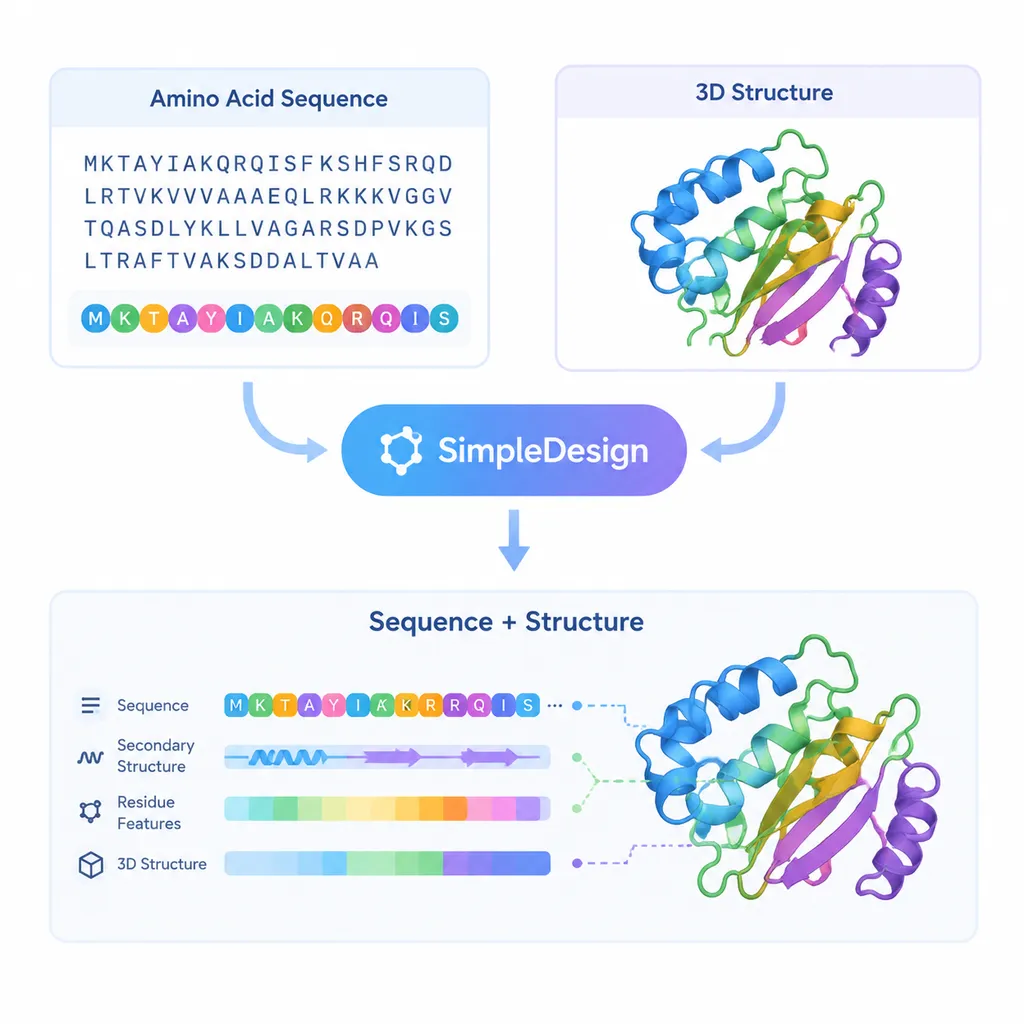
Apple researchers recently unveiled a protein design model called SimpleDesign. Unlike models that are responsible only for predicting structure or only for inferring a sequence from a structure, SimpleDesign attempts to answer both questions in a single generation process: what amino acids make up the protein, and what three-dimensional structure those amino acids will ultimately fold into.
The related paper was published as a preprint in September 2026. The research team says that SimpleDesign achieved competitive results on benchmarks for joint protein design, structure generation, and sequence generation, with the overall quality of its generated sequences matching or exceeding that of most competing multimodal models.
But the real significance of this work is not simply that there is now one more protein model. It is that Apple has chosen a relatively “counter-mainstream” technical approach: instead of first compressing proteins into discrete intermediate symbols and then handing them to a generative model, it trains a unified model directly on raw amino acid sequences and continuous three-dimensional coordinates.
This makes the model simpler and the training process shorter. However, a simple architecture does not mean a simple problem. Protein design ultimately has to be validated in the laboratory. The current paper has not yet demonstrated that the molecules generated by the model can fold stably, perform their intended functions, or operate safely in real biological systems.
From SimpleFold to SimpleDesign
SimpleDesign continues the approach behind Apple’s previously announced SimpleFold. SimpleFold takes a known amino acid sequence as input and predicts its corresponding three-dimensional structure. SimpleDesign moves the problem one step forward: the model must not only understand “how a sequence folds,” but also work backward to find “what kind of sequence can form a target structure.”
A protein can be thought of as a long chain made up of amino acids. The sequence determines the chemical properties along the chain, while the chain folds under complex physical constraints, ultimately forming a three-dimensional molecule with a specific shape. Traditional protein design often requires switching back and forth between sequence space and structure space: generating a structure first and then finding a matching sequence, or training a structure encoder first and then training a generative model. Every additional layer of conversion can introduce information loss and additional training difficulty.
SimpleDesign’s approach is more like placing two interdependent design variables on the same sheet of paper. The model sees the raw data of the sequence and three-dimensional coordinates, learning the relationship between them rather than first translating the structure into a string of artificially defined “structure tokens.”
This approach stands in sharp contrast to classic structure-prediction systems such as AlphaFold2 and RoseTTAFold2. Those systems use numerous components specifically designed for protein-related problems—including triangle updates, pair representations, and multiple sequence alignments (MSAs)—deeply embedding the prior knowledge accumulated by researchers into the models. They are extremely powerful at structure prediction, but their systems are also more complex, with heavier training and inference processes.
Apple’s assessment is that a general-purpose Transformer combined with an appropriate generative method may already be sufficient to learn a substantial portion of sequence–structure relationships from data. This does not mean that specialized components have no value. Rather, it poses the question to a more general model: can we use less hand engineering and let the model discover more of the patterns for itself?
One Model for Folding, Inverse Folding, and Joint Design
The core of SimpleDesign’s training method is not particularly complicated. The research team used more than two million paired protein sequence–structure samples, primarily from the AFESM dataset. During training, the model randomly masks part of the amino acid sequence while adding noise to the corresponding three-dimensional structure, and then learns to restore the corrupted information.
The key is that researchers can control how severely the sequence and structure are corrupted, respectively. Different corruption ratios effectively correspond to different protein tasks:
- The sequence is largely intact while the structure is heavily noised: The model must recover the three-dimensional form from the sequence, approximating the protein-folding task.
- The structure is largely intact while the sequence is heavily masked: The model must generate a sequence capable of forming that structure, approximating the inverse-folding task.
- Both the sequence and structure are partially corrupted: The model must combine the two types of incomplete information to perform joint sequence–structure design.
- Both the sequence and structure provide little information: The model can attempt to generate a complete protein candidate from weaker conditions.
In more intuitive terms, the process is like simultaneously repairing a written manuscript and a three-dimensional model. Part of the manuscript is missing, while the three-dimensional model is also covered by noise. The model must use the clues remaining on both sides to cross-check one another: the sequence tells it which chemical combinations are more plausible, while the structure constrains whether those combinations can ultimately form the target shape.
The advantage of this unified training approach is that separate model suites do not have to be maintained for folding, inverse folding, and de novo design. For researchers, switching tasks can be accomplished by adjusting the input conditions rather than rebuilding an entire training pipeline. For the generative model, sequence and structure are no longer two isolated outputs; instead, they jointly form a state that must explain each other.
The Real Technical Change: Bypassing Discrete Latent Representations
Many joint protein design models first train an autoencoder to convert complex three-dimensional structures into discrete latent representations. The generative model then only needs to generate these “structure tokens,” after which a decoder reconstructs the spatial coordinates.
This is similar to how text-to-image systems first compress an image into a latent space and then generate it there. The advantage is more manageable computation, making the generative model easier to handle. The problem is that both compression and reconstruction can lose details. Atomic distances, bond angles, and local geometric relationships in protein structures often cannot be represented losslessly by a few strings of discrete symbols.
SimpleDesign performs end-to-end training directly on amino acid sequences and continuous three-dimensional coordinates, skipping the intermediate representation conversion. This reduces the number of modules and avoids requiring the model to adapt simultaneously to two objectives: how to encode structure and how to generate structure.
Of course, end-to-end modeling is not a free lunch. Continuous three-dimensional coordinates have high dimensionality and numerous constraints. Training must account for geometric issues such as rotation and translation, while generated results must satisfy reasonable spatial relationships. The more directly a model confronts raw data, the more rigorously it must handle data quality, loss functions, and the sampling process.
Thus, SimpleDesign’s value is better understood as offering a viable architectural direction, not as declaring that “all protein models should become simpler.” If it can maintain its performance at larger scales, across more complex protein families, and on real design tasks, that would indicate that general-purpose generative models truly have the potential to take on more biological structure-modeling work. If performance declines significantly on long sequences, rare structures, or functional design, specialized priors will remain an unavoidable part of the picture.
Competitive Results, but Not Yet Usability
According to the paper, SimpleDesign demonstrated competitive performance on multiple computational benchmarks. The model can generate structurally plausible proteins, and the quality of its generated sequences is comparable to or better than that of most competing multimodal models. At a minimum, this shows that simplifying the architecture did not immediately sacrifice the model’s basic capabilities.
But this is also where protein design is most easily misunderstood. Passing a benchmark does not mean that a new protein will work in the laboratory. Computational metrics typically answer questions such as whether a structure looks plausible, whether a sequence fits the training distribution, and whether the predicted structure is close to the target. They cannot fully answer the following questions:
- Will the generated protein actually fold in the predicted manner?
- Will the folded molecule be sufficiently stable to maintain its structure under experimental conditions?
- Will it possess the catalytic, binding, or regulatory function expected by the designer?
- Will the protein interact unexpectedly with non-target molecules?
- Will it be safe in biological systems such as cells or animals?
These questions require step-by-step validation through expression, purification, structural determination, biochemical experiments, and even cellular and animal studies. Especially when proteins are generated de novo, a model may produce sequences that “look like proteins,” but those sequences may not be easy to synthesize, may not be stably expressed, and may not have any useful function.
Therefore, SimpleDesign is currently more accurately positioned as a computational design tool and research prototype. It can help researchers expand the candidate space, propose experimental hypotheses, and reduce the cost of early-stage screening, but it cannot replace experimentation. Treating model outputs directly as new drugs, enzymes, or materials would be a dangerous overinterpretation of this kind of research.
Apple’s Entry into Protein Generation Is Not About “Building Another AlphaFold”
Apple is not the first company or research institution to work on protein generation. The field already includes multiple approaches focused on structure prediction, sequence design, antibody generation, and protein language models. SimpleDesign’s distinction also does not lie in having comprehensively surpassed AlphaFold or other mature systems.
What makes it more worthy of attention is that it compresses a problem that originally required the collaboration of multiple specialized modules into a more unified generative-modeling task. This resembles a broader trend in AI in recent years: models are no longer limited to performing a single prediction, but are attempting to handle inputs, completion, transformation, and creation within the same conditional generation framework.
For developers, this architecture offers three lessons.
First, Unified Representation May Matter More Than Stacking Modules
When sequence and structure are placed within the same training objective, the model can establish a more direct connection between the two types of information. In the future, if functional labels, binding partners, experimental conditions, and even knowledge from the literature are added, protein design may further evolve into a multi-condition generation problem.
Second, Data Quality Still Determines the Ceiling
More than two million paired sequence–structure samples sounds like a large amount of data, but a considerable portion of these structures comes from prediction databases rather than experimental measurements. Predicted data can expand scale, but it can also carry the biases of upstream models into the training set. The more a model relies on this type of data, the more important it becomes to distinguish high-confidence samples from uncertain ones.
Third, Evaluation Must Move from “Does It Look Right?” to “Can It Be Used?”
The geometric plausibility of a generated structure is only the first hurdle. A genuinely valuable model must be evaluated for stability, expressibility, functional hit rates, and experimental success rates. For biological AI, model leaderboards will not be the endpoint; wet-lab feedback will be.
How Far Is This Work from Commercialization?
In the short term, SimpleDesign is more likely to serve researchers in candidate generation and computational screening than to become a protein design product for the general public. The reason is practical: the bottlenecks in protein design lie not only in generative models, but also in the cost of experimental validation, the speed of the data loop, and safety reviews.
If the model can eventually be connected to structure prediction, molecular simulation, sequence screening, and automated experimental platforms, its value will truly be unlocked. The model can propose large numbers of candidates, the experimental system can validate them quickly, and the results can then feed back into training. Once this loop is established, protein AI may be able to move from merely “generating” to actually “designing.”
Aggregation platforms such as OpenAI Hub are currently better suited to general-purpose large-model invocation and development workflows, whereas SimpleDesign is a specialized research model for biological structures and cannot simply be understood in the same way as a chat model. For developers, what is truly worth watching is the method behind it: joint modeling on raw data, one unified model covering multiple tasks, and control over generation behavior through the degree of conditional corruption.
Apple’s release does not present a biotechnology product that has already completed industrial validation. Instead, it sends a clear research signal: protein design is moving from “predicting a structure” toward “generating a self-consistent sequence and structure simultaneously.” This step may not immediately transform drug development, but it could change how researchers build protein-generation systems.
The most important next step is not for the model to improve by a few more percentage points on benchmark leaderboards, but for Apple to disclose more training details, generated samples, and experimental validation results. If SimpleDesign’s candidates can truly fold in the laboratory and perform their intended tasks, its “simplicity” will have evolved from an architectural choice into a technical advantage capable of influencing the industry.
Conclusion
SimpleDesign’s core contribution is to place protein sequence generation and three-dimensional structure generation within the same end-to-end framework, using sequence masking and structure noising to handle folding, inverse folding, and joint design tasks in a unified way. Its results are already strong enough to show that this direction is worth further research, but not strong enough to prove that the model can directly design usable proteins.
The criteria for evaluating this work should be clear: Can it reduce the number of experimental screening rounds? Can it improve the efficiency of discovering functional proteins? Can it produce stable, reproducible results in real biological systems? SimpleDesign still has a way to go before these questions are answered.