# Motus 2 Lets Robots Begin to Self-Evolve
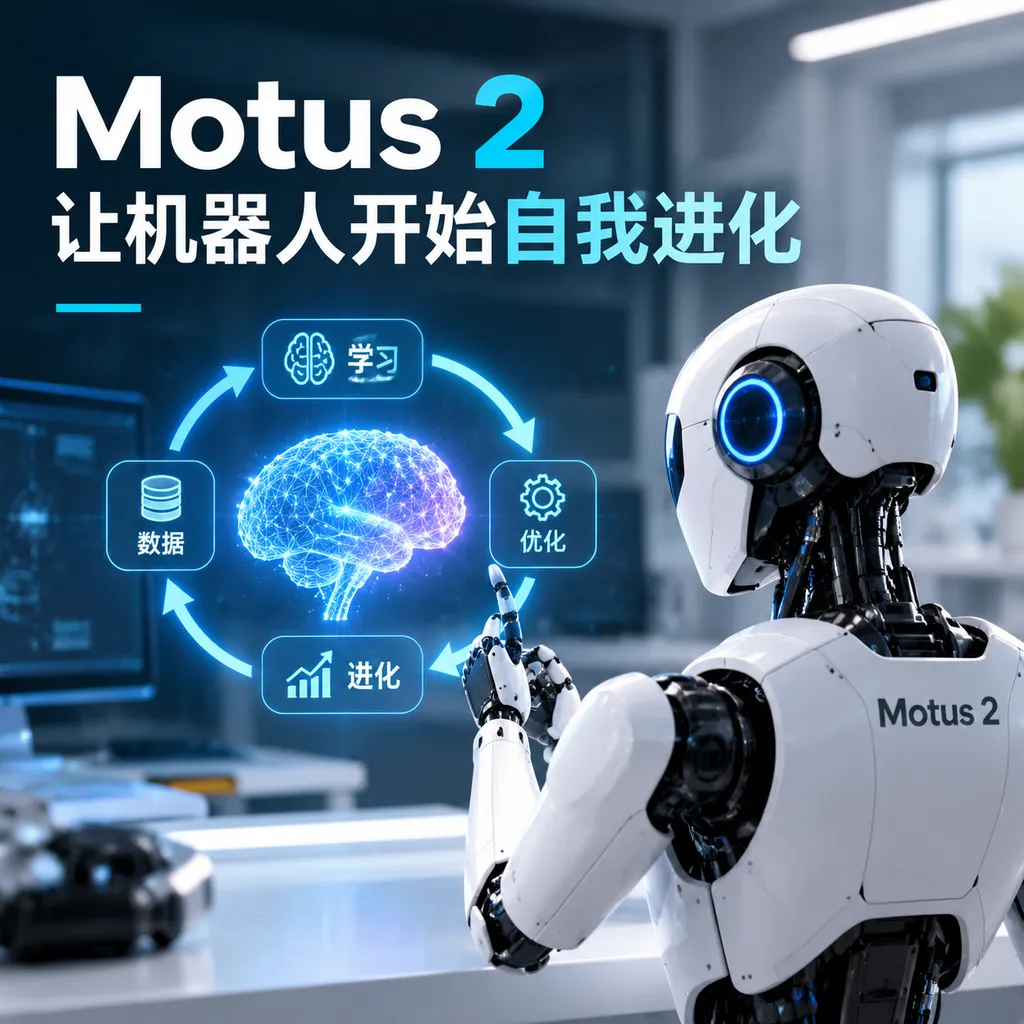
Shengshu releases the next-generation world model Motus 2, placing vision, touch, memory, Ego data, and action decision-making into a single closed-loop system. It has not yet solved the most difficult long-term autonomy problem in general-purpose robotics, but it has already advanced “learning while doing” from a concept to a verifiable engineering path.
ShengShu Takes the World Model Deeper into the Robot Body
ShengShu Technology recently released its next-generation general-purpose world model, Motus 2. The core change is not simply another increase in parameter count, but giving robots more of the capabilities needed to act in ways closer to reality: seeing the environment, understanding contact, recalling the past, and using the results of an action to adjust their next strategy.
This also represents a step forward for world models—from “generating future videos” to “guiding real-world actions.” For robots, predicting how a cup on a tabletop will move is only the first hurdle. The real difficulty is knowing whether the fingers have already touched the rim, whether the grip is tight enough, and which step to return to after an action fails. Motus 2 attempts to place this information within the same decision-making loop.
Based on publicly available information, Motus 2 is still in the stage of extending from L3 toward L4, with validation focused on specific robots and manipulation tasks. It remains clearly distant from “robots setting their own goals, learning over the long term, and adapting to open environments.” That does not diminish the value of its technical approach, however. Compared with demonstrating one-off success rates only in the laboratory, Motus 2 addresses the central contradictions of embodied intelligence more directly: insufficient data, incomplete feedback, and models that cannot continuously improve from the results of their actions.
Why Robots Need “World Models”
Traditional robotic systems are generally like pipelines assembled from multiple software modules: the vision module identifies objects, the planning module determines paths, the controller executes them, and another policy model processes language instructions. Such systems can be highly efficient in fixed environments, but the modules often lack a unified representation of state. Once an object’s position changes, the lighting shifts, or slight slippage occurs during grasping, the output from one module may no longer be correctly utilized by the next.
VLA models connect vision, language, and action, and can already perform many instruction-driven operations. However, they are closer to “imitating actions from demonstrations.” World models seek to answer a further set of questions: If the robot acts this way now, what will happen a few seconds later? If the action does not produce the expected result, what should it do next?
They can be understood as a robot’s “mental rehearsal” before acting. Rather than first colliding with a real object every time, the robot can use the model to generate several possible futures based on its current observations, and then evaluate the value of the actions associated with those futures. Visual prediction alone, however, is still insufficient. Video can tell a model where objects are and how they move, but it is difficult for video alone to directly provide information about applied pressure, changes in friction, and contact intent. This is precisely why tactile sensing and real robotic trajectories are key additions in Motus 2.
Touch Fills in the “Final Inch”
In handling, insertion and removal, twisting, and delicate grasping, vision solves the question of “where the hand should go,” while touch solves the question of “what the hand actually came into contact with.” The difference is like watching someone twist a bottle cap through a camera: you can see the position of the hand, but you do not know whether the cap has not been tightened enough or has already become stuck.
On the execution side, Motus 2 introduces an independent, lightweight tactile expert to refine the short actions about to be performed and predict force feedback after contact. The main model can determine the task direction based on visual and language information, while the tactile expert performs finer-grained corrections at the moment actual contact occurs. As a result, the robot does not merely “grasp by looking”; it can use contact signals such as pressure, collision, gripping, and rotation to adjust its actions.
The practical significance of this design is greater than that of merely stacking multiple modalities conceptually. Failures in the real world often occur within the final few centimeters: the gripper has approached the object, but the contact angle is off; the plug is aligned with the socket, but resistance indicates that it has not been fully inserted; the robotic hand has grasped the cup, but excessive force deforms its wall. Touch may not suddenly make a robot intelligent, but it can significantly reduce local errors that the vision system cannot explain.
Of course, a tactile expert also introduces new engineering challenges: how to calibrate the sensors, how to align force feedback with the video timeline, how to transfer tactile data across different robot bodies, and how the model can distinguish “normal contact” from abnormal contact that is “about to cause damage.” Public information is still insufficient to prove that Motus 2 has solved these problems. A more accurate description is therefore that it has incorporated them into a unified model and training process, rather than having already achieved generalization.
Memory Means Robots No Longer “Forget” Every Time
If touch addresses instantaneous feedback, memory handles the accumulation of information across time. Without memory, a robot still approaches the next attempt as though it were seeing the scene for the first time after completing a task once. With memory, it may know that a particular drawer needs to be lifted slightly before it can be opened, that the surface of a particular object is prone to slipping, or that an earlier failure resulted from moving too quickly.
Motus 2 places memory within the prediction and decision-making components of the world model, using it to retain historical observations, actions, and their results. The model therefore acts not only on the basis of a single current image, but can also refer to what happened previously. This is especially important for long-horizon tasks: tidying a tabletop, assembling components, and folding clothes usually cannot be completed in one action, but instead consist of multiple steps. An error in an early step may not become apparent until dozens of seconds later; without state memory, the model cannot trace the source of the error.
But “having memory” does not mean possessing human long-term memory. A robot must distinguish which information is worth preserving and which has become outdated, while also avoiding treating accidental noise as a stable pattern. The longer the memory, the higher the computational and retrieval costs. Once erroneous information is written into memory, incorrect strategies may also be repeatedly reinforced. As a result, whether the memory module can operate reliably in open environments still requires more long-term experiments.
Ego Data: From Watching Others Act to Feeling for Itself
The data system ShengShu designed for Motus 2 follows the “data pyramid” approach of moving from observation toward action. At the base is a larger volume of internet video, which helps the model learn about objects, scenes, motion, and human behavior. Above that are domain-specific videos, first-person human videos, and human demonstrations with action records. At the top is real robotic interaction data.
Different types of data serve different purposes. Internet video provides breadth, but generally lacks information about actions and forces. Human ego data provides first-person views of manipulation processes, allowing the model to see “how a hand approaches an object and adjusts its posture.” Real robot data completes the final grounding in action, connecting predictions with specific mechanical structures, control frequencies, and contact outcomes.
The value of this approach is that it no longer places the entire burden of learning capabilities on expensive robot data collection. Real robot trajectories are scarce, slow to collect, and costly, and are often tied to a particular type of hardware. Although video lacks complete action labels, it contains an enormous amount of knowledge about the world. Learning “how the world usually changes” from large volumes of video, and then learning “how actions cause changes” from human and robotic data, is currently a more realistic path to scaling.
This also explains why ShengShu is advancing video-generation models and embodied intelligence at the same time: the former provides dynamic priors in the digital world, while the latter handles action loops in the physical world. These two lines are not simply parallel products; they share the ability to model world states, patterns of change, and multimodal information.
What Exactly Does Motus 2 Do?
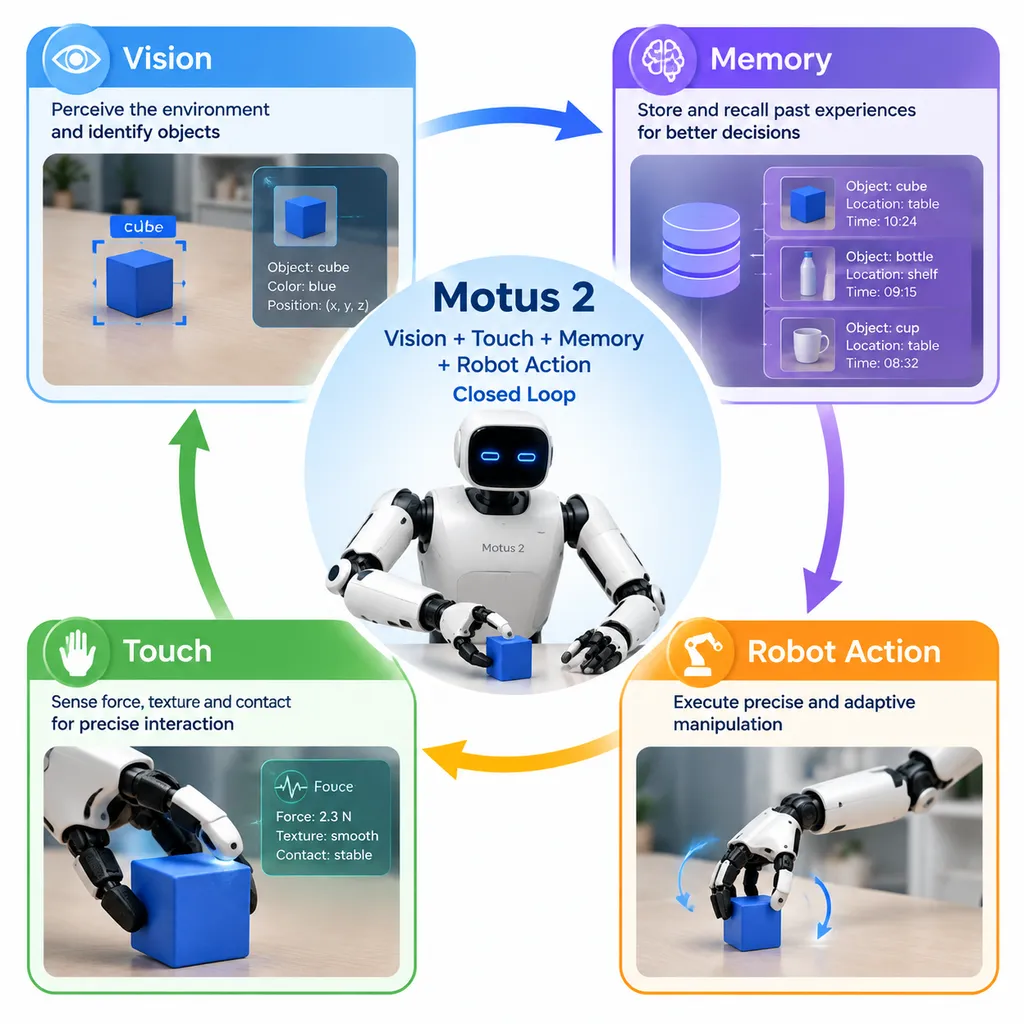
From the perspective of system capabilities, Motus 2 attempts to place four components within a unified framework:
- Policy generation: Understand the task objective and current environment, and propose the next action.
- Future simulation: Predict possible changes in state before acting, reducing blind trial and error.
- Value assessment: Compare the results produced by different actions and select the more promising path.
- Tactile feedback: After contact occurs, use force and tactile signals to correct short actions.
If these four components are disconnected, robots exhibit typical problems: the policy model says “pick up the cup,” but the controller does not know that the cup has slipped; the prediction model generates a seemingly reasonable future, but there is no corresponding executable action; after an action fails, the system can only replan instead of turning the failure into experience. Motus 2 aims to make observation, prediction, action, and outcome feedback into a loop.
At the architectural level, this continues the unified world-model approach previously proposed by ShengShu: fusing visual-language knowledge, video-dynamics knowledge, and action-skill knowledge across modalities, rather than training several models separately and connecting them through interfaces. The advantage of a unified architecture is that information can directly constrain one another; the disadvantages are increased training difficulty, data-alignment difficulty, and deployment costs.
How Far Is It from “Self-Evolution”?
“Self-evolution” is the phrase in this release most likely to spark people’s imagination, but it needs to be broken down. If it means that a robot can update its strategy based on feedback after acting and improve its success rate the next time, then Motus 2 has already presented a relatively clear technical path. If it means that a robot can autonomously propose goals, continuously accumulate general knowledge, transfer across hardware, and learn safely over the long term without human intervention, no such conclusion can yet be drawn.
Public information indicates that Motus 2 is currently being validated mainly on specific robots and manipulation tasks. The formation of autonomous goals, persistent memory, generalization to open environments, long-term online learning, and safe control remain open questions. Online learning is particularly challenging: once a model writes an erroneous action into its long-term policy, the robot may not “learn more,” but instead continue repeating the mistake. Industrial scenarios also require interpretability, rollback, and auditability—none of which can be solved by model scale alone.
Therefore, the aspect of Motus 2 that deserves the most attention is not whether it has already become the “brain” of a general-purpose robot, but that it shifts the evaluation criteria for world models from static generation quality toward closed-loop performance in real tasks: Can it predict the consequences of actions? Can it use touch to correct them? Can it remember failures? Can it transfer across more robot bodies and tasks?
Compared with Traditional VLA Models, Its Strengths and Weaknesses Are Both Clear
Compared with VLAs focused primarily on behavioral imitation, the world-model approach adds a layer of “predict first, then act.” In theory, it is better suited to long-horizon, multistep tasks and has greater potential to handle combinations of situations that were not fully represented in the training data. ShengShu previously disclosed that Motus demonstrated generalization capabilities across a range of embodied tasks and achieved higher success rates than Pi0.5 in relevant comparisons. However, such figures depend heavily on the task set, robot platform, and evaluation setup, and cannot be directly equated with comprehensive leadership.
Its weaknesses are also practical. A world model must learn both “how the world changes” and “how the robot changes the world,” making its training objectives much more complex than simple action imitation. A video prediction that looks realistic does not mean the corresponding action is actually executable. Once tactile data is collected with a different sensor or robotic hand, the original representations may also fail. In addition, a unified model generally implies higher inference latency and deployment requirements. How to run it in real time on edge devices is a question that must be answered for commercialization.
My assessment is that Motus 2 currently looks more like a research path with concrete engineering leverage than a mature general-purpose robotics platform. Its real competitiveness lies in placing the data pyramid, world model, and real-world action feedback within the same narrative, and beginning to validate them through task-level closed loops rather than merely showcasing the isolated capabilities of a single module.
What It Means for Developers
In the short term, developers are unlikely to receive a “general-purpose robotics API” that can immediately enable any robotic arm to perform complex tasks. The more realistic opportunities lie in building toolchains around data and evaluation: aligning first-person videos with action trajectories, converting tactile streams into learnable events, automatically segmenting failed tasks, and establishing unified evaluation sets across different robot bodies.
If more weights or interfaces for this type of world model become available in the future, application development will also shift from “hard-coding action procedures” toward “defining goals, constraints, and safety boundaries.” This does not mean traditional control will disappear. For high-risk actions, low-level controllers, collision detection, and human takeover will still be necessary. World models are better suited to high-level prediction and policy selection than to replacing all real-time control.
Teams currently focused only on software and multimodal applications can also begin by paying attention to how data is organized. How video, ego trajectories, language instructions, robot actions, and tactile feedback jointly describe a task may be more worth learning from than any individual model name. The future moat in embodied intelligence may lie not only in parameter count, but in whether high-quality “action–outcome” data can be acquired continuously.
Conclusion: From Being Able to Predict to Being Accountable
The destination of a world model is not to generate a video that merely looks plausible, but to make the model accountable for the consequences of its actions. By connecting touch, memory, ego data, and action decision-making, Motus 2 at least shows that the industry is moving from asking “Can a robot perform an action?” to asking “Can a robot understand what it did, why it failed, and how to adjust next time?”
There is still a long way to go. The field needs more real interaction data, more reliable transfer across robot bodies, lower inference latency, and safety mechanisms capable of constraining online learning. But as a research direction, placing prediction, action, and feedback into a verifiable closed loop is indeed closer to the core problems of general embodied intelligence than simply stacking perception modules.
Sources
- Zhihu: The World’s Number-One Embodied Intelligence Foundation Model: ShengShu Technology’s Fusion of VLA and World Models — Introduces Motus’s unified world-model approach, data, and embodied-task direction.
- Zhihu: Discussions on ShengShu Technology’s World-Model Technology — Provides additional background on world models, video data, and embodied intelligence in the industry.
Note: This article was compiled based on publicly available information. The specific parameters, complete evaluation sets, deployment configurations, and scope of open sourcing for Motus 2 should remain subject to subsequent official releases by ShengShu Technology.